
How Do You Get Hired as a Drywall Helper?
You can get hired as a drywall helper by learning the basics, arriving ready, and asking crews for work.
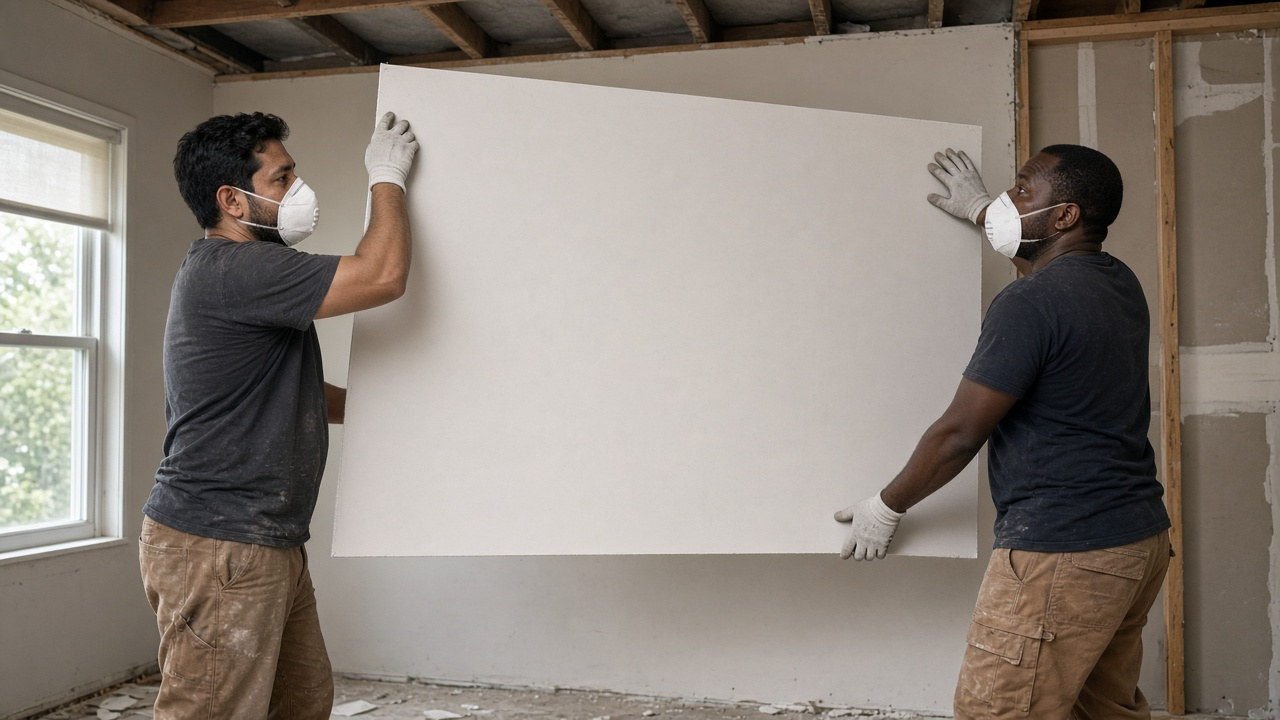
You can get hired as a drywall helper by learning the basics, arriving ready, and asking crews for work.
Drywall work is one of the most common ways to get onto a residential remodel or new-build crew. The job is physical, dusty, and learnable. You do not need a license to carry board, cut openings, or mix mud under a lead installer's direction. You do need to show up on time, follow directions, and work safely around dust and lifts.
This guide covers what a drywall helper actually does, what the work tends to pay, how to get a first day, and how to turn that day into more work.
What a drywall helper does
A helper supports the installer and, on some jobs, the taper. The Bureau of Labor Statistics does not publish a separate "drywall helper" occupation, so the work often sits between construction laborer and drywall installer. Typical tasks include these.
- Unloading, carrying, and staging sheets of drywall close to the rooms being hung
- Measuring and marking cuts, and making straight cuts with a knife and T-square once you are shown how
- Lifting sheets into place on walls and ceilings while the installer fastens them
- Cutting openings for outlets, switches, and fixtures after the installer marks them
- Mixing setting-type or all-purpose compound and keeping the mud board supplied
- Cleaning leftover board, screws, and mud so the taper can work
- Helping with simple taping or sanding only when the lead asks you to, and only to the standard they set
Ceiling work and long commercial sheets are a two-person job. If you cannot lift safely with a partner, say so. Our back-safety guide for laborers (https://chambanow.com/chambamatters/how-to-lift-heavy-objects-safely-a-back-safety-guide-for-laborers) covers the basics before you take a ceiling day.
What this job is not
A helper is not the lead installer and is not a taper unless the crew trains you for that. Finish work shows. A rushed joint or a bad screw pattern can cost the crew a callback. Do not invent cuts, hang board over a problem, or sand into a cloud without the dust controls the lead wants.
Some tasks also have health rules. Cutting or sanding drywall can release dust that contains silica. OSHA's crystalline silica standard for construction (https://www.osha.gov/laws-regs/regulations/standardnumber/1926/1926.1153) requires controls such as wet methods or a vacuum with the right filter when work kicks up that dust. Wear the respirator the employer specifies, not a loose cloth, if the task needs one. OSHA's silica page (https://www.osha.gov/silica-crystalline) explains why this matters.
Houses built before 1978 can also have lead paint on walls you are opening or scraping. That work can require lead-safe practices under the EPA's Renovation, Repair, and Painting Program (https://www.epa.gov/lead/lead-renovation-repair-and-painting-program). If a supervisor tells you the house is pre-1978, follow their lead-safe steps or ask before you start cutting.
What the work pays
There is no official "drywall helper" wage. Closest Bureau of Labor Statistics May 2025 national medians, also used in our hirer guide on what to look for when hiring drywall helpers (https://chambanow.com/chambamatters/what-to-look-for-when-hiring-drywall-helpers), are these.
- Drywall and ceiling tile installers: $28.33 an hour, with the middle half between $22.81 and $35.69
- Tapers: $32.82 an hour, with the middle half between $25.35 and $42.57
- Helpers, construction trades, all other: $20.51 an hour, with the middle half between $17.80 and $23.50
- Construction laborers: $22.66 an hour
A first-week helper often starts closer to the helper or laborer figures than to the installer median. Local pay varies, and many cities have a higher minimum wage than the federal $7.25. Check your state and city floor on the U.S. Department of Labor's state minimum wage page (https://www.dol.gov/agencies/whd/minimum-wage/state). Confirm the rate, the expected hours, and how you will be paid before you start.
What to bring and what to wear
You do not need a full installer kit on day one. A short personal list is enough, and the hirer should provide the specialty tools and the required safety gear. See what a day laborer should bring to the job (https://chambanow.com/chambamatters/what-a-day-laborer-should-bring-to-the-job-and-what-the-hirer-should-provide) and what you should wear to a construction or labor job (https://chambanow.com/chambamatters/what-should-you-wear-to-a-construction-or-labor-job).
- Sturdy work shoes or boots with a closed toe, not sneakers if the site is rough
- Long pants, a shirt you can work in, and a hat or glasses if the site requires them
- A sharp utility knife, a tape measure, a pencil, and a screw gun only if you already own them and the lead wants you to use them
- A dust mask or the respirator the employer issues for sanding or cutting
- Water and a lunch, because drywall days often run straight through
Ask on the first morning who provides stilts, lifts, screw guns, and sanders. Do not climb makeshift platforms. If the work is above a short step, the employer should have a stable bench, a scaffold, or a lift and should tell you how to use it.
How to get hired
You can get a first day without a formal resume if you are clear about what you can do. Our guide on how to get a construction job with no experience (https://chambanow.com/chambamatters/how-to-get-a-construction-job-with-no-experience) is a good companion to the steps below.
- Step 1: Learn the vocabulary. Know the difference between hanging and taping, what a lift and a screw pattern are, and why joints need to dry before the next coat.
- Step 2: Practice a few basics at home if you can, such as reading a tape measure and making a straight score-and-snap cut on scrap. See how to read a tape measure for construction and labor jobs (https://chambanow.com/chambamatters/how-to-read-a-tape-measure-for-construction-and-labor-jobs) if that skill is new.
- Step 3: Get your name in front of crews. Post your skills on ChambaNOW, which is free for workers at https://chambanow.com/for-workers, and list drywall help separately from general labor. Browse drywall jobs by city, such as Los Angeles at https://chambanow.com/jobs/in/los-angeles-ca/drywall, Houston at https://chambanow.com/jobs/in/houston-tx/drywall, Dallas at https://chambanow.com/jobs/in/dallas-tx/drywall, or Chicago at https://chambanow.com/jobs/in/chicago-il/drywall.
- Step 4: Tell the truth about your experience. Say if you have carried board, hung a wall, or only done cleanup. Crews would rather train an honest helper than fix a hidden mistake.
- Step 5: Be the person they can call again. Show up early, keep the room picked up, and ask how to get rehired after a one-day labor job (https://chambanow.com/chambamatters/how-to-get-rehired-after-a-one-day-labor-job).
An OSHA 10 card is not required for every residential drywall day, but it helps on many sites. See whether an OSHA 10 card is worth it for day laborers (https://chambanow.com/chambamatters/is-an-osha-10-card-worth-it-for-day-laborers).
How to be useful on the first day
Watch the lead's screw pattern and sheet layout before you fasten anything. Carry with your partner, not ahead of them. Keep screws, knives, and offcuts off the floor. If you do not understand a cut, ask once, clearly, before you ruin a sheet. The habits in how to be a good helper to a tradesperson (https://chambanow.com/chambamatters/how-to-be-a-good-helper-to-a-tradesperson) apply here.
If something feels unsafe, such as a wobbly lift, missing dust control on a sanding job, or a request to stand on a stack of buckets, stop and say so. How to speak up about safety on a job site (https://chambanow.com/chambamatters/how-to-speak-up-about-safety-on-a-job-site) and a beginner's guide to construction site safety (https://chambanow.com/chambamatters/a-beginner-s-guide-to-construction-site-safety) walk through that conversation.
Moving from helper to installer
Many installers started as helpers. Learn on the job without getting in the way, ask for slightly harder tasks when the crew has time, and look at apprenticeships when you are ready. See how to move from general labor into a skilled trade (https://chambanow.com/chambamatters/how-to-move-from-general-labor-into-a-skilled-trade) and how to get into a trade apprenticeship from day labor (https://chambanow.com/chambamatters/how-to-get-into-a-trade-apprenticeship-from-day-labor). Pick hanging or taping to get good at before you claim both.
The short version
Drywall helper work is available in most cities, and crews hire people who are honest, careful, and ready to lift. Learn the basics, protect your lungs, and ask for the next day before you leave.
Sources
- U.S. Bureau of Labor Statistics, OEWS May 2025, Drywall and Ceiling Tile Installers (47-2081) (https://www.bls.gov/oes/current/oes472081.htm)
- U.S. Bureau of Labor Statistics, OEWS May 2025, Tapers (47-2082) (https://www.bls.gov/oes/current/oes472082.htm)
- U.S. Bureau of Labor Statistics, OEWS May 2025, Helpers, Construction Trades, All Other (47-3019) (https://www.bls.gov/oes/current/oes473019.htm)
- U.S. Bureau of Labor Statistics, OEWS May 2025, Construction Laborers (47-2061) (https://www.bls.gov/oes/current/oes472061.htm)
- O*NET OnLine, Drywall and Ceiling Tile Installers (47-2081.00) (https://www.onetonline.org/link/summary/47-2081.00)
- OSHA, Respirable Crystalline Silica (https://www.osha.gov/silica-crystalline)
- OSHA, 29 CFR 1926.1153, Respirable crystalline silica (https://www.osha.gov/laws-regs/regulations/standardnumber/1926/1926.1153)
- U.S. Environmental Protection Agency, Lead Renovation, Repair and Painting Program (https://www.epa.gov/lead/lead-renovation-repair-and-painting-program)
- U.S. Department of Labor, State Minimum Wage Laws (https://www.dol.gov/agencies/whd/minimum-wage/state)
Written by Barry Graham, Founder, ChambaNOW
Construyendo conocimiento que funciona.