
How to Lift Heavy Objects Safely: A Back-Safety Guide for Laborers
To lift heavy objects safely, keep the load close, bend your knees, lift with your legs, and never twist.
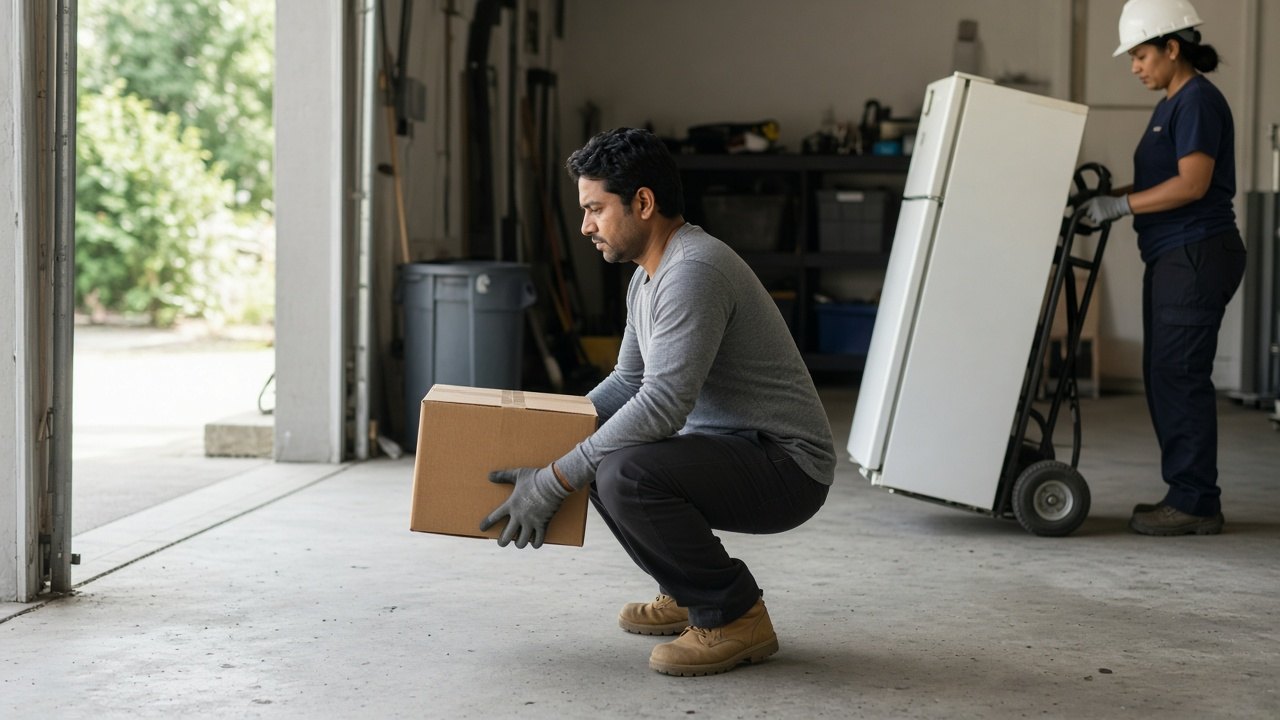
To lift heavy objects safely, keep the load close, bend your knees, lift with your legs, and never twist.
Back injuries are one of the most common ways laborers get hurt, and one bad lift can keep you out of work for weeks. The good news is that most lifting injuries can be prevented with good habits and the right equipment. This guide covers the proper lifting technique step by step, how much one person should lift, and when to use a partner or a dolly.
What is the proper way to lift a heavy object?
The safest lift keeps the load close to your body, uses your legs instead of your back, and avoids twisting. OSHA and the National Institute for Occupational Safety and Health both stress that the farther a load is from your body, the more strain it puts on your lower back. Planning the lift and using help or equipment for heavy items matters as much as technique.
The short answer: plan the lift, get close, bend at the knees, keep your back straight, hold the load tight to your body, lift smoothly with your legs, and turn with your feet.
How to lift step by step
- Step 1: Size up the load. Tip a corner to test the weight. Check for sharp edges, loose parts, or shifting contents.
- Step 2: Plan the path. Clear the route, open doors, and know where you will set the load down.
- Step 3: Get close. Stand with your feet about shoulder-width apart, one foot slightly forward, and the load between your feet if you can.
- Step 4: Bend at the hips and knees. Keep your back straight, not rounded, and your chest forward.
- Step 5: Get a good grip. Use your whole hand, not just your fingers, and wear gloves with grip.
- Step 6: Tighten your core and lift smoothly with your legs. Do not jerk the load.
- Step 7: Keep the load close to your waist as you carry it.
- Step 8: Turn by moving your feet, not by twisting your back.
- Step 9: Set it down the same way you picked it up, bending your knees.
How much weight can one person lift safely?
NIOSH's Revised Lifting Equation uses 51 pounds as the starting load limit for one person under ideal conditions. Ideal means the load is close to the body, at about waist height, lifted straight up without twisting, not too often, and with a good grip. In real jobs, conditions are rarely ideal, so the safe limit is often much lower than 51 pounds.
These conditions lower the safe weight.
- Load held far from the body
- Lifting from the floor or above the shoulders
- Twisting while lifting
- Lifting many times per hour
- Awkward shapes with poor handholds
- Long carries or carrying on stairs
When should you use a partner or equipment?
Use a partner or equipment any time a load is heavy, awkward, or has to go far. Do not let pride or a hurried hirer push you into an unsafe lift.
- Two-person lift: for long items, large furniture, and anything you cannot hold close
- Hand truck or appliance dolly: for boxes, appliances, and tall items
- Furniture dolly: for flat, heavy items like dressers
- Lifting straps: for team lifts of furniture
- Wheelbarrow: for soil, gravel, and debris
- Pallet jack or forklift: for palletized loads, with proper training
For team lifts, agree on signals before you start, like "lift on three" and "set down on three." One person should call the moves.
What about carrying, pushing, and pulling?
Pushing is usually easier on your body than pulling, because you can use your body weight and see where you are going. Keep carts and dollies in good repair so they roll easily. When carrying, keep loads small enough that you can see over them, and take extra care on stairs, slopes, and wet surfaces.
How do you prevent back injuries over a long day?
Technique is only part of it. Fatigue causes many injuries late in a shift.
- Warm up with a few minutes of easy movement before heavy work
- Take short breaks, especially between heavy lifts
- Drink water and eat. Dehydration and hunger increase fatigue
- Rotate tasks with crew members so no one does all the heavy lifting
- Stop and speak up if something hurts. Pain is a warning sign
See how to speak up about safety on a job site (https://chambanow.com/chambamatters/how-to-speak-up-about-safety-on-a-job-site).
What should you do if you hurt your back at work?
Stop the activity and tell the hirer or supervisor right away. Get medical care if the pain is severe, if it shoots down your leg, or if you have numbness or weakness. If you were working as an employee, you may be covered by workers' compensation, depending on your state and the hirer. Write down the date, time, place, and what happened. See what happens if a day laborer gets hurt on your property (https://chambanow.com/chambamatters/what-happens-if-a-day-laborer-gets-hurt-on-your-property). This is general information, not legal or medical advice.
What gear helps with lifting?
- Work gloves with good grip
- Boots or shoes with solid soles and ankle support
- Forearm lifting straps for team furniture lifts
- Knee pads for jobs with a lot of kneeling and floor-level lifting
Back belts are common on jobsites, but NIOSH has said there is not enough scientific evidence that back belts prevent back injuries in workers who have not been injured. Good technique, equipment, and help matter more.
A safe-lifting checklist before every job
- Load: tested, and checked for weight and sharp edges
- Path: clear, with doors open and a set-down spot ready
- Help: a partner or dolly for heavy or awkward items
- Gear: gloves and good shoes
- Body: warmed up, rested, and drinking water
- Signals: agreed before team lifts
Find work on ChambaNOW
ChambaNOW lists local labor jobs in English and Spanish, and workers always use it free. Clear job posts help you plan, so you can ask hirers about heavy items and equipment before you arrive. Browse moving jobs in cities like Los Angeles (https://chambanow.com/jobs/in/los-angeles-ca/moving) and Chicago (https://chambanow.com/jobs/in/chicago-il/moving), or start on the worker page (https://chambanow.com/for-workers). For more site safety basics, see a beginner's guide to construction site safety (https://chambanow.com/chambamatters/a-beginner-s-guide-to-construction-site-safety).
Quick answers
What is the most important rule of safe lifting?
Keep the load close to your body and do not twist. Turn with your feet.
How heavy is too heavy to lift alone?
NIOSH uses 51 pounds as the starting limit under ideal conditions, and the safe limit is lower in most real situations.
Do back belts prevent injuries?
NIOSH has said the evidence does not show that back belts prevent injuries in uninjured workers.
Is it better to push or pull a heavy cart?
Pushing is usually safer and easier to control than pulling.
Sources - CDC/NIOSH, Applications Manual for the Revised NIOSH Lifting Equation (https://www.cdc.gov/niosh/docs/94-110/default.html) - CDC/NIOSH, Ergonomics and Musculoskeletal Disorders (https://www.cdc.gov/niosh/ergonomics/about/index.html) - CDC/NIOSH, Back Belts: Do They Prevent Injury? (https://www.cdc.gov/niosh/docs/94-127/default.html) - OSHA, Materials Handling and Storage (https://www.osha.gov/sites/default/files/publications/osha2236.pdf) - OSHA, Ergonomics (https://www.osha.gov/ergonomics)
Written by Barry Graham, Founder, ChambaNOW
Construyendo conocimiento que funciona.