
A Beginner’s Guide to Construction Site Safety
Your first weeks on a construction site are the riskiest, so learn the biggest hazards before your first day.
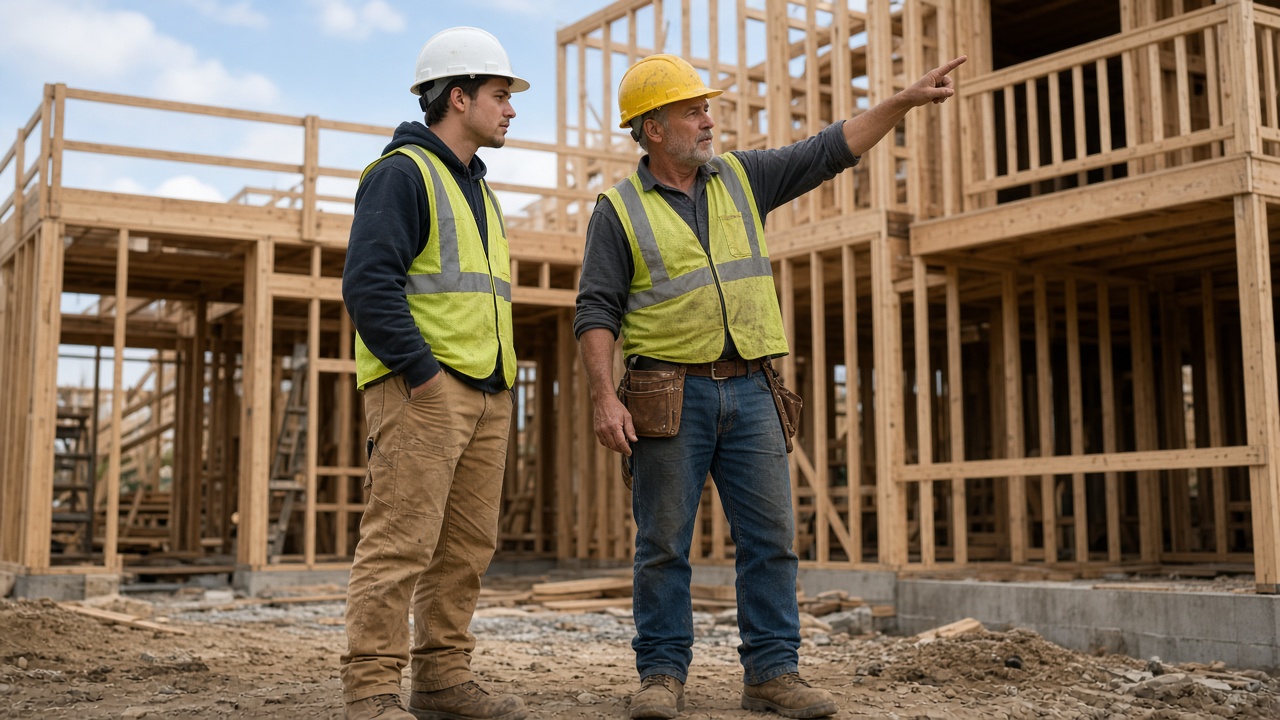
Your first weeks on a construction site are the riskiest, so learn the biggest hazards before your first day.
Construction pays well and teaches skills you can build a career on. It is also one of the most dangerous kinds of work in the country. The Bureau of Labor Statistics counted 1,032 fatal work injuries among construction and extraction workers in 2024, and 370 of them were falls, slips, or trips (https://www.bls.gov/news.release/cfoi.nr0.htm). This guide is for people who are new to construction or day labor. It covers the hazards that cause the most serious injuries and simple habits that keep you safe from day one.
Why new workers get hurt more
New workers do not know where the hazards are yet, may not want to ask questions, and often feel pressure to prove themselves. A CPWR study of Tennessee workers' compensation claims from 2014 and 2015 found that 44.5% of construction injuries happened to workers with one year or less on the job with their employer, and about two-thirds of those first-year injuries happened in the first six months (https://www.cpwr.com/wp-content/uploads/publications_KF2019-Tennessee-new-employee-injury.pdf).
The fix is not to be fearless. It is to be alert, ask questions, and learn a few rules well.
Learn the Focus Four
OSHA's construction training is built around four hazards it calls the Focus Four: falls, struck-by, caught-in or -between, and electrocution (https://www.osha.gov/training/outreach/construction/focus-four). OSHA's training materials note that most construction fatalities are caused by fall hazards (https://www.osha.gov/sites/default/files/constrfocusfour_introduction.pdf). If you learn to spot these four, you will recognize most of what can seriously hurt you.
Hazard 1 Falls
Falls happen from roofs, ladders, scaffolds, and edges, and also through holes and skylights. OSHA generally requires construction employers to protect workers from falls of 6 feet or more with guardrails, safety nets, or personal fall arrest systems (https://www.ecfr.gov/current/title-29/subtitle-B/chapter-XVII/part-1926/subpart-M/section-1926.501).
Ladders cause many injuries. Follow OSHA's ladder basics (https://www.osha.gov/sites/default/files/publications/portable_ladder_qc.pdf).
- Inspect the ladder before you use it
- Keep three points of contact: two hands and a foot, or two feet and a hand
- Face the ladder when you climb, and keep your body centered
- Set an extension ladder with its base about one-quarter of its working length from the wall
- Extend the ladder at least 3 feet above the landing when you use it to get onto a roof or upper level
- Do not stand on the top step of a stepladder unless it is designed for that
- Keep metal ladders away from power lines
Never step on a cover over a hole unless you know it is secured and marked, and never walk on skylights.
Hazard 2 Struck-by
Struck-by injuries come from moving vehicles and equipment, falling objects, and flying debris.
- Wear your hi-vis vest when equipment or traffic is near
- Make eye contact with equipment operators before you walk behind or near a machine
- Stay out of the swing area of excavators and cranes
- Never stand or walk under a suspended load
- Wear your hard hat where anything can fall from above
- Wear safety glasses when cutting, grinding, nailing, or chipping
Hazard 3 Caught-in or -between
These injuries happen when someone is crushed or pinched by equipment, materials, or collapsing soil.
- Trenches are a major danger. OSHA requires cave-in protection, such as shoring, shielding, or sloping, in excavations 5 feet or deeper, and sometimes shallower if the soil is unstable (https://www.ecfr.gov/current/title-29/subtitle-B/chapter-XVII/part-1926/subpart-P/section-1926.652). Do not enter an unprotected trench, even for a minute
- Keep hands, hair, and loose clothing away from rotating parts and belts
- Never reach into a machine that is running; never reach into an operating chipper
- Stay out from between a moving machine and a wall or another object
Hazard 4 Electrocution
Electricity can kill without warning.
- Look up before you raise a ladder, pole, or long material. OSHA's tree care guidance tells workers to stay at least 10 feet from overhead lines, and farther for higher voltages (https://www.osha.gov/sites/default/files/publications/OSHA3861.pdf)
- Treat every wire as live until a qualified person says it is not
- Use cords and tools with no cuts, missing ground pins, or taped repairs
- Plug into GFCI-protected outlets outdoors and in wet areas
- Leave electrical work to licensed electricians
Do not forget health hazards
Some construction dangers hurt you slowly.
- Silica dust comes from cutting or grinding concrete, brick, stone, and tile. OSHA says applying water to a saw blade when cutting these materials substantially reduces dust (https://www.osha.gov/silica-crystalline/construction). Use water or vacuum controls and a respirator when required
- Noise from saws, jackhammers, and compressors damages hearing over time. Wear earplugs or earmuffs
- Heat. OSHA reports that almost half of heat-related deaths happen on a worker's first day, and more than 70% in the first week, so new workers should ease in and drink water often (https://www.osha.gov/heat-exposure/protecting-new-workers)
- Lifting. Use dollies and carts, lift with your legs, and ask for a second person for heavy or awkward loads
Know your gear and who pays for it
Under OSHA's construction rule, employers generally must provide required protective equipment at no cost to you, such as hard hats, safety glasses, hearing protection, and fall protection. Exceptions include everyday work clothes and ordinary safety-toe boots in many cases (https://www.osha.gov/laws-regs/regulations/standardnumber/1926/1926.95). ChambaMatters covers what to wear in What Should You Wear to a Construction or Labor Job? (https://chambanow.com/chambamatters/what-should-you-wear-to-a-construction-or-labor-job).
Know your rights
OSHA says workers have the right to training in a language they understand, to safe equipment, and to report injuries and raise safety concerns without retaliation (https://www.osha.gov/workers). Federal construction rules also require employers to instruct each employee on recognizing and avoiding unsafe conditions (https://www.ecfr.gov/current/title-29/subtitle-B/chapter-XVII/part-1926/subpart-C/section-1926.21). If something looks wrong, ChambaMatters explains how to raise it in How to Speak Up About Safety on a Job Site (https://chambanow.com/chambamatters/how-to-speak-up-about-safety-on-a-job-site).
If you get hurt
Tell your supervisor or the hirer right away, even for an injury that seems small. Get medical care. Write down what happened, when, and who saw it. Take photos. Keep copies of medical paperwork. Depending on your state and who hired you, workers' compensation may cover medical bills and some lost wages, so ask the hirer or agency about it and contact your state workers' compensation agency if you have questions. ChambaMatters covers more in Your Right to a Safe Workplace (https://chambanow.com/chambamatters/your-right-to-a-safe-workplace).
Habits for your first week
- Ask "What are the hazards here?" on your first morning
- Find the water, the restroom, the first aid kit, and the exit
- Wear your gear the whole time, not just when someone is watching
- Look up for power lines and overhead work; look down for holes and edges
- Never enter an unprotected trench or work at height without protection
- Speak up or stop if a task looks unsafe
Many workers take an OSHA 10-hour construction course to learn these hazards in more depth. ChambaMatters explains when it is worth it in Is an OSHA 10 Card Worth It for Day Laborers? (https://chambanow.com/chambamatters/is-an-osha-10-card-worth-it-for-day-laborers).
ChambaNOW is always free for workers. Find construction and labor jobs near you at https://chambanow.com/for-workers, or browse local pages such as https://chambanow.com/jobs/in/houston-tx/construction or https://chambanow.com/jobs/in/los-angeles-ca/construction.
This guide is general safety information, not legal or medical advice. Follow your site's safety rules and your supervisor's instructions, and get medical care for any injury.
Sources
- Bureau of Labor Statistics, Census of Fatal Occupational Injuries, 2024: https://www.bls.gov/news.release/cfoi.nr0.htm
- CPWR, Key Findings: New Employee Injuries in Tennessee (2019): https://www.cpwr.com/wp-content/uploads/publications_KF2019-Tennessee-new-employee-injury.pdf
- OSHA, Construction Focus Four Training: https://www.osha.gov/training/outreach/construction/focus-four
- OSHA, Construction Focus Four Outreach Training Packet: https://www.osha.gov/sites/default/files/constrfocusfour_introduction.pdf
- 29 CFR 1926.501, Fall protection: https://www.ecfr.gov/current/title-29/subtitle-B/chapter-XVII/part-1926/subpart-M/section-1926.501
- OSHA, Portable Ladder Safety QuickCard: https://www.osha.gov/sites/default/files/publications/portable_ladder_qc.pdf
- 29 CFR 1926.652, Excavations: https://www.ecfr.gov/current/title-29/subtitle-B/chapter-XVII/part-1926/subpart-P/section-1926.652
- OSHA, Electricity and Tree Care Work: https://www.osha.gov/sites/default/files/publications/OSHA3861.pdf
- OSHA, Silica, Crystalline - Construction: https://www.osha.gov/silica-crystalline/construction
- OSHA, Protecting New Workers (heat): https://www.osha.gov/heat-exposure/protecting-new-workers
- OSHA, 29 CFR 1926.95: https://www.osha.gov/laws-regs/regulations/standardnumber/1926/1926.95
- OSHA, Worker Rights and Protections: https://www.osha.gov/workers
- 29 CFR 1926.21, Safety training and education: https://www.ecfr.gov/current/title-29/subtitle-B/chapter-XVII/part-1926/subpart-C/section-1926.21
Written by Barry Graham, Founder, ChambaNOW
Building knowledge that works.