
What to Look for When Hiring Drywall Helpers
Drywall helpers carry the load on hang days, and the right one also protects your finishing schedule.
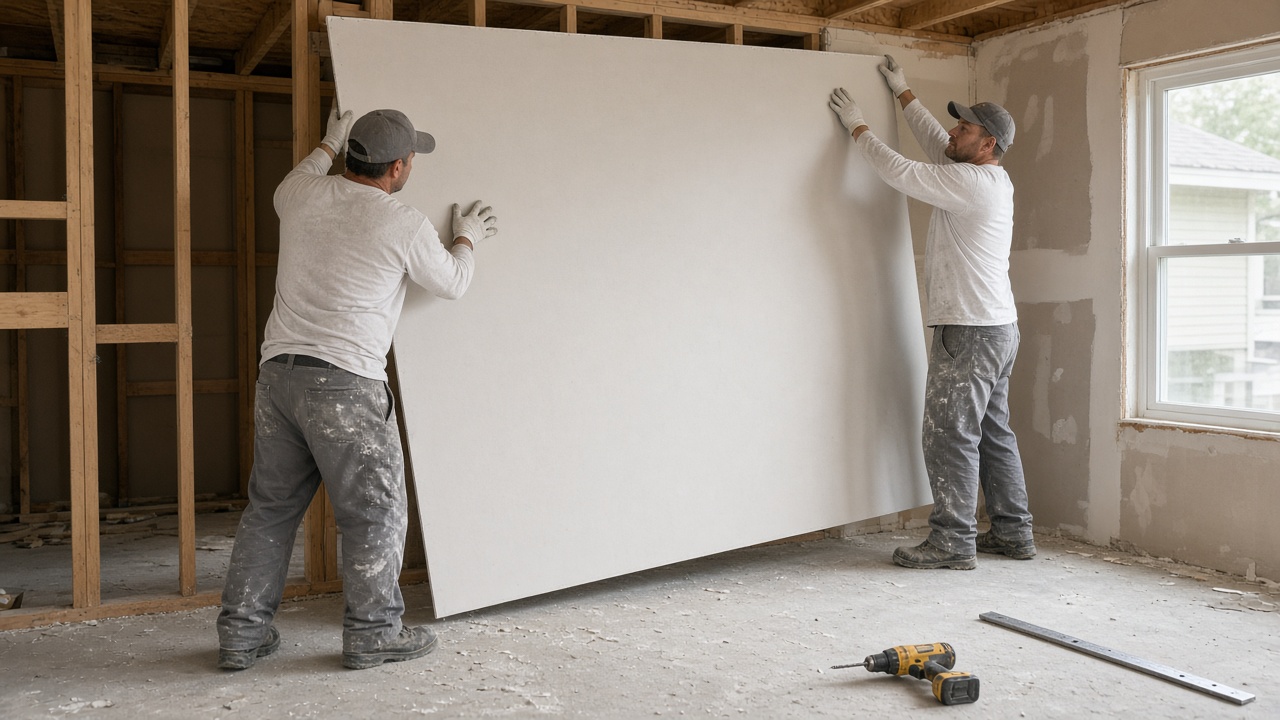
Drywall helpers carry the load on hang days, and the right one also protects your finishing schedule.
Drywall looks like simple work from the outside: carry sheets, screw them up, tape, mud, sand, paint. Anyone who has run a drywall job knows the reality. Sheets are heavy and awkward, ceilings are punishing, dust gets everywhere, and a sloppy hang creates hours of extra finishing work. A good helper makes the hang faster and the finish cleaner. A poor one damages board, breaks corners, and leaves screws that pop through the paper.
This guide is for drywall contractors, remodelers, and homeowners managing a remodel who need temporary help on a drywall job. It covers what helpers do in each phase, what skills to look for, how national wage data frames pay, and the safety and dust issues to plan for.
What drywall helpers do in each phase
Drywall work has distinct phases, and the helper role changes with each one.
Delivery and stocking
- Carry sheets from the truck or stocking point to each room
- Lean sheets in the right rooms, in the right sizes, without crushing corners
- Keep stairways and doorways clear
Hanging
- Hold and lift sheets, especially for ceilings
- Measure and cut sheets to size with a utility knife and T-square
- Cut openings for boxes, windows, and fixtures with the hanger's direction
- Drive screws to the right depth and pattern the hanger sets
Taping and finishing
- Mix joint compound and keep pans and buckets clean
- Set up and move scaffolding or benches under the finisher's direction
- Mask floors, windows, and finished surfaces
- Sand between coats and clean up dust
Cleanup
- Bag scraps and dust daily, not just at the end
- Protect floors and HVAC returns from dust
Skills to look for
A strong drywall helper usually has these skills, or can show them in the first hour.
- Accurate measuring and clean straight cuts with a knife and square
- Correct screw depth: set just below the surface without tearing the paper
- Comfort lifting and holding sheets overhead, or using a drywall lift
- Understanding of where seams should fall, such as staggered joints and avoiding seams at the corners of openings
- Experience mixing compound to the right consistency for the coat
- Care around electrical boxes, plumbing, and finished surfaces
Experienced helpers can also hang walls on their own after the lead sets the layout. If you need that level, say so in the job post and pay accordingly.
What wage data shows
The Bureau of Labor Statistics does not publish a separate "drywall helper" occupation. The closest reference points from the May 2025 national wage data are these.
- Drywall and ceiling tile installers: median $28.33 per hour, with the middle half earning $22.81 to $35.69
- Tapers: median $32.82 per hour, with the middle half earning $25.35 to $42.57
- Helpers, construction trades, all other: median $20.51 per hour, with the middle half earning $17.80 to $23.50
- Construction laborers: median $22.66 per hour
Treat these as national employee wage benchmarks, not local quotes. A helper who can hang walls independently often earns closer to the installer range. A helper who only carries and cleans will usually be closer to the laborer range. Drywall is also commonly bid by the sheet or by the square foot. If you are comparing bids, ask whether the price includes delivery stocking, hanging, all coats of finish, texture, and cleanup.
Questions to ask before you hire
- Have you hung ceilings, and did you use a lift or hold sheets by hand
- What screw pattern and depth do you use on walls and ceilings
- Have you worked with 12-foot sheets or moisture-resistant board
- Have you mixed and applied compound, or only sanded
- What tools do you bring
For a structured way to test answers on day one, see how to confirm a worker's skills without a formal resume (https://chambanow.com/chambamatters/how-to-confirm-a-worker-s-skills-without-a-formal-resume).
A 15-minute check on the first morning
Before the helper touches a ceiling, give them three small tasks and watch how they work.
- Measure and cut a sheet to fit a marked wall section, including one outlet opening
- Drive a row of screws into a scrap piece fastened to a stud, then check the depth
- Carry and set a full sheet against a wall without damaging the corners
A helper who passes all three can usually hang walls under light supervision by the afternoon. A helper who struggles with the cuts should stay on carrying, stocking, masking, and cleanup, which still saves your hanger hours. Adjust the work, not just your opinion of the worker.
Safety and health issues on drywall jobs
Drywall work brings a few predictable hazards.
Height and access
Ceiling and high-wall work usually involves ladders, benches, or rolling scaffolds. Under OSHA's construction rules, scaffolds that put workers more than 10 feet above a lower level require fall protection, and scaffolds must be erected, moved, or altered only under the supervision of a competent person. Portable ladders used to reach an upper level must extend at least 3 feet above the landing.
Dust
Sanding joint compound produces fine dust. Provide eye protection and dust masks or respirators appropriate for the task, ventilate when possible, and protect HVAC returns. Cleaner methods such as vacuum sanders cut cleanup time.
Older homes
If you are removing old drywall or plaster before the hang, the tear-out can raise other issues. In homes built before 1978, EPA's Renovation, Repair and Painting rule requires that anyone paid to perform work disturbing painted surfaces be certified and use lead-safe work practices, with employees trained by a certified renovator. EPA lists patching compounds and textured paint used on walls and ceilings among the places asbestos may be found, and notes that you generally cannot tell whether a material contains asbestos just by looking at it. If you are unsure about older materials, test before disturbing them. For tear-out labor specifically, see our guide to demo and debris haul labor (https://chambanow.com/chambamatters/a-guide-to-hiring-demo-and-debris-haul-labor-for-a-home-remodel).
Setting up the job so helpers are productive
- Confirm the sheet count, sizes, and ceiling heights before helpers arrive
- Mark which rooms get moisture-resistant or fire-rated board
- Decide who cuts openings and who checks them
- Set a daily cleanup routine and a place for scrap
- Agree on start and end times and the number of days
A written scope prevents most disagreements. See a guide to setting pay, hours, and a scope of work before laborers arrive (https://chambanow.com/chambamatters/a-guide-to-setting-pay-hours-and-a-scope-of-work-before-laborers-arrive).
Homeowners hiring drywall labor directly
If you are a homeowner hiring labor for drywall in your own remodel, check whether your project needs a permit and whether your state limits what you can do without a licensed contractor. Our guide on hiring temporary labor without a contractor's license (https://chambanow.com/chambamatters/a-homeowner-s-guide-to-hiring-temporary-labor-without-a-contractor-s-license) explains the general issues. Do not ask a drywall helper to move electrical boxes, reroute wiring, or relocate plumbing. Those tasks belong to licensed trades.
Finding drywall helpers on ChambaNOW
On ChambaNOW, you can post a drywall helper job for free, review workers who respond, and message them about that job. You can browse drywall workers by city, for example in Phoenix (https://chambanow.com/hire/phoenix-az/drywall), or start at the hirer overview (https://chambanow.com/for-hirers).
Bottom line for drywall jobs
Match the helper to the phase, pay based on whether they can hang or only carry and clean, plan for height and dust, and test older materials before tear-out.
Sources - U.S. Bureau of Labor Statistics, OEWS May 2025, Drywall and Ceiling Tile Installers (47-2081) (https://www.bls.gov/oes/current/oes472081.htm) - U.S. Bureau of Labor Statistics, OEWS May 2025, Tapers (47-2082) (https://www.bls.gov/oes/current/oes472082.htm) - U.S. Bureau of Labor Statistics, OEWS May 2025, Helpers, Construction Trades, All Other (47-3019) (https://www.bls.gov/oes/current/oes473019.htm) - U.S. Bureau of Labor Statistics, OEWS May 2025, Construction Laborers (47-2061) (https://www.bls.gov/oes/current/oes472061.htm) - OSHA, 29 CFR 1926.451, Scaffolds general requirements (https://www.osha.gov/laws-regs/regulations/standardnumber/1926/1926.451) - OSHA, 29 CFR 1926.1053, Ladders (https://www.osha.gov/laws-regs/regulations/standardnumber/1926/1926.1053) - U.S. EPA, Lead Renovation, Repair and Painting Program (https://www.epa.gov/lead/renovation-repair-and-painting-program) - U.S. EPA, Protect Your Family from Exposures to Asbestos (https://www.epa.gov/asbestos/protect-your-family-exposures-asbestos) - U.S. EPA, Learn About Asbestos (https://www.epa.gov/asbestos/learn-about-asbestos)
Written by Barry Graham, Founder, ChambaNOW
Building knowledge that works.