
How to Get a Construction Job With No Experience
Most construction laborers start with zero experience and learn the work on the job.
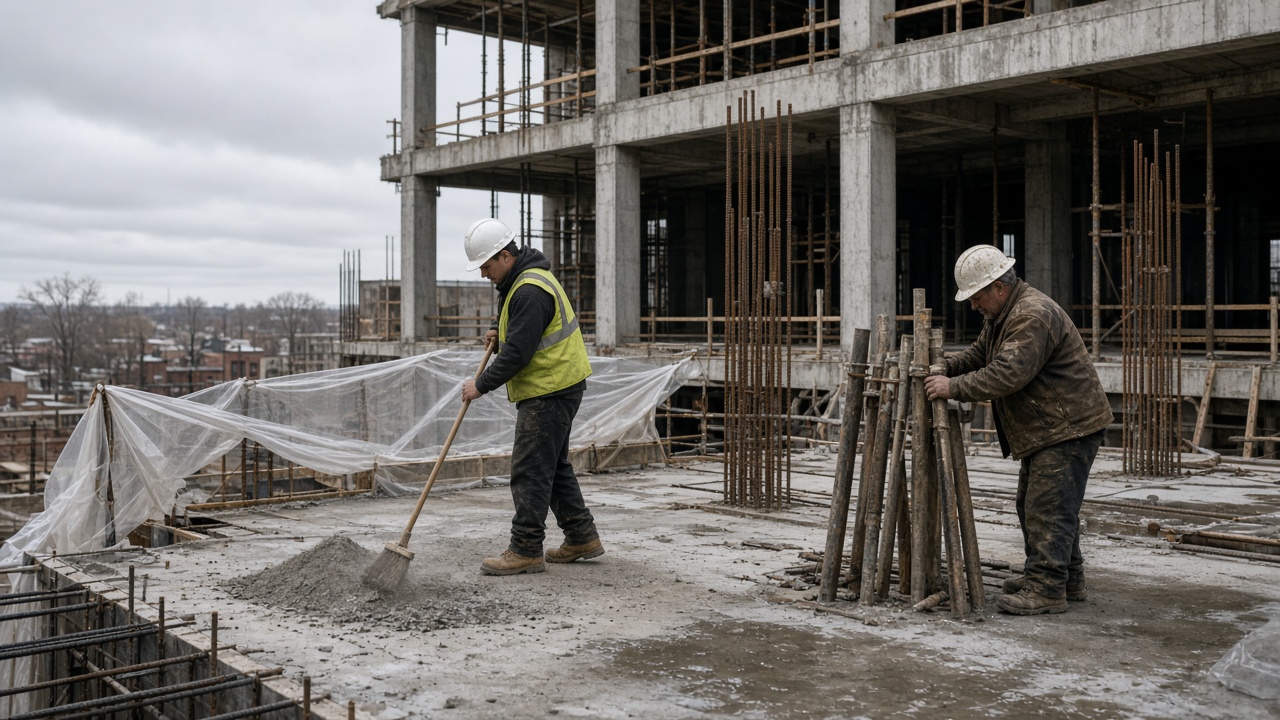
Most construction laborers start with zero experience and learn the work on the job.
That is not a pep talk; it is how the federal government describes the job. The Bureau of Labor Statistics says construction laborers and helpers "learn on the job," usually by shadowing experienced workers, and that formal education is not typically required (https://www.bls.gov/ooh/construction-and-extraction/construction-laborers-and-helpers.htm). What employers want from a beginner is simpler than most people think: show up, work safely, listen, and keep learning.
What entry-level construction jobs actually involve
Your first construction job will most likely be as a construction laborer or a helper to a tradesperson. O*NET, the Labor Department's occupation database, lists common laborer tasks such as cleaning and preparing sites, loading and unloading materials, digging trenches, setting up scaffolding, mixing and pouring concrete, and assisting craft workers (https://www.onetonline.org/link/summary/47-2061.00).
In plain terms, expect to carry, sweep, dig, stack, hold, and fetch for the first weeks. That work is not a waste of time. It is how you learn the order of a job, the names of materials, and how a crew moves.
What does it pay?
BLS reports a May 2025 median of $22.44 an hour ($46,680 a year) for construction laborers and helpers, with the lowest 10 percent under $34,820 a year and the highest 10 percent over $76,400. Helpers for specific trades earned medians from $40,470 (painters' helpers) to $47,550 (brick, block, and tile helpers). Pay through temporary staffing agencies ran lower, with a $35,740 median. Your local pay will depend on your state, your city, and the type of work.
What employers look for when you have no experience
You do not need a resume full of construction jobs. You need to show that you will not be a risk or a headache. BLS lists the qualities that matter most for laborers and helpers: physical stamina, physical strength, basic math for measuring, mechanical skills, and the ability to work as a team.
Here is how to show those without a construction history.
- Reliability. Point to any job where you showed up on time for months: warehouse, restaurant, farm, delivery, cleaning.
- Physical work. Moving, landscaping, stocking, and farm work all prove you can handle a long physical day.
- Tools. If you have used a drill, a circular saw, a shovel, or a pressure washer, say so honestly.
- Safety. A completed OSHA 10-hour construction course tells a foreman you know the basic hazards. BLS notes that employers often require safety certification that meets OSHA guidelines, either before or after hiring.
- Transportation. BLS notes a driver's license may be required. If you can get to sites on your own by 6:30 a.m., say so.
- Language. If you speak English and Spanish, mention it. Many crews need someone who can help both sides understand each other.
Five ways in when you have no experience
There is no single front door. Most people come in through one of these.
- Day labor jobs. Short jobs on demolition, cleanup, moving, and landscaping are the easiest place to start. Post your skills and availability free on ChambaNOW at https://chambanow.com/for-workers and browse construction work by city, such as https://chambanow.com/jobs/in/philadelphia-pa/construction or https://chambanow.com/jobs/in/denver-co/construction.
- A general contractor or subcontractor. Small residential builders, concrete companies, and demolition outfits often hire laborers directly. Ask at supply yards and job sites before or after work hours.
- A staffing agency. Agencies place beginners on sites quickly. It is a way to get hours and meet foremen, even if the pay is lower.
- A pre-apprenticeship program. The Labor Department describes pre-apprenticeship as a program designed to prepare people to enter and succeed in a Registered Apprenticeship (https://www.apprenticeship.gov/employers/explore-pre-apprenticeship). Many are free and include safety training and a connection to union or contractor apprenticeships.
- A Registered Apprenticeship. Federal rules let apprenticeships accept people as young as 16 and require at least 2,000 hours of on-the-job learning under the time-based model, with wages that rise as you gain skills (https://www.ecfr.gov/current/title-29/subtitle-A/part-29/section-29.5). Some programs accept beginners directly.
Your local American Job Center can point you to pre-apprenticeship and training programs; find one at https://www.careeronestop.org/LocalHelp/AmericanJobCenters/find-american-job-centers.aspx.
Get the OSHA 10 if you can
The OSHA 10-hour construction course is a basic safety awareness class. OSHA is clear that it is voluntary and not a certification, but some states and cities require it, and many employers prefer it (https://www.osha.gov/training/outreach). Take it only from an OSHA-authorized trainer or an authorized online provider. ChambaMatters covers whether it is worth it in a separate guide on the OSHA 10 card.
What to say when someone asks about your experience
Keep it short and honest. Here is an example, not a script you have to memorize.
I have not worked on a construction crew yet, but I did two years of moving and warehouse work, so I am used to lifting and long days. I have my own boots and gloves, I can be here by 6:30, and I want to learn.
That answer covers reliability, physical ability, gear, and attitude in four sentences. It is better than overselling skills you do not have.
How to keep your first construction job
Getting hired is step one. The first few months are when most beginners either earn a spot on the crew or get let go.
They are also the riskiest months for injuries. A 2019 CPWR study of Tennessee workers' compensation claims from 2014 and 2015 found that 44.5 percent of reported construction injuries involved workers with one year or less with their employer, and about two-thirds of those first-year injuries happened in the first six months (https://www.cpwr.com/wp-content/uploads/publications_KF2019-Tennessee-new-employee-injury.pdf). The most common causes were lifting and strain. Slow down, ask how to lift or carry something you have not handled before, and use the safety gear you are given.
Habits that keep beginners on the crew.
- Be early, every day
- Ask one clear question instead of guessing
- Watch how experienced workers do the job before you try it
- Keep your work area clean without being told
- Put your phone away while you are working
- Tell the foreman right away if you made a mistake or something broke
How long until you are not a beginner anymore?
There is no official clock. As a rule of thumb, many crews stop treating you as brand new once you can work a full week without being told where things go, read a tape measure accurately, and handle common tools safely. From there, the next steps are a helper job in a specific trade, an apprenticeship, or a lead role on a laborer crew. ChambaMatters covers each of those paths in its guides on apprenticeships, carpenter helpers, and moving into a skilled trade.
Key takeaways
- BLS says construction laborers and helpers learn on the job; no formal education is typically required
- The May 2025 median pay for laborers and helpers was $22.44 an hour
- Show reliability, physical ability, basic tool use, and a safety mindset, even from non-construction jobs
- Day labor, direct hiring, agencies, pre-apprenticeships, and Registered Apprenticeships are all valid ways in
- Your first six months carry the highest injury risk, so learn to lift and work safely before you speed up
Sources
- U.S. Bureau of Labor Statistics, Occupational Outlook Handbook, Construction Laborers and Helpers (May 2025 data): https://www.bls.gov/ooh/construction-and-extraction/construction-laborers-and-helpers.htm
- O*NET OnLine, 47-2061.00 Construction Laborers: https://www.onetonline.org/link/summary/47-2061.00
- OSHA, Outreach Training Program: https://www.osha.gov/training/outreach
- Apprenticeship.gov, Explore Pre-Apprenticeship: https://www.apprenticeship.gov/employers/explore-pre-apprenticeship
- 29 CFR 29.5, Standards of apprenticeship: https://www.ecfr.gov/current/title-29/subtitle-A/part-29/section-29.5
- CPWR, "Early months of employment critical in terms of safety," April 2019: https://www.cpwr.com/wp-content/uploads/publications_KF2019-Tennessee-new-employee-injury.pdf
- CareerOneStop, American Job Center Finder: https://www.careeronestop.org/LocalHelp/AmericanJobCenters/find-american-job-centers.aspx
Written by Barry Graham, Founder, ChambaNOW
Building knowledge that works.