
How Do I Hire Labor for a Small Concrete Patio or Walkway?
A small patio or walkway pour goes better when you hire labor and plan the work before the truck arrives.
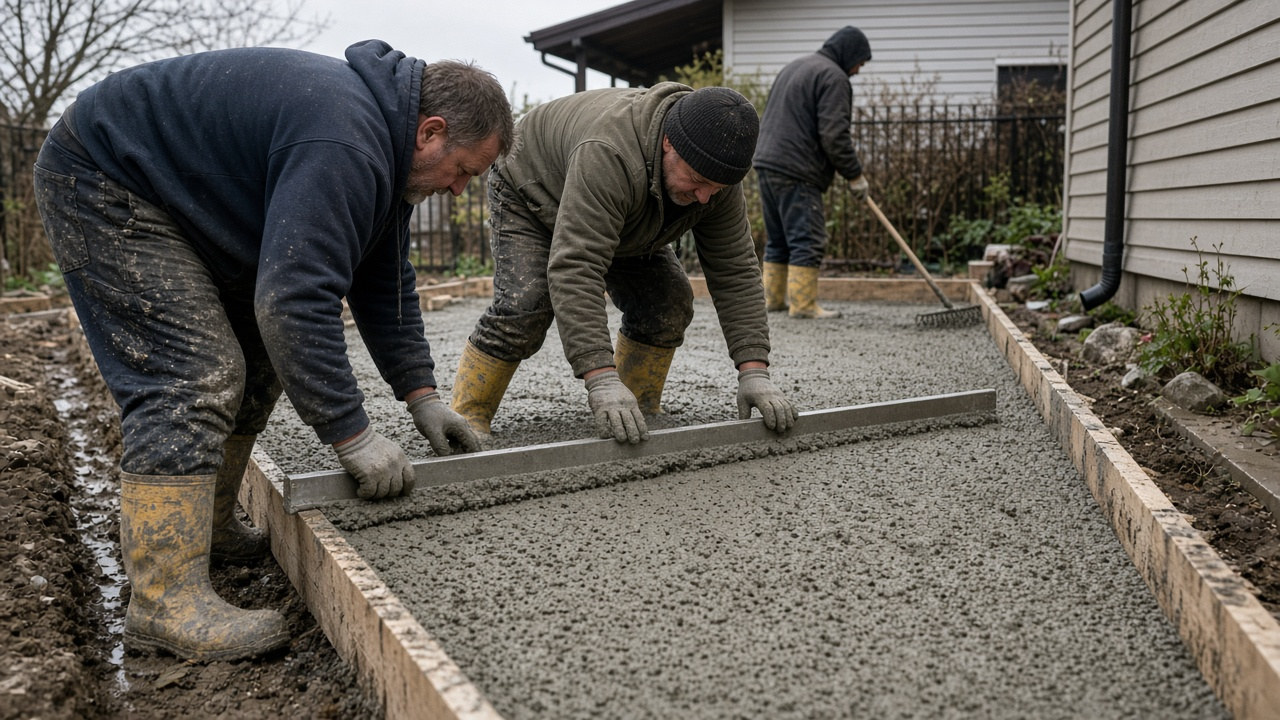
A small patio or walkway pour goes better when you hire labor and plan the work before the truck arrives.
A short concrete job looks simple until the truck is in the street and the mix is already starting to set. For a small patio, a sidewalk, or a walkway, the labor around the pour is often as important as the finisher. Forms have to be tight, the base has to be ready, and enough people have to be on site to move and level the concrete without a panic. You can hire that help, but the day only works if the planning is done first.
This guide covers what labor you need, what should stay with a qualified finisher or a licensed contractor, how to time the truck, and how to hire without wasting a load of concrete. Concrete and formwork labor, what to look for before you hire (https://chambanow.com/chambamatters/concrete-and-formwork-labor-what-to-look-for-before-you-hire) is the closer look at skills.
What labor you actually need
Most small residential pours need both prep and pour help.
- Layout, digging, and compacting the base
- Building and bracing forms so they will not blow out
- Placing rebar, mesh, or dowels to the plan
- Spotting the truck, moving the chute, and raking or wheeling the mix
- Helping the finisher screed, edge, and broom
- Covering or curing the slab, then stripping forms later
A typical short walkway or small patio is often two or three people on pour day, including the finisher, plus at least one person who can come back to strip forms. If the truck cannot get close, you will need more labor and more wheelbarrow time. See how many workers you need (https://chambanow.com/chambamatters/how-many-workers-do-you-need-a-crew-size-guide-for-moving-landscaping-and-cleanu) for the broader crew-size method.
What should stay with a qualified pro
A helper can move concrete. A helper should not be the only person deciding thickness, drainage, or the finish on a slab you will look at every day. Decorative work, stamped patterns, and structural or permitted work belong with someone who does that regularly. License and permit rules vary by place, so check with your building department and, when a contractor is involved, verify the license (https://chambanow.com/chambamatters/verify-contractor-licenses). Can a homeowner hire labor without a contractor's license (https://chambanow.com/chambamatters/can-a-homeowner-hire-labor-without-a-contractor-s-license) is the homeowner-side question.
Do not add water to the mix to make it easier to push unless the person responsible for the slab tells you to. That weakens the concrete. If the forecast is a hard freeze or a washout rain, reschedule. A wasted truck is more expensive than a new date.
Safety on a small pour
Wet concrete can burn skin and eyes. The crew should have gloves, eye protection, long sleeves, and boots they can wash, and they should rinse splashes off quickly. Cutting or grinding cured concrete can release silica dust, which OSHA regulates on its silica page (https://www.osha.gov/silica-crystalline) and in 29 CFR 1926.1153 (https://www.osha.gov/laws-regs/regulations/standardnumber/1926/1926.1153). Our lifting guide (https://chambanow.com/chambamatters/how-to-lift-heavy-objects-safely-a-back-safety-guide-for-laborers) and a homeowner's guide to jobsite safety (https://chambanow.com/chambamatters/a-homeowner-s-guide-to-jobsite-safety-when-hiring-temporary-labor) are worth sharing before the truck arrives. Keep children, pets, and parked cars out of the path.
What to pay
In Bureau of Labor Statistics May 2025 national data, cement masons and concrete finishers earned a median of $27.41 an hour, construction laborers earned $22.66, and carpenters, a reference for formwork, earned $29.12. A pour helper often sits closer to the laborer figure, and the finisher should be paid as a finisher. You must at least meet the state and city minimum wage at https://www.dol.gov/agencies/whd/minimum-wage/state. See how much you should pay a day laborer in 2026 (https://chambanow.com/chambamatters/how-much-should-you-pay-a-day-laborer-in-2026-rates-by-job-type). Confirm whether form stripping is the same job or a later visit.
How to plan the hire
- Step 1: Measure the area, decide the thickness, and confirm drainage and permits before you order concrete.
- Step 2: Finish the base and the forms, or hire that as a separate day, so pour day is only the pour.
- Step 3: Order the concrete with a realistic start time and enough labor already booked. The truck will not wait while you look for a second person.
- Step 4: Post the labor job with the date, the access, and the work at https://chambanow.com/for-hirers, or from a city hire page such as Houston at https://chambanow.com/hire/houston-tx, Phoenix at https://chambanow.com/hire/phoenix-az, or Dallas at https://chambanow.com/hire/dallas-tx. How to write a clear scope of work (https://chambanow.com/chambamatters/how-to-write-a-clear-scope-of-work-before-a-day-labor-job-starts) and how soon you should book day laborers (https://chambanow.com/chambamatters/how-soon-should-you-book-day-laborers-before-a-job-starts) will help you staff the morning.
- Step 5: Have water, tools, a washout plan, and a cure plan ready before the first yard comes down the chute.
A realistic example
A 4-foot-wide walkway of 20 or 30 feet, with the base already compacted and the forms already in, is a pour-morning job for a finisher and one or two helpers if the truck can get close. If the base is not done, that is a separate day. If the truck has to park in the street and the mix has to be wheeled through a gate, add labor and time, and tell the supplier. A small patio against the house, with a tight access path and a finish you will see from the kitchen window, needs the same planning and a finisher you trust, not only extra rakes.
Have a washout plan that does not put leftover concrete in a storm drain, and have plastic or blankets ready if the temperature is going to drop.
Mistakes to avoid
Do not order the truck before the forms are braced. Do not hire one person for a pour that needs three. Do not ignore the forecast. Do not leave leftover mix in the street or in a neighbor's gutter. And do not walk on the slab or let pets onto it because it "looks set" at the end of the day. The short job is only short when the preparation is already done and the crew is already there, ready for the truck.
After the pour
The job is not finished when the truck leaves. Someone has to protect the slab, keep people and pets off it, and come back to strip the forms. Write that into the hire, including the later visit. Ask how long to wait before you walk on the slab, and how you should keep it damp or covered if the finisher wants a cure. A good short pour includes that aftercare, not only the hour when the mix is moving.
The short version
A small patio or walkway is a labor job and a finishing job. Get the base and forms right, hire enough people before the truck is on the way, and keep the finish and the permitted work with a qualified pro. Concrete does not wait, so the planning has to happen first.
Sources
- U.S. Bureau of Labor Statistics, OEWS May 2025, Cement Masons and Concrete Finishers (47-2051) (https://www.bls.gov/oes/current/oes472051.htm)
- U.S. Bureau of Labor Statistics, OEWS May 2025, Construction Laborers (47-2061) (https://www.bls.gov/oes/current/oes472061.htm)
- U.S. Bureau of Labor Statistics, OEWS May 2025, Carpenters (47-2031) (https://www.bls.gov/oes/current/oes472031.htm)
- OSHA, Respirable Crystalline Silica (https://www.osha.gov/silica-crystalline)
- OSHA, 29 CFR 1926.1153, Respirable crystalline silica (https://www.osha.gov/laws-regs/regulations/standardnumber/1926/1926.1153)
- U.S. Department of Labor, State Minimum Wage Laws (https://www.dol.gov/agencies/whd/minimum-wage/state)
Written by Barry Graham, Founder, ChambaNOW
Building knowledge that works.