
Concrete and Formwork Labor: What to Look For Before You Hire
Concrete gives you one shot at a pour, so your labor should be hired and briefed before the truck arrives.
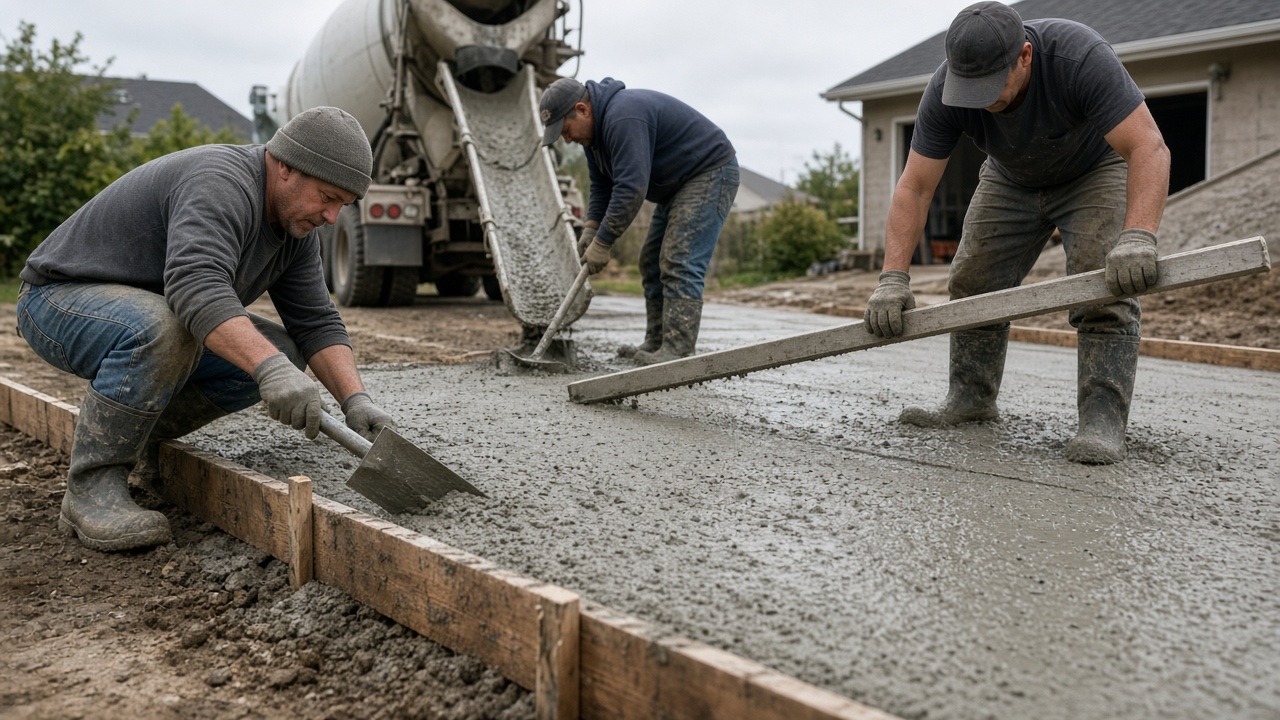
Concrete gives you one shot at a pour, so your labor should be hired and briefed before the truck arrives.
Concrete is unforgiving. Once the ready-mix truck shows up, the clock starts. Material has to be placed, consolidated, screeded, floated, and finished before it sets, and forms have to hold the load the whole time. Every problem you did not solve before the pour becomes a permanent problem in the slab, footing, or wall. That is why hiring for concrete and formwork is less about finding bodies and more about putting the right skills in place on the right day.
This guide is for contractors, builders, and property owners hiring labor for slabs, driveways, sidewalks, footings, or formed walls. It covers the roles on a concrete crew, what to look for in each, national wage data, and the safety rules that apply to forms and rebar.
The roles on a concrete crew
Form setter or form carpenter
Builds and sets forms to line and grade, installs stakes and bracing, and makes sure forms are tight, straight, and strong enough for the pour. On walls and elevated work, formwork can be complex and may be engineered. Experience matters.
Finisher or cement mason
Screeds, floats, edges, joints, and finishes the surface. Finishers judge timing, which depends on mix, temperature, wind, and sun. This is the most skill-dependent role on most flatwork pours.
Concrete laborer
Prepares and compacts base material, sets rebar or wire mesh on chairs as directed, moves concrete with rakes and come-alongs, runs the chute or helps with a pump hose, and cleans tools and forms. Good laborers keep the finishers working instead of chasing material.
Lead or foreman
Checks forms, grade, and reinforcement before the pour, coordinates the truck or pump, and decides when to start finishing. On many small jobs, the lead is also the main finisher.
What to look for before you hire
- Forms: ask form setters how they set grade, how they brace for the depth of the pour, and how they check forms before the truck arrives.
- Finishing: ask finishers what tools they use at each stage, how they decide when to start floating, and how they handle hot or windy days.
- Laborers: ask about prior pours, whether they have worked with a pump, and whether they bring rubber boots and gloves.
- Photos: ask for photos of finished work similar to yours, especially exposed flatwork.
A short conversation tells you a lot. Finishers who have done the work describe timing and conditions, not just tools.
What wage data shows
In the Bureau of Labor Statistics May 2025 national data, cement masons and concrete finishers earned a median of $27.41 per hour, with the middle half earning $22.60 to $32.15. Construction laborers earned a median of $22.66 per hour, with the middle half earning $18.57 to $28.72. Carpenters, which includes form carpenters, earned a median of $29.12.
These are national employee wages. Concrete contractors usually price flatwork by the square foot and include material, pump or equipment costs, reinforcement, finishing, and cleanup. When comparing a contractor's bid to hiring labor yourself, remember that the ready-mix, pump, rentals, and any wasted load are on you if you self-manage.
For broader rate context, see how much you should pay a day laborer in 2026 (https://chambanow.com/chambamatters/how-much-should-you-pay-a-day-laborer-in-2026-rates-by-job-type).
Safety rules for forms and rebar
OSHA's construction concrete standards include requirements that bear directly on crew planning.
- Formwork must be designed, fabricated, erected, supported, braced, and maintained so it can support all vertical and lateral loads that may reasonably be anticipated, under 29 CFR 1926.703(a)(1).
- All protruding reinforcing steel onto and into which employees could fall must be guarded to eliminate the hazard of impalement, under 29 CFR 1926.701(b). Rebar caps or covers rated for impalement protection are a common control.
- Cutting, grinding, or drilling cured concrete can release crystalline silica, and OSHA's silica standard lists controls for common tools, such as water delivery on saws.
Wet cement is a hazard too
OSHA warns that wet portland cement can cause caustic burns, which may not hurt at first. Its guidance recommends well-fitting butyl or nitrile gloves, waterproof boots high enough to keep cement out, eye protection, and washing skin promptly with clean water. Construction employers must provide washing facilities for workers exposed to portland cement. Laborers standing in fresh concrete need proper boots, not sneakers.
Before you dig
If the job involves excavation for footings or base, contact 811 a few business days ahead so buried utilities are marked. OSHA's excavation rules also require protective systems for workers in excavations, with limited exceptions for stable rock or shallow excavations a competent person has examined.
A pour-day checklist
- Forms checked for line, grade, bracing, and tightness
- Base compacted and, where specified, vapor barrier in place
- Reinforcement on chairs at the right height and inspected if required
- Rebar ends capped or covered
- Truck or pump access route clear and protected
- Water, tools, and spare screed boards on site
- Enough laborers and finishers for the volume and the weather
- A plan for washout that follows local rules
Hiring mistakes that ruin pours
- Booking laborers for pour day without telling them the start time depends on the truck
- Assuming any laborer can finish, then discovering nobody can float before the surface sets
- Letting a new helper adjust forms or bracing without the lead checking
- Leaving rebar uncapped because "we will only be here a day"
- Starting a big pour short-handed on a hot, windy afternoon
Each of these is cheaper to prevent with a phone call the day before than to fix with a saw and a jackhammer afterward.
Crew size: plan for the pour, not the average day
Prep days may need only a lead and one or two laborers. Pour day often needs more people for a short period. As a planning example only, a small residential slab might involve a lead finisher, a second finisher, and two or three laborers, while a long driveway on a hot day may need more. The right number depends on volume, placement method, and conditions. Ask your lead finisher how many people they want, and schedule temporary laborers specifically for pour day.
Permits and licensing
Many driveways, slabs, and structural footings require permits, and some require inspections before the pour. If you are a homeowner hiring workers directly, check your state's licensing rules first. In California, for example, the Contractors State License Board says the minor-work exemption does not apply when a permit is required or the unlicensed person employs workers. See can a homeowner hire labor without a contractor's license (https://chambanow.com/chambamatters/can-a-homeowner-hire-labor-without-a-contractor-s-license).
Hiring concrete labor on ChambaNOW
ChambaNOW lists concrete workers by city, for example in Houston (https://chambanow.com/hire/houston-tx/concrete). Post the job free, describe the pour and the roles you need, review workers who respond, and message them about that job. A clear scope helps, so see how to write a clear scope of work before a day labor job starts (https://chambanow.com/chambamatters/how-to-write-a-clear-scope-of-work-before-a-day-labor-job-starts), and start from the hirer overview (https://chambanow.com/for-hirers).
Before the truck arrives
Hire skill where it counts, in forms and finishing. Add laborers for pour day. Check forms and cap rebar before the truck arrives, protect skin from wet cement, and confirm permits before you dig.
Sources - U.S. Bureau of Labor Statistics, OEWS May 2025, Cement Masons and Concrete Finishers (47-2051) (https://www.bls.gov/oes/current/oes472051.htm) - U.S. Bureau of Labor Statistics, OEWS May 2025, Construction Laborers (47-2061) (https://www.bls.gov/oes/current/oes472061.htm) - U.S. Bureau of Labor Statistics, OEWS May 2025, Carpenters (47-2031) (https://www.bls.gov/oes/current/oes472031.htm) - OSHA, 29 CFR 1926.703, Requirements for cast-in-place concrete (https://www.osha.gov/laws-regs/regulations/standardnumber/1926/1926.703) - OSHA, 29 CFR 1926.701, General requirements, concrete and masonry (https://www.osha.gov/laws-regs/regulations/standardnumber/1926/1926.701) - OSHA, 29 CFR 1926.1153, Respirable crystalline silica (https://www.osha.gov/laws-regs/regulations/standardnumber/1926/1926.1153) - OSHA, Preventing Skin Problems from Working with Portland Cement, OSHA 3351 (https://www.osha.gov/sites/default/files/publications/OSHA-3351-PORTLAND-CEMENT.pdf) - OSHA, 29 CFR 1926.652, Requirements for protective systems (https://www.osha.gov/laws-regs/regulations/standardnumber/1926/1926.652) - 811, Before You Dig (https://call811.com/) - California Contractors State License Board, Handyperson Exemption to Increase to $1,000 in 2025 (https://www.cslb.ca.gov/Resources/PressReleases/2024/AB2622.FINAL.pdf)
Written by Barry Graham, Founder, ChambaNOW
Building knowledge that works.