
How Do You Get Roofing Helper Jobs, and What Safety Training Do You Need?
Roofing helper jobs come easier when you know the work, the risks, and the safety training crews expect.
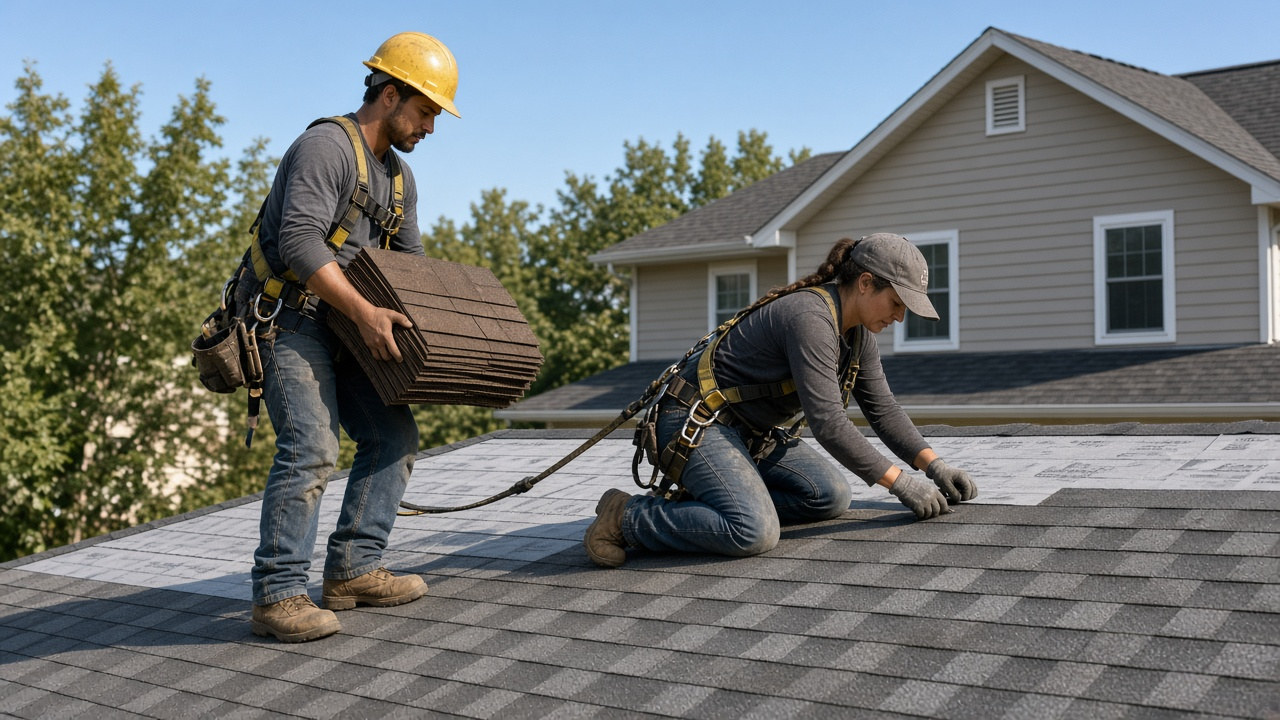
Roofing helper jobs come easier when you know the work, the risks, and the safety training crews expect.
Roofing is one of the more dangerous construction jobs in the United States, and helpers are hired to keep materials moving so the roofers can work faster. The work is real, it can pay steadily in busy seasons, and it is not a job you should take lightly. Fall protection, heat, cold, and lifting all matter on day one.
This guide covers what a roofing helper does, what the work tends to pay, the safety training crews look for, and how to get hired.
What a roofing helper does
The Bureau of Labor Statistics tracks helpers--roofers as its own occupation, and O*NET's summary for that role (https://www.onetonline.org/link/summary/47-3016.00) includes supplying materials, clearing debris, and helping roofers install or repair roofs. On a typical residential day, that often means these tasks.
- Unloading bundles of shingles, underlayment, and flashing, and staging them so the crew is not waiting
- Carrying materials up to the roof only when the lead says the access and the load are safe
- Clearing torn-off shingles and nails into a trailer or dumpster
- Sweeping the roof and the yard for nails with a magnetic roller
- Cutting and handing underlayment or starter shingles once you are shown the method
- Helping with simple repairs only under direct direction, such as passing materials to the roofer who is making the seal
A helper is support, not the person who should decide how to flash a valley or seal a pipe boot. Those details keep water out of the house.
What this job is not
Do not walk a steep roof, work near a skylight, or climb an unsecured ladder just to prove you are willing. OSHA's fall protection standard for construction (https://www.osha.gov/laws-regs/regulations/standardnumber/1926/1926.501) generally requires protection at six feet or more, and OSHA's fall protection page (https://www.osha.gov/fall-protection) explains the common methods, including harnesses, guardrails, and scaffolds. The employer should provide the system and the training for it. If there is no plan, do not go up.
Roofing in summer brings heat risk, and winter work brings cold, ice, and shorter days. See heat safety for outdoor labor (https://chambanow.com/chambamatters/heat-safety-for-outdoor-labor-water-shade-and-rest-breaks) and cold-weather safety for outdoor workers (https://chambanow.com/chambamatters/cold-weather-safety-for-outdoor-workers-layers-breaks-and-warning-signs). Do not work on a frost-covered or rain-slick roof.
Electrical lines, brittle old decks, and asbestos or lead on older buildings are other stop signs. If you are told to tear off material on a pre-1978 house, ask about lead-safe steps under the EPA's Renovation, Repair and Painting Program (https://www.epa.gov/lead/lead-renovation-repair-and-painting-program) before you start scraping painted surfaces.
What the work pays
In Bureau of Labor Statistics May 2025 national data, roofers earned a median of $26.65 an hour, with the middle half between $22.24 and $31.44. Helpers for roofers earned a median of $21.23 an hour, with the middle half between $17.80 and $23.54. Construction laborers earned a median of $22.66. Local rates vary, and your pay must at least meet the state and city minimum, which you can check on the U.S. Department of Labor's state minimum wage page (https://www.dol.gov/agencies/whd/minimum-wage/state).
Storm work and steep or high roofs often pay more because the risk and the pace are higher. Confirm the rate, the hours, and how you will be paid before you leave for the site.
What safety training helps
An OSHA 10 card is not a license, and it does not replace site-specific fall training. It does show a crew that you have had a basic safety class, and some job sites require it. OSHA's Outreach Training Program (https://www.osha.gov/training/outreach) is the official path for OSHA 10 and OSHA 30 classes. See whether an OSHA 10 card is worth it for day laborers (https://chambanow.com/chambamatters/is-an-osha-10-card-worth-it-for-day-laborers) and what certifications help construction laborers get hired faster (https://chambanow.com/chambamatters/what-certifications-help-construction-laborers-get-hired-faster).
The employer still has to train you on the actual fall system, ladder, or lift you will use that day. OSHA also has rules on protecting temporary workers (https://www.osha.gov/temporaryworkers). If no one shows you how to clip a harness or how to set a ladder, ask before you climb.
How to get hired
Roofing crews hire helpers who will show up early, lift carefully, and stay off unsafe ground.
- Step 1: Get the basics in order. Wear boots with grip, bring gloves, water, and sun or cold protection, and be ready to spend the day on your feet. See what you should wear to a construction or labor job (https://chambanow.com/chambamatters/what-should-you-wear-to-a-construction-or-labor-job).
- Step 2: Be honest about heights. If steep roofs or two-story work are new to you, say so. A crew can start you on the ground staging materials.
- Step 3: List roofing help where hirers search. On ChambaNOW, which is free for workers at https://chambanow.com/for-workers, add roofing separately from general labor. Browse roofing jobs by city, such as Dallas at https://chambanow.com/jobs/in/dallas-tx/roofing, Houston at https://chambanow.com/jobs/in/houston-tx/roofing, Phoenix at https://chambanow.com/jobs/in/phoenix-az/roofing, or Los Angeles at https://chambanow.com/jobs/in/los-angeles-ca/roofing.
- Step 4: Ask about fall protection, breaks, and the pitch of the roof before you accept. A clear answer is a good sign.
- Step 5: Work clean and ask for the next day. Keep nails off the lawn, stay in the system you were shown, and follow the habits in how to get rehired after a one-day labor job (https://chambanow.com/chambamatters/how-to-get-rehired-after-a-one-day-labor-job).
If you want to stay in the trade, roofing apprenticeships and formal installer training are the longer path. See how to get into a trade apprenticeship from day labor (https://chambanow.com/chambamatters/how-to-get-into-a-trade-apprenticeship-from-day-labor). Helper work can be the first step, not the last.
A typical first day
Many first days start on the ground. You unload the truck, stage bundles where the lead wants them, keep the tear-off moving into a trailer, and run a magnet around the yard before you leave. If the crew is comfortable with you, they may have you come up on a low, protected roof later in the day. That is a better first day than being sent to a steep, two-story roof with no briefing.
If you do go up, stay inside the fall system you were shown, watch your footing, and never turn your back on a skylight or an unguarded edge. Drink water even in cool weather, because a roof is still hard work. If the lead changes the plan because the deck is bad or the weather turns, treat that as a good sign, not as lost time.
Questions worth asking
Ask about the pitch of the roof, the fall protection, who provides the harness, where you will unload, and whether the day is a tear-off, a repair, or a full reroof. Ask how you will be paid if weather stops the job at noon. A crew that can answer those questions clearly is usually a safer crew to work with than one that says you will figure it out when you get there.
The short version
Roofing helper jobs exist in most markets, and crews will hire people who are strong, honest, and careful around heights. Learn the safety expectations, do not climb without a plan, and treat the first day as a tryout for the next one.
Sources
- U.S. Bureau of Labor Statistics, OEWS May 2025, Roofers (47-2181) (https://www.bls.gov/oes/current/oes472181.htm)
- U.S. Bureau of Labor Statistics, OEWS May 2025, Helpers--Roofers (47-3016) (https://www.bls.gov/oes/current/oes473016.htm)
- U.S. Bureau of Labor Statistics, OEWS May 2025, Construction Laborers (47-2061) (https://www.bls.gov/oes/current/oes472061.htm)
- O*NET OnLine, Helpers--Roofers (47-3016.00) (https://www.onetonline.org/link/summary/47-3016.00)
- OSHA, 29 CFR 1926.501, Duty to have fall protection (https://www.osha.gov/laws-regs/regulations/standardnumber/1926/1926.501)
- OSHA, Fall Protection (https://www.osha.gov/fall-protection)
- OSHA, Outreach Training Program (https://www.osha.gov/training/outreach)
- OSHA, Protecting Temporary Workers (https://www.osha.gov/temporaryworkers)
- U.S. Environmental Protection Agency, Lead Renovation, Repair and Painting Program (https://www.epa.gov/lead/lead-renovation-repair-and-painting-program)
- U.S. Department of Labor, State Minimum Wage Laws (https://www.dol.gov/agencies/whd/minimum-wage/state)
Written by Barry Graham, Founder, ChambaNOW
Construyendo conocimiento que funciona.