
What Certifications Help Construction Laborers Get Hired Faster?
A few safety cards and short courses can move you to the front of the hiring line.
A few safety cards and short courses can move you to the front of the hiring line.
You do not need a college degree to work construction. But many contractors use training cards as a quick filter when picking a crew. The Bureau of Labor Statistics says employers often require construction laborers and helpers to complete safety certification that meets OSHA guidelines, before or after hiring, and that some workers earn optional certifications such as rigging or scaffolding to show they can handle more complex tasks (https://www.bls.gov/ooh/construction-and-extraction/construction-laborers-and-helpers.htm). This guide covers which cards and courses matter most, which are legally required, and which are worth it for your goals.
A word on the term "certification"
Many workers call every card a certification. The official terms differ. OSHA, for example, says its 10- and 30-hour Outreach courses are not certifications; they are completion cards for voluntary awareness training (https://www.osha.gov/training/outreach). Some credentials are state cards, some are employer evaluations, and some are true third-party certifications. What matters to a hirer is whether the card is real and whether it fits the work.
OSHA 10-hour construction card
This is the most common card on construction sites and the best first one for most laborers. It is a 10-hour safety awareness course from an OSHA-authorized trainer. Some states require it for certain work; Nevada requires it for construction workers, and New York, Missouri, and several other states require it on certain public works projects. ChambaMatters covers the details in its guide, "Is an OSHA 10 Card Worth It for Day Laborers?"
OSHA 30-hour construction card
OSHA says the 30-hour course is more appropriate for supervisors or workers with some safety responsibility. Get it when you are moving toward crew lead or foreman work, not as your first card.
New York City Site Safety Training (SST) card
If you work in New York City, this one matters most. Under Local Law 196 of 2017, workers on sites that require a site safety plan and a designated superintendent, coordinator, or manager must hold an SST card showing at least 40 hours of training, and supervisors need 62 hours. Cards are valid for five years, and one approved path builds on the OSHA 10 with fall prevention, site safety, and scaffold courses (https://www.nyc.gov/site/buildings/safety/sst-worker-information.page).
Flagger card
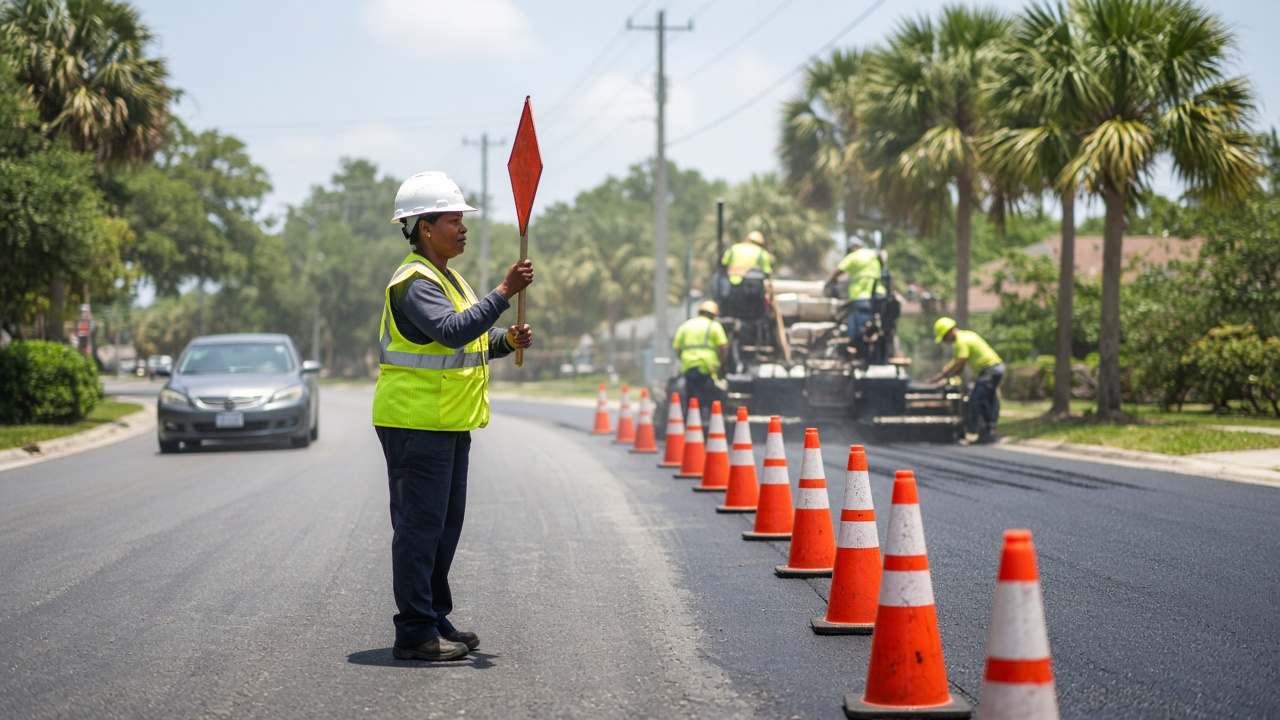
Road and utility crews need flaggers, and many states require training. OSHA's construction rule says flaggers must follow Part 6 of the federal traffic manual, the MUTCD, which requires workers in road work zones to wear ANSI Class 2 or 3 high-visibility apparel (https://mutcd.fhwa.dot.gov/pdfs/11th_Edition/part6.pdf). Some states issue cards. Washington, for example, requires flaggers to carry a valid Washington flagger card or a card from a reciprocal state such as Oregon, Idaho, or Montana, valid for no more than three years (https://app.leg.wa.gov/WAC/default.aspx?cite=296-155-305). Check your state's transportation or labor department.
Forklift and powered industrial truck training
Forklift skills open doors on construction sites, warehouses, and supply yards. Federal rules require every operator to be trained and evaluated before operating, with a performance evaluation at least once every three years, and construction rules apply the same training requirement (https://www.ecfr.gov/current/title-29/subtitle-B/chapter-XVII/part-1910/subpart-N/section-1910.178). Know one catch: the evaluation is done for the specific employer and equipment, so a new employer will usually still evaluate you. A training certificate still helps you get hired, because it shows you are close to ready.
First aid and CPR
On construction sites without a reasonably accessible clinic or hospital, OSHA requires a person with valid first aid training to be available at the worksite (https://www.ecfr.gov/current/title-29/subtitle-B/chapter-XVII/part-1926/subpart-D/section-1926.50). That makes a current first aid and CPR card useful on remote and small crews. The American Red Cross and other providers offer classes; see https://www.redcross.org/take-a-class/first-aid.
Scaffold training
Scaffolds show up on masonry, painting, siding, and commercial work. Federal rules require employers to train scaffold users through a qualified person and scaffold builders through a competent person. Having completed a scaffold user course shows a hirer you will need less onboarding, though the employer is still responsible for site-specific training.
Rigging and signal person qualification
These are for workers moving toward crane and heavy-lift work. Federal rules require a signal person to be qualified through either a third-party qualified evaluator or the employer's own qualified evaluator, including an oral or written test and a practical test. Only third-party qualification is portable to other employers; an employer's own evaluation is not (https://www.ecfr.gov/current/title-29/subtitle-B/chapter-XVII/part-1926/subpart-CC/section-1926.1428). If you want this path, look for third-party programs.
Silica awareness
Cutting, grinding, and drilling concrete, brick, and stone create silica dust. OSHA's construction silica standard requires employers to train exposed workers on hazards including cancer and lung effects (https://www.ecfr.gov/current/title-29/subtitle-B/chapter-XVII/part-1926/subpart-Z/section-1926.1153). A silica awareness course is a good add-on if you do concrete or demolition.
Driver's license
Not a certification, but BLS notes a valid driver's license may be required for laborers. A clean license, and especially the ability to drive a work truck or pull a trailer, makes you more useful to small contractors.
Which ones to get first
This is a practical ranking for a typical laborer, not an official one. Adjust for your city and goals.
- Everyone heading into construction: OSHA 10 construction
- Working in New York City: SST card
- Road, utility, or paving crews: state flagger card
- Supply yards, warehouses, or big sites: forklift training
- Small or remote crews: first aid and CPR
- Masonry, painting, or siding: scaffold user training
- Concrete and demolition: silica awareness
- Aiming for crew lead: OSHA 30
How to make sure a card is real
- Use OSHA-authorized trainers for OSHA 10 and 30, and check OSHA's Outreach Trainer Watch List, linked from https://www.osha.gov/training/outreach
- For state cards, use the training providers your state approves
- Be wary of anyone selling a card without real training time
- Keep the physical card and a photo of it on your phone
You can search for legitimate credentials by occupation with the CareerOneStop Certification Finder at https://www.careeronestop.org/Toolkit/Training/find-certifications.aspx.
Make your cards work for you
A card only helps if hirers know you have it. Mention it in every conversation with a foreman and list it in your free ChambaNOW worker profile at https://chambanow.com/for-workers. Pair each card with a skill: "OSHA 10, flagger card, concrete and demolition" is far stronger than either on its own.
Key takeaways
- BLS says employers often require OSHA-guideline safety training for laborers, and optional certifications like rigging or scaffolding help with complex tasks
- The OSHA 10 is the best first card for most laborers; the OSHA 30 is for supervisors
- NYC sites often require a 40-hour SST card; many states require flagger cards for road work
- Forklift evaluations are employer-specific, but training still helps you get hired
- Check every provider, keep your cards, and list them where hirers can see them
Sources
- OSHA, Outreach Training Program: https://www.osha.gov/training/outreach
- NYC Department of Buildings, SST Card Information: https://www.nyc.gov/site/buildings/safety/sst-worker-information.page
- Washington Administrative Code 296-155-305: https://app.leg.wa.gov/WAC/default.aspx?cite=296-155-305
- FHWA, MUTCD 11th Edition, Part 6: https://mutcd.fhwa.dot.gov/pdfs/11th_Edition/part6.pdf
- 29 CFR 1910.178, Powered industrial trucks: https://www.ecfr.gov/current/title-29/subtitle-B/chapter-XVII/part-1910/subpart-N/section-1910.178
- 29 CFR 1926.50, Medical services and first aid: https://www.ecfr.gov/current/title-29/subtitle-B/chapter-XVII/part-1926/subpart-D/section-1926.50
- 29 CFR 1926.1428, Signal person qualifications: https://www.ecfr.gov/current/title-29/subtitle-B/chapter-XVII/part-1926/subpart-CC/section-1926.1428
- 29 CFR 1926.1153, Respirable crystalline silica: https://www.ecfr.gov/current/title-29/subtitle-B/chapter-XVII/part-1926/subpart-Z/section-1926.1153
- U.S. Bureau of Labor Statistics, Construction Laborers and Helpers: https://www.bls.gov/ooh/construction-and-extraction/construction-laborers-and-helpers.htm
- CareerOneStop, Certification Finder: https://www.careeronestop.org/Toolkit/Training/find-certifications.aspx
Written by Barry Graham, Founder, ChambaNOW
Construyendo conocimiento que funciona.