
Heat Safety for Outdoor Labor: Water, Shade, and Rest Breaks
Outdoor workers stay safest in the heat with three things: cool drinking water close by and drunk often, shade or a cool place to rest, and regular breaks that get longer as the he
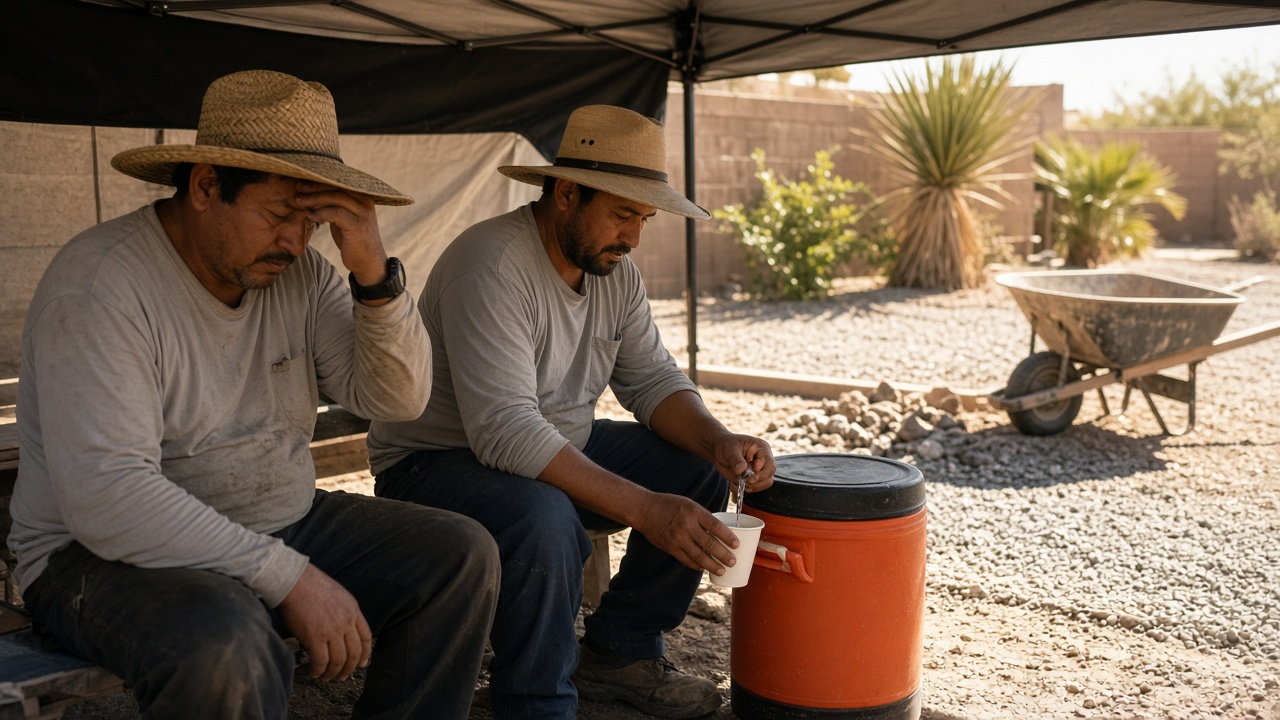
Outdoor workers stay safest in the heat with three things: cool drinking water close by and drunk often, shade or a cool place to rest, and regular breaks that get longer as the heat rises. New workers and anyone returning after a week or more away need extra care, because they have not adjusted to the heat yet. OSHA reports that almost half of heat-related worker deaths happen on the first day of work, and more than 70 percent during the first week. For a one-day labor job, almost every worker may be "new" to that site, so plan as if they are.
This article is general information, not legal or medical advice. Heat illness can be life-threatening. Call 911 if someone shows signs of heat stroke, such as confusion, fainting, or very high body temperature.
What is heat illness?
Heat illness is a group of conditions, from heat rash and cramps to heat exhaustion and heat stroke, that happen when the body cannot cool itself enough. Heat stroke is a medical emergency.
How much water should workers drink?
NIOSH, the federal research agency for worker safety, recommends that workers doing moderate activity in the heat for less than two hours drink one cup, 8 ounces, of water every 15 to 20 minutes. It says that during prolonged sweating lasting several hours, workers should drink sports drinks containing balanced electrolytes, and that fluid intake should generally not exceed 6 cups per hour. NIOSH also recommends that drinking water be cool, below 59 degrees Fahrenheit, located near the work area, and provided in individual cups (https://www.cdc.gov/niosh/heat-stress/recommendations/).
OSHA's Water.Rest.Shade guidance adds that workers should drink water frequently, not only when they are thirsty, that water should be close to the work in sufficient quantity, and that for work lasting more than two hours, employers should provide electrolyte drinks (https://www.osha.gov/heat-exposure/water-rest-shade).
In California, the Cal/OSHA heat standard requires employers to provide enough fresh, pure, suitably cool water, free of charge, for each employee to drink at least one quart per hour for the entire shift (https://www.dir.ca.gov/title8/3395.html).
How often should workers rest, and where?
OSHA says rest breaks should increase in length and frequency as heat stress rises, and recommends hourly breaks when heat stress exceeds recommended limits. Shade can be a natural shady spot, an air-conditioned vehicle or building, or a tent or canopy, with fans or misting where helpful.
Cal/OSHA requires shade to be present when the temperature exceeds 80 degrees Fahrenheit and allows workers to take a preventive cool-down rest in the shade of at least five minutes when they feel they need it. At 95 degrees Fahrenheit or above, California employers must follow high-heat procedures, such as closer observation of workers and reminders to drink water.
Why do new workers need acclimatization?
Acclimatization is the process of the body gradually adjusting to working in heat. OSHA's page on protecting new workers cites research finding that almost half of heat-related deaths occurred on a worker's first day, and more than 70 percent during the first week (https://www.osha.gov/heat-exposure/protecting-new-workers).
OSHA describes the "rule of 20 percent" for new workers: on the first day, work no more than 20 percent of the usual duration in the heat, and increase by no more than 20 percent each day. For an 8-hour day, that means no more than 1 hour and 40 minutes of heavy heat exposure on day one. NIOSH says acclimatization can take 7 to 14 days, and suggests a schedule for experienced workers of 50 percent of usual heat exposure on day one, 60 percent on day two, 80 percent on day three, and 100 percent on day four.
A homeowner hiring one person for a single hot day cannot run a two-week program. What you can do:
- Schedule the heaviest work for early morning
- Rotate workers between hot tasks and lighter or shaded tasks
- Add more workers to a heavy task instead of pushing one person, which NIOSH recommends
- Use a buddy system so workers watch each other for symptoms
- Ask the worker whether they have been working outdoors recently, and adjust
What are the warning signs?
Watch for heavy sweating, cramps, dizziness, headache, nausea, weakness, or confusion. If a worker is confused, faints, or stops sweating with hot skin, treat it as heat stroke: call 911, move them to shade, and cool them with water and air while waiting.
Is there a federal OSHA heat standard in 2026?
Not yet. OSHA published a proposed rule on heat injury and illness prevention on August 30, 2024, held an informal hearing from June 16 to July 2, 2025, and extended the post-hearing comment period to October 30, 2025 (https://www.federalregister.gov/documents/2025/09/25/2025-18670/heat-injury-and-illness-prevention-in-outdoor-and-indoor-work-settings). As of November 9, 2026, no final rule has been published. OSHA still enforces heat hazards under the General Duty Clause, which requires employers to keep workplaces free from recognized serious hazards.
Which states have heat rules?
OSHA's heat standards page lists state plans with heat-related standards in California, Colorado for agriculture, Minnesota for indoor workplaces, Oregon, and Washington (https://www.osha.gov/heat-exposure/standards). Other states and cities may have rules or proposals; check your state labor department.
Heat safety checklist for a one-day outdoor job
- Check the forecast and heat index the night before
- Start early and plan the hardest work for the coolest hours
- Provide cool water close to the work, at least enough for a quart per worker per hour
- Have electrolyte drinks on hand for jobs longer than two hours
- Set up shade before work starts: canopy, tree cover, or an air-conditioned car
- Schedule breaks, more often as it gets hotter; let workers rest when they ask
- Ask about recent heat exposure and lighten the load for anyone new
- Pair workers so they can watch each other
- Know the job address and the nearest emergency room
- Stop work when conditions are dangerous
Why does this matter for day laborers in particular?
Day laborers often move from job to job and may not get a chance to acclimatize to each site. The 2006 national "On the Corner" study found that 44 percent of day laborers reported being denied food, water, or breaks by an employer (https://www.coshnetwork.org/sites/default/files/Day%20Labor%20study%202006.pdf). That data is two decades old, but it shows why water and breaks need to be stated, not assumed.
Where does ChambaNOW fit?
Put water, shade, and break plans right in the job description so workers know before they arrive. Posting a job on ChambaNOW is free, and hirers contact workers only about a posted job, which keeps those terms in writing. Workers can read about safety rights at https://chambanow.com/chambamatters/your-right-to-a-safe-workplace and find more resources at https://chambanow.com/worker-resources. Hirers in hot-weather cities can browse local landscaping help, for example at https://chambanow.com/hire/phoenix-az/landscaping, and review hiring guidance at https://chambanow.com/for-hirers.
Key takeaways
- Water, rest, and shade: cool water near the work, regular breaks, and a shaded place to cool down
- NIOSH recommends a cup of water every 15 to 20 minutes and no more than 6 cups per hour
- Almost half of heat-related worker deaths happen on the first day; ease new workers in
- California requires shade above 80 degrees and a quart of water per worker per hour
- A federal heat standard was proposed in 2024 but is not final as of November 2026
Sources
- OSHA, Water.Rest.Shade; Protecting New Workers; Heat Standards
- NIOSH, Heat Stress Recommendations
- California Code of Regulations, Title 8, section 3395
- Federal Register, Heat Injury and Illness Prevention in Outdoor and Indoor Work Settings, document 2025-18670
- "On the Corner: Day Labor in the United States," 2006
Written by Barry Graham, Founder, ChambaNOW
Building knowledge that works.