
How Many Helpers Do I Need to Hang Drywall in a Room?
Hanging drywall in a typical room usually takes two people, because the boards are heavy and awkward.
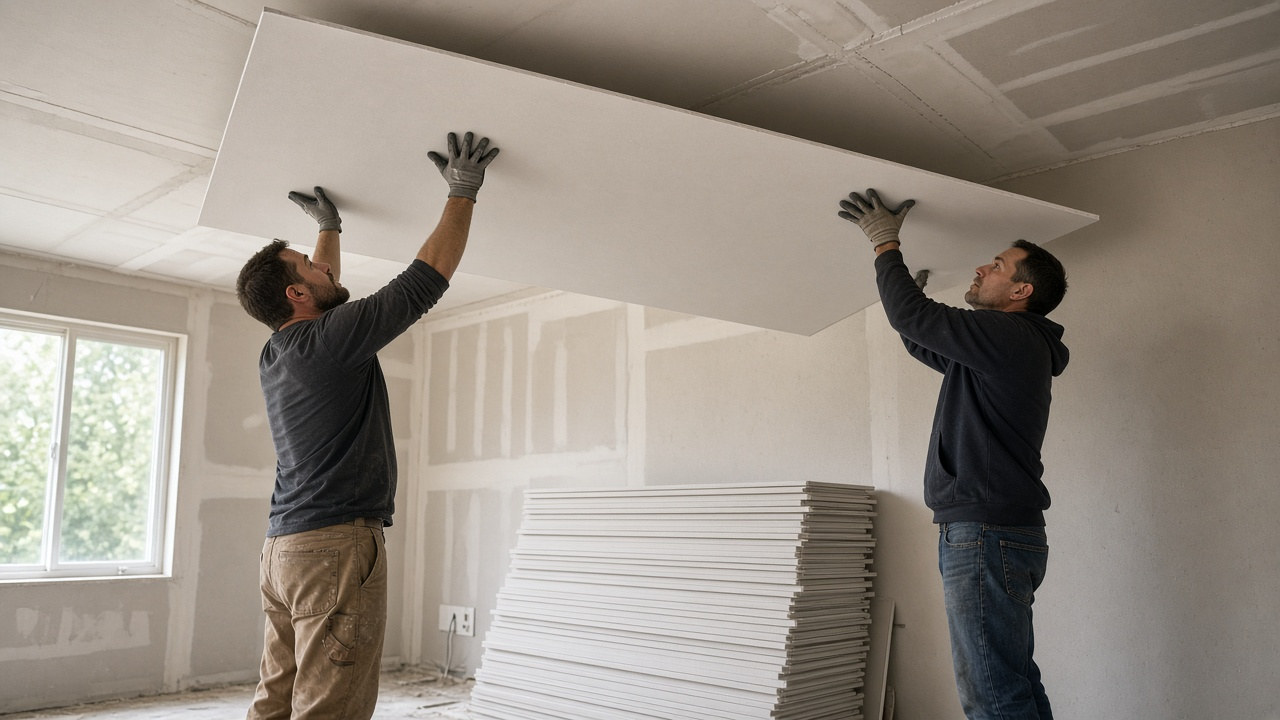
Hanging drywall in a typical room usually takes two people, because the boards are heavy and awkward.
A sheet of drywall is large, fragile at the corners, and heavy enough to injure someone who tries to hang a ceiling alone. Homeowners and contractors often ask how many helpers they need for a bedroom, a garage, or a small remodel. The short practical answer is that most rooms go better with two people, and larger rooms or ceiling work can need a third pair of hands for staging and cleanup.
This guide covers how to size the crew, what the helpers should be able to do, what the work tends to cost in labor terms, and how to plan the day.
Why two people is the usual starting point
A standard sheet is four feet by eight, ten, or twelve feet. Walls can sometimes be hung by one experienced installer with a lift or a temporary support, but a helper makes the work safer and faster. Ceilings are a two-person job in almost every house, and long commercial or 12-foot sheets are too awkward for one person to control on a ladder or a bench.
For a typical 10-by-12 or 12-by-12 bedroom with an 8-foot ceiling, two workers can often hang the walls and ceiling in a half day to a day, depending on openings, odd angles, and how much material is already on site. A larger living room, a garage, or a room with a vaulted ceiling takes longer and may need a third person to stage sheets and keep the floor clear. See how many workers you need for moving, landscaping, and cleanup (https://chambanow.com/chambamatters/how-many-workers-do-you-need-a-crew-size-guide-for-moving-landscaping-and-cleanu) for the broader crew-size method, and what to look for when hiring drywall helpers (https://chambanow.com/chambamatters/what-to-look-for-when-hiring-drywall-helpers) for the skill side.
What the helpers should actually do
You are hiring people to lift, cut, fasten, and keep the room ready, not to invent a layout. A useful crew can usually do these tasks.
- Carry and stage sheets without breaking the corners
- Measure and make straight cuts once the lead has marked them, or hold the sheet while the lead cuts
- Hang walls and ceilings with a consistent screw pattern
- Cut openings for outlets and switches after they are marked
- Mix mud and do simple cleanup so a taper can start later, if taping is part of the same job
Taping and finishing are a different skill. If you want a smooth, paint-ready surface, do not assume the same two hangers are finishers unless they have shown you that work. Many jobs use a hanging crew one day and a taper later.
When you may need more than two
Add a person, or split the job, in these cases.
- Heavy 12-foot sheets, high ceilings, or a lot of overhead work
- A large open room where someone has to keep materials moving from the truck or garage
- A same-day hang-and-stock job, where cleanup and the next delivery overlap
- A worker who is new and should stay on the ground staging, not on a ceiling
Do not add people just to go faster if they will be standing in each other's way in a small bedroom. Two people who can lift together will beat four people in a tight room.
Safety and dust
Drywall is a lifting job and a dust job. Our back-safety guide (https://chambanow.com/chambamatters/how-to-lift-heavy-objects-safely-a-back-safety-guide-for-laborers) is worth sharing with the crew. Cutting and sanding can release dust that contains silica, which OSHA regulates in construction (https://www.osha.gov/laws-regs/regulations/standardnumber/1926/1926.1153). Ask the crew how they will control dust, and do not let anyone dry-sand a room into a cloud, especially in an occupied house. If the home was built before 1978, disturbing painted surfaces can also raise lead-safe issues under the EPA's Renovation, Repair and Painting Program (https://www.epa.gov/lead/lead-renovation-repair-and-painting-program).
Provide a clear path, a place to stage sheets, and the boards already on site if you can. A helper waiting for material is a wasted hire. See a guide to preparing your home or jobsite before workers arrive (https://chambanow.com/chambamatters/a-guide-to-preparing-your-home-or-jobsite-before-workers-arrive).
What to pay
The Bureau of Labor Statistics does not publish a separate "drywall helper" wage. May 2025 national medians are $28.33 an hour for drywall and ceiling tile installers, $32.82 for tapers, $20.51 for helpers in other construction trades, and $22.66 for construction laborers. A hanging crew often includes a lead and a helper, so the two people on site may not be paid the same rate.
Local rates vary, and you must at least meet the state and city minimum wage at https://www.dol.gov/agencies/whd/minimum-wage/state. For ranges by job type, see how much you should pay a day laborer in 2026 (https://chambanow.com/chambamatters/how-much-should-you-pay-a-day-laborer-in-2026-rates-by-job-type). Agree on the rate, the hours, and whether hanging and taping are the same job before anyone starts.
How to hire the right number of people
- Step 1: Measure the room, note the ceiling height, and count the openings. That is enough to decide between two people and three.
- Step 2: Separate hanging from finishing in the scope, unless you have a crew that does both.
- Step 3: Say who provides the board, the lift or benches, and the screws. How to write a clear scope of work (https://chambanow.com/chambamatters/how-to-write-a-clear-scope-of-work-before-a-day-labor-job-starts) will keep the day from expanding.
- Step 4: Post the job at https://chambanow.com/for-hirers, or from a city page such as Houston at https://chambanow.com/hire/houston-tx, Dallas at https://chambanow.com/hire/dallas-tx, or Phoenix at https://chambanow.com/hire/phoenix-az. Ask for two people who have hung drywall together if you can.
- Step 5: Confirm they can lift ceilings safely and that they have a plan for dust and leftover board.
A realistic example
A 12-by-12 bedroom with an 8-foot ceiling, a closet, and a couple of openings is a classic two-person hang if the board is already in the house. One person can measure and cut, the other can help lift and hold, and they switch as needed. The same two people may not finish the room to paint-ready that day. If you also want taping and two or three coats of mud, plan a later visit or hire a taper, and give the joints time to dry.
A garage with 12-foot sheets, or a living room with a high ceiling, is where a third person earns their pay. That person stages, keeps the floor clear, and reduces the time the other two are walking sheets through a doorway. In a small bedroom, that third person may only get in the way.
Mistakes to avoid
Do not order the wrong thickness or the wrong length of board and then expect the crew to make it work. Do not ask one person to hang a ceiling alone. Do not mix hanging and heavy demolition in the same tight room at the same time. And do not skip a place to stack scrap, because a floor full of offcuts is how sheets get broken and ankles get turned. Have the material, the parking, and the path ready, then hire the number of people the room can actually use.
The short version
Plan on two people for a typical room, and add a third when the sheets are long, the ceiling is high, or someone needs to keep material moving. Treat finishing as a separate skill, keep dust under control, and write the scope so the crew knows whether they are hanging, taping, or both.
Sources
- U.S. Bureau of Labor Statistics, OEWS May 2025, Drywall and Ceiling Tile Installers (47-2081) (https://www.bls.gov/oes/current/oes472081.htm)
- U.S. Bureau of Labor Statistics, OEWS May 2025, Tapers (47-2082) (https://www.bls.gov/oes/current/oes472082.htm)
- U.S. Bureau of Labor Statistics, OEWS May 2025, Helpers, Construction Trades, All Other (47-3019) (https://www.bls.gov/oes/current/oes473019.htm)
- U.S. Bureau of Labor Statistics, OEWS May 2025, Construction Laborers (47-2061) (https://www.bls.gov/oes/current/oes472061.htm)
- OSHA, 29 CFR 1926.1153, Respirable crystalline silica (https://www.osha.gov/laws-regs/regulations/standardnumber/1926/1926.1153)
- OSHA, Respirable Crystalline Silica (https://www.osha.gov/silica-crystalline)
- U.S. Environmental Protection Agency, Lead Renovation, Repair and Painting Program (https://www.epa.gov/lead/lead-renovation-repair-and-painting-program)
- U.S. Department of Labor, State Minimum Wage Laws (https://www.dol.gov/agencies/whd/minimum-wage/state)
Written by Barry Graham, Founder, ChambaNOW
Building knowledge that works.