
How Do You Become a Plumber’s Helper?
You can become a plumber's helper by learning the basics, working carefully, and asking a plumber for work.
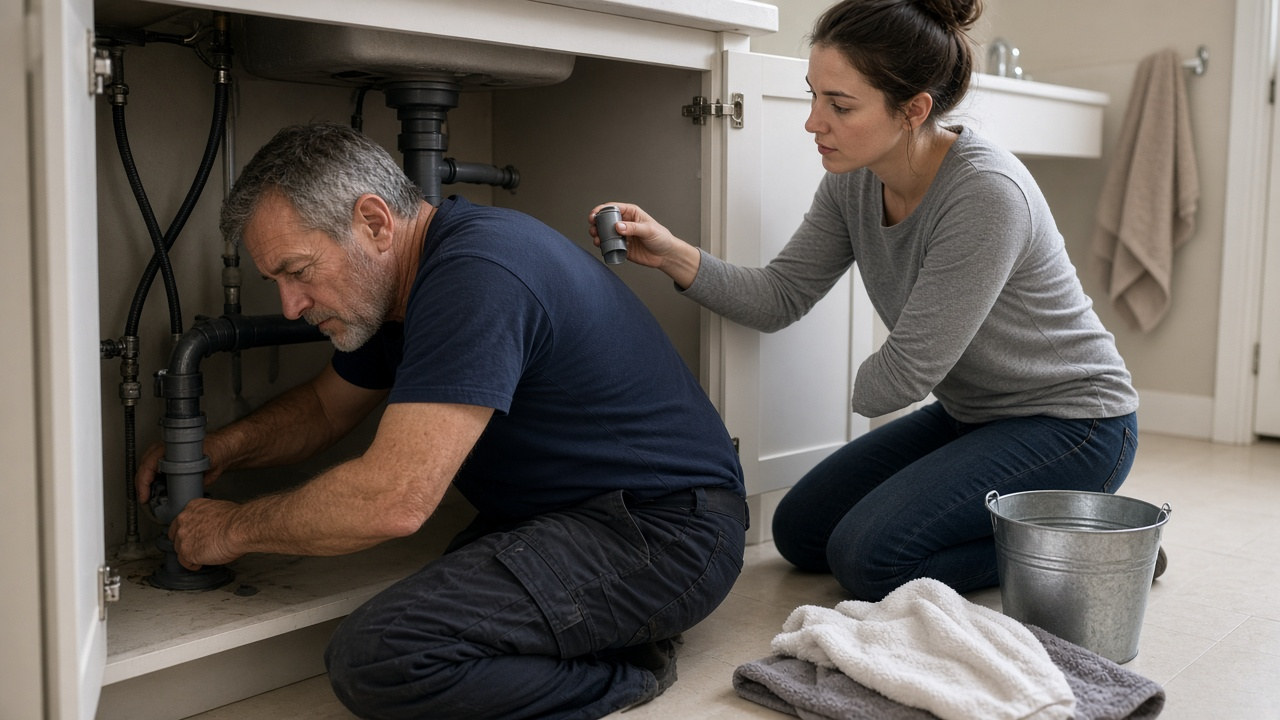
You can become a plumber's helper by learning the basics, working carefully, and asking a plumber for work.
A plumber's helper is one of the most practical first steps into a licensed trade. The work is physical, it happens in homes and on jobsites every day, and a licensed plumber can use a careful helper almost immediately. You will not be the person who decides how to size a drain or pull a permit. You will be the person who keeps the job moving so the plumber can do that work.
This guide covers what a plumber's helper does, what the helper cannot do, what the work tends to pay, and how to get a first day.
What a plumber's helper does
The Bureau of Labor Statistics tracks helpers for pipelayers, plumbers, pipefitters, and steamfitters as its own occupation. O*NET's summary for that role (https://www.onetonline.org/link/summary/47-3015.00) includes moving materials, helping with installation, and keeping the work area ready. On a residential call or a remodel, that often means these tasks.
- Loading and unloading pipe, fittings, water heaters, and fixtures, and staging them near the work
- Cutting, reaming, and cleaning pipe once the plumber has shown you the method
- Fetching the right fitting, soldering only if you are trained and asked, and holding pipe in place
- Opening up access, pulling old fixtures, and hauling debris
- Helping test lines under the plumber's direction, such as watching a gauge or a joint
- Keeping the workspace dry and clean, and protecting floors in an occupied home
- Simple excavation or backfill on a short outdoor run, if that is part of the job
The helper's value is attention and pace, not guessing. Hand the fitting that was asked for, not the one that looks close.
What this job is not
Plumbing is a licensed trade in most states for the work that connects to the water supply, the drain system, or the gas line. A helper should not make new connections, size a system, or sign off on a test unless the licensed plumber is directing that exact step and local rules allow it. If you are not sure whether a task is helper work, ask before you do it. Our hirer-facing article on hiring plumbing helpers for a residential job (https://chambanow.com/chambamatters/hiring-plumbing-helpers-for-a-residential-job) is written for the person paying, but it makes the same split between labor and licensed work.
Gas, sewer, and water-heater connections are not practice tasks. Neither is work on a fire sprinkler or a medical-gas line. If a job is in a space with a live electrical hazard, stop and let the plumber handle the setup.
What the work pays
In Bureau of Labor Statistics May 2025 national data, helpers for pipelayers, plumbers, pipefitters, and steamfitters earned a median of $20.36 an hour, with the middle half earning $17.76 to $22.94. Plumbers, pipefitters, and steamfitters earned a median of $30.67 an hour, with the middle half earning $24.13 to $40.92. A first week as a helper usually sits closer to the helper figure. Local rates vary, and your pay must at least meet the state and city minimum on the U.S. Department of Labor's state minimum wage page (https://www.dol.gov/agencies/whd/minimum-wage/state). Confirm the rate, the expected hours, and how you will be paid before you start.
What to bring and how to be useful
You do not need a full plumber's van on day one. Bring the personal basics and let the plumber provide the trade tools and required safety gear. See what a day laborer should bring (https://chambanow.com/chambamatters/what-a-day-laborer-should-bring-to-the-job-and-what-the-hirer-should-provide) and how to be a good helper to a tradesperson (https://chambanow.com/chambamatters/how-to-be-a-good-helper-to-a-tradesperson).
- Sturdy boots, long pants, and gloves
- A tape measure, a pencil, and a knife
- Clothes you can get dirty in a crawl space or under a sink
- A small flashlight or headlamp, if you have one
- Water and a lunch
Listen once, then move. Keep parts in the order they came off a fixture. Do not toss old fittings until the plumber says they can go. If you do not know a fitting name, hold it up and ask, rather than bringing the wrong one twice.
How to get hired
Plumbers hire helpers the same way other trades do: a clear, honest offer and a first day that makes the job easier.
- Step 1: Learn the common names. Supply versus drain, copper, PEX, PVC, a shutoff valve, a trap, and a water heater are everyday words on this job. You do not need to be an expert. You need to understand the request.
- Step 2: Be honest about your experience. Say if you have helped a plumber, only done demolition, or worked in general labor. A plumber can start you on hauling and cleanup the same day.
- Step 3: List plumbing help where hirers search. On ChambaNOW, which is free for workers at https://chambanow.com/for-workers, add plumbing separately from general labor. Browse plumbing jobs by city, such as Houston at https://chambanow.com/jobs/in/houston-tx/plumbing, Los Angeles at https://chambanow.com/jobs/in/los-angeles-ca/plumbing, Dallas at https://chambanow.com/jobs/in/dallas-tx/plumbing, or Phoenix at https://chambanow.com/jobs/in/phoenix-az/plumbing.
- Step 4: Ask what the day involves, whether the home will be occupied, and who provides tools. Crawl-space and attic work should be mentioned up front.
- Step 5: Finish clean and ask to be called again. How to get rehired after a one-day labor job (https://chambanow.com/chambamatters/how-to-get-rehired-after-a-one-day-labor-job) and how to become a carpenter helper (https://chambanow.com/chambamatters/how-to-become-a-carpenter-helper) show the same first-step pattern in another trade.
If you want to stay in plumbing, the longer path is an apprenticeship with related classroom time. See how to get into a trade apprenticeship from day labor (https://chambanow.com/chambamatters/how-to-get-into-a-trade-apprenticeship-from-day-labor) and the official apprenticeship job finder at https://www.apprenticeship.gov/apprenticeship-job-finder. An OSHA 10 card can also help on larger sites (https://chambanow.com/chambamatters/is-an-osha-10-card-worth-it-for-day-laborers).
A typical first day
A typical first day might be a water-heater swap, a bathroom remodel rough-in, or a service call in an occupied house. You help get the old unit or fixture out, keep the path protected, fetch pipe and fittings, and clean as you go. In an occupied home, that also means being quiet, parking where you were told, and not tracking mud through a living room. The plumber is watching how you handle other people's houses as much as how you handle a cutter.
If you are in a crawl space or an attic, say when you need a break or better light. Those spaces are hard work, and a helper who will not speak up can make a mistake or get hurt. At the end of the day, ask what you should practice or learn before the next call, and ask to be on the list for the following week.
Questions worth asking
Ask whether the job is a service call, a remodel, or a new install, and whether the home will be occupied. Ask about crawl spaces, attics, and whether you should bring a light and a change of clothes. Ask who provides tools, and what you should not touch, especially shutoffs and gas. If the plumber wants a helper who already knows how to solder or to work with PEX, they should say that in the post so you can be honest about your experience.
The short version
A plumber's helper carries, preps, and assists so licensed work can get done. Learn the basic names, stay inside the helper role, and show a plumber that the job goes faster with you there. That is how you get the first day, and how you get the next one.
Sources
- U.S. Bureau of Labor Statistics, OEWS May 2025, Helpers--Pipelayers, Plumbers, Pipefitters, and Steamfitters (47-3015) (https://www.bls.gov/oes/current/oes473015.htm)
- U.S. Bureau of Labor Statistics, OEWS May 2025, Plumbers, Pipefitters, and Steamfitters (47-2152) (https://www.bls.gov/oes/current/oes472152.htm)
- O*NET OnLine, Helpers--Pipelayers, Plumbers, Pipefitters, and Steamfitters (47-3015.00) (https://www.onetonline.org/link/summary/47-3015.00)
- Apprenticeship.gov, Apprenticeship Job Finder (https://www.apprenticeship.gov/apprenticeship-job-finder)
- U.S. Department of Labor, State Minimum Wage Laws (https://www.dol.gov/agencies/whd/minimum-wage/state)
Written by Barry Graham, Founder, ChambaNOW
Building knowledge that works.