
How to Become a Carpenter Helper
Carpenter helper is one of the most direct ways to move from day labor into a real trade.
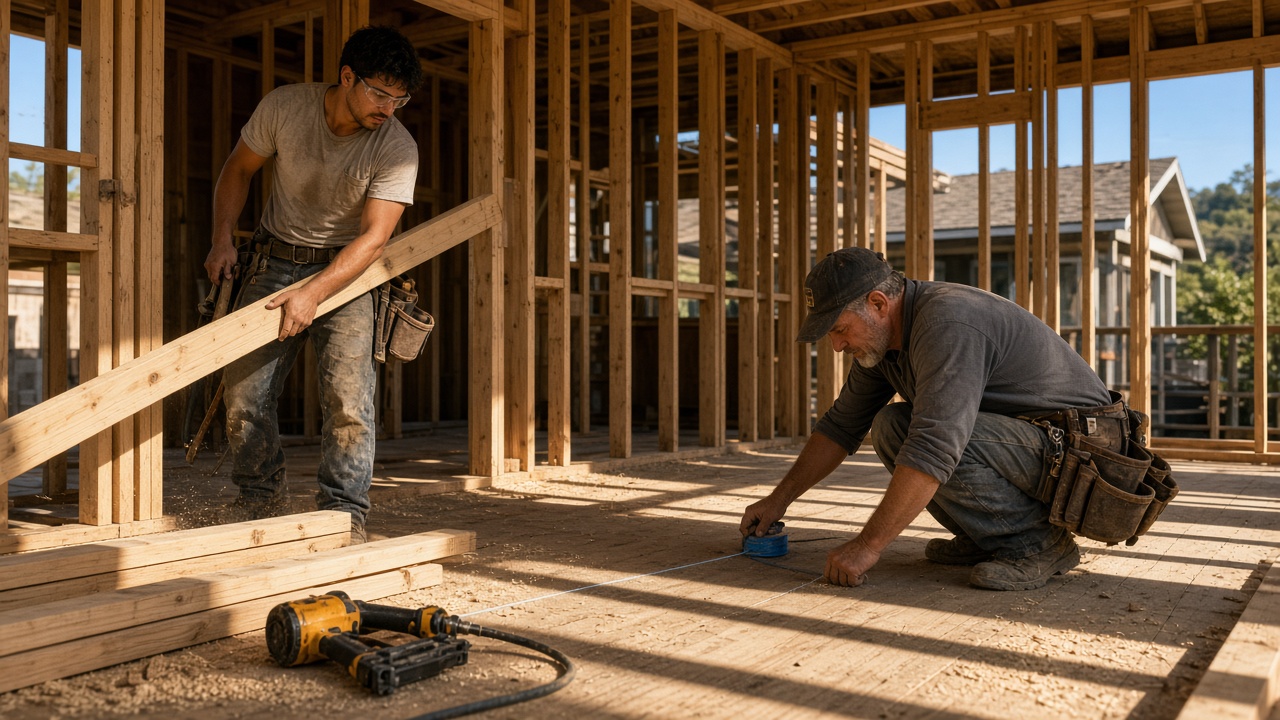
Carpenter helper is one of the most direct ways to move from day labor into a real trade.
A carpenter helper works alongside carpenters on framing, forms, remodels, and finish work, doing the tasks that need less skill while learning the ones that need more. You do not need a license or a diploma to start. You need to be reliable, careful, and good with a tape measure. This guide covers what the job involves, what it pays, how to get hired, and where it leads.
What does a carpenter helper do?
O*NET, the Labor Department's occupation database, describes carpenter helpers as workers who help carpenters by "using, supplying, or holding materials or tools, and cleaning work area and equipment" (https://www.onetonline.org/link/summary/47-3012.00). Its task list includes.
- Erecting scaffolding, shoring, or braces
- Cleaning work areas, machines, and equipment
- Positioning and holding lumber or paneling for fastening or cutting
- Cutting lumber to specified dimensions
- Selecting tools and materials from storage and bringing them to the work area
- Building concrete forms and helping raise them into place
- Drilling holes and installing hardware under direction
On a typical day, expect to stage lumber, cut to marks, hold boards while the carpenter nails, carry sheets of plywood, set up and break down, and keep the site clean. Over time, you get trusted with layout, cutting, and fastening on your own.
What does it pay?
The Bureau of Labor Statistics reports a May 2025 median of $43,780 a year for carpenter helpers, which O*NET lists as $21.05 an hour (https://www.bls.gov/ooh/construction-and-extraction/construction-laborers-and-helpers.htm). Full carpenters earned a median of $60,580 a year, or $29.12 an hour, with the highest 10 percent above $99,910 (https://www.bls.gov/ooh/construction-and-extraction/carpenters.htm).
That gap is the point. The helper job is a step, not a destination.
One honest note on the numbers: BLS counts only about 21,900 jobs with the official title of carpenter helper and projects a 2 percent decline from 2025 to 2035. Carpenters, by contrast, held about 889,700 jobs with about 62,800 openings projected each year. Many people doing helper work are called laborers or apprentices instead, so the title matters less than the path.
Skills you need to get started
BLS lists detail orientation, dexterity, math, physical strength, and teamwork as important qualities for carpenters, and notes they lift materials weighing up to 100 pounds. For a helper, the most valuable early skills are.
- Reading a tape measure quickly and accurately to the sixteenth of an inch
- Marking and cutting square to a line
- Knowing the names of common lumber sizes, fasteners, and tools
- Lifting and carrying long or heavy material safely, with a partner when needed
- Keeping a clean, organized work area
- Following instructions exactly, and asking when unsure
BLS describes the learning path plainly: carpenters often begin with simple tasks such as measuring and cutting wood under the guidance of experienced carpenters, then move to reading blueprints and building structures.
Do you need your own tools?
BLS says many employers require carpenters to supply their own tools. Helpers are often expected to bring basic hand tools, while employers or lead carpenters usually supply the larger power tools. The list below is a practical starter set, not a requirement, and you should ask any employer what they expect.
- Tool belt or pouch
- 25-foot tape measure
- Framing hammer
- Utility knife with spare blades
- Speed square
- Carpenter's pencils and a chalk line
- Torpedo level
- Cat's paw or small pry bar
- Safety glasses, gloves, and hearing protection
Buy good basics first. Hold off on expensive power tools until you know what kind of carpentry you will be doing.
Safety training that helps you get hired
BLS states that all carpenters must pass the OSHA 10-hour safety course. OSHA describes the 10-hour class as voluntary safety awareness training, not a certification, but many employers expect it (https://www.osha.gov/training/outreach).
Carpenters and helpers often work on scaffolds. Federal rules require employers to train every worker who works on a scaffold, through a qualified person, to recognize its hazards, and to train those who build or take down scaffolds through a competent person (https://www.ecfr.gov/current/title-29/subtitle-B/chapter-XVII/part-1926/subpart-L/section-1926.454). Ask for that training before you go up.
How to get hired as a carpenter helper
There are a few reliable routes.
- From day labor. Take demolition, framing cleanup, and remodel helper jobs, and tell every carpenter you work with that you want to learn. Browse carpentry jobs by city, such as Houston at https://chambanow.com/jobs/in/houston-tx/carpentry, Los Angeles at https://chambanow.com/jobs/in/los-angeles-ca/carpentry, Dallas at https://chambanow.com/jobs/in/dallas-tx/carpentry, or San Jose at https://chambanow.com/jobs/in/san-jose-ca/carpentry.
- From a laborer job. BLS notes that some carpenters work as construction laborers or helpers before becoming carpenters.
- Directly from contractors. Framing crews, remodelers, deck builders, and cabinet installers often hire helpers. Visit lumber yards early in the morning and ask.
- Through apprenticeship. BLS says unions and contractor associations sponsor carpentry apprenticeships, with paid on-the-job training and technical instruction each year. Search for openings at https://www.apprenticeship.gov/apprenticeship-job-finder or call 877-872-5627.
When you post your skills on ChambaNOW, which is free for workers at https://chambanow.com/for-workers, list carpentry help separately from general labor so carpentry hirers can find you.
What to say to a carpenter who might hire you
Here is an example of how to pitch yourself without overselling.
I've done about six months of demo and cleanup on remodels. I can read a tape, cut to a line, and I have my own belt and hand tools. I want to learn framing and I'll do whatever needs doing.
That tells a carpenter you are useful today and coachable for tomorrow.
Mistakes new carpenter helpers make
These are common examples from crews, not an official list. Avoiding them will put you ahead of most beginners.
- Cutting on the wrong side of the line, which makes the piece short by the width of the blade
- Reading 5/8 as 3/8 or mixing up which end of the tape you started from
- Carrying long boards without watching the ends around people, windows, and doorways
- Standing in front of a nail gun or holding material where a nail could pass through
- Leaving offcuts and nails on the floor where someone can step on them
- Guessing at a measurement instead of asking the carpenter to repeat it
If you make one of these mistakes, say so right away. Carpenters expect beginners to make mistakes. They do not forgive hidden ones, because a short board found later can mean tearing out finished work.
From helper to carpenter
Most helpers who stick with it follow some version of this path. Timelines vary a lot, so treat this as a general picture, not a promise.
- Helper: stage materials, cut to marks, hold and fasten under direction
- Advanced helper or apprentice: layout, framing walls, building forms, installing doors and trim with less supervision
- Carpenter: work from plans, run sections of a job, direct helpers
- Lead carpenter or supervisor: BLS lists first-line supervisor, lead carpenter, independent contractor, and general construction supervisor as advancement options
Specialties include rough framing, concrete forms, finish carpentry, cabinets, and flooring. Picking one and getting good at it is often the fastest way to raise your pay.
Key takeaways
- Carpenter helpers support carpenters by staging, holding, cutting, and cleaning, and learn the trade on the job
- BLS reports a May 2025 median of $43,780 for helpers and $60,580 for carpenters
- Learn the tape measure, square cuts, lumber names, and safe lifting first
- Bring basic hand tools; ask the employer about power tools
- Get in through day labor, laborer jobs, direct hiring, or an apprenticeship
Sources
- U.S. Bureau of Labor Statistics, Carpenters (May 2025 data, modified August 27, 2026): https://www.bls.gov/ooh/construction-and-extraction/carpenters.htm
- U.S. Bureau of Labor Statistics, Construction Laborers and Helpers: https://www.bls.gov/ooh/construction-and-extraction/construction-laborers-and-helpers.htm
- O*NET OnLine, 47-3012.00 Helpers--Carpenters: https://www.onetonline.org/link/summary/47-3012.00
- Apprenticeship.gov, Apprenticeship Job Finder: https://www.apprenticeship.gov/apprenticeship-job-finder
- OSHA, Outreach Training Program: https://www.osha.gov/training/outreach
- 29 CFR 1926.454, Scaffold training requirements: https://www.ecfr.gov/current/title-29/subtitle-B/chapter-XVII/part-1926/subpart-L/section-1926.454
Written by Barry Graham, Founder, ChambaNOW
Construyendo conocimiento que funciona.