
Hiring Plumbing Helpers for a Residential Job
A plumbing helper can dig, haul, and prep on a home job, while the plumbing stays with a licensed plumber.
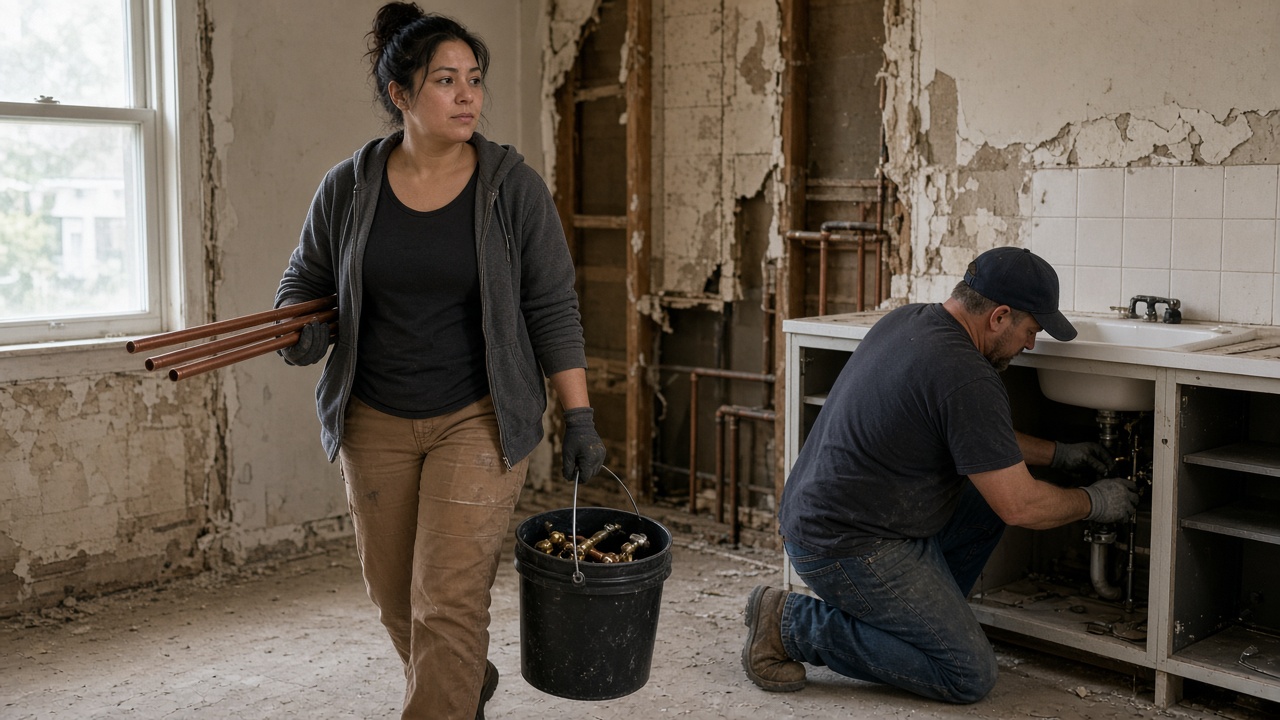
A plumbing helper can dig, haul, and prep on a home job, while the plumbing stays with a licensed plumber.
On a residential plumbing job, a lot of the hours go into work that is not plumbing at all. Crews dig trenches, carry water heaters, cut access holes, crawl under houses, and clean up. A good helper takes that load off a licensed plumber so the plumber can spend time on the work that requires a license. The key is knowing where the line sits in your state and keeping helpers on the right side of it.
This guide is for plumbing contractors adding a helper for a few days or weeks, and for homeowners and remodelers who want to understand what they can hire separately on a residential plumbing project.
How licensing shapes the helper role
Plumbing is licensed at the state level in many places and at the local level in others. Texas offers a clear illustration of how strict the line can be.
Under Texas law, a person who wants to learn the trade of plumbing must register as a plumber's apprentice before assisting a licensed plumber in the trade. The Texas State Board of Plumbing Examiners explains that a registered apprentice may assist with plumbing under the direct supervision of a licensed plumber, which means a licensee is on the job site whenever the apprentice performs plumbing work. If a licensee is not present, the apprentice may only perform manual tasks like digging trenches.
Not every state works the same way, but the pattern is common: helping with plumbing installation may require registration, while pure manual labor usually does not. Ask the plumber of record what your state requires before the helper starts.
What plumbing helpers commonly do
Depending on registration and supervision rules, helpers on residential jobs often handle tasks like these.
- Unloading and carrying pipe, fittings, fixtures, water heaters, and tools
- Digging trenches for water, sewer, or gas lines after the plumber has located utilities
- Opening access in floors or walls where the plumber marks, and protecting nearby finishes
- Crawling under homes to stage material or clear debris
- Cleaning up cut pipe, packaging, and mud
- Assisting with installation where the helper is properly registered and supervised
What should stay with licensed plumbers
- Connecting supply, drain, waste, vent, or gas piping
- Installing or connecting water heaters and fixtures
- Pressure tests and code decisions
- Anything that requires a permit or inspection under local rules
Gas work deserves special mention. Gas piping mistakes can cause fires and explosions. Treat gas lines as licensed work, full stop.
Trench safety is not optional
Trenching is one of the most common helper tasks, and one of the most dangerous. OSHA's construction rules require that each employee in an excavation be protected from cave-ins by an adequate protective system, unless the excavation is entirely in stable rock or is less than 5 feet deep and a competent person finds no indication of a potential cave-in. Shallow does not automatically mean safe.
Before anyone digs, contact 811 or your state's 811 center a few business days ahead. The 811 service says anyone planning to dig should request that buried utility lines be marked, including for smaller projects.
Where a helper saves the most plumber time
Some residential jobs are especially helper-heavy. Planning for them up front makes a temporary hire worth the cost.
- Whole-house repipe: helpers open and protect access points, carry pipe, and clean up each room so the plumber can move from run to run.
- Sewer line replacement: helpers dig and backfill where the excavation plan allows, and haul spoil, while the plumber handles pipe, slope, and connections.
- Water heater replacement: a second person is often needed to move the old tank out and the new one in, especially from attics, closets, or garages with steps.
- Bathroom remodel rough-in: helpers remove old flooring and debris and keep the work area clear while the plumber sets drains and supply lines.
On each of these, write down the helper's tasks before the day starts so nobody improvises into licensed work.
What wage data shows
In the Bureau of Labor Statistics May 2025 national data, helpers for pipelayers, plumbers, pipefitters, and steamfitters earned a median of $20.36 per hour, with the middle half earning $17.76 to $22.94. Plumbers, pipefitters, and steamfitters earned a median of $30.67 per hour, with the middle half earning $24.13 to $40.92.
Use these as national benchmarks for employee wages. A registered apprentice with prior experience is usually paid more than a helper who only digs and carries. For broader day-rate context, see how much you should pay a day laborer in 2026 (https://chambanow.com/chambamatters/how-much-should-you-pay-a-day-laborer-in-2026-rates-by-job-type).
What to look for in a plumbing helper
Plumbing contractors should screen for these qualities.
- Comfort in crawlspaces, attics, and trenches
- Ability to follow marks and instructions exactly, especially when cutting access holes
- Care around finished surfaces and occupied homes
- Basic hand and power tool skills, such as reciprocating saws, drills, and shovels
- Current apprentice registration or license if your state requires it for the tasks you plan
Questions to ask before hiring
- What plumbing jobs have you helped on, and what did you do on them
- Are you registered as an apprentice in this state, and can you send the number
- Have you worked in trenches, and what protection did the crew use
- Have you worked in occupied homes, and how did you protect floors
For more ways to verify skills, see how to confirm a worker's skills without a formal resume (https://chambanow.com/chambamatters/how-to-confirm-a-worker-s-skills-without-a-formal-resume).
Homeowners: what you can hire separately
Homeowners planning a bathroom or kitchen remodel can often hire day labor for work that is clearly not plumbing.
- Removing cabinets, vanities, and flooring after the plumber has shut off and capped lines
- Hauling old fixtures and debris to a disposal site
- Clearing access to crawlspaces and attics
- Patching and cleaning after the plumber finishes
Do not ask a laborer to disconnect, move, or reconnect plumbing. If you are not sure whether a task counts as plumbing, assume it does and ask a licensed plumber. Our guides on demo and debris haul labor (https://chambanow.com/chambamatters/a-guide-to-hiring-demo-and-debris-haul-labor-for-a-home-remodel) and hiring temporary labor without a contractor's license (https://chambanow.com/chambamatters/a-homeowner-s-guide-to-hiring-temporary-labor-without-a-contractor-s-license) go deeper.
A first-day checklist for contractors
- Confirm registration status in writing if required
- Show where water and gas shutoffs are and who may operate them
- Walk the trench or crawlspace route and explain protective measures
- Lay out protection for floors and finishes in occupied homes
- Set clear rules for what the helper may cut and where
Classification and insurance
Make sure temporary helpers are covered by your workers' compensation policy and correctly classified. See workers' compensation for contractors (https://chambanow.com/chambamatters/workers-comp-for-contractors).
Hiring on ChambaNOW
ChambaNOW lists plumbing workers by city, such as San Antonio (https://chambanow.com/hire/san-antonio-tx/plumbing). Contractors can post a plumbing helper job free, review workers who respond, and message them about that job. Homeowners should use it to find licensed plumbers for the plumbing and laborers only for clearly non-plumbing tasks. Learn more on the hirer overview (https://chambanow.com/for-hirers).
Bottom line for plumbing jobs
Know your state's apprentice and licensing rules, keep helpers on manual and supervised tasks, protect trenches every time, and call 811 before anyone digs.
Sources - U.S. Bureau of Labor Statistics, OEWS May 2025, Helpers--Pipelayers, Plumbers, Pipefitters, and Steamfitters (47-3015) (https://www.bls.gov/oes/current/oes473015.htm) - U.S. Bureau of Labor Statistics, OEWS May 2025, Plumbers, Pipefitters, and Steamfitters (47-2152) (https://www.bls.gov/oes/current/oes472152.htm) - Texas State Board of Plumbing Examiners, Apprentice Registration (https://tsbpe.texas.gov/license-types/apprentice/) - Texas Occupations Code, Chapter 1301 (https://statutes.capitol.texas.gov/GetStatute.aspx?Code=OC&Value=1301) - OSHA, 29 CFR 1926.652, Requirements for protective systems (https://www.osha.gov/laws-regs/regulations/standardnumber/1926/1926.652) - 811, Before You Dig (https://call811.com/)
Written by Barry Graham, Founder, ChambaNOW
Construyendo conocimiento que funciona.