
What Does a Concrete Laborer Do, and How Do You Get Hired?
A concrete laborer helps set forms, pour, and finish, and you can get hired without a long resume.
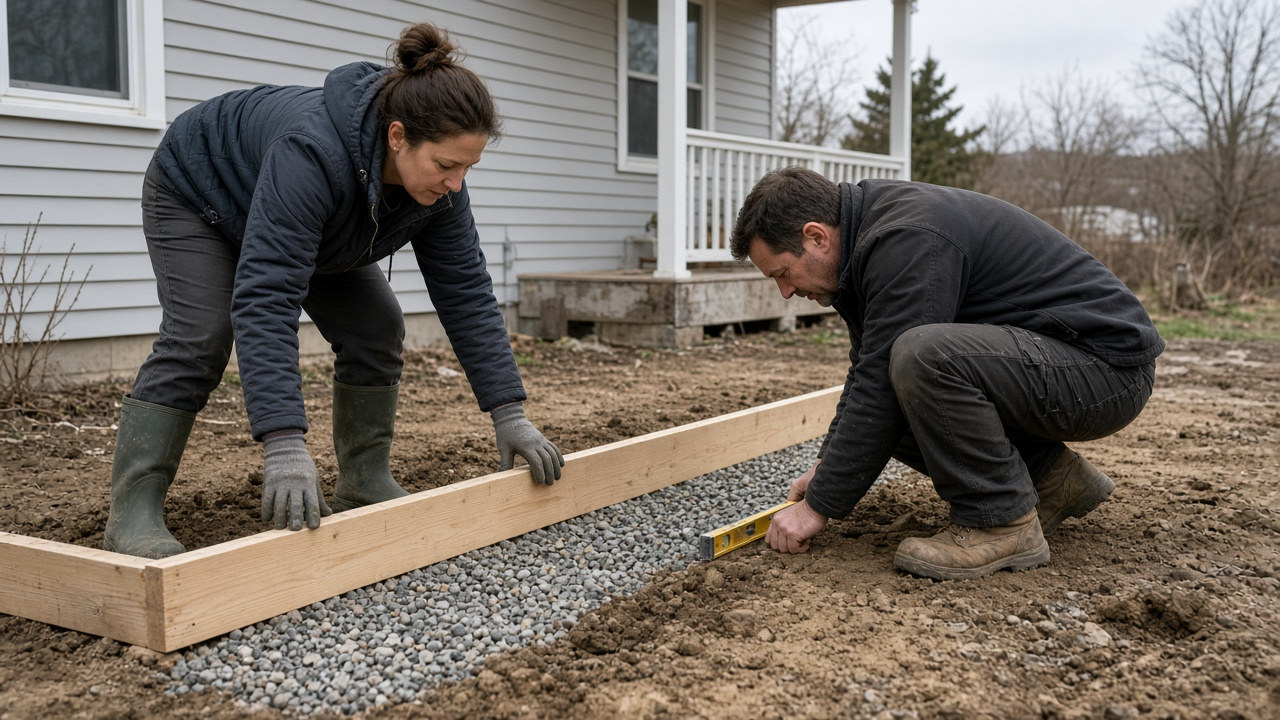
A concrete laborer helps set forms, pour, and finish, and you can get hired without a long resume.
Concrete work is timed. When the truck arrives, the crew needs extra hands to move, spread, and level the mix before it sets. That is why contractors and homeowners hire laborers for patios, walkways, slabs, and formwork even when a finisher is already on the job. You can get that first day if you are strong, on time, and willing to follow a fast set of instructions.
This guide covers what a concrete laborer does, what the work tends to pay, the safety issues that come with wet concrete and dust, and how to get hired.
What a concrete laborer does
On a small residential pour, labor often includes both formwork and the pour itself. O*NET's summary for construction laborers (https://www.onetonline.org/link/summary/47-2061.00) includes moving materials and helping skilled trades, which is the heart of this job. Common tasks include these.
- Digging, grading, and compacting the base, and running a plate compactor if you are shown how
- Building and bracing wooden or metal forms, and checking that they will not blow out
- Placing rebar, mesh, or dowels the lead has laid out
- Spotting the truck, moving the chute, and wheeling or raking concrete into the forms
- Pulling a screed board, edging, and brooming only when the finisher wants help
- Covering the slab, misting it, or applying a cure as instructed
- Stripping forms after the concrete has set, and cleaning tools before the mix hardens on them
A good helper watches the finisher's pace. Concrete does not wait, and a delay at the truck can show up as a cold joint or a rough finish.
What this job is not
A laborer is not automatically a cement mason. Decorative finishes, stamped patterns, and structural work should stay with someone who does that work regularly. Do not add water to the mix to make it easier to move unless the lead tells you to, because that weakens the slab.
Wet concrete is also a skin and eye hazard. It is alkaline and can burn after a short time on bare skin or in a boot. Wear the gloves, long sleeves, eye protection, and rubber boots the employer wants you to use, and wash splashes off right away. Cutting, grinding, or demolishing cured concrete can release silica dust. OSHA's crystalline silica standard for construction (https://www.osha.gov/laws-regs/regulations/standardnumber/1926/1926.1153) and OSHA's silica page (https://www.osha.gov/silica-crystalline) require controls such as wet cutting or a vacuum with the right filter. Do not dry-cut a slab with a bare grinder.
What the work pays
In Bureau of Labor Statistics May 2025 national data, cement masons and concrete finishers earned a median of $27.41 an hour, with the middle half earning $22.60 to $32.15. Construction laborers earned a median of $22.66 an hour, with the middle half earning $18.57 to $28.72. Carpenters, a useful reference when the day is mostly formwork, earned a median of $29.12. A first day as a pour helper often sits closer to the laborer figure than to the finisher median.
Local rates vary, and your pay must at least meet the state and city minimum on the U.S. Department of Labor's state minimum wage page (https://www.dol.gov/agencies/whd/minimum-wage/state). Confirm the rate, the expected length of the pour, and whether a weather delay changes the pay before you start.
What to bring
The contractor should provide forms, tools, and the required safety gear. Bring the personal basics. See what a day laborer should bring (https://chambanow.com/chambamatters/what-a-day-laborer-should-bring-to-the-job-and-what-the-hirer-should-provide) and how to lift heavy objects safely (https://chambanow.com/chambamatters/how-to-lift-heavy-objects-safely-a-back-safety-guide-for-laborers).
- Waterproof boots you can wash, long pants, and gloves
- Eye protection, or use the pair the employer issues
- A change of socks, because wet concrete in a boot is a burn risk
- Water and a lunch, because a pour may not stop for a long break
- Clothes for heat or cold, since pours happen in both
How to get hired
Crews remember helpers who arrive before the truck, not after it.
- Step 1: Learn the order of work. Base, forms, steel, pour, finish, and cure. If you know the sequence, you will be in the right place when the pace picks up.
- Step 2: Be honest about your experience. Say if you have done a patio pour, only formwork, or only general labor. A lead can still use you on the wheelbarrow and the rake.
- Step 3: List concrete help where hirers search. On ChambaNOW, which is free for workers at https://chambanow.com/for-workers, add concrete separately from general labor. Browse concrete jobs by city, such as Houston at https://chambanow.com/jobs/in/houston-tx/concrete, Dallas at https://chambanow.com/jobs/in/dallas-tx/concrete, Los Angeles at https://chambanow.com/jobs/in/los-angeles-ca/concrete, or Phoenix at https://chambanow.com/jobs/in/phoenix-az/concrete.
- Step 4: Ask when the truck is coming, how many yards, and who provides boots and gloves. A late helper is hard to use.
- Step 5: Work clean and ask to be called for the next pour. How to get rehired after a one-day labor job (https://chambanow.com/chambamatters/how-to-get-rehired-after-a-one-day-labor-job) and how to be a good helper to a tradesperson (https://chambanow.com/chambamatters/how-to-be-a-good-helper-to-a-tradesperson) apply on a slab the same way they do on a remodel.
If you want to stay in the trade, finishing is a skilled path of its own. See how to move from general labor into a skilled trade (https://chambanow.com/chambamatters/how-to-move-from-general-labor-into-a-skilled-trade) and how to get into a trade apprenticeship from day labor (https://chambanow.com/chambamatters/how-to-get-into-a-trade-apprenticeship-from-day-labor). An OSHA 10 card can also help on larger sites (https://chambanow.com/chambamatters/is-an-osha-10-card-worth-it-for-day-laborers).
A typical pour day
A typical small pour starts early. The forms are already up, or you help finish them before the truck is due. When the concrete arrives, the lead wants people at the chute, at the rake, and at the screed, not on their phones. The mix has to be placed, leveled, and edged in a short window. After the finisher has the surface where they want it, you may help with a broom or a cover, then clean tools immediately so the concrete does not set on them.
If the truck is late, stay ready and do not wander off. If the slump is not what the lead expected, wait for instructions rather than adding water on your own. At the end of the day, ask whether you should come back to strip forms. That second, shorter visit is often how a one-day helper becomes the person the contractor calls for the next patio.
Questions worth asking
Ask when the truck is coming, how many yards are ordered, how close the truck can get, and who provides boots and gloves. Ask whether formwork is the same day or already done, and whether rain or a freeze will cancel the pour. If you have never been around a concrete truck, say so. A good lead would rather brief you than have you stand in the wrong place when the chute swings.
The short version
Concrete labor is timed, physical, and learnable. Protect your skin and your lungs, show up before the truck, and follow the finisher's lead. That is how you get hired, and how you get hired again.
Sources
- U.S. Bureau of Labor Statistics, OEWS May 2025, Cement Masons and Concrete Finishers (47-2051) (https://www.bls.gov/oes/current/oes472051.htm)
- U.S. Bureau of Labor Statistics, OEWS May 2025, Construction Laborers (47-2061) (https://www.bls.gov/oes/current/oes472061.htm)
- U.S. Bureau of Labor Statistics, OEWS May 2025, Carpenters (47-2031) (https://www.bls.gov/oes/current/oes472031.htm)
- O*NET OnLine, Construction Laborers (47-2061.00) (https://www.onetonline.org/link/summary/47-2061.00)
- OSHA, Respirable Crystalline Silica (https://www.osha.gov/silica-crystalline)
- OSHA, 29 CFR 1926.1153, Respirable crystalline silica (https://www.osha.gov/laws-regs/regulations/standardnumber/1926/1926.1153)
- U.S. Department of Labor, State Minimum Wage Laws (https://www.dol.gov/agencies/whd/minimum-wage/state)
Written by Barry Graham, Founder, ChambaNOW
Building knowledge that works.