
How Do You Become a Painter’s Helper?
A painter's helper gets hired by doing careful prep work and showing they can follow directions.
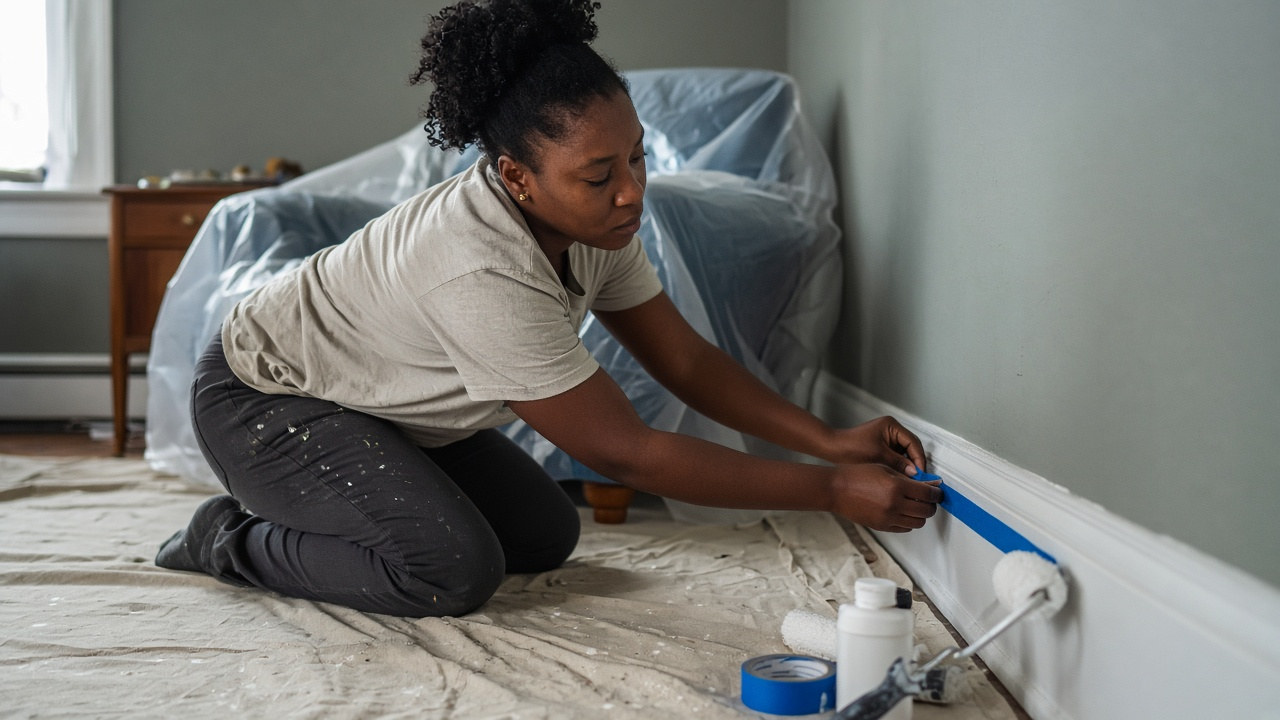
A painter's helper gets hired by doing careful prep work and showing they can follow directions.
Most of a good paint job is prep, not the final coat. Painters hire helpers to mask, sand, move furniture, wash walls, and keep the room clean so the painter can focus on cutting in and rolling. You can get that work without a long resume if you are careful, tidy, and honest about what you have done.
This guide covers what a painter's helper does, what the work tends to pay, the safety rules that come up on older homes, and how to get hired.
What a painter's helper does
The Bureau of Labor Statistics groups this work with helpers for painters, paperhangers, plasterers, and stucco masons. O*NET's summary for that helper role (https://www.onetonline.org/link/summary/47-3014.00) includes moving materials, covering surfaces, and helping the painter prepare and clean the site. On a house or apartment job, that usually looks like this.
- Moving furniture to the center of the room and covering it, or taking it to another room
- Laying drop cloths and taping baseboards, trim, windows, and fixtures
- Washing walls, filling small nail holes, and sanding rough spots the painter marks
- Removing outlet covers and switch plates, and bagging the screws so they do not get lost
- Pouring paint, keeping the roller tray supplied, and stirring cans when asked
- Rolling large wall fields only after the painter has set the standard, if they want you to roll
- Cleaning brushes, rollers, and the room at the end of the day
A helper who preps well is more valuable than a helper who rushes to roll. Edges, drips, and missed tape show up under paint and cost time.
What this job is not
A helper is not automatically a painter. Cutting a clean line at the ceiling, spraying a cabinet, matching a stain, or hanging wallpaper are skilled tasks. Do not start them unless the painter asks and shows you the standard.
Older homes add another limit. If the building was constructed before 1978, sanding, scraping, or disturbing painted surfaces can release lead dust. The EPA's Renovation, Repair and Painting Program (https://www.epa.gov/lead/lead-renovation-repair-and-painting-program) sets rules for that work, and OSHA also has a lead in construction standard (https://www.osha.gov/laws-regs/regulations/standardnumber/1926/1926.62). Do not dry-sand old paint unless the person running the job has told you it is lead-safe and has given you the right method and gear. If you are not sure of the age of the house, ask before you sand.
Paint fumes also need fresh air. The EPA explains that paints and solvents can release volatile organic compounds into indoor air (https://www.epa.gov/indoor-air-quality-iaq/volatile-organic-compounds-impact-indoor-air-quality). Open windows when the painter says it is all right, use the fans they set up, and do not work in a closed room until you feel dizzy.
What the work pays
In Bureau of Labor Statistics May 2025 data, construction and maintenance painters earned a national median of $23.75 an hour. Painter and plasterer helpers had a median of about $40,470 a year, which is about $19.46 an hour on a full-time year. Local day-labor rates vary, and many cities sit above the federal $7.25 minimum wage. Check your state and city floor on the U.S. Department of Labor's state minimum wage page (https://www.dol.gov/agencies/whd/minimum-wage/state).
A first day of masking and moving furniture often starts near the helper figure, not the painter median. Confirm the rate, the hours, and whether you will be paid in cash, check, or another method before you start. Our guide to your pay rights as a day laborer (https://chambanow.com/chambamatters/a-guide-to-your-pay-rights-as-a-day-laborer) is worth reading if you are new to this kind of work.
What to bring
You do not need a sprayer or a full brush set on day one. Bring the personal basics, and let the painter provide the trade tools and the required safety gear. See what a day laborer should bring (https://chambanow.com/chambamatters/what-a-day-laborer-should-bring-to-the-job-and-what-the-hirer-should-provide) and what you should wear (https://chambanow.com/chambamatters/what-should-you-wear-to-a-construction-or-labor-job).
- Clothes you can ruin, plus clean shoes you can remove if you have to walk through a finished room
- A good work knife, a tape measure, and a pencil
- Work gloves and a dust mask or the respirator the employer issues for sanding
- A clean rag and a small notepad for room-by-room instructions
- Water and a lunch
Ask who provides ladders, roller poles, and tape. Use a stable ladder the way you are shown. Do not stand on the top cap or on a stack of buckets to cut a ceiling line.
How to get hired
Painters hire helpers who will not leave tape marks, lost screws, or paint on the floor. You can show that before you have a long work history.
- Step 1: Learn the prep sequence. Cover, clean, patch, sand, and then paint. If you skip a step, the coat will show it.
- Step 2: Be honest in your pitch. Say if you have painted a room at home, prepped for a painter, or only done general cleanup. Crews can train a careful beginner.
- Step 3: List the skill where hirers look. On ChambaNOW, which is free for workers at https://chambanow.com/for-workers, add painting help as its own skill. Browse painting jobs by city, such as Phoenix at https://chambanow.com/jobs/in/phoenix-az/painting, Houston at https://chambanow.com/jobs/in/houston-tx/painting, Los Angeles at https://chambanow.com/jobs/in/los-angeles-ca/painting, or New York at https://chambanow.com/jobs/in/new-york-ny/painting.
- Step 4: Ask the right questions before you accept. What rooms, what height, who brings supplies, and whether the home might have old paint that needs lead-safe work.
- Step 5: Finish clean and ask to be called back. How to get rehired after a one-day labor job (https://chambanow.com/chambamatters/how-to-get-rehired-after-a-one-day-labor-job) and how to be a good helper to a tradesperson (https://chambanow.com/chambamatters/how-to-be-a-good-helper-to-a-tradesperson) apply directly to paint crews.
If you want a longer path into the trade, look at apprenticeships and local training after you have a few solid days. See how to get into a trade apprenticeship from day labor (https://chambanow.com/chambamatters/how-to-get-into-a-trade-apprenticeship-from-day-labor) and what certifications help construction laborers get hired faster (https://chambanow.com/chambamatters/what-certifications-help-construction-laborers-get-hired-faster). Lead-safe (RRP) training matters if you will work on pre-1978 homes.
A note on indoor winter work
Interior painting often continues when outdoor work slows down, because a closed, heated house can be a good place to paint if the label's temperature range is met. If you want more hours in the cold months, painting help is one of the indoor jobs worth watching, along with drywall and cleaning.
A typical first day
A common first day is a single bedroom or a living room that is already emptied. You arrive, help finish covering the floors, wash the walls, tape the trim, and keep the painter supplied. You may roll a field after the painter has cut the edges. At the end you pull tape slowly, look for drips, and leave the room ready for a walk-through. If that day goes well, the next one may be a longer list of rooms, or a prep-only day ahead of a spray job you will not be asked to run.
Questions worth asking
Ask what rooms are in the job, how high the work is, who brings paint and ladders, and whether the house may date to before 1978. Ask how long the painter expects the day to run, and how you will be paid. If the job includes cabinets, a stairwell, or a dark-to-light color change, confirm that you are being hired as a helper, not as the person responsible for the finish. Those questions protect both you and the painter, and they make you look like someone who has thought about the work.
The short version
Painters hire helpers who prep carefully, keep the room clean, and do not oversell their skill. Learn the prep, tell the truth about your experience, and treat old paint and fumes with respect. That is how a first day turns into the next one.
Sources
- U.S. Bureau of Labor Statistics, Occupational Outlook Handbook, Painters, Construction and Maintenance (May 2025 data) (https://www.bls.gov/ooh/construction-and-extraction/painters-construction-and-maintenance.htm)
- U.S. Bureau of Labor Statistics, Occupational Outlook Handbook, Construction Laborers and Helpers (May 2025 data) (https://www.bls.gov/ooh/construction-and-extraction/construction-laborers-and-helpers.htm)
- O*NET OnLine, Helpers--Painters, Paperhangers, Plasterers, and Stucco Masons (47-3014.00) (https://www.onetonline.org/link/summary/47-3014.00)
- U.S. Environmental Protection Agency, Lead Renovation, Repair and Painting Program (https://www.epa.gov/lead/lead-renovation-repair-and-painting-program)
- U.S. Environmental Protection Agency, Volatile Organic Compounds' Impact on Indoor Air Quality (https://www.epa.gov/indoor-air-quality-iaq/volatile-organic-compounds-impact-indoor-air-quality)
- OSHA, 29 CFR 1926.62, Lead (https://www.osha.gov/laws-regs/regulations/standardnumber/1926/1926.62)
- OSHA, Lead (https://www.osha.gov/lead)
- U.S. Department of Labor, State Minimum Wage Laws (https://www.dol.gov/agencies/whd/minimum-wage/state)
Written by Barry Graham, Founder, ChambaNOW
Construyendo conocimiento que funciona.