
A Guide to Hiring Demo and Debris-Haul Labor for a Home Remodel
Demo and debris hauling are good jobs for hired labor when you check for hazards and plan the waste first.
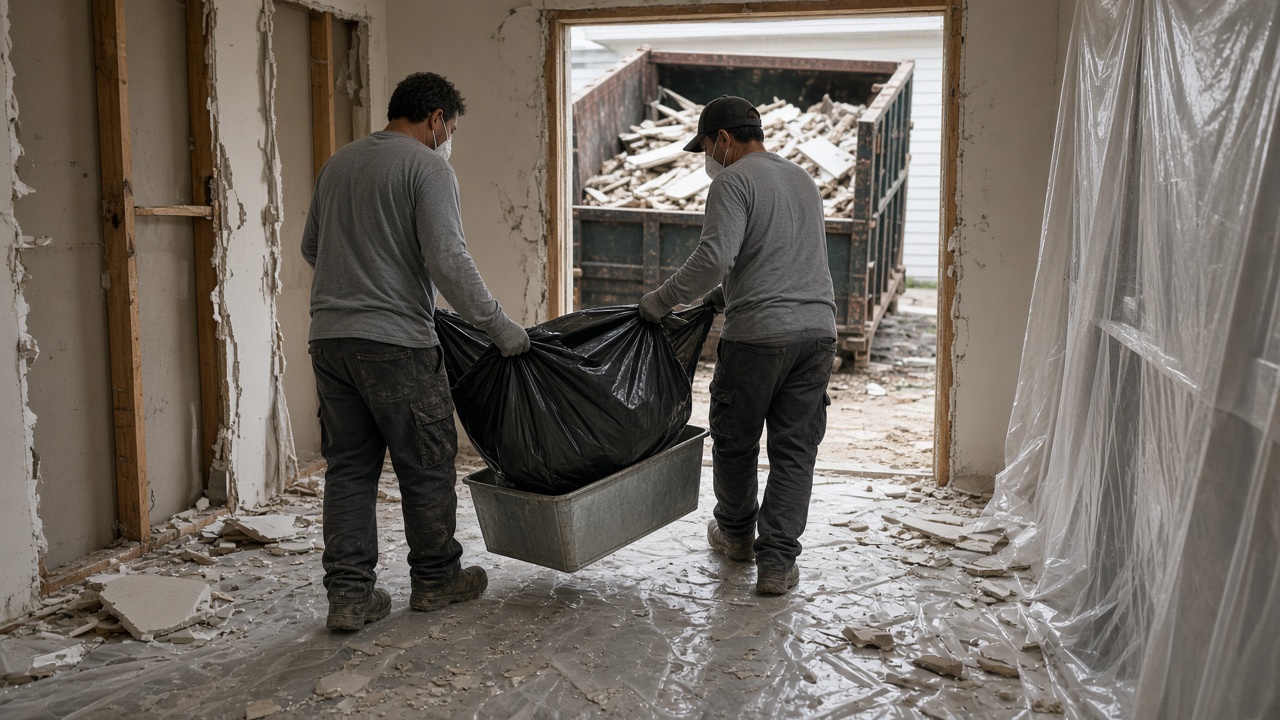
Demo and debris hauling are good jobs for hired labor when you check for hazards and plan the waste first.
Tearing out an old kitchen, a bathroom, or a deck is one of the most satisfying parts of a remodel, and one of the most common jobs homeowners hire day laborers for. It is also where hidden hazards show up: live wires in a wall, old flooring with asbestos, lead paint on trim, silica dust from tile and concrete. This guide covers what hired labor can safely tear out, what needs a professional, and how to plan the debris so demo day ends on time.
Step 1 Decide what laborers can and cannot demo
Day laborers are a good fit for non-structural demolition and hauling.
- Removing cabinets, countertops, and vanities after plumbing and electrical are disconnected
- Pulling up carpet, pad, and tack strip
- Removing drywall from non-structural partitions after utilities are confirmed off
- Tearing out old decks, sheds, and fences that are not attached to the house structure
- Hauling debris to a dumpster, trailer, or curb
- Cleaning up the work area
Leave these tasks to licensed or certified professionals.
- Disconnecting plumbing, gas, and electrical; these generally require licensed trades
- Removing or cutting any load-bearing wall, beam, or post; that needs an engineer or contractor and usually a permit
- Removing materials that may contain asbestos
- Disturbing painted surfaces in a pre-1978 home, unless the workers are lead-safe certified
- Anything that requires a building permit in your city
Ask your local building department whether your demo needs a permit. Many remodels do, especially when walls, plumbing, or electrical are involved.
Step 2 Check for asbestos before demo
Asbestos is the hazard homeowners most often miss. EPA says you generally cannot tell whether a material contains asbestos by looking at it, and recommends having a trained and accredited asbestos professional inspect your home if you are planning to remodel (https://www.epa.gov/asbestos/protect-your-family). EPA lists places asbestos may be found in older homes, including vinyl floor tiles and the backing on vinyl sheet flooring and adhesives, textured paint and patching compounds on walls and ceilings, roofing and siding shingles, and vermiculite attic insulation (https://www.epa.gov/asbestos/learn-about-asbestos).
EPA also notes that federal law does not require people who inspect, repair, or remove asbestos in detached single-family homes to be trained and accredited, but some states and localities do. Either way, EPA advises homeowners to make sure the workers they hire for asbestos work are trained and accredited. If testing finds asbestos, removal is a job for accredited professionals, not a day labor crew.
Step 3 Check for lead paint in pre-1978 homes
EPA's lead rule defines renovation to include removing building components such as walls, ceilings, and windows, and requires anyone paid to disturb painted surfaces in pre-1978 homes to be lead-safe certified, with exceptions for small jobs (https://www.ecfr.gov/current/title-40/chapter-I/subchapter-R/part-745/subpart-E/section-745.83). The minor repair exception does not apply to demolition of painted surface areas. In practice, if you are tearing out painted walls or trim in an older home, hire a lead-safe certified contractor for that part (https://www.epa.gov/lead/renovation-repair-and-painting-program).
Step 4 Plan for silica dust
Breaking up tile, concrete, brick, or stone countertops creates silica dust. OSHA notes that applying water to a saw blade when cutting materials like stone, concrete, brick, and block substantially reduces dust (https://www.osha.gov/silica-crystalline/construction). Its construction standard also restricts dry sweeping where wet methods or HEPA vacuums are feasible (https://www.ecfr.gov/current/title-29/subtitle-B/chapter-XVII/part-1926/subpart-Z/section-1926.1153). For a home demo, that means wet methods, HEPA vacuums, respirators where needed, and good ventilation.
Step 5 Shut off and mark utilities
Before anyone swings a hammer, have the right professional shut off and cap water, gas, and electrical in the demo area. Label breakers. Test outlets and switches in the area to confirm they are dead. Tell the crew where pipes and wires are likely to run, and ask them to stop and call you if they find anything unexpected. If the demo includes pulling fence posts or digging out a slab, contact 811 a few business days ahead (https://call811.com/before-you-dig/).
Step 6 Plan the debris before demo day
Debris is where demo budgets and schedules break. Decide these points in advance.
- Container: a roll-off dumpster, a trailer the crew hauls, or a junk-removal service
- Size and weight: dumpster companies set weight limits and charge for overages; concrete, tile, and plaster are heavy
- Placement: a driveway may need protection boards; a street placement may need a city permit
- Banned items: most haulers refuse paint, chemicals, tires, batteries, and some appliances; ask yours
- Separation: metal, clean wood, and concrete may be recyclable or cheaper to dump separately
- Disposal fees: landfill and transfer station fees vary widely by region, so get a local quote
Plan a path from the demo area to the container that avoids finished floors, or protect them.
Step 7 Equip and protect the crew
Demolition creates flying debris, sharp edges, and heavy loads. Provide or confirm the crew has the following gear.
- Safety glasses, work gloves, and sturdy boots
- Hard hats when overhead material may fall
- Hearing protection around power tools and breakers
- Respirators appropriate to the dust
- Wheelbarrows and dollies for heavy debris
Keep children and pets far from the work and the container. Keep the site free of protruding nails and broken glass at the end of every day.
Run demo day in a set order
A simple order keeps demo safe and fast. Start with a short walkthrough: what comes out, what stays, where the shutoffs are, and where debris goes. Remove loose items and fixtures first, then cabinets and counters, then wall and floor materials, working from the top of the room down. Haul as you go so debris never piles up in walkways. End each day with a sweep using a HEPA vacuum, a magnet sweep for nails outside, and a check that no live wires or open pipes are exposed.
Step 8 Post the job clearly
Describe the demo honestly: what is being removed, the room size, the materials, whether utilities are already off, what tools you provide, where debris goes, and how heavy the work is. ChambaNOW is free to post at https://chambanow.com/for-hirers, and you can message the workers who apply about that job. Local pages include https://chambanow.com/hire/dallas-tx/demolition, https://chambanow.com/hire/seattle-wa/demolition, https://chambanow.com/hire/austin-tx/demolition, and https://chambanow.com/hire/houston-tx/junk_removal.
Pay must meet your state and local minimum wage (https://www.dol.gov/agencies/whd/minimum-wage/state). Demo work is heavy and dusty, so expect to offer a fair rate for it.
Demo day checklist
- Scope limited to non-structural removal and hauling
- Permit checked with the building department
- Asbestos inspection done if the home is older or materials are suspect
- Lead-safe certified contractor for painted demo in pre-1978 homes
- Water, gas, and electrical shut off and confirmed by professionals
- Wet methods and HEPA vacuums for silica dust
- Dumpster size, placement, permit, and banned items confirmed
- Safety gear for every worker
- Site left free of nails and glass each night
This guide is general information, not legal advice. Demolition, disposal, and hazardous-material rules vary by state and city.
Sources
- EPA, Protect Your Family from Asbestos-Contaminated Materials: https://www.epa.gov/asbestos/protect-your-family
- EPA, Learn About Asbestos: https://www.epa.gov/asbestos/learn-about-asbestos
- 40 CFR 745.83, Definitions: https://www.ecfr.gov/current/title-40/chapter-I/subchapter-R/part-745/subpart-E/section-745.83
- EPA, Lead Renovation, Repair and Painting Program: https://www.epa.gov/lead/renovation-repair-and-painting-program
- OSHA, Silica, Crystalline - Construction: https://www.osha.gov/silica-crystalline/construction
- 29 CFR 1926.1153, Respirable crystalline silica: https://www.ecfr.gov/current/title-29/subtitle-B/chapter-XVII/part-1926/subpart-Z/section-1926.1153
- 811, Before You Dig: https://call811.com/before-you-dig/
- U.S. Department of Labor, State Minimum Wage Laws: https://www.dol.gov/agencies/whd/minimum-wage/state
Written by Barry Graham, Founder, ChambaNOW
Building knowledge that works.