
Workers' Comp for Contractors: What You Need to Know
Understanding workers' comp for contractors is essential. Get the details on state rules and contract requirements to protect your business.

Most contractors in the United States must carry workers’ compensation once they hire even one employee. True independent contractors and sole proprietors working alone are often exempt by state law, but that exemption rarely protects you from what a general contractor’s contract actually requires. Here is what to do right now:
- Check your state’s rule. Visit your state’s workers’ compensation board website and confirm the employee threshold and any construction-industry presumptions that apply.
- Read your GC or owner contract. Many contracts require proof of coverage regardless of your legal exemption status. Lacking a certificate of insurance can cost you the job.
- Secure coverage or document your exemption in writing. Either buy a policy, elect voluntary coverage if your state allows it, or obtain a signed written exemption from your insurer and keep it on file.
Key Takeaways
Workers’ compensation requirements for contractors are driven by state law, trade classification, and contract terms, and the gap between legal exemption and practical job-site access is where most compliance problems occur.
| Point | Details |
|---|---|
| State law sets the baseline | Most states require coverage once you hire one W-2 employee; check your state board for the exact threshold and any construction presumptions. |
| 1099 does not equal exempt | Tax form classification does not determine workers’ comp status; state behavioral and financial control tests govern. |
| GC contracts often go further | Even legally exempt sole proprietors may need a COI to access a job site; verify contract requirements before bidding. |
| Premium is driven by class code and EMR | Rates range from roughly $3 to $25 per $100 of payroll by trade; a clean claims history lowers your experience modification rate and your cost. |
| Chambanow supports compliant hiring | Chambanow’s marketplace helps hirers find and document local workers quickly; insurance responsibility remains with the contracting parties. |
Table of Contents
- Who must carry workers’ comp — employees, subcontractors, and common exceptions
- State variation and construction-industry presumptions you need to understand
- How agencies and courts decide who is an independent contractor
- Ways contractors can obtain workers’ compensation coverage
- What general contractors and project owners ask you to prove
- How workers’ comp premiums are calculated and what drives your cost
- Consequences of skipping required workers’ compensation
- Step-by-step process to buy workers’ compensation or elect coverage
- What to do after an on-the-job injury
- Hiring short-term and day laborers: workers’ comp implications for hirers
- What contractors who stay compliant actually do differently
- Chambanow helps you find and document local labor, fast
- Sources
Who must carry workers’ comp — employees, subcontractors, and common exceptions
Workers’ compensation coverage pays for medical care, wage replacement, rehabilitation and death benefits when a worker is injured on the job. For contractors, the trigger for mandatory coverage is almost always payroll. Once you hire a W-2 employee, most states require you to carry a policy immediately.
The practical difference between a legal exemption and a contractual requirement trips up a lot of contractors. A sole proprietor with no employees may be fully exempt under state law, yet still be locked out of a commercial job site, because the project owner’s contract demands a certificate of insurance. That gap between what the law requires and what the market demands is where most compliance problems start.
Common exceptions to mandatory coverage include:
- Sole proprietors with no employees (in most states)
- Certain corporate officers who elect to exclude themselves in writing
- Partners in a partnership, depending on the state
- Volunteers and family members in some agricultural or domestic settings
- Businesses below a state’s minimum employee threshold (some states use thresholds of two, three, or five employees)
Pro Tip: Even if you qualify for a sole-proprietor exemption, buying a voluntary policy protects your personal income from work-related medical bills and lost wages. The premium is often far less than one week of missed work.
State variation and construction-industry presumptions you need to understand
State rules are not uniform, and construction contractors face a stricter set of rules than most other industries. State thresholds and fund structures vary widely, and four states, Ohio, Washington, Wyoming, and North Dakota, operate monopolistic state funds, meaning private carriers cannot sell workers’ compensation there. Contractors in those states buy directly from the state fund.
Construction-industry presumptions add another layer. New York’s Construction Industry Fair Play Act, for example, presumes that any worker on a construction site is an employee unless the hiring party can affirmatively prove otherwise. Similar presumptions exist in other states and shift the burden of proof onto the contractor, not the worker. That means a subcontractor who looks independent on paper may still be treated as an employee for workers’ compensation purposes if the working relationship does not meet the state’s specific criteria.
Before starting any project, confirm the following on your state’s workers’ compensation or labor department website:
- The minimum employee threshold that triggers mandatory coverage
- Whether your state has a construction-industry presumption or special classification rule
- Opt-in or elective coverage forms available to sole proprietors
- Whether your state uses a monopolistic fund or allows private carriers
- Any required state forms for exemptions or waivers
How agencies and courts decide who is an independent contractor
Receiving a 1099 at tax time does not make someone an independent contractor for workers’ compensation purposes. Form 1099 is a tax record, not a classification determination. State agencies and courts apply their own tests, and those tests focus on the actual working relationship.
The most common frameworks include the ABC test, used in states like California and New Jersey, which presumes a worker is an employee unless the hiring party proves all three: the worker is free from control, performs work outside the usual course of the business, and is customarily engaged in an independently established trade. Other states use a right-to-control test, asking primarily whether the hiring party controls how the work is done, not just the result. The IRS guidance on employee vs. contractor designation examines behavioral control, financial control, and the type of relationship, and explicitly states that no single factor is decisive.
To support independent-contractor status, collect and keep:
- A signed W-9 and a written independent-contractor agreement
- Business registration documents (LLC, corporation, DBA)
- Invoices issued to multiple clients, not just one hiring party
- Evidence of your own tools, equipment, and work schedule
- Your own general liability and workers’ compensation policies
- Any licenses, certifications, or trade registrations in your name
Ways contractors can obtain workers’ compensation coverage
Contractors have four main routes to coverage, and the right one depends on your state, your trade, and your claims history.
- Private carrier. Most contractors in competitive-market states buy from a private insurer. Carriers like The Hartford write workers’ compensation policies for contractors and can often issue a certificate of insurance within 24–48 hours of binding. Private carriers offer the widest range of endorsements and pay-as-you-go payroll billing options.
- State fund. Many states operate a state fund alongside private carriers as a competitive option. In monopolistic states (Ohio, Washington, Wyoming, North Dakota), the state fund is the only option. Billing and claims processes differ from the private market, so expect a different administrative experience.
- Assigned-risk or residual market. Contractors with poor claims history or in high-hazard trades who cannot find a voluntary carrier are placed in the assigned-risk pool, administered through the NCCI in most states. Premiums are typically higher and options are more limited, but coverage is available.
- Voluntary election for sole proprietors. If your state allows it, you can elect to cover yourself even when not legally required. This gives you access to medical and wage-replacement benefits if you are injured and satisfies most GC certificate requirements.
Before relying on any policy for job access or a claim, verify these policy details:
- Effective and expiration dates match the project timeline
- The NCCI classification code matches your actual trade
- Policy limits meet the GC’s or owner’s minimum requirements
- Payroll reporting method (annual audit vs. pay-as-you-go)
- Employer’s liability limits (Part II of a standard workers’ comp policy)
For contractors working in construction, consulting an agent experienced with subcontractor needs, such as those at Gregg Stapp Insurance, can help you match the right carrier and class code to your specific trade before you bid a job.
What general contractors and project owners ask you to prove
A certificate of insurance is the standard document a GC requests before allowing a subcontractor on site. Knowing exactly what fields to check prevents delays at onboarding.
Check these fields on every COI you send or receive:
- Named insured: Must match the legal business name on the contract exactly
- Policy effective and expiration dates: Coverage must be active for the full project duration
- Workers’ compensation line: Must show “statutory” limits for the state where work is performed
- Employer’s liability limits: Commonly $100,000/$500,000/$100,000, though many GCs require higher
- Policy number: Confirms the certificate references a real, active policy
- States covered: The endorsement must include the state where the project is located
Before starting work, send the GC:
- The COI from your insurer or broker
- A declaration page excerpt showing the policy number and effective dates
- Any state fund documentation or elective-coverage election form if applicable
Pro Tip: Never rely solely on a paper COI to verify a subcontractor’s coverage. Call the insurer directly or use your state’s online policy lookup tool to confirm the policy is active. Expired or canceled policies sometimes circulate on old certificates.
How workers’ comp premiums are calculated and what drives your cost
The standard premium formula is straightforward: (Classification Rate per $100 of payroll) × (Estimated Annual Payroll ÷ 100) × Experience Modification Rate (EMR). A contractor with $200,000 in annual payroll, a class-code rate of $8 per $100, and an EMR of 1.0 would pay roughly $16,000 per year before any discounts or surcharges.

Rates vary significantly by trade, with ranges running from approximately $3 to $25 per $100 of payroll depending on the classification code and state. Roofing consistently carries some of the highest rates because of fall-risk exposure. Electrical and plumbing trades typically fall in a mid-range. Painting and drywall sit lower, though still above office-class rates.
| Trade | Approximate Rate Range per $100 Payroll | Primary Risk Factor |
|---|---|---|
| Roofing | $25 | Falls, height exposure |
| Structural steel / ironwork | $3–$25 | Falls, heavy equipment |
| Plumbing | $5–$8 | Cuts, burns, confined spaces |
| Electrical | $4–$9 | Shock, falls |
| Painting / drywall | $4–$8 | Falls, respiratory hazards |
| Carpentry / framing | $6–$8 | Cuts, falls, tool injuries |
| General construction labor | $8 | Broad exposure |
Rates are illustrative ranges based on NCCI class-code guidance and vary by state and carrier.
Your experience modification rate (EMR) is the single biggest lever you control. An EMR below 1.0 means fewer claims than average and lowers your premium. An EMR above 1.0 raises it. Many large GCs will not award contracts to subcontractors with an EMR above 1.25.
Pro Tip: Before requesting quotes, gather your estimated annual payroll by trade classification, your three-year claims history, your current EMR if you have one, and the project start date. A broker can turn that information into accurate quotes from multiple carriers in one call.
Consequences of skipping required workers’ compensation
The penalties for operating without required coverage are serious, and the liability does not stop at the uninsured contractor. When a subcontractor lacks coverage, the general contractor or intermediate contractor can be held liable for benefits owed to that worker’s injured employees. That chain-of-liability concept means a GC’s own policy can be tapped to pay a claim that should have been the sub’s responsibility.
Typical penalties for non-compliance include:
- Fines: State agencies issue per-day fines for operating without coverage; amounts vary but can reach thousands of dollars per day in some states
- Stop-work orders: Inspectors can shut down an entire job site immediately, affecting every contractor on the project
- License suspension or revocation: Many states tie contractor licensing to proof of workers’ compensation compliance
- Criminal exposure: Some states treat willful non-compliance as a misdemeanor or felony
- Personal liability: Without a policy, the contractor pays medical bills and wage replacement out of pocket if a worker is injured
To limit exposure, verify every subcontractor’s COI before they set foot on site, require updated certificates at each policy renewal, and keep a dated log of every verification. That paper trail matters if a claim surfaces months after the work is done.
Step-by-step process to buy workers’ compensation or elect coverage
Getting covered is faster than most contractors expect. Here is the sequence:
- Identify your trade classification. Look up your NCCI class code or ask a broker to confirm it. Misclassification can void a policy or trigger a large audit adjustment.
- Estimate your annual payroll. Include all W-2 wages. If you are electing coverage for yourself as a sole proprietor, your state will specify a minimum or maximum payroll figure to use.
- Pull your three-year loss runs. Contact your prior carrier or your state fund for a loss-run report showing claims history. Carriers require this for underwriting.
- Determine required limits. Review your GC contracts for minimum employer’s liability limits and any additional insured or waiver-of-subrogation endorsements required.
- Contact a broker or carrier. Provide your class code, payroll estimate, loss runs, desired limits, and the date coverage must start. A broker with construction experience can approach multiple carriers simultaneously.
- Review the quote carefully. Confirm the class code, effective date, and payroll basis before binding. Ask about pay-as-you-go billing, which ties premium payments to actual payroll runs and reduces the risk of a large year-end audit.
- Bind and request your COI. Once bound, request a certificate of insurance immediately. Most carriers and brokers can issue one the same day.
Pay-as-you-go payroll reporting is worth asking about specifically. It replaces the traditional large deposit and annual audit with smaller, more frequent payments tied to your actual payroll, which helps cash flow and reduces audit surprises at year end.
What to do after an on-the-job injury
Speed matters after a workplace injury. Delayed reporting can affect claim eligibility and benefit amounts.
- Get medical care first. In a non-emergency, use the insurer’s designated medical provider network if one exists. In an emergency, go to the nearest facility.
- Notify your employer or insurer immediately. Most states require the injured worker or employer to report the injury within a specific window, often 24–72 hours.
- File the required state form. Each state has its own first-report-of-injury form. Find it on your state workers’ compensation board’s website. Missing the filing deadline can delay or reduce benefits.
- Document everything. Photograph the scene, collect witness names, and keep copies of all medical records and communications with the insurer.
A standard workers’ compensation claim covers medical treatment, a portion of lost wages (typically two-thirds of the worker’s average weekly wage), vocational rehabilitation if needed, permanent impairment benefits, and death benefits for surviving dependents. Benefit amounts and duration are set by state statute, so check your state board’s schedule for the specific figures that apply to your situation.
Hiring short-term and day laborers: workers’ comp implications for hirers
Contractors who hire day laborers or short-term workers through a marketplace face the same classification questions as those who use traditional subcontractors. The key distinction is whether the worker is truly independent or functionally an employee under the state’s test. A worker who shows up daily, uses your tools, and works exclusively for you looks a lot like an employee regardless of how the arrangement is labeled.
For hirers using a marketplace to find short-term labor, a practical verification checklist includes:
- Collect a signed work agreement that specifies the scope, duration, and independent nature of the engagement
- Obtain a W-9 before the first payment
- Confirm whether the worker carries their own workers’ compensation policy or falls under your coverage obligation
- Keep a record of the verification date and the documents collected
- For recurring workers, update documentation at each new engagement
Onboarding documentation that supports independent-contractor status includes signed agreements, W-9s, licenses, current COIs, and a written status analysis tied to the governing state’s test.
Chambanow’s worker resources page gives hirers a centralized place to browse worker profiles, review availability, and communicate through automatic language translation. That visibility helps hirers make faster, better-informed decisions about who they bring on site.
Pro Tip: When mixing day laborers with subcontracted crews on the same project, document each relationship separately in writing. A single blanket agreement covering both categories creates classification ambiguity that can shift liability to you if a worker is injured.
What contractors who stay compliant actually do differently
Most contractors who lose bids or get pulled off job sites for insurance reasons share one thing: they treated workers’ compensation as a paperwork problem rather than a business asset. The contractors who win work consistently treat their COI the same way they treat their license. It is current, it is accurate, and it is ready to send before anyone asks.
The classification question deserves more attention than most contractors give it. A 1099 form is not a shield. If the working relationship looks like employment under your state’s test, the tax form does not change the outcome. Getting a written classification analysis from a labor attorney or a knowledgeable broker before you scale up hiring is a fraction of the cost of a misclassification audit.
One tactical point for bidding: include your COI and your current EMR in your bid package without being asked. GCs notice when a subcontractor leads with compliance documentation. It signals that you run a tight operation and reduces the administrative burden on their end, which often matters as much as price on competitive bids.
Chambanow helps you find and document local labor, fast
Sorting out workers’ compensation is your responsibility as a contractor or hirer, and the policy must be in place before work begins. Once that coverage is confirmed, the next challenge is finding reliable local workers quickly and keeping the documentation organized.
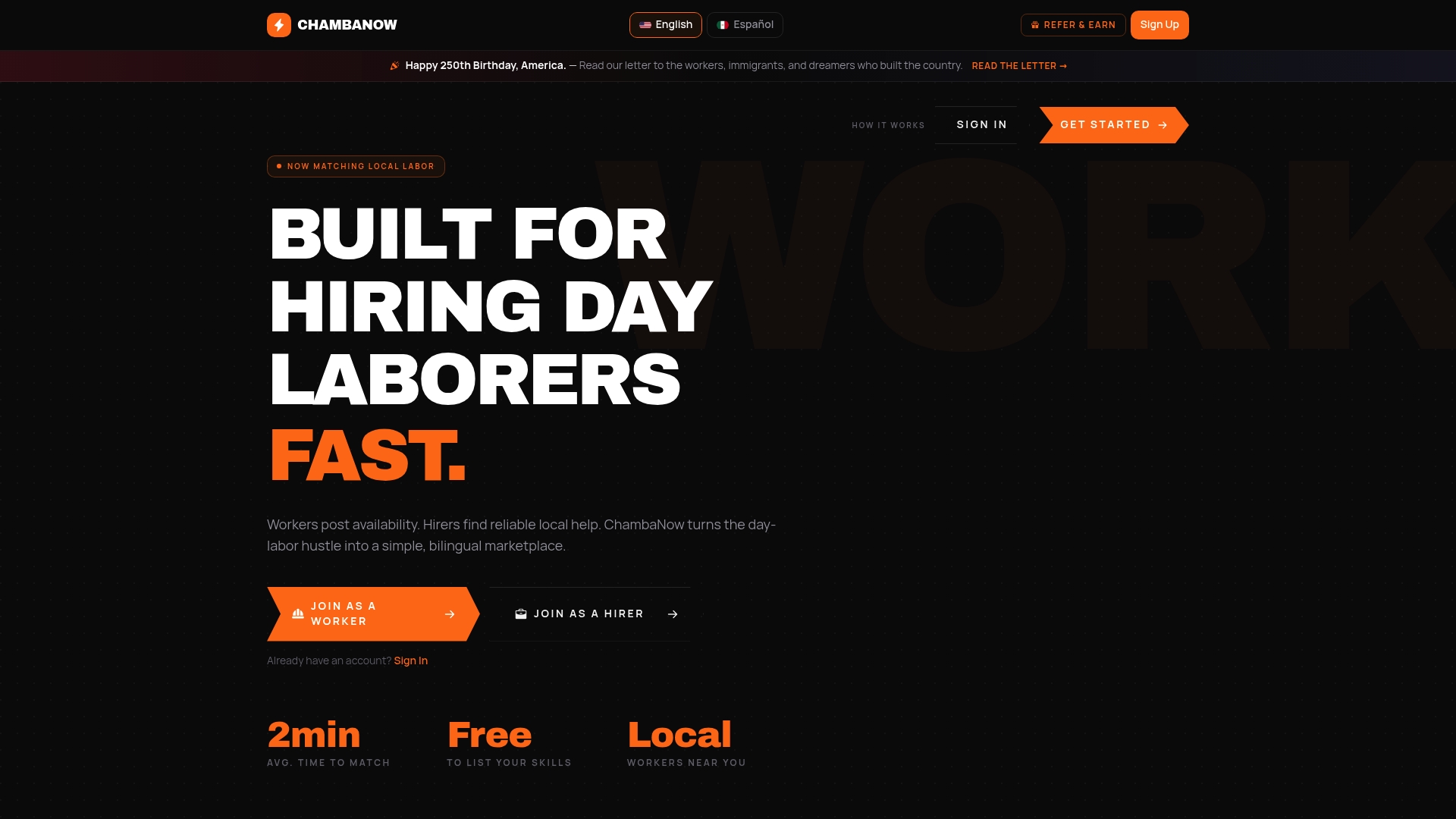
Chambanow is a bilingual hiring marketplace built for exactly that situation. Hirers can browse local worker profiles, post jobs, and communicate through automatic language translation, which matters on job sites where crews speak different languages. For contractors in cities like Long Beach, the day labor hiring page connects you with workers who are available today, not next week. Chambanow does not assume insurance responsibility for workers found through the platform. That obligation stays with the parties named in the policy. What Chambanow does is reduce the time between needing a worker and having one on site. Check Chambanow’s pricing to see the Hirer Plus subscription options and start posting jobs.
Sources
The following official and authoritative sources are worth bookmarking for audits, contract reviews, and state-specific compliance questions.
- Workers’ Comp Insurance For Contractors (2026 Guide)
- Workers’ compensation liability of contractors
- Workers Comp Insurance for Contractors 2026: Requirements & Costs
- Contractor Workers Comp Insurance: Costs & Providers
- Workers Comp for 1099 Contractors Guide | Aegivra
- Irs
Save these links in a shared folder with your policy documents and COIs. When a GC’s compliance team or a state auditor asks a question, having the source material ready shortens the conversation considerably.
This article is general information, not a substitute for advice from a qualified financial advisor. Consult a qualified financial professional about your own circumstances before acting on anything here.
Recommended
Construyendo conocimiento que funciona.