
A Homeowner’s Guide to Hiring Roofing Labor
Roof installation belongs with a qualified roofer, but homeowners can still hire labor for the work around it.
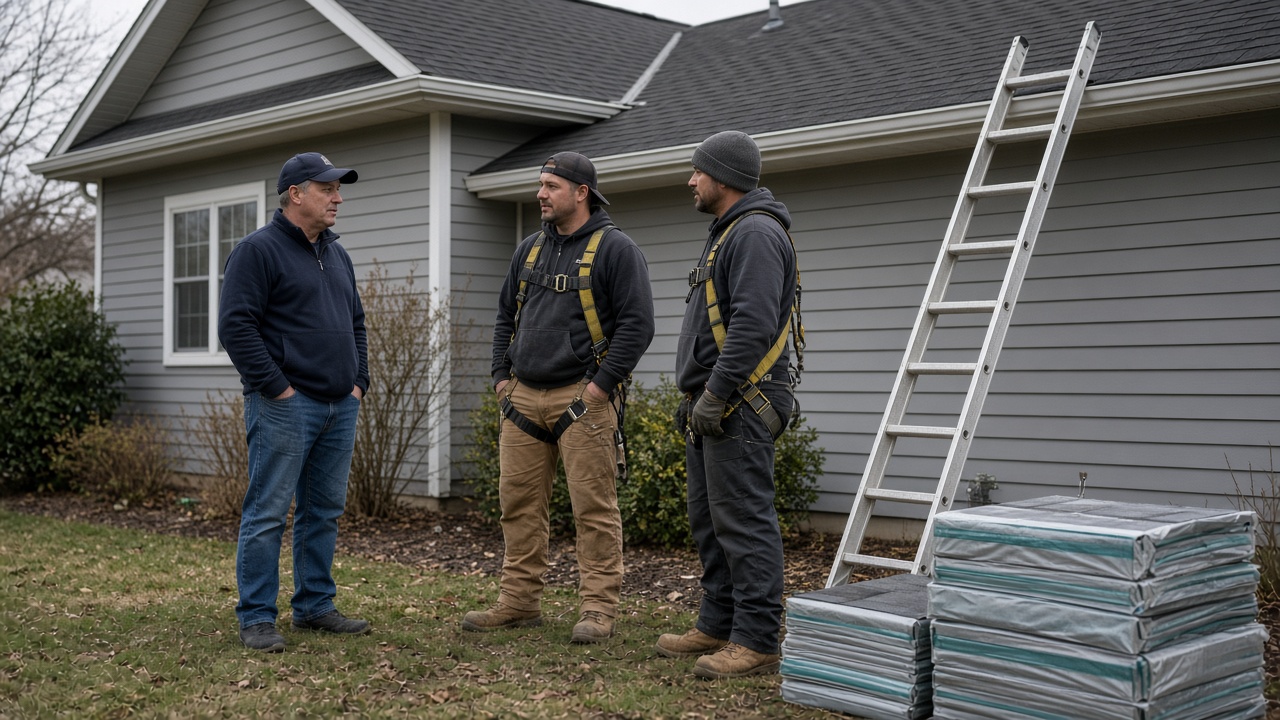
Roof installation belongs with a qualified roofer, but homeowners can still hire labor for the work around it.
Roofs are one of the most dangerous places to work on a house, and one of the easiest places to cause expensive water damage. That combination is why this guide draws a clear line. Installing, repairing, or replacing roofing is work for a qualified, properly licensed roofing contractor where your state or city requires one. There is still plenty of ground-level and support work where a homeowner can reasonably hire labor, and knowing the difference protects both your house and the people you hire.
This guide is for homeowners planning a roof replacement, a repair, or storm cleanup. It explains what roofing work needs a contractor, what labor tasks can be handled separately, what national wage data shows, and the safety and legal questions to settle before anyone climbs a ladder.
Work that belongs with a roofing contractor
Leave these jobs to a qualified roofing contractor, and confirm license requirements with your state and city.
- Tear-off and installation of shingles, tile, metal, or membrane roofing
- Flashing around chimneys, walls, skylights, vents, and valleys
- Replacing damaged roof decking or anything structural
- Roof penetrations for vents, fans, or solar mounts
- Any work that requires a permit in your jurisdiction
Many cities and counties require a permit for reroofing, and some states require roofing contractors to hold a specific license. Rules vary, so check with your local building department and your state's contractor licensing agency before you sign anything. ChambaMatters has a guide on how to verify contractor licenses (https://chambanow.com/chambamatters/verify-contractor-licenses).
Labor tasks homeowners can hire separately
Some work around a roof project does not involve going on the roof and does not change the roof itself. Depending on your contractor's agreement, these tasks are often reasonable to hire as day labor.
- Moving patio furniture, grills, planters, and vehicles away from the drop zone
- Covering landscaping, AC units, and pools with tarps before the crew starts
- Ground-level debris pickup that the roofing contract does not include
- Sweeping the yard, driveway, and gutters line with a magnetic nail sweeper after the job
- Hauling debris to a dumpster or a disposal site, if your roofer is not handling it
- Clearing the attic of stored items before decking work, so falling debris does not land on them
Before you hire for these tasks, read your roofing contract. Many roofers include cleanup and disposal in their price. Paying separately for work the contractor already owes you wastes money and can cause disputes about who damaged what.
What labor should not do
Do not hire day laborers to go on the roof for you, even for "just carrying bundles up" or "just pulling a few shingles." Stocking a roof, tear-off, and patching are roofing work, and they are dangerous without training and fall protection. If a worker falls while working for you, you may also face liability questions your homeowner's insurance may not answer the way you hope. Ask your insurer before you hire anyone to work at height on your property.
Safety rules that frame the job
Federal OSHA rules apply to employers, and they set a useful benchmark for anyone hiring roof work.
- In residential construction, workers 6 feet or more above a lower level must be protected by guardrails, safety nets, or personal fall arrest unless another provision of the standard applies.
- Portable ladders used to access a roof must extend at least 3 feet above the landing.
- Heat is a serious hazard on roofs and in attics. OSHA provides guidance on preventing heat illness, including water, rest, and shade.
Ask any roofing contractor how they will meet these requirements on your house. A contractor who cannot describe a fall protection plan is a warning sign.
Older homes and hidden materials
If your home was built before 1978, work that disturbs painted surfaces such as fascia, soffits, or trim may fall under EPA's Renovation, Repair and Painting rule, which requires paid contractors to be certified and to use lead-safe practices. EPA also advises treating materials as if they contain asbestos when you are unsure, because you usually cannot tell by looking. EPA lists roofing and siding shingles among the places asbestos may be found, so older materials are worth asking about before tear-off.
What wage data shows
National wage data gives you a reality check on labor pricing. In the Bureau of Labor Statistics May 2025 data, roofers earned a median of $26.65 per hour, with the middle half between $22.24 and $31.44. Helpers for roofers earned a median of $21.23 per hour, with the middle half between $17.80 and $23.54. Construction laborers earned a median of $22.66.
These are employee wages, not what a roofing company charges. A roofing bid includes materials, insurance, equipment, disposal, overhead, and profit. For ground-level cleanup and hauling labor, the laborer and helper figures are a reasonable starting reference, adjusted for your local market. See how much you should pay a day laborer in 2026 (https://chambanow.com/chambamatters/how-much-should-you-pay-a-day-laborer-in-2026-rates-by-job-type).
A step-by-step plan for homeowners
Step 1 Get roofing bids from qualified contractors
Ask each contractor for license and insurance information, permit responsibility, start date, cleanup terms, and disposal terms in writing. Our guide to subcontractor certificates of insurance (https://chambanow.com/chambamatters/subcontractor-certificate-of-insurance) explains what to ask for.
Step 2 List what the contract does not cover
Look for gaps such as moving outdoor items, attic clearing, extra yard cleanup, or hauling.
Step 3 Hire labor only for those gaps
Write a clear scope that keeps workers on the ground. See how to write a clear scope of work before a day labor job starts (https://chambanow.com/chambamatters/how-to-write-a-clear-scope-of-work-before-a-day-labor-job-starts).
Step 4 Schedule around the roofer
Have prep labor finish before the roofing crew arrives and cleanup labor start after the roofer is off the roof. Do not put laborers under active roof work.
Step 5 Ask the roofer how separate labor fits their site plan
Some roofing contractors prefer to control everyone on site during the job. Ask these questions before you schedule outside help.
- Where will the dumpster and the drop zone be each day
- Which areas must stay clear while the crew is working overhead
- Is daily magnetic sweeping already included, or only a final sweep
- Who is responsible if a separate laborer damages something
Step 6 Walk the property at the end
Check for nails in the driveway and lawn, damaged plants, and gutter debris before you release anyone.
Licensing questions for homeowners
Homeowners who hire workers directly should understand their state's rules. In California, for example, the Contractors State License Board says the minor-work exemption does not apply if the work needs a permit or if the unlicensed person hires workers. For a broader explanation, see can a homeowner hire labor without a contractor's license (https://chambanow.com/chambamatters/can-a-homeowner-hire-labor-without-a-contractor-s-license).
Finding help on ChambaNOW
ChambaNOW lists roofing workers and contractors by city, for example in Houston (https://chambanow.com/hire/houston-tx/roofing), alongside general laborers for prep and cleanup. You can post the job free, review workers who respond, and message them about that job. Ask anyone who will do roofing work about licensing, insurance, and fall protection before you hire. You can also start from the hirer overview (https://chambanow.com/for-hirers).
What to remember before roof work starts
Hire a qualified roofer for the roof, hire labor only for clearly defined ground-level work, keep laborers out from under active work, and confirm permits, insurance, and licensing before the job starts.
Sources - U.S. Bureau of Labor Statistics, OEWS May 2025, Roofers (47-2181) (https://www.bls.gov/oes/current/oes472181.htm) - U.S. Bureau of Labor Statistics, OEWS May 2025, Helpers--Roofers (47-3016) (https://www.bls.gov/oes/current/oes473016.htm) - U.S. Bureau of Labor Statistics, OEWS May 2025, Construction Laborers (47-2061) (https://www.bls.gov/oes/current/oes472061.htm) - OSHA, 29 CFR 1926.501, Duty to have fall protection (https://www.osha.gov/laws-regs/regulations/standardnumber/1926/1926.501) - OSHA, 29 CFR 1926.1053, Ladders (https://www.osha.gov/laws-regs/regulations/standardnumber/1926/1926.1053) - OSHA, Heat Exposure (https://www.osha.gov/heat-exposure) - U.S. EPA, Lead Renovation, Repair and Painting Program (https://www.epa.gov/lead/renovation-repair-and-painting-program) - U.S. EPA, Protect Your Family from Exposures to Asbestos (https://www.epa.gov/asbestos/protect-your-family-exposures-asbestos) - U.S. EPA, Learn About Asbestos (https://www.epa.gov/asbestos/learn-about-asbestos) - California Contractors State License Board, Handyperson Exemption to Increase to $1,000 in 2025 (https://www.cslb.ca.gov/Resources/PressReleases/2024/AB2622.FINAL.pdf)
Written by Barry Graham, Founder, ChambaNOW
Construyendo conocimiento que funciona.