
Subcontractor Certificate of Insurance: What Contractors Must Verify
Ensure your subcontractor's certificate of insurance meets compliance standards with key coverage checks and endorsements for project success.

A compliant subcontractor certificate of insurance must show ACORD Form 25 issued by a carrier rated A- VII or better by A.M. Best, active coverage across all required lines (CGL, Products/Completed Operations, Workers’ Compensation, Employers’ Liability, Commercial Auto, and Umbrella/Excess), and the correct endorsements physically attached, not just noted in a checkbox.
Quick compliance checklist before mobilization:
- ACORD Form 25 from a rated carrier (A.M. Best A- VII minimum)
- Commercial General Liability: coverage meeting standard minimum limits per contract
- Workers’ Compensation at statutory limits with adequate Employers’ Liability coverage
- Commercial Auto with a combined single limit as required by contract
- Umbrella/Excess coverage levels appropriate to the trade risk
- Additional Insured endorsements CG 20 10 and CG 20 37 physically attached
- Require Primary & Noncontributory coverage wording as specified by contract wording confirmed
- Require Waiver of Subrogation endorsement per contract requirements where required by contract
- Correct certificate holder name and project ID in the description field
Pro Tip: The ACORD 25 checkbox for Additional Insured means nothing without the actual endorsement form attached. Always request the CG 20 10 and CG 20 37 documents separately. A checked box is not coverage.
Platforms like myCOI Central automate this collection and flag missing documents before work begins, which is the most reliable way to keep a project’s compliance status current.
Key Takeaways
A compliant subcontractor certificate of insurance requires verified endorsements attached to the policy, not just a checked box on ACORD Form 25.
| Point | Details |
|---|---|
| Endorsements over certificates | CG 20 10 and CG 20 37 must be physically attached; the ACORD checkbox alone grants no coverage rights. |
| Minimum limits as a baseline | Require $1M/$2M CGL, statutory WC, $1M auto, and $1M–$5M umbrella adjusted for trade risk. |
| Gate mobilization and payment | Block work commencement and payment until a compliant COI and all endorsements are on file. |
| Verify the carrier rating | Confirm A.M. Best A- VII or better before accepting any certificate from a subcontractor. |
| Use a digital compliance system | Platforms like myCOI Central automate requests, flag expirations, and hold payments until compliance is confirmed. |
Table of Contents
- What is a subcontractor certificate of insurance and why does it matter?
- Which insurance lines and minimum limits should you require from subcontractors?
- What endorsements and certificate language should you demand?
- How do you request, collect, and verify a subcontractor COI?
- What should subcontractors do to deliver a compliant COI quickly?
- What are the red flags and common mistakes in COI review?
- What contract clauses and ACORD description text should you use?
- What are your options when a subcontractor can’t meet insurance requirements?
- How long does it take and what does it cost?
- Hiring with compliance in mind: a note from Chambanow
- What the editorial perspective says about COI compliance
- Sources
What is a subcontractor certificate of insurance and why does it matter?
A Certificate of Insurance (COI) is a summary document, not the insurance policy itself. According to Procore, a COI proves that coverage is in force at the time of issuance but does not substitute for the full policy and cannot create endorsements or change policy terms. A description box on the certificate may reference Additional Insured status, but that reference does not prove the endorsement actually exists on the underlying policy.
GCs require COIs before mobilization, before lease agreements, for lender compliance, and on public owner projects. The stakes are real. Risk management experts at Next Insurance warn that assuming the GC’s own policy will cover subcontractor-caused losses is one of the most dangerous misconceptions in construction risk management. When a subcontractor causes a loss and the GC has no Additional Insured status on that sub’s policy, the GC absorbs the legal costs and project delays directly.
A COI is required at four predictable moments: before a subcontractor mobilizes on site, at each policy renewal, when scope changes materially, and whenever a lender or owner audits the project.
Which insurance lines and minimum limits should you require from subcontractors?
The core lines are Commercial General Liability (CGL), Products and Completed Operations, Workers’ Compensation, Employers’ Liability, Commercial Auto, and Umbrella/Excess. Each serves a distinct purpose, and missing any one of them leaves a gap that the GC’s own policy is unlikely to fill.
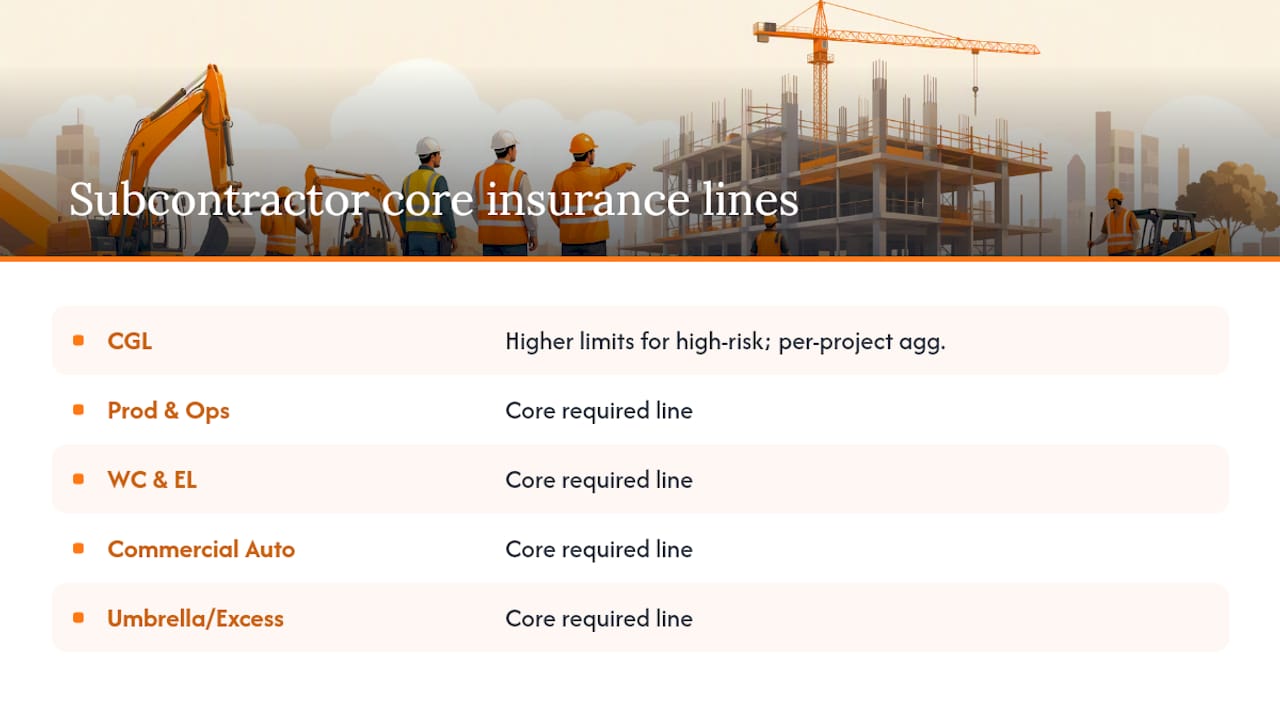
High-risk trades such as roofing, demolition, and structural steel typically warrant higher CGL limits and a per-project aggregate. A blanket aggregate can be exhausted across multiple jobs, leaving your project with reduced coverage mid-construction.
Pro Tip: Require a per-project aggregate endorsement as appropriate for the project for any subcontractor working on more than one project simultaneously. A blanket aggregate shared across jobs can be depleted before your project ever files a claim.
What endorsements and certificate language should you demand?
The endorsements are where actual risk transfer happens. Grit Insurance explains that being named as an Additional Insured, backed by the correct ISO endorsement forms, grants the GC coverage rights under the subcontractor’s policy for claims arising from that sub’s scope of work. The certificate alone grants nothing.
The three endorsements every GC should require:
- Additional Insured (ongoing operations): ISO form CG 20 10. Covers claims arising during the subcontractor’s active work.
- Additional Insured (completed operations): ISO form CG 20 37. Covers claims that arise after work is finished, often years later.
- Require Primary & Noncontributory coverage wording as specified by contract: Requires the sub’s policy to respond first, before the GC’s own coverage contributes.
- Require Waiver of Subrogation endorsement per contract requirements: Prevents the sub’s insurer from pursuing the GC to recover paid claims.
Edition dates on ISO forms matter. A CG 20 10 from 2004 covers completed operations differently than the 2012 edition. Specify the edition year in your subcontract to avoid ambiguity.
Pro Tip: When collecting documents, require the endorsement form number and the carrier’s signature or agent attestation on each form. A photocopy of the form without a policy number or signature is not proof of attachment.
Sample ACORD 25 description-of-operations language: “[Owner Name] and [GC Name] are named as Additional Insureds per CG 20 10 and CG 20 37 (specify edition). Coverage is primary and noncontributory. Require Waiver of Subrogation endorsement per contract requirements applies in favor of Additional Insureds. Project: [Project Name and Address].”
How do you request, collect, and verify a subcontractor COI?
A reliable verification workflow runs in this sequence:
- Send a written COI request specifying required lines, limits, endorsement forms, and certificate holder wording before the subcontract is signed.
- Confirm the named insured on the COI matches the legal entity signing the subcontract exactly.
- Check each policy line and limit against the subcontract’s insurance exhibit.
- Verify endorsements are physically attached, not just referenced in the description box.
- Check the carrier rating using A.M. Best. Require A- VII or better; a lower-rated carrier may be unable to pay a large claim.
- Call the insurer or agent to confirm the policy is active. The New Hampshire Insurance Department recommends requesting the COI directly from the insurer or agent and contacting the insurer to confirm coverage when in doubt.
- Log the COI in your compliance system with expiration dates flagged for renewal reminders.
- Hold mobilization until every item is confirmed.
Alberici’s sample Exhibit B requires ACORD Form 25 with endorsements attached, a project-specific description, and blocks both work commencement and payments until the subcontractor registers in myCOI Central and a compliant COI is received. That workflow is a practical model: the compliance gate is built into the payment process, not treated as a separate administrative task.
ICINS Solutions reinforces that a COI plus a signed subcontract does not equal compliance. Endorsements, renewal records, and named insured verification must all be confirmed and tracked through the life of the project.
What should subcontractors do to deliver a compliant COI quickly?
The three fastest compliance wins for a subcontractor are confirming the carrier’s A.M. Best rating, securing the required endorsements attached to the COI, and adding project-specific language in the ACORD 25 description field.
Documents to supply to the GC:
- ACORD Form 25 with all required lines and limits shown
- CG 20 10 and CG 20 37 endorsement forms physically attached
- Require Waiver of Subrogation endorsement per contract requirements where required
- Proof of Workers’ Compensation and Employers’ Liability
- Commercial Auto declarations page
- Umbrella/Excess policy declarations
Ready-to-send broker request: “Please issue an ACORD 25 certificate for [Project Name] naming [GC Name] and [Owner Name] as Additional Insureds per CG 20 10 and CG 20 37. Attach the endorsement forms, add Require Primary & Noncontributory coverage wording as specified by contract and Require Waiver of Subrogation endorsement per contract requirements language, and include the project address in the description field. Policy numbers: [list here].”
Standard COI updates typically take same-day to 48 hours. Adding a new endorsement may take two to five business days if underwriting approval is required.
What are the red flags and common mistakes in COI review?
The most common failures are expired policy dates, a named insured that doesn’t match the subcontract, missing endorsement forms, a low-rated carrier, and certificates that appear altered or typed over.
Red flags and immediate responses:
- Expired dates: Stop mobilization. Request a renewed certificate before any work begins.
- Named insured mismatch: Verify the legal entity. A DBA or subsidiary name is not the same as the contracting party.
- ACORD box checked but no endorsement attached: Bramble’s verification guide notes that the certificate face omits critical details like per-project aggregate and endorsement edition dates. Request the actual CG 20 10 and CG 20 37 forms.
- Carrier rated below A- VII: Contact the sub and require a replacement policy or a higher-rated excess carrier.
- Altered or typed-over certificate: Reject immediately and request a fresh certificate issued directly by the agent.
- No Require Waiver of Subrogation endorsement per contract requirements when required: The sub’s insurer can pursue the GC after paying a claim. Require the endorsement before work starts.
Pro Tip: Most states maintain an online workers’ compensation coverage lookup. Verify WC status through your state’s workers’ comp board website before mobilization rather than relying solely on the certificate.
What contract clauses and ACORD description text should you use?
A concise, enforceable insurance exhibit clause for a subcontract:
“Prior to commencing work, Subcontractor shall furnish to Contractor certificates of insurance on ACORD Form 25 evidencing the required coverages and limits, with all required endorsements attached. Coverage shall be primary and noncontributory. Contractor and Owner shall be named as Additional Insureds on CG 20 10 and CG 20 37 (2012 edition or later). Require Waiver of Subrogation endorsement per contract requirements shall apply in favor of all Additional Insureds. No work shall commence, and no payment shall be issued, until compliant certificates and endorsements are received and approved.”
| Document | Required Language |
|---|---|
| ACORD 25 description field | “[GC] and [Owner] named AI per CG 20 10 and CG 20 37; primary/noncontributory; WOS applies; Project: [name/address]” |
| CG 20 10 endorsement | Ongoing operations AI; specify edition year; list GC and Owner by legal name |
| CG 20 37 endorsement | Completed operations AI; same named parties; same edition year |
| Require Waiver of Subrogation endorsement per contract requirements | “Insurer waives right of recovery against [GC] and [Owner] for losses covered under this policy” |
Sample deficiency notice for non-compliant COIs: “Your certificate of insurance dated [date] does not meet the requirements of the subcontract. Deficiencies: [list specific items]. Work may not commence and payment will be withheld until a corrected certificate and all required endorsement forms are received. Please resubmit within [X] business days.”
For state-specific nuances, confirm WC statutory limits with your state’s workers’ compensation board and verify whether your state requires specific auto endorsements for commercial vehicles.
What are your options when a subcontractor can’t meet insurance requirements?
When a subcontractor cannot meet the required limits or endorsements, the GC has four practical options, roughly in order of preference:
- Deny the award and source a sub that meets requirements. The cleanest risk outcome.
- Require a performance and payment bond to offset the coverage gap, particularly for high-value scopes.
- Limit the subcontractor’s scope to lower-risk tasks that fall within their actual coverage.
- Purchase insurance on the sub’s behalf and back-charge the cost. Many subcontracts include a clause permitting this when a sub fails to maintain required coverage.
The right choice depends on the project dollar value, the trade’s inherent risk, and what the owner or lender requires. A $500 landscaping sub missing an umbrella endorsement is a different calculation than a structural steel contractor with inadequate CGL limits. Contractual indemnity language can shift some risk, but it does not replace actual insurance coverage and will not protect the GC if the sub has no assets to indemnify against.
How long does it take and what does it cost?
Standard COI updates, such as adding a certificate holder or updating a project description, typically process same-day to 48 hours. Adding an Additional Insured endorsement may take two to five business days if the carrier requires underwriting review. Increasing umbrella limits can take one to three weeks and will trigger a premium adjustment. Require Waiver of Subrogation endorsement per contract requirements endorsements are usually processed within two to three business days but may carry a modest additional premium depending on the carrier and trade class.
Cost factors that affect endorsement premiums include the subcontractor’s trade classification, total payroll, prior loss history, and the project’s total contract value. High-risk trades pay more for AI endorsements. When a sub needs an endorsement added quickly, the fastest path is a direct call from the sub’s broker to the underwriter, not an email request through the agency service team.
Hiring with compliance in mind: a note from Chambanow
Chambanow connects contractors with local workers who are ready to work today. Before posting mobilization instructions on the platform, verify that any subcontractor or crew lead has a compliant COI on file. Use Chambanow’s messaging tools to request documentation up front and tag workers as “COI provided” before dispatch. The platform’s job-posting controls let you specify documentation requirements in the job description so workers and subs know what to bring before they show up.
For contractors who need to source hire-ready crews quickly, Chambanow’s hirer resources make it straightforward to post jobs, communicate requirements, and connect with workers who are available now. Whether you’re building a long-term crew or filling a one-day gap, compliance starts before the first worker sets foot on site.
What the editorial perspective says about COI compliance
Most contractors treat COI collection as a paperwork formality. The real risk is subtler: a certificate that looks complete can still leave a GC fully exposed if the endorsements aren’t physically attached to the policy. The ACORD 25 checkbox for Additional Insured is the single most misleading field in construction compliance. It signals coverage that may not exist.
The smarter approach is to treat COI review the same way a lender treats a title search: assume nothing is clear until you have the actual documents in hand. Require the endorsement forms, not just the certificate. Call the carrier when something looks off. Build the compliance gate into the payment process, as Alberici does with myCOI Central, so that the financial incentive and the compliance requirement point in the same direction.
Contractors who do this consistently rarely face the worst outcomes. Those who rely on a checked box and a certificate date tend to find out the hard way that a COI is only as good as the endorsements behind it.
Sources
- Subcontractor Insurance Requirements (What GCs Must Verify) | Grit
- ACI sample Exhibit B — Alberici
- Subcontractor Insurance — Next Insurance
- What Is a Certificate of Insurance (COI) for Contractors — Procore
- Sub COI Requirements: What GCs Must Verify | Bramble
- Subcontractor insurance and risk management for general contractors | ICINS Solutions
- How to Verify If Your Contractor Has the Right Insurance | New Hampshire Insurance Department
This article is general information, not a substitute for advice from a qualified lawyer. Consult a qualified legal professional about your own circumstances before acting on anything here.
Recommended
Construyendo conocimiento que funciona.