
What Indoor Labor Jobs Can You Find When Outdoor Work Slows Down?
When outdoor work slows down, indoor jobs in painting, drywall, cleaning, and remodels can fill the gap.
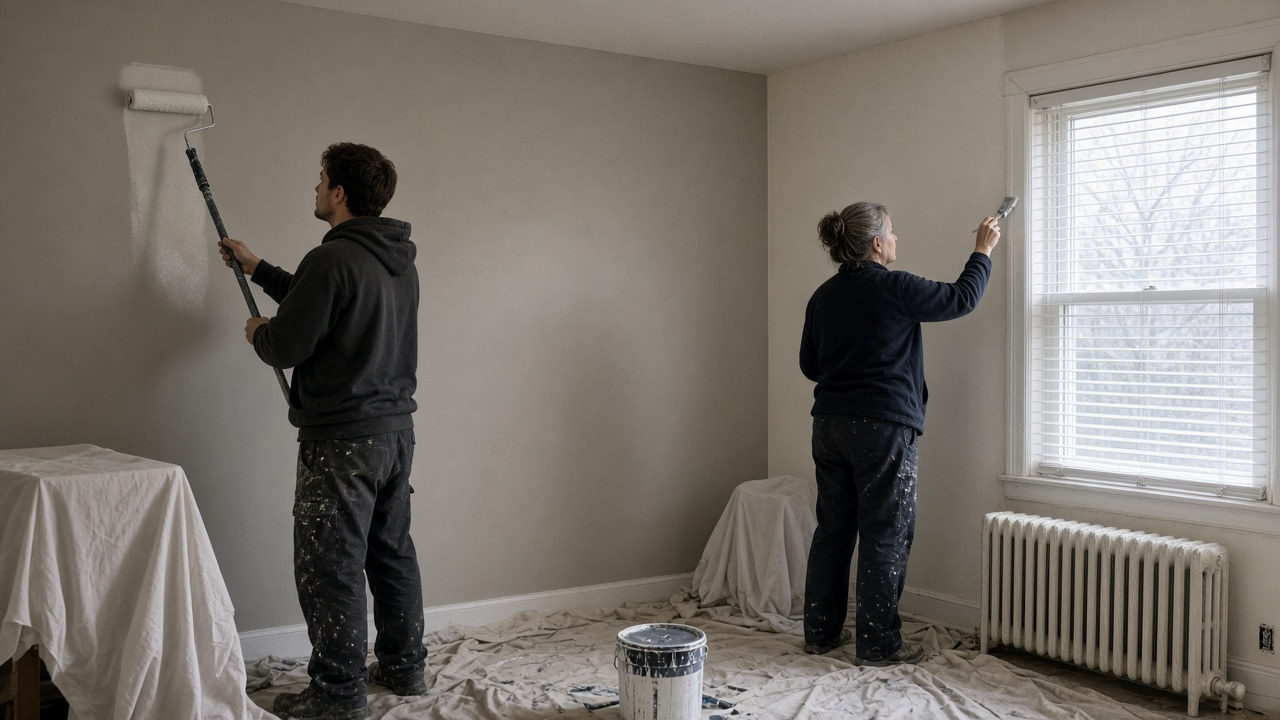
When outdoor work slows down, indoor jobs in painting, drywall, cleaning, and remodels can fill the gap.
In many parts of the country, late fall and winter cut into landscaping, some exterior building work, and other outdoor labor. That does not have to mean a blank calendar. Interior remodeling, painting, drywall, cleaning, warehouse help, and some moving jobs continue, and some homeowners use the slower season to get inside work done. The key is to shift what you offer, not to wait for the ground to thaw.
This guide covers which indoor jobs are most realistic, what they tend to pay, how to stay visible to hirers in the slow months, and how to move between outdoor and indoor work.
Which indoor jobs are realistic
The work that holds up best in winter is work that happens inside a finished or nearly finished space, or in a warehouse or shop.
- Interior painting and paint prep, especially in occupied homes that are already closed up and heated
- Drywall hanging, taping, and punch-list repairs on remodels and new interiors
- House cleaning, turnover cleans, and post-holiday deep cleans
- Interior demolition of non-structural finishes, when a remodel is underway
- Furniture assembly, closet or shed organizing, and other indoor labor
- Warehouse, loading-dock, and inventory help, including seasonal retail back-of-house work
- Indoor moving help, apartment moves, and packing, which continue year-round and can pick up in January
Outdoor work does not vanish everywhere. Mild-winter cities still have landscaping, and cold-weather cities still have snow removal and storm cleanup. The point is to add indoor skills so a freeze or a long rain week does not stop your income.
What the work pays
Pay follows the job, not the season alone. Bureau of Labor Statistics May 2025 national medians give you a starting point.
- Construction laborers: $22.66 an hour
- Drywall and ceiling tile installers: $28.33 an hour, with helpers often closer to other construction-helper figures around $20.51
- Construction and maintenance painters: $23.75 an hour, with painter helpers around $19.46
- Janitors and building cleaners: $17.71 an hour
- Hand laborers and material movers: $19.35 an hour
Local rates vary, and your pay must at least meet the state and city minimum on the U.S. Department of Labor's state minimum wage page (https://www.dol.gov/agencies/whd/minimum-wage/state). Indoor work can also mean shorter or split days, so confirm the hours, not only the rate.
How to make the switch
Hirers cannot offer you indoor work if they only know you as a mowing or exterior laborer. Update what you say you can do, and be honest about it.
- Step 1: Pick two indoor skills you can really do, such as paint prep and cleaning, or drywall help and moving. A short, true list is better than a long one.
- Step 2: Get the basics ready. Indoor shoes that will not mark floors, clothes you can ruin, a tape measure, a knife, and the safety habits in what a day laborer should bring (https://chambanow.com/chambamatters/what-a-day-laborer-should-bring-to-the-job-and-what-the-hirer-should-provide).
- Step 3: Update your profile and job search. On ChambaNOW, which is free for workers at https://chambanow.com/for-workers, add those indoor skills and keep your availability on. Look at painting jobs in Los Angeles at https://chambanow.com/jobs/in/los-angeles-ca/painting, drywall jobs in Houston at https://chambanow.com/jobs/in/houston-tx/drywall, cleaning jobs in Chicago at https://chambanow.com/jobs/in/chicago-il/cleaning, or moving jobs in Dallas at https://chambanow.com/jobs/in/dallas-tx/moving.
- Step 4: Watch for remodel and punch-list work. Contractors often need extra hands in December and January to close out interiors. Closing out a job with punch-list and site-cleanup labor (https://chambanow.com/chambamatters/closing-out-a-job-punch-list-and-site-cleanup-labor-for-contractors) is written for hirers, but it shows the work they are trying to staff.
- Step 5: Keep some outdoor options ready. Snow, winter yard cleanup, and indoor work can sit on the same week. How to get more hours as a day laborer (https://chambanow.com/chambamatters/how-to-get-more-hours-as-a-day-laborer) and odd jobs near you (https://chambanow.com/chambamatters/odd-jobs-near-me-15-ways-to-earn-extra-money-this-week) can help you fill gaps.
Safety still applies indoors
Indoor jobs are not automatically easy jobs. Drywall and concrete cutting can create silica dust, which OSHA regulates (https://www.osha.gov/silica-crystalline). Paint fumes need ventilation, as the EPA notes in its indoor-air guidance on volatile organic compounds (https://www.epa.gov/indoor-air-quality-iaq/volatile-organic-compounds-impact-indoor-air-quality). Older homes can have lead paint, which is why the EPA's Renovation, Repair and Painting Program (https://www.epa.gov/lead/lead-renovation-repair-and-painting-program) matters when you sand or disturb painted surfaces. Lifting furniture in a stairwell can hurt you as easily as lifting stone in a yard. Use the same caution you would use outside, and speak up if a room is not safe (https://chambanow.com/chambamatters/how-to-speak-up-about-safety-on-a-job-site).
A typical slow month
A slow outdoor month does not have to be an empty month. You might spend a Monday on a living-room paint job, a Wednesday on a drywall hang, and a Saturday unloading a warehouse truck or helping someone move apartments. The work is less visible from the street than a mowing route, so you have to stay in front of hirers with an updated list of skills and a fast reply.
If you have a regular outdoor client, tell them you are available for indoor work too. Many homeowners who hired you for leaves or a fence in October also need a room painted or a garage organized in January. That conversation is often worth more than a new cold pitch.
How to talk about indoor skills honestly
Do not list every indoor trade if you have only done cleanup. It is better to say you can prep paint, carry drywall, or clean a house, and to learn the next skill on a job where the lead has time to show you. General labor versus a skilled trade helper (https://chambanow.com/chambamatters/general-labor-vs-skilled-trade-helper-what-s-the-difference) is a useful distinction to keep straight in your profile and in your messages.
If you need a short-term stopgap, same-day work (https://chambanow.com/chambamatters/find-same-day-work-near-me) and moving helper jobs (https://chambanow.com/chambamatters/moving-helper-jobs-what-they-pay-and-how-to-get-hired) can fill a week while you wait for a remodel crew to call you back.
Keeping a winter routine
Set a simple weekly routine so the slow season does not turn into a week of waiting. Check new jobs in the morning and in the late afternoon, reply the same day, and keep one indoor skill and one outdoor skill ready to go. If a storm is in the forecast, offer snow or cleanup help to people you already know. If the week stays dry and cold, look for paint, drywall, cleaning, and moving work instead. A short routine will produce more hours than checking only when you are already out of work. Stay in that habit until outdoor work picks up again in the spring.
The short version
When outdoor work slows down, indoor painting, drywall, cleaning, remodel help, warehouse work, and moving can keep you working. Update your skills, follow the same safety habits, and stay in touch with the crews who will need you outside again in the spring.
Sources
- U.S. Bureau of Labor Statistics, OEWS May 2025, Construction Laborers (47-2061) (https://www.bls.gov/oes/current/oes472061.htm)
- U.S. Bureau of Labor Statistics, OEWS May 2025, Drywall and Ceiling Tile Installers (47-2081) (https://www.bls.gov/oes/current/oes472081.htm)
- U.S. Bureau of Labor Statistics, OEWS May 2025, Helpers, Construction Trades, All Other (47-3019) (https://www.bls.gov/oes/current/oes473019.htm)
- U.S. Bureau of Labor Statistics, Occupational Outlook Handbook, Painters, Construction and Maintenance (May 2025 data) (https://www.bls.gov/ooh/construction-and-extraction/painters-construction-and-maintenance.htm)
- U.S. Bureau of Labor Statistics, OEWS May 2025, Janitors and Cleaners (37-2011) (https://www.bls.gov/oes/current/oes372011.htm)
- U.S. Bureau of Labor Statistics, OEWS May 2025, Laborers and Freight, Stock, and Material Movers, Hand (53-7062) (https://www.bls.gov/oes/current/oes537062.htm)
- OSHA, Respirable Crystalline Silica (https://www.osha.gov/silica-crystalline)
- U.S. Environmental Protection Agency, Volatile Organic Compounds' Impact on Indoor Air Quality (https://www.epa.gov/indoor-air-quality-iaq/volatile-organic-compounds-impact-indoor-air-quality)
- U.S. Environmental Protection Agency, Lead Renovation, Repair and Painting Program (https://www.epa.gov/lead/lead-renovation-repair-and-painting-program)
- U.S. Department of Labor, State Minimum Wage Laws (https://www.dol.gov/agencies/whd/minimum-wage/state)
Written by Barry Graham, Founder, ChambaNOW
Building knowledge that works.