
What Businesses Should Know Before Hiring Labor for an Office Move
An office move goes smoothly when labor, IT, building rules, and the floor plan are settled before moving day.
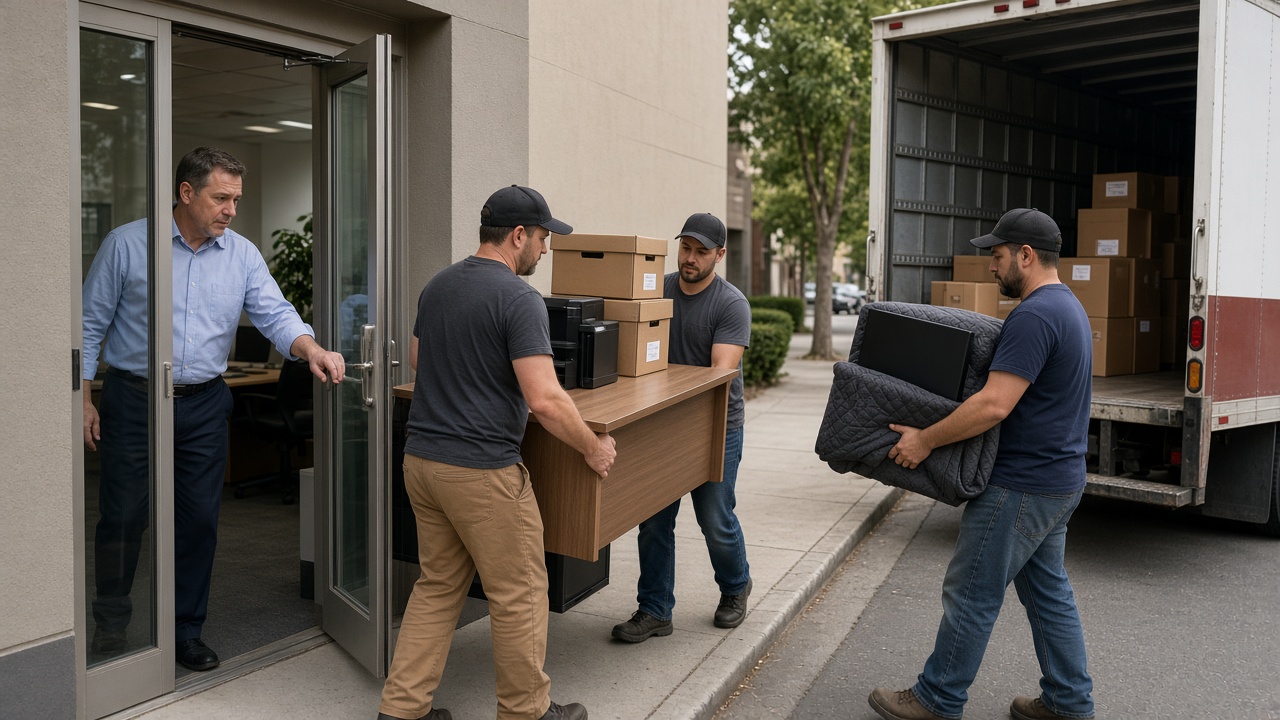
An office move goes smoothly when labor, IT, building rules, and the floor plan are settled before moving day.
Moving an office is not a bigger version of moving a house. It involves landlords and building managers, freight elevators with reservation windows, insurance certificates, modular furniture, servers and network gear, confidential files, and employees who need to be working again on Monday. The labor you hire is only one piece, but it is the piece that touches everything else. A crew that shows up without a plan can scratch a lobby, block a loading dock, or lose the box with the payroll files.
This guide is for office managers, business owners, and facilities leads planning a small or mid-size office move, whether across the hall or across town. It focuses on the business side of moving: building rules, labeling, furniture, IT, data security, crew roles, and budgeting. If you are moving a household instead, see our homeowner guide to a one-day move (https://chambanow.com/chambamatters/a-homeowner-s-guide-to-hiring-help-for-a-one-day-move).
A simple timeline helps. Six to eight weeks out, confirm dates with both buildings. Three to four weeks out, finalize the floor plan, furniture plan, and IT plan, and post the labor job. One week out, distribute labels and packing supplies. The day before, confirm every worker, the elevator, and the dock.
Step 1 Get both buildings' rules in writing
Commercial buildings often have move rules that affect labor directly. Ask the property managers at both the old and new locations for these details.
- Approved move days and hours, which are often evenings or weekends
- Freight elevator reservations and any elevator operator requirements
- Loading dock access, time limits, and vehicle height limits
- Floor, wall, and elevator protection requirements
- Certificate of insurance requirements, including named insureds and coverage amounts, if the building asks for them
- Rules for removing trash, packaging, and old furniture
Many buildings will not let a crew in without a certificate of insurance on file. If you hire a moving company, they provide it. If you hire laborers directly, ask the building what it will accept before you schedule anyone. Our guide to certificates of insurance (https://chambanow.com/chambamatters/subcontractor-certificate-of-insurance) explains the basics.
Step 2 Build a floor plan and a labeling system
Every item should have a destination before move day.
- Number every room and workstation on the new floor plan
- Give each employee a label set with their destination number
- Color-code by floor or department if the move is large
- Label furniture, boxes, and equipment on the sides, not just the tops, so labels stay visible in stacks
- Post the floor plan at the new location's entrance and in each area
Laborers can work fast and accurately when the destination is obvious. Without labels, they guess, and you sort it out on Monday.
Step 3 Decide who handles IT
Keep computers, servers, network equipment, and phones under your IT staff's or IT vendor's control. A reasonable split looks like this.
- IT staff disconnect, label, and pack equipment, or supervise it closely
- Laborers move packed equipment in designated crates or carts
- IT staff reconnect and test at the new location
Do not have laborers unplug or reconnect network equipment. If old computers, drives, or copiers are being retired during the move, treat the data on them as a security issue. NIST's media sanitization guidelines, SP 800-88 Revision 2, published in September 2025, are a common reference for how organizations should handle data on devices leaving their control. Have IT handle sanitization or use a qualified vendor, and keep a record of what was disposed of.
Step 4 Plan for confidential files
HR, payroll, legal, and client files should be packed by your staff, sealed, labeled, and kept in view during the move. Consider moving the most sensitive boxes separately with a staff member present.
Step 5 Handle furniture deliberately
Office furniture is where labor time disappears.
- Modular workstations: disassembly and reassembly can take far longer than moving. Check whether the furniture manufacturer or dealer requires its own installers, and get the original installation drawings if you can.
- Desks and tables: many need legs or returns removed to fit through doors and elevators.
- Filing cabinets and lateral files: empty them or follow the manufacturer's guidance before moving, since full cabinets are dangerous to tip and carry.
- Safes and very heavy items: use specialists with the right equipment.
- Furniture you are not keeping: decide in advance whether it is being sold, donated, recycled, or hauled away, and by whom.
Step 6 Define crew roles
Even a small office move benefits from clear roles.
- Move lead: holds the floor plan, directs placement, and answers questions
- Packing and wrapping crew: wraps furniture and protects equipment
- Carry crew: moves items from rooms to the elevator and dock
- Truck crew: loads and unloads the truck so items stay secure
- Placement crew at the new site: puts each item in its labeled location
- Your staff point person: makes decisions about anything unlabeled or unclear
On a small move, one person may cover two roles, but the move lead and your staff point person should be different people.
What wage data shows
In the Bureau of Labor Statistics May 2025 national data, hand laborers and freight, stock, and material movers earned a median of $19.35 per hour, with the middle half earning $17.35 to $22.56. These are employee wages, not moving company prices, which include trucks, equipment, insurance, and overhead. After-hours and weekend work, common for office moves, can raise local rates.
A hypothetical budget for direct labor
This is an illustration only. Suppose you hire four laborers at $20 per hour for a 6-hour evening, plus one move lead at $25 per hour. Direct wages would be $480 plus $150, or $630, before any truck, equipment rental, building fees, or payroll costs. Compare that with full-service moving quotes for the same scope, including insurance and certificates the building requires.
For broader day-rate context, see how much you should pay a day laborer in 2026 (https://chambanow.com/chambamatters/how-much-should-you-pay-a-day-laborer-in-2026-rates-by-job-type).
Safety on office moves
Material handling injuries are common in moving work. OSHA identifies overexertion in lifting and lowering as a major cause of injuries in material handling work such as warehousing. Use dollies, panel carts, and furniture skates, require team lifts for heavy items, and keep hallways and stairwells clear. Protect floors and walls in both buildings, and check elevator weight limits before loading heavy furniture.
Move-day checklist
- Building approvals, elevator reservations, and certificates confirmed
- Floor plan posted and every item labeled
- IT equipment packed and labeled by IT
- Confidential files sealed and supervised
- Protection materials installed in both buildings
- Move lead and staff point person identified
- Trash and old furniture plan in place
- Walk-through of both sites before the crew leaves
Hiring office move labor on ChambaNOW
ChambaNOW lists moving workers by city, for example in Austin (https://chambanow.com/hire/austin-tx/moving). Businesses can post an office move job free, describe the building rules and hours, review workers who respond, and message them about that job. Start at the hirer overview (https://chambanow.com/for-hirers).
Bottom line for office moves
Get building rules in writing, label everything to a floor plan, keep IT and confidential files under staff control, plan furniture disassembly, and give the crew a move lead and a clear point of contact.
Sources - National Institute of Standards and Technology, SP 800-88 Rev. 2, Guidelines for Media Sanitization (https://csrc.nist.gov/pubs/sp/800/88/r2/final) - OSHA, Warehousing (https://www.osha.gov/warehousing) - U.S. Bureau of Labor Statistics, OEWS May 2025, Laborers and Freight, Stock, and Material Movers, Hand (53-7062) (https://www.bls.gov/oes/current/oes537062.htm)
Written by Barry Graham, Founder, ChambaNOW
Building knowledge that works.