
A Homeowner’s Guide to Hiring Help for a One-Day Move
A one-day move with hired helpers works when the boxes, truck, and route are ready before anyone arrives.
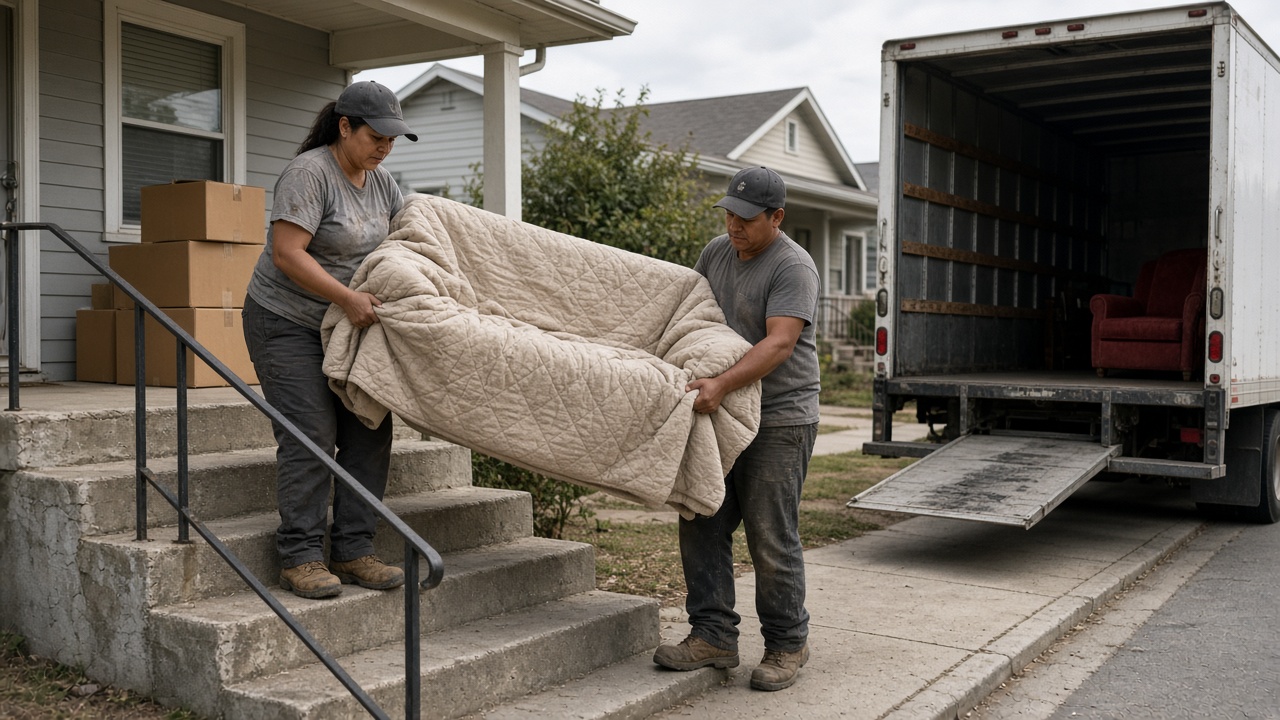
A one-day move with hired helpers works when the boxes, truck, and route are ready before anyone arrives.
Hiring a few helpers to load and unload is one of the most common ways homeowners use day labor. You handle the truck and the plan; the crew handles the lifting. Done well, a two- or three-bedroom move can wrap up in a single day. Done poorly, you pay a crew to wait while you tape boxes. This guide shows you how to set it up.
Labor-only help or a full-service mover?
There are two basic ways to move. A full-service moving company supplies the truck, the crew, and usually some liability coverage for your belongings, and it handles the driving. With labor-only help, you rent or borrow the truck, you or a licensed driver drive it, and you hire people only for loading, unloading, and carrying.
Labor-only help usually makes sense in these situations.
- The move is local and you are comfortable driving a rental truck
- Most items are standard furniture and boxes
- You can pack everything before moving day
- You want control over the schedule and the budget
A full-service mover or specialist may be the better call for long-distance moves, pianos, gun safes, large aquariums, slate pool tables, or valuable antiques. Those items need special equipment and know-how, and a mistake can injure someone or destroy the item.
Step 1 Pack completely before the crew arrives
This is the single biggest factor in how long your move takes. Hired helpers are fast at carrying and loading. They are slow and expensive as packers if you did not plan for it.
- Every box packed, taped, and labeled with the destination room
- Boxes kept to a weight one person can carry; heavy items like books go in small boxes
- Drawers emptied or secured, and loose items bagged
- Beds, tables, and shelving taken apart, with hardware bagged and taped to the piece
- Fragile and valuable items (documents, jewelry, medication, laptops) set aside to travel with you
If you want packing help too, say so in your job post and plan the hours for it.
Step 2 Line up the truck and the gear
If you rent a truck, reserve it early and ask about the rental company's damage coverage. Ask whether the truck has a loading ramp and whether you can rent equipment with it.
This gear makes a moving crew faster and safer.
- An appliance dolly and one or two furniture dollies
- Plenty of furniture pads or moving blankets
- Ratchet straps or rope to secure the load
- Plastic wrap for mattresses and upholstered pieces
- Basic tools for disassembly: drill, screwdriver set, Allen keys
- Floor and door-frame protection if your new place has finished floors
Tell the crew in advance which tools you provide and which, if any, they should bring.
Step 3 Plan both ends of the move
Movers lose the most time at the two addresses, not on the road.
- Reserve elevators or loading docks if either building has them
- Check whether you need a parking permit or a reserved space for the truck; some cities require one for street loading
- Measure doorways, stairs, and hallways for your largest pieces
- Clear a straight path from the door to the truck at both ends
- Decide where boxes go at the new place and tape room labels on doors
Step 4 Size the crew and the schedule
Two helpers are common for a small apartment, and three or more for a larger house, but stairs, long carries, and heavy furniture change the math. ChambaMatters has detailed starting points in How Many Workers Do You Need? A Crew-Size Guide for Moving, Landscaping, and Cleanup (https://chambanow.com/chambamatters/how-many-workers-do-you-need-a-crew-size-guide-for-moving-landscaping-and-cleanu).
Decide who rides where. Many labor-only crews need a ride between the two addresses, or will follow in their own car. Settle this in the job post so nobody is stranded, and be clear about whether drive time is paid. For hourly workers, travel from one job site to another during the workday is generally counted as work time under federal wage rules (https://www.dol.gov/agencies/whd/fact-sheets/22-flsa-hours-worked).
Step 5 Set fair pay and post the job
Moving is hard physical work. The Bureau of Labor Statistics reports a May 2025 national median of $18.38 an hour for hand laborers and material movers (https://www.bls.gov/ooh/transportation-and-material-moving/hand-laborers-and-material-movers.htm). Local rates vary, and you may need to offer more for stairs, very heavy items, or same-day requests to attract workers. Your rate must at least meet your state and local minimum wage (https://www.dol.gov/agencies/whd/minimum-wage/state).
In your job post, include the date, start time, both neighborhoods, number of bedrooms, stairs or elevators at each end, any very heavy items, whether a ride is provided, the pay, and how you will pay. ChambaNOW is free to post, and you can message the workers who apply about that move. Look at local pages such as https://chambanow.com/hire/houston-tx/moving, https://chambanow.com/hire/chicago-il/moving, or https://chambanow.com/hire/san-diego-ca/moving, or start at https://chambanow.com/for-hirers.
Step 6 Run moving day
Start with a five-minute walkthrough. Point out the fragile items, the pieces that need to come apart, anything that is not moving, and the order you want the truck loaded. A common approach is heaviest and largest items first, against the front wall of the truck, with boxes stacked tight and the load strapped in sections.
Lifting is where people get hurt. NIOSH's lifting guidelines use 51 pounds as the starting maximum for an ideal two-handed lift, and the recommended weight drops when loads are bulky, low, far from the body, or carried while twisting (https://www.cdc.gov/niosh/media/pdfs/Ergonomic-Guidelines-for-Manual-Material-Handling_2007-131.pdf). That is why dollies, two-person carries, and smaller boxes matter. Never pressure anyone to carry something alone.
Keep water out and give breaks, especially in hot weather. OSHA notes that new workers are at the highest risk of heat illness and recommends water, rest, and shade (https://www.osha.gov/heat-exposure/water-rest-shade).
If something gets damaged
Even careful crews sometimes scratch a wall or ding a table. Decide ahead of time how you will handle it, and say it calmly at the start: point out anything already damaged, ask the crew to tell you right away if something happens, and take photos of valuable pieces before they are loaded. Labor-only helpers may not carry the kind of coverage for your belongings that a moving company offers, so check what your renters or homeowners policy covers for belongings in transit. Protecting pieces with pads and wrap up front is cheaper than any claim.
Step 7 Unload, check, and pay
At the new place, stand at the door and direct traffic room by room. Have the crew reassemble beds and tables if that was part of the deal. Before anyone leaves, walk through, check for damage, and confirm everything came off the truck.
Pay as agreed, in full, before the crew leaves. Note the date, names, hours, and amount for your records.
Moving day checklist
- Everything packed and labeled the night before
- Truck, dollies, pads, straps, and tools ready
- Elevator, dock, or parking reserved at both ends
- Paths cleared and largest pieces measured
- Crew confirmed in writing with start time, address, ride plan, and pay
- Water and snacks on hand
- Valuables traveling with you
- Final walkthrough at both addresses before paying
This guide is general information. Truck rental terms, parking rules, and insurance vary, so check with your rental company, your city, and your insurer.
Sources
- Bureau of Labor Statistics, Hand Laborers and Material Movers: https://www.bls.gov/ooh/transportation-and-material-moving/hand-laborers-and-material-movers.htm
- U.S. Department of Labor, State Minimum Wage Laws: https://www.dol.gov/agencies/whd/minimum-wage/state
- U.S. Department of Labor, Fact Sheet 22, Hours Worked: https://www.dol.gov/agencies/whd/fact-sheets/22-flsa-hours-worked
- NIOSH, Ergonomic Guidelines for Manual Material Handling: https://www.cdc.gov/niosh/media/pdfs/Ergonomic-Guidelines-for-Manual-Material-Handling_2007-131.pdf
- OSHA, Water. Rest. Shade.: https://www.osha.gov/heat-exposure/water-rest-shade
Written by Barry Graham, Founder, ChambaNOW
Building knowledge that works.