
Taking Down Holiday Lights and Decorations: What to Pay and What to Ask
Holiday lights come down faster and safer when you hire help and plan the takedown in advance.
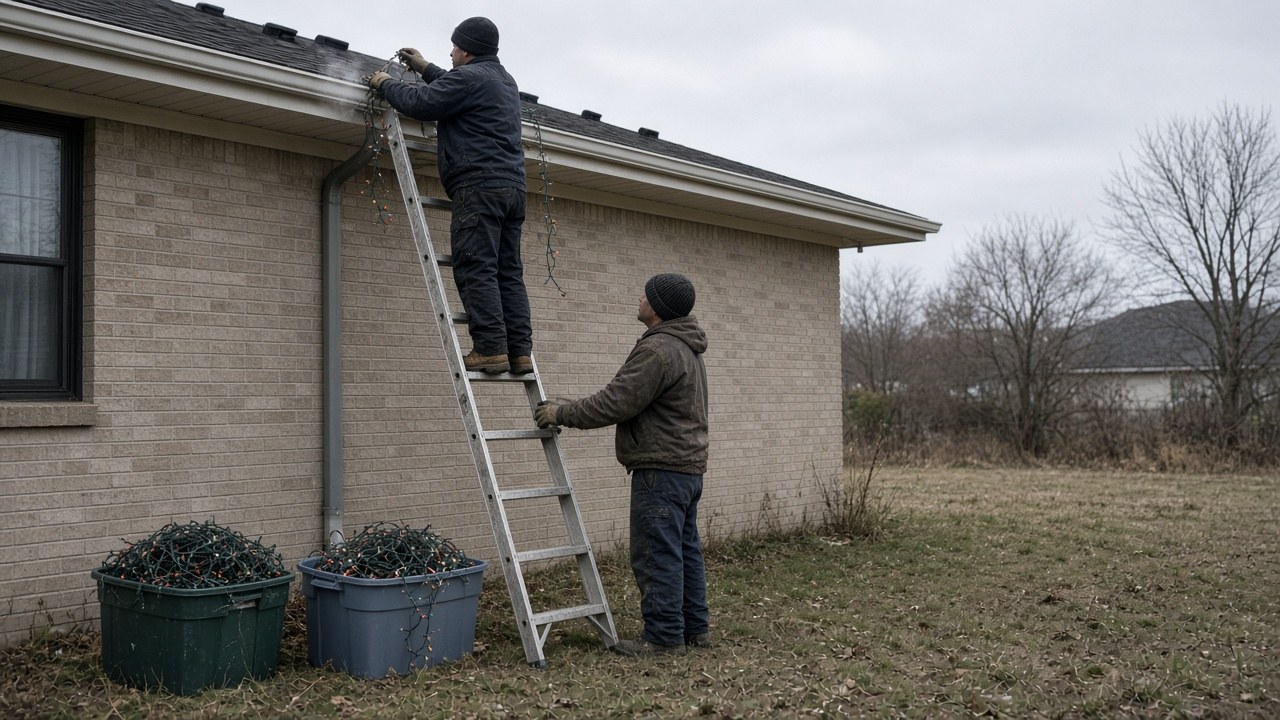
Holiday lights come down faster and safer when you hire help and plan the takedown in advance.
Putting lights up gets most of the attention, but taking them down is its own job. Ladders, cold weather, and dried-out trees are the main risks in January. This guide covers what to pay, what general labor can do, and how to store decorations so they are ready next year. It is a companion to how much it costs to hire someone to hang Christmas lights (https://chambanow.com/chambamatters/how-much-does-it-cost-to-hire-someone-to-hang-christmas-lights), which focuses on the install.
Why takedown should not wait
The National Fire Protection Association reports that more than one-third of U.S. home fires involving Christmas trees occur in January. NFPA advises getting rid of the tree after Christmas or when it is dry, and not leaving a dried-out tree in the home, in the garage, or outside against the house. Use a local recycling program if your city has one.
The U.S. Fire Administration gives the same basic advice: get rid of the tree after Christmas or when it is dry, and keep it away from heat while it is still up. Outdoor lights should come inside after the holidays so they last longer and are not damaged by weather.
What general labor can do
Hired helpers are a good fit for ground-level and careful single-story work when you supply bins, labels, and a plan.
- Unplugging lights by gripping the plug, not pulling the cord, as NFPA recommends
- Taking lights off bushes, railings, windows, and a single-story roofline from a stable ladder
- Coiling strands, checking for damage, and bagging or wrapping each set
- Taking down wreaths, inflatables, stakes, and yard figures
- Carrying a tree to the curb or a recycling drop, once it is off the stand
- Moving decoration bins to an attic, basement, or garage location you choose
- A light cleanup of needles, hooks, and packing debris
Inspect strands as they come down. NFPA says to throw out sets with loose connections, broken sockets, or cracked or bare wires, and to store electrical decorations in a dry place. The U.S. Consumer Product Safety Commission also warns people to check lights for damage and to use indoor or outdoor ratings as labeled.
What needs a professional or should be skipped
- Walking on a steep, wet, or icy roof
- Two-story or higher work that needs fall protection
- Anything near overhead power lines
- Electrical changes, such as removing hardwired fixtures
- Tree removal that requires climbing or cutting large branches
If the install was done by a lighting company that included takedown, use that agreement first.
How do you keep a takedown job safe?
Use the same ladder habits as the install. OSHA's portable ladder rules, written for workplaces, are a practical benchmark.
- Step 1: Work on a dry, calm day. Ice and wind are a reason to reschedule.
- Step 2: Use a ladder tall enough that no one stands on the top rungs.
- Step 3: Set an extension ladder about 1 foot out at the base for every 4 feet of height, and extend it 3 feet above a roof edge if it is used to reach one.
- Step 4: Keep three points of contact, and have a second person foot the ladder when needed.
- Step 5: Unplug lights before you pull them. Grip the plug, not the cord.
- Step 6: Do not leave a dried tree indoors overnight once you have decided it is coming down.
For broader jobsite habits when you hire help, see a homeowner's guide to jobsite safety when hiring temporary labor (https://chambanow.com/chambamatters/a-homeowner-s-guide-to-jobsite-safety-when-hiring-temporary-labor).
What to pay and how long it takes
Takedown is usually shorter than the install if hooks are already in place and strands were labeled. There is no federal wage category for holiday-light work. Closest Bureau of Labor Statistics May 2025 national medians are $23.84 an hour for general maintenance and repair workers and $18.82 for landscaping workers. Local rates vary. See how much should you pay a day laborer in 2026 (https://chambanow.com/chambamatters/how-much-should-you-pay-a-day-laborer-in-2026-rates-by-job-type).
Example labor estimates
These are hypothetical illustrations, not quotes. They use rounded national medians.
- Single-story lights you own, 1 worker for 2 to 3 hours at about $24: about $48 to $72
- Lights plus bushes and yard figures, 2 workers for 3 hours at about $22: about $132
- Two-story front that stays on ladders, or a professional lighting crew: price that separately
- Tree to the curb and a needle cleanup: often an extra hour, not a full second job
Agree on whether storage, labeling, and tree recycling are included. If you already booked takedown with the install, confirm the date in early January so it does not slip.
A takedown checklist
- Date and a weather backup
- Which lights and decorations are in scope
- Where bins will go, and how strands should be labeled
- Ladder and a second person to foot it
- Unplug plan and outdoor-outlet locations
- Tree recycling date or drop-off site
- Damaged strands set aside, not packed with good ones
- Pay, start time, and end time
Write those details into the job post, following how to write a clear scope of work (https://chambanow.com/chambamatters/how-to-write-a-clear-scope-of-work-before-a-day-labor-job-starts).
How to hire help step by step
- Step 1: Photograph the layout before anything comes down, so next year's install is easier.
- Step 2: Set out bins, labels, and a clearly marked storage spot.
- Step 3: Post the job with the height, number of stories, tree disposal, and the rate.
- Step 4: Confirm a dry-weather date in late December or early January.
- Step 5: Walk the house with the worker, unplug together, and agree on the order of work.
- Step 6: Check that lights are coiled, labeled, and stored dry before you pay.
Hiring takedown help on ChambaNOW
ChambaNOW lists local workers in English and Spanish for seasonal labor, including January takedown and cleanup. Posting a job is free. Put the height, the tree, and the storage plan in the post, then message workers about that posted job. Start on the hirer page (https://chambanow.com/for-hirers), or browse helpers in cities such as Dallas (https://chambanow.com/hire/dallas-tx) and Chicago (https://chambanow.com/hire/chicago-il).
Quick answers
When should holiday lights and the tree come down?
After Christmas or as soon as the tree is dry. Do not leave a dried tree in the house or garage. NFPA notes that more than one-third of Christmas tree home fires occur in January.
Can I hire a day laborer to take down Christmas lights?
Yes, for ground-level and careful single-story work. Steep, icy, or two-story roof work belongs with a professional.
Is takedown cheaper than installation?
Usually, if hooks are already up and you only need a few hours. Treat it as a separate, shorter job unless you already bundled it.
What should I do with a real tree?
Use a municipal recycling pickup or drop-off if you can. Do not store a dried tree in the garage or against the house.
Sources
- National Fire Protection Association, More than one-third of Christmas tree home fires occur in January (https://www.nfpa.org/about-nfpa/press-room/news-releases/2026/more-than-one-third-of-christmas-tree-home-fires-occur-in-january)
- National Fire Protection Association, Winter holidays (https://www.nfpa.org/education-and-research/home-fire-safety/winter-holidays)
- U.S. Fire Administration, Holiday Fire Safety (https://www.usfa.fema.gov/prevention/home-fires/prevent-fires/holiday/)
- U.S. Consumer Product Safety Commission, Holiday Safety Information Center (https://www.cpsc.gov/Safety-Education/Safety-Education-Centers/Holiday-Safety)
- OSHA, 29 CFR 1926.1053, Ladders (https://www.osha.gov/laws-regs/regulations/standardnumber/1926/1926.1053)
- OSHA, Portable Ladder Safety QuickCard (https://www.osha.gov/sites/default/files/publications/PORTABLE_LADDER_QC.pdf)
- U.S. Bureau of Labor Statistics, OEWS May 2025, Maintenance and Repair Workers, General (49-9071) (https://www.bls.gov/oes/current/oes499071.htm)
- U.S. Bureau of Labor Statistics, OEWS May 2025, Landscaping and Groundskeeping Workers (37-3011) (https://www.bls.gov/oes/current/oes373011.htm)
Written by Barry Graham, Founder, ChambaNOW
Building knowledge that works.