
What Happens If a Day Laborer Gets Hurt on Your Property?
If a day laborer gets hurt on your property, the first job is getting them medical care, calling 911 for anything serious. After that, what happens depends on the relationship. If
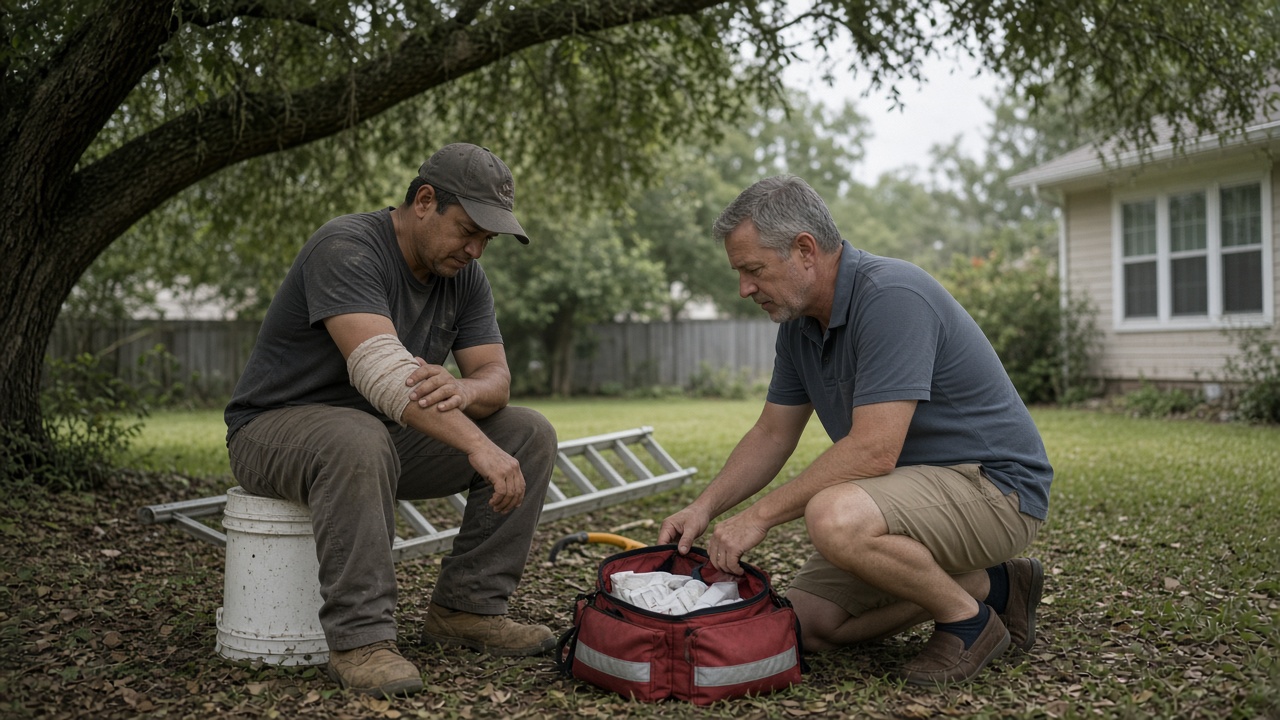
If a day laborer gets hurt on your property, the first job is getting them medical care, calling 911 for anything serious. After that, what happens depends on the relationship. If you are a contractor or business and the worker is your employee, their medical bills and lost wages generally run through your workers' compensation insurance, and serious injuries must be reported to OSHA within strict deadlines. If you are a homeowner, coverage depends on your state and your insurance policy: some states require homeowners policies to cover household workers, others do not, and an uncovered injury can leave both the worker and the homeowner exposed.
This article is general information, not legal or insurance advice. Talk to your insurer and, if needed, a licensed attorney in your state as soon as possible after an injury.
What should you do in the first hour?
- Stop the work and make the area safe
- Call 911 for serious injuries: head injuries, falls from height, heavy bleeding, chest pain, fainting, or signs of heat stroke
- For minor injuries, give first aid and offer to take the worker to urgent care
- Do not pressure the worker to keep working or to skip medical care
- Write down what happened, when, where, and who saw it
- Take photos of the area and any equipment involved
- Exchange contact information and stay in touch
What injuries are common in day labor?
A 2017 brief from the UCLA Labor Occupational Safety and Health Program and the National Day Laborer Organizing Network studied 64 day laborers injured on residential jobs in California. 75 percent of injuries were musculoskeletal, such as back strains, 17 percent were cuts, and 9 percent were broken bones. Three quarters of the injured workers lost work time, and about half lost seven or more days. 62 percent said they had felt pressure to work in dangerous conditions (https://losh.ucla.edu/wp-content/uploads/sites/37/2016/01/On-The-Job-Injuries-And-Day-Laborers-April-2017.pdf).
The same brief found that one third of injured workers paid their own medical bills, 82 percent were never compensated for lost work time, and only 5 percent received workers' compensation payments, even though many appeared eligible.
Who pays if the hirer is a contractor or business?
If the worker is your employee, the claim generally goes through your workers' compensation policy. Report the injury to your insurer right away and follow your state's claim process. The US Department of Labor's directory links to every state's workers' compensation agency (https://www.dol.gov/agencies/owcp/wc).
If the worker came through a staffing agency, OSHA treats the agency and the host employer as joint employers who share responsibility for safety, with the host typically responsible for site-specific hazards (https://www.osha.gov/temporaryworkers). The agency's workers' compensation policy may apply; notify both the agency and your insurer.
Do you have to report the injury to OSHA?
Employers covered by OSHA must report severe injuries under 29 CFR 1904.39 (https://www.ecfr.gov/current/title-29/subtitle-B/chapter-XVII/part-1904/subpart-E/section-1904.39):
- A work-related fatality: within 8 hours
- An in-patient hospitalization, amputation, or loss of an eye: within 24 hours
Reports can be made online at https://www.osha.gov/report, by phone at 1-800-321-OSHA, or at the nearest OSHA area office. These rules apply to OSHA-covered employers. Under OSHA policy at 29 CFR 1975.6, individuals who privately employ people in their own residences for ordinary domestic household tasks, such as house cleaning, cooking, and child care, are not subject to the OSH Act for that employment (https://www.ecfr.gov/current/title-29/subtitle-B/chapter-XVII/part-1975/section-1975.6). A contractor working on the same property is a covered employer.
Who pays if the hirer is a homeowner?
It depends on the state and the policy.
- California: Insurance Code section 11590 requires homeowners and other comprehensive personal liability policies to include workers' compensation for household employees. However, Labor Code section 3352 excludes household employees who, in the 90 days before the injury, worked less than 52 hours or earned $100 or less
- Other states: the 2017 UCLA brief reported that 26 states had provisions extending workers' compensation to residential employees, many with thresholds; check your state's rules
- Homeowners insurance: depending on the policy, medical payments or liability coverage may respond to an injury to someone on your property; call your insurer to find out
If no insurance applies, an injured worker may have legal claims against the person who hired them. That is a reason to check coverage before the job, as explained in the ChambaMatters guide on whether you need workers' compensation when you hire a day laborer.
Does immigration status affect an injured worker's rights?
Under federal wage law, the Department of Labor says it enforces the Fair Labor Standards Act without regard to whether workers are documented or undocumented, and that workers are owed minimum wage and overtime for hours worked (https://www.dol.gov/agencies/whd/fact-sheets/48-hoffman-plastics). Workers' compensation is state law. The UCLA brief notes that California's definition of employee covers workers "whether lawfully or unlawfully employed." Rules in other states differ; workers can contact their state agency or a worker center for help.
What records should you keep after an injury?
- Date, time, and location of the injury
- What the worker was doing and with what tools
- Names and phone numbers of witnesses
- Photos of the area
- The scope of work, hours worked, and pay
- Medical care given or offered
- Every call or message with your insurer
What should the injured worker do?
- Get medical care and keep all paperwork
- Tell the hirer in writing, by text if that is easiest, the same day
- Write down the details while you remember them
- Ask whether the hirer has workers' compensation or insurance
- Contact your state's workers' compensation agency, a worker center, or a legal aid group if you are unsure of your rights
ChambaMatters explains how to get help in https://chambanow.com/chambamatters/how-to-report-a-problem-and-get-help and safety rights in https://chambanow.com/chambamatters/your-right-to-a-safe-workplace.
How do you prevent injuries in the first place?
- Write a clear scope and keep workers off tasks outside it, such as roofs or trees
- Provide the right tools, ladders, and protective equipment
- Plan for heat: water, shade, and breaks
- Use team lifts for anything heavy
- Walk the site with the worker before starting to point out hazards
Where does ChambaNOW fit?
A job post on ChambaNOW, which is free to post, lets hirers describe the tasks and any hazards so workers can decide before accepting, and workers can find safety and rights information at https://chambanow.com/worker-resources. Hirers can review the process at https://chambanow.com/for-hirers and read more on hirer liability at https://chambanow.com/chambamatters/liability-when-hiring-contractors.
Key takeaways
- Get medical care first and document what happened
- For employees, claims generally go through workers' compensation; report to your insurer right away
- OSHA-covered employers must report fatalities within 8 hours and hospitalizations, amputations, or eye loss within 24 hours
- Homeowner coverage depends on the state and the policy; California requires it in homeowners policies but with a 52-hour or $100 threshold
- Check coverage before risky jobs, not after an injury
Sources
- OSHA, 29 CFR 1904.39 and reporting guidance; 29 CFR 1975.6; Protecting Temporary Workers
- U.S. Department of Labor, State Workers' Compensation Officials; Fact Sheet 48
- California Insurance Code section 11590; Labor Code section 3352
- UCLA-LOSH and NDLON, On-the-Job Injuries and Workers' Compensation Eligibility among Day Laborers in Residential Worksites in California, April 2017
Written by Barry Graham, Founder, ChambaNOW
Construyendo conocimiento que funciona.