
How Much Does Furniture Assembly Cost, and When Should You Hire Help?
Furniture assembly cost depends mostly on the hours it takes, and most single pieces take one to three hours.
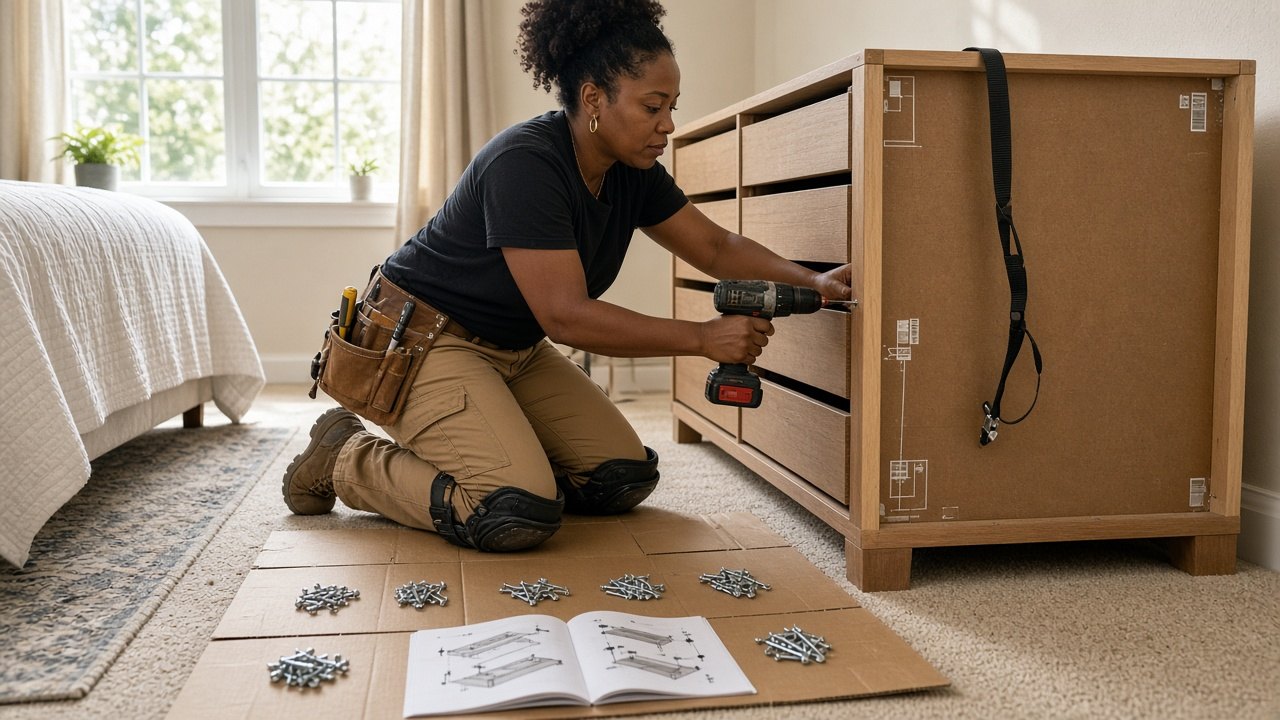
Furniture assembly cost depends mostly on the hours it takes, and most single pieces take one to three hours.
Flat-pack furniture saves money at the store, but the time it takes to build can surprise people. Beds, dressers, wardrobes, desks, and outdoor sets can eat up a whole weekend. This guide explains how to estimate the cost of hiring help, what affects the time, and the safety step many people skip.
How much does furniture assembly cost?
Assembly help is usually paid by the hour or by the piece. The closest federal wage benchmark is general maintenance and repair workers, who do this kind of work regularly. In Bureau of Labor Statistics May 2025 data, they earned a national median of $23.84 per hour, with the middle half between $19.64 and $30.10. Local rates vary.
The short answer: estimate how many hours each piece will take, multiply by a fair local hourly rate, and add a little time for unpacking, cleanup, and wall anchoring.
How long does furniture assembly take?
Times vary by brand, size, and the worker's experience. These are rough planning ranges, not guarantees. Many manufacturers print an estimated assembly time or the number of people needed in the instructions, so check there first.
- Small bookcase, nightstand, or side table: under an hour for an experienced assembler
- Desk or TV stand: about one to two hours
- Bed frame: about one to two hours, longer with storage drawers
- Six-drawer dresser: about two to three hours
- Large wardrobe or closet system: three hours or more, often two people
- Outdoor patio set or playset: from a couple of hours to a full day
Example estimates
These are hypothetical examples using a rounded rate of $24 per hour, for planning only.
- Bed frame and two nightstands, 1 worker for 2.5 hours: about $60
- Dresser and a desk, 1 worker for 4 hours: about $96
- Full bedroom set with wardrobe, 2 workers for 4 hours: about $192
- Home office with desk, shelves, and chair, 1 worker for 3 hours: about $72
What affects the cost?
- Number of pieces and parts
- Large items that need two people to lift or stand up
- Missing or damaged parts that cause delays
- Wall mounting and anchoring
- Moving boxes up stairs before assembly
- Removing old furniture and packaging
Do you need a handyman or a general helper?
Simple flat-pack assembly is a good fit for a general helper who is careful and patient. Some tasks go beyond assembly and need more skill or a license.
- Mounting TVs and heavy shelves into studs: a skilled handyman
- Anything that involves cutting into walls or electrical wiring: a licensed professional
- Built-in closet systems: an experienced installer
For more on the difference, see handyman hourly rates (https://chambanow.com/chambamatters/handyman-hourly-rates) and when to hire a handyman vs day labor for property repairs (https://chambanow.com/chambamatters/when-to-hire-a-handyman-vs-day-labor-for-property-repairs).
Why should tall furniture be anchored to the wall?
This is the step people skip, and it matters. The U.S. Consumer Product Safety Commission warns that furniture and TV tip-overs injure and kill children every year. CPSC's Anchor It campaign urges families to secure dressers, bookcases, and TVs to the wall. A federal safety standard for clothing storage units, created under the STURDY Act, also requires new dressers and similar units to meet stability tests and carry warning labels.
- Step 1: Use the anchor kit that came with the furniture, or buy one rated for the weight.
- Step 2: Attach anchors to a wall stud when possible, or use the right wall anchors for drywall.
- Step 3: Keep heavy items in lower drawers.
- Step 4: Do not put TVs on top of dressers that are not designed for them.
Ask your assembler to include anchoring in the job and confirm they have a stud finder and the right screws.
How to hire furniture assembly help step by step
- Step 1: List each piece, with brand and model if you have it.
- Step 2: Check that all boxes are delivered and in the room where they will be built.
- Step 3: Clear floor space so the worker can lay out parts.
- Step 4: Post the job with the list of items, stairs, and whether anchoring is included.
- Step 5: Agree on an hourly or per-piece rate before the worker starts.
- Step 6: Confirm tools: a drill or driver, bits, a level, a stud finder, and a hammer.
- Step 7: Inspect each piece before paying: drawers slide, doors close, and nothing wobbles.
- Step 8: Ask the worker to break down boxes and bag packaging.
Hourly or per piece?
Hourly pay is simple and fair when you are not sure how long things will take. Per-piece pay works for repeat jobs with known times. Many hirers agree on an hourly rate with an estimated range, then adjust if a piece turns out to be missing parts. See day rate vs. hourly pay (https://chambanow.com/chambamatters/day-rate-vs-hourly-pay-which-is-fairer-for-short-labor-jobs).
Assembly for offices and rentals
Businesses setting up an office and property managers furnishing rentals often need many identical pieces built at once. Here, per-piece pay can make sense, and two workers can work in parallel. Plan delivery, staging, and box removal so the crew is not waiting. See what businesses should know before hiring labor for an office move (https://chambanow.com/chambamatters/what-businesses-should-know-before-hiring-labor-for-an-office-move).
A furniture assembly checklist
- Items: list of every piece, with instructions on hand
- Space: cleared floor area in the right room
- Tools: drill, bits, level, stud finder, hammer
- Anchoring: kits for tall or heavy pieces
- Cleanup: who breaks down boxes and hauls packaging
- Pay: hourly or per-piece rate agreed in advance
Hiring assembly help on ChambaNOW
ChambaNOW lists local workers in English and Spanish who take on assembly, moving, and handyman-type jobs. Post a job free with the list of pieces, and message workers about that posted job. Start on the hirer page (https://chambanow.com/for-hirers), or browse help in cities like San Jose (https://chambanow.com/hire/san-jose-ca) and Dallas (https://chambanow.com/hire/dallas-tx).
Quick answers
How long does it take to assemble a dresser?
A large dresser often takes about two to three hours. Check the instructions for the manufacturer's estimate.
Should I pay by the hour or by the piece?
Hourly is simplest when times are uncertain. Per-piece works for repeat jobs with known times.
Do I need to anchor my dresser to the wall?
CPSC strongly recommends anchoring dressers, bookcases, and TVs to prevent tip-overs.
Can a general helper assemble furniture?
Yes. Flat-pack assembly is a good fit for a careful helper. TV mounting and electrical work need more skill.
Sources - U.S. Bureau of Labor Statistics, OEWS May 2025, Maintenance and Repair Workers, General (49-9071) (https://www.bls.gov/oes/current/oes499071.htm) - U.S. Consumer Product Safety Commission, Anchor It (https://www.anchorit.gov/) - U.S. Consumer Product Safety Commission, Furniture Tip-Over Information Center (https://www.cpsc.gov/Safety-Education/Safety-Education-Centers/Furniture-and-TV-Tip-Over-Information-Center) - U.S. Consumer Product Safety Commission, Clothing Storage Units (STURDY Act) Business Guidance (https://www.cpsc.gov/Business--Manufacturing/Business-Education/Business-Guidance/Clothing-Storage-Units)
Written by Barry Graham, Founder, ChambaNOW
Building knowledge that works.