
How Much Does a House or Garage Cleanout Cost in Labor?
Cleanout labor is usually two to four workers for a few hours to a full day, plus hauling costs.
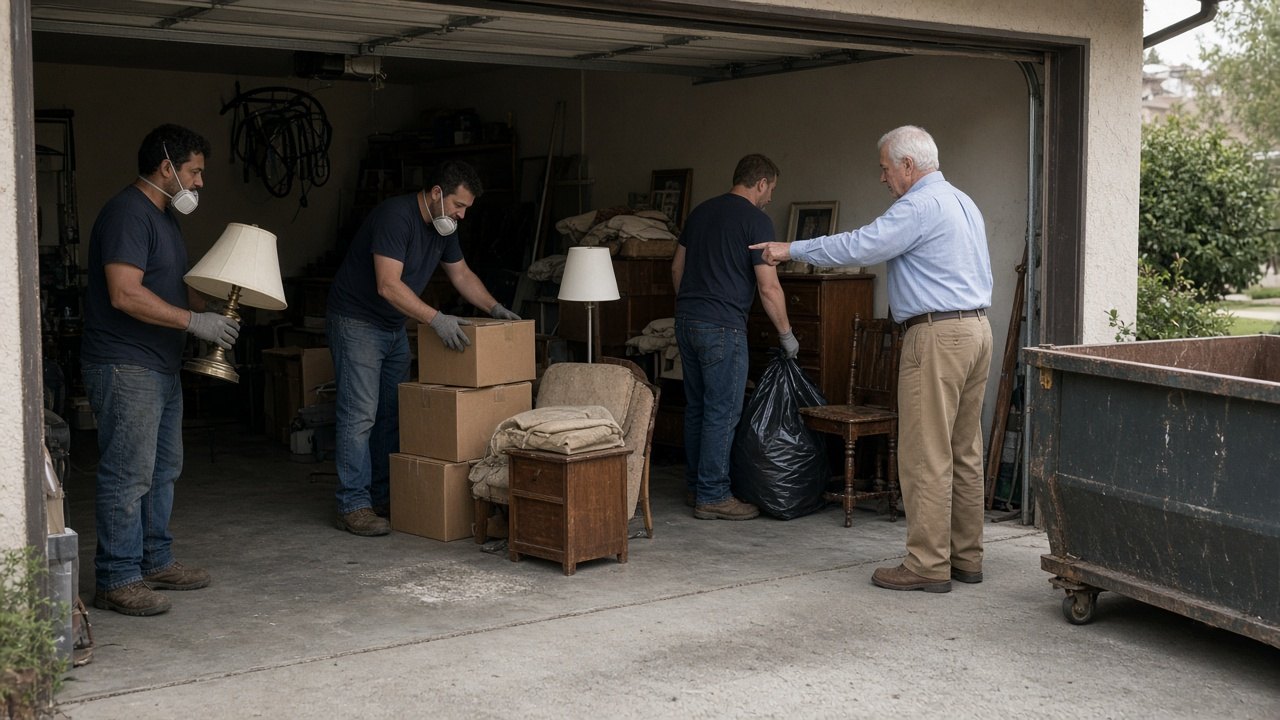
Cleanout labor is usually two to four workers for a few hours to a full day, plus hauling costs.
A cleanout clears out years of belongings, from a packed garage to a whole house after a move, a sale, or a loss in the family. The biggest costs are labor, hauling, and disposal. This guide shows how to estimate the labor, how to plan the job, and how to handle items that cannot go in the trash.
How much does a house or garage cleanout cost in labor?
Labor cost depends on how much stuff there is, how far it has to be carried, and how much sorting is needed. Most cleanouts use hand labor, and the closest federal wage benchmark is hand laborers and material movers. In Bureau of Labor Statistics May 2025 data, they earned a national median of $19.35 per hour, with the middle half between $17.35 and $22.56.
The short answer: a typical garage cleanout might take two workers four to six hours, and a full house cleanout might take three or four workers one or more full days. Disposal and truck costs are extra.
Example labor estimates
These are hypothetical examples using rounded national figures, for planning only. Local rates vary.
- One-car garage, light to moderate load, 2 workers for 4 hours at about $20: about $160
- Two-car garage, packed, 3 workers for 6 hours at about $20: about $360
- Two-bedroom house, furnished, 3 workers for 8 hours at about $20: about $480
- Large house with attic and basement, 4 workers for two 8-hour days at about $20: about $1,280
For crew sizing help, see how many workers do you need (https://chambanow.com/chambamatters/how-many-workers-do-you-need-a-crew-size-guide-for-moving-landscaping-and-cleanu).
What else does a cleanout cost besides labor?
Labor is only part of the budget. Plan for these too.
- Dumpster rental: priced by size and rental days in most areas
- Truck or trailer rental: if you are hauling to a landfill or transfer station yourself
- Landfill or transfer station fees: usually charged by weight or load
- Special disposal: paint, chemicals, electronics, tires, and appliances often have separate rules
- Donation pickup: some charities pick up usable furniture, sometimes free
How to price a one-day moving, junk removal, or yard-work job (https://chambanow.com/chambamatters/how-to-price-a-one-day-moving-junk-removal-or-yard-work-job) walks through a full budget.
Hiring a junk removal company vs. hiring labor
A junk removal company usually charges by truck volume and includes labor, hauling, and disposal. Hiring workers directly makes sense when you have a dumpster or truck already, when lots of sorting is needed, or when you want items carried to a donation or sale area instead of hauled away. Many people combine the two: workers sort and stage, and a dumpster or company hauls.
How should you plan a cleanout?
- Step 1: Decide what stays, what is sold or donated, and what goes. Mark keep items clearly before workers arrive.
- Step 2: Remove valuables, documents, medicines, and firearms from the area yourself.
- Step 3: Choose your disposal plan: dumpster, truck runs, junk removal company, or a mix.
- Step 4: Check local rules for hazardous waste and electronics.
- Step 5: Post the job with the size of the space, the type of items, stairs, and the disposal plan.
- Step 6: Set up sorting zones on site: keep, donate, recycle, trash, and hazardous.
- Step 7: Walk through the space with the crew at the start and point out anything fragile or valuable.
Our guide to writing a clear scope of work (https://chambanow.com/chambamatters/how-to-write-a-clear-scope-of-work-before-a-day-labor-job-starts) shows how to describe this in a job post.
What can't go in the trash?
Many household items need special handling. The U.S. Environmental Protection Agency explains that leftover paints, oils, cleaners, pesticides, and batteries can be household hazardous waste. Many communities run collection days or drop-off sites. These common items need a plan.
- Paint, solvents, and pool chemicals
- Motor oil, antifreeze, and gas cans
- Batteries, especially lithium batteries
- Electronics like TVs, computers, and monitors
- Refrigerators, freezers, and air conditioners, which contain refrigerants
- Tires
- Fluorescent bulbs, which contain mercury
Do not ask workers to mix chemicals or pour liquids down drains. Keep hazardous items separate and take them to the right facility.
What safety issues come up in cleanouts?
Cleanouts look simple but involve heavy lifting, sharp objects, dust, and sometimes pests or mold.
- Provide or ask workers to bring gloves, closed-toe boots, and dust masks
- Watch for nails, broken glass, and sharp metal
- Lift with legs, carry with a partner, and use a dolly for heavy items
- Avoid disturbing materials that may contain asbestos in older homes, like some old floor tiles or pipe insulation
- Stop and get professional help if there is significant mold or animal waste
See what a day laborer should bring to the job (https://chambanow.com/chambamatters/what-a-day-laborer-should-bring-to-the-job-and-what-the-hirer-should-provide).
Cleanouts after a death or an estate sale
Estate cleanouts can be emotional. Give family members time to walk through first, and label keep items clearly. Ask workers to set aside papers, photos, and anything that looks personal rather than throwing them away. Clear instructions protect everyone. If the property is being sold, coordinate the cleanout with the realtor or estate sale company so nothing they plan to sell is hauled away.
A cleanout checklist
- Space: rooms, garage, attic, basement, shed
- Volume: light, moderate, or packed
- Access: stairs, long carries, parking for a truck or dumpster
- Disposal: dumpster, truck, company, donation, and hazardous waste plan
- Sorting: keep, donate, recycle, trash, and hazardous zones
- Gear: gloves, masks, dolly, contractor bags, brooms
- Pay: hourly or day rate and how payment will happen
Hiring cleanout help on ChambaNOW
ChambaNOW lists local workers in English and Spanish who handle cleanouts, hauling, and cleaning. Post a job free, describe the space and the disposal plan, and message workers about that posted job. Browse cleaning and moving help in cities like Houston (https://chambanow.com/hire/houston-tx/cleaning), Los Angeles (https://chambanow.com/hire/los-angeles-ca/moving), and Phoenix (https://chambanow.com/hire/phoenix-az/cleaning), or start on the hirer page (https://chambanow.com/for-hirers). After the cleanout, see a guide to hiring a cleanup crew after a renovation (https://chambanow.com/chambamatters/a-guide-to-hiring-a-cleanup-crew-after-a-renovation) for deep cleaning ideas.
Quick answers
How long does a garage cleanout take?
A packed two-car garage might take three workers most of a day. Lighter loads take less time.
How many workers do I need for a house cleanout?
Three or four for a furnished house, depending on stairs and sorting.
Is it cheaper to hire labor or a junk removal company?
Labor is often cheaper if you already have a dumpster or truck. Companies include hauling and disposal in one price.
What should I do with old paint and chemicals?
Keep them separate and take them to a household hazardous waste collection site.
Sources - U.S. Bureau of Labor Statistics, OEWS May 2025, Laborers and Freight, Stock, and Material Movers, Hand (53-7062) (https://www.bls.gov/oes/current/oes537062.htm) - U.S. EPA, Household Hazardous Waste (https://www.epa.gov/hw/household-hazardous-waste-hhw) - U.S. EPA, Appliance Disposal (Section 608) (https://www.epa.gov/section608/appliance-disposal) - U.S. EPA, Used Electronics Recycling (https://www.epa.gov/recycle/electronics-donation-and-recycling) - U.S. EPA, Protect Your Family from Exposures to Asbestos (https://www.epa.gov/asbestos/protect-your-family-exposures-asbestos) - OSHA, Materials Handling and Storage (https://www.osha.gov/sites/default/files/publications/osha2236.pdf)
Written by Barry Graham, Founder, ChambaNOW
Construyendo conocimiento que funciona.