
Extra Hands for Material Staging and End-of-Day Cleanup
A laborer who stages materials and cleans at day's end can keep skilled trades moving faster.
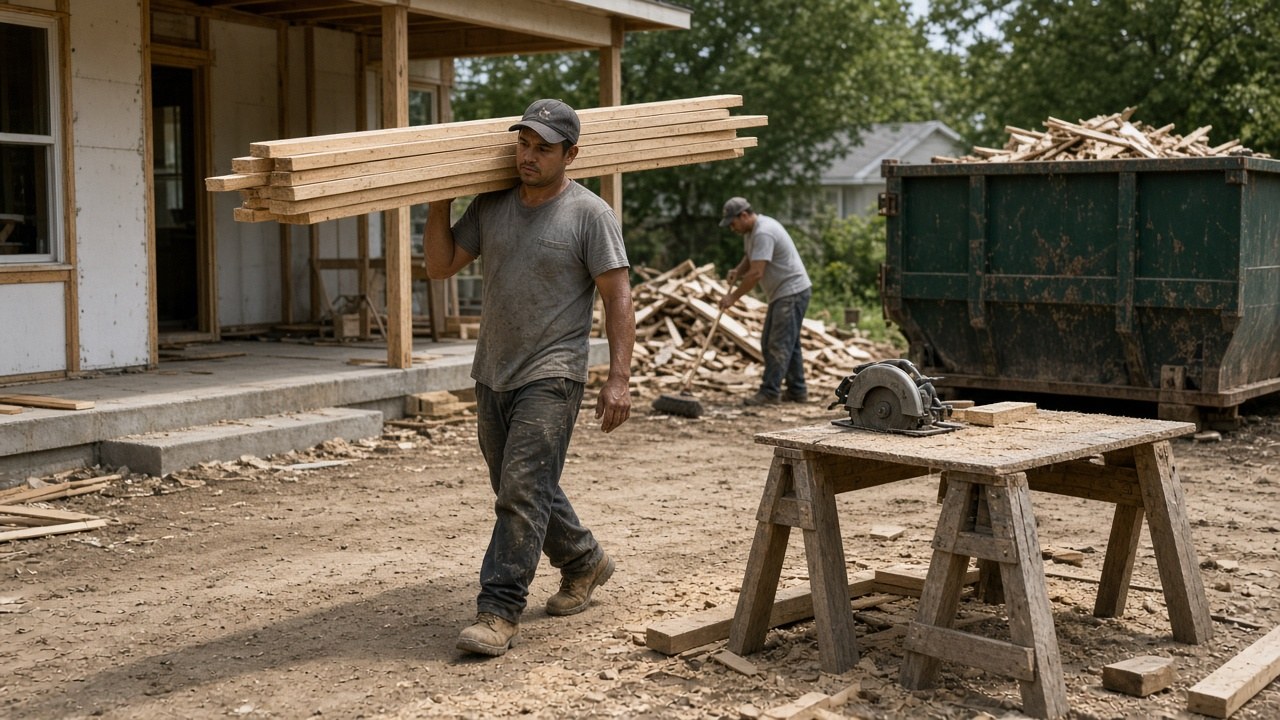
A laborer who stages materials and cleans at day's end can keep skilled trades moving faster.
On many jobs, the carpenter, electrician, or installer loses time walking materials, moving scrap, and sweeping so the next trade can start. A temporary laborer hired for staging and cleanup is often the cheapest way to buy that time back. This is a contractor's guide, not a homeowner post-renovation cleanup plan. For that, see a guide to hiring a cleanup crew after a renovation (https://chambanow.com/chambamatters/a-guide-to-hiring-a-cleanup-crew-after-a-renovation).
What this helper is for
The work is physical and specific. It is not a chance to invent a second tradesperson.
- Unloading trucks and carrying material to the room or cut station where it will be used
- Stacking lumber, drywall, tile, or fixtures so they stay off the work path
- Moving packaging, offcuts, and scrap to a dumpster or a sorted pile
- Sweeping and picking up fasteners at breaks and at the end of the day
- Protecting finished floors or installed work with paper or boards you supply
- Helping with a team lift when a lead asks
- A last walk to leave the site broom-clean and locked if that is your rule
OSHA's construction housekeeping rule, 29 CFR 1926.25, requires debris to be cleared and the site to be kept in a condition that does not create hazards (https://www.osha.gov/laws-regs/regulations/standardnumber/1926/1926.25). OSHA's material-storage rule, 29 CFR 1926.250, covers how materials may be stacked and stored so they do not fall or block access (https://www.osha.gov/laws-regs/regulations/standardnumber/1926/1926.250). A helper who follows those habits protects the schedule as well as the site.
When the extra hands pay for themselves
A helper is usually worth it when a skilled worker would otherwise spend the first and last hour of the day on carrying and cleanup, or when a delivery will land in the street until someone moves it. If your lead is waiting on material, or a dumpster is overflowing into a walkway, you are already paying for the delay.
If the site only needs a final clean after the job is over, book that as close-out work instead. Closing out a job is a different scope.
What the helper should not do
- Make layout or install decisions
- Use powder-actuated tools, powder saws, or equipment they have not been trained to use
- Work from an unguarded edge or an unsafe ladder setup
- Move energized, gas, or pressurized equipment
- Sort or haul hazardous waste you have not identified, such as paints, solvents, or asbestos-containing debris. See the EPA's household hazardous waste page if you are unsure what cannot go in ordinary trash (https://www.epa.gov/hw/household-hazardous-waste-hhw)
Confirm skills, then brief the first task. See how to confirm a worker's skills without a formal resume (https://chambanow.com/chambamatters/how-to-confirm-a-worker-s-skills-without-a-formal-resume).
How to set up the day
- Tell the helper where deliveries will land and where each material belongs
- Mark a scrap pile or dumpster, and a keep-clear path for other trades
- Provide gloves, eye protection, and any other PPE you require
- Name the person who can redirect the helper
- Build end-of-day cleanup into the paid hours, not into unpaid overtime you hope to avoid
- If the helper will also do punch-list odds and ends, write that down so it does not appear at 3:30 as a surprise
A morning briefing is worth the few minutes it takes. OSHA's training rule in 29 CFR 1926.21 is a useful reminder to point out the day's hazards before work starts (https://www.osha.gov/laws-regs/regulations/standardnumber/1926/1926.21).
What to pay and how long to book
Many contractors book a half day around a delivery, or a full day when a trade crew will be installing all day. Closest Bureau of Labor Statistics May 2025 national medians are $22.66 an hour for construction laborers and $20.51 for helpers of construction trades, all other. Local rates vary. See how much should you pay a day laborer in 2026 (https://chambanow.com/chambamatters/how-much-should-you-pay-a-day-laborer-in-2026-rates-by-job-type).
Example labor estimates
These are hypothetical illustrations, not quotes.
- Unload and stage a morning delivery, 1 laborer for 4 hours at about $23: about $92
- Full day staging and end-of-day cleanup beside a two-person trade crew, 1 laborer for 8 hours at about $23: about $184
- Two laborers for a heavy delivery plus a late dumpster run: price the extra hours and the dump fees separately
How to stage a delivery without blocking the site
Have a landing zone that is not the only walkway or the only parking stall. The helper's first job is to clear that zone into the marked stacks, not to start a random cleanup in another room. Heavy material should sit on a flat, sound surface, not on unguarded edges or in front of an exit. OSHA's storage rule is about preventing collapse and blocked access, which is exactly what a messy delivery creates.
If two trades need the same hallway, stagger the staging or have the helper move one stack as soon as a room is ready. A 10-minute move now is cheaper than a 40-minute argument at noon.
An end-of-day routine
- Stop install work with enough paid time left to clean
- Protect finished surfaces before sweeping grit across them
- Stack leftover material in the agreed place
- Fill or close the dumpster area so it is not a trip or wind hazard overnight
- Walk the path the first person will use in the morning
- Confirm tomorrow's first delivery or first task before everyone leaves
Put that routine in the helper's briefing so it is not an unpaid add-on at 4:55 p.m.
A short briefing is still required
Even if the job is "just carrying and sweeping," point out the day's hazards, the dumpster, and the off-limits areas before work starts. A helper who has not been shown a leading edge, a wet floor, or a live cut station can create a delay or an injury in the first hour. Pay for that briefing time, then get the first delivery or the first stack moving.
Hiring a staging and cleanup helper on ChambaNOW
ChambaNOW is a bilingual marketplace for contractors who need general labor and trade helpers. Posting a job is free. Put the delivery window, the site, and the rate in the post, then message workers about that posted job. Start on the hirer page (https://chambanow.com/for-hirers), or browse workers in cities such as Dallas (https://chambanow.com/hire/dallas-tx) and Phoenix (https://chambanow.com/hire/phoenix-az).
Quick answers
Is a cleanup laborer the same as a post-renovation cleaning crew?
No. Staging and end-of-day cleanup support the trades during the job. A post-renovation crew is usually for a finished house.
Do I need a laborer every day?
Only when deliveries, scrap, or skilled-trade time justify it. Many jobs need help on delivery days and on close-out days, not every shift.
Who provides the dumpster?
Usually the contractor. Say so in the post, and do not expect a helper to guess where debris goes.
Should this person also install material?
Only if you hired for that skill and have confirmed it. Staging and cleanup should stay the core of this job.
Sources
- Occupational Safety and Health Administration, 29 CFR 1926.25, Housekeeping (https://www.osha.gov/laws-regs/regulations/standardnumber/1926/1926.25)
- Occupational Safety and Health Administration, 29 CFR 1926.250, General Requirements for Storage (https://www.osha.gov/laws-regs/regulations/standardnumber/1926/1926.250)
- Occupational Safety and Health Administration, 29 CFR 1926.21, Safety Training and Education (https://www.osha.gov/laws-regs/regulations/standardnumber/1926/1926.21)
- U.S. Environmental Protection Agency, Household Hazardous Waste (https://www.epa.gov/hw/household-hazardous-waste-hhw)
- U.S. Bureau of Labor Statistics, OEWS May 2025, Construction Laborers (47-2061) (https://www.bls.gov/oes/current/oes472061.htm)
- U.S. Bureau of Labor Statistics, OEWS May 2025, Helpers, Construction Trades, All Other (47-3019) (https://www.bls.gov/oes/current/oes473019.htm)
Written by Barry Graham, Founder, ChambaNOW
Construyendo conocimiento que funciona.