
Electrician’s Helpers: What They Can and Can’t Do on a Job
An electrician's helper can speed up a job, but a licensed electrician must direct and own the electrical work.
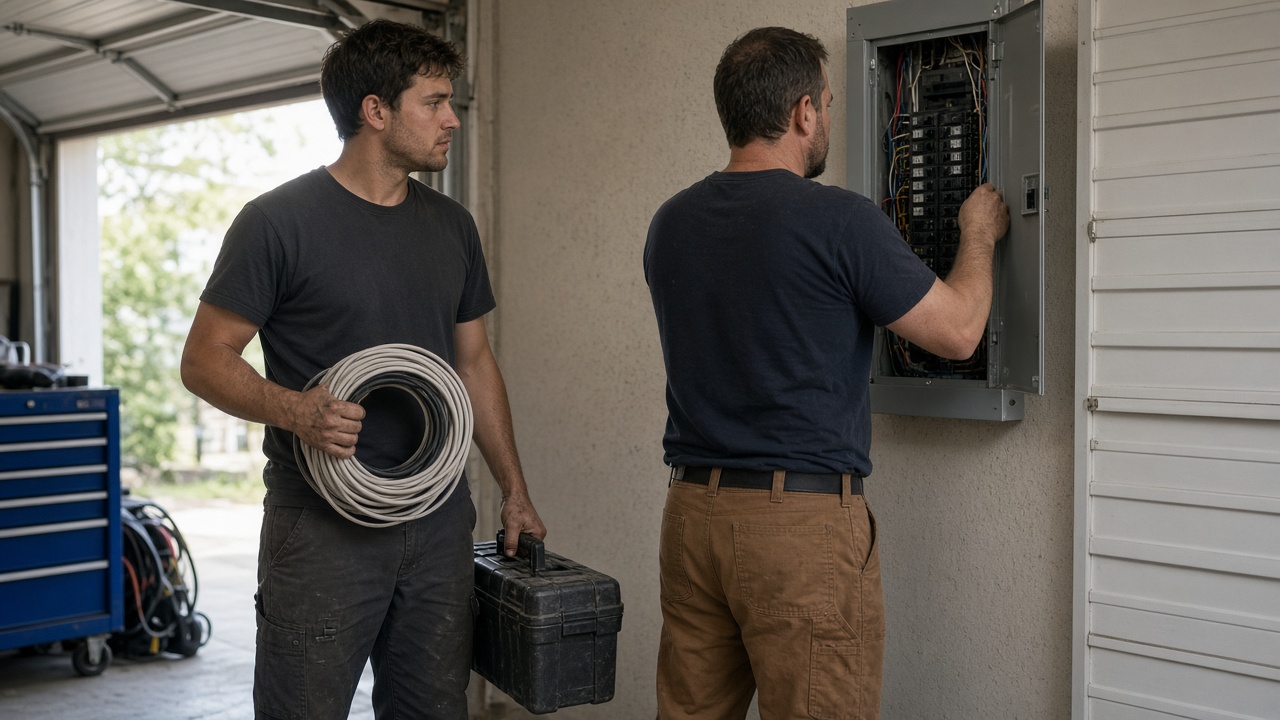
An electrician's helper can speed up a job, but a licensed electrician must direct and own the electrical work.
Electrical contractors and homeowners often ask the same question from different directions. The contractor wants to know how much work a helper can take off a licensed electrician's plate. The homeowner wants to know whether a helper can do small electrical jobs more cheaply than an electrician. The honest answer to both is that state and local licensing rules decide most of it, and those rules are stricter for electrical work than for most trades.
This guide explains the typical split between helper tasks and licensed electrical work, how licensing shapes that split, what national wage data shows for helpers and electricians, and how to hire helpers without creating legal or safety problems.
Why electrical work is different
Electrical mistakes can start fires or kill people, often long after the job is finished. That is why states and cities license electricians and why most electrical work requires permits and inspections.
Texas is a clear example. The Texas Department of Licensing and Regulation states that anyone who performs, or offers to perform, non-exempt electrical work in Texas must be licensed and perform that work through a licensed electrical contractor. Texas licenses apprentice electricians as well as journeymen and masters. Other states have their own systems, and some leave licensing to cities. Check the rules where the job is before you hire anyone to touch wiring.
Tasks helpers commonly handle
Under a licensed electrician's direction, and where state rules allow, helpers commonly do supporting work like this.
- Unloading and staging wire, conduit, boxes, fixtures, and panels
- Carrying tools and material to work areas, including attics and crawlspaces
- Setting up ladders, lighting, and extension cords for the crew
- Digging trenches for underground conduit after utilities are marked through 811
- Cleaning up wire scraps, packaging, and drilling debris
- Holding fish tape, pulling wire through, or feeding wire as the electrician directs, where the helper is permitted to assist
Whether a helper may assist with installation, such as pulling wire or mounting boxes, depends on your state. In some states, that assistance requires apprentice registration or licensing. Ask the electrician of record, not the helper, what the rules allow.
Work a helper should not do
These tasks belong to a licensed electrician, and in many places must also be permitted and inspected.
- Making connections at panels, breakers, receptacles, switches, or fixtures
- Any work on energized circuits
- Adding or modifying circuits, service equipment, or subpanels
- Deciding wire sizes, breaker sizes, or box fill
- Working unsupervised on anything electrical
OSHA's construction rules are blunt about energized work. Under 29 CFR 1926.416(a)(1), no employer may permit an employee to work close enough to an electric power circuit to contact it unless the employee is protected by deenergizing and grounding the circuit or by effectively guarding it. A temporary helper should never be put in that position.
A note for homeowners
If you are a homeowner, do not hire a general laborer or helper to do electrical work on your house, even small jobs like replacing a light fixture or adding an outlet, unless your state clearly allows it and you have confirmed the details. Hire a licensed electrician. You can still hire day labor for the non-electrical parts of a project, such as moving furniture, clearing an attic for the electrician's access, digging a marked trench, or patching drywall after the electrician is done. For licensing questions, see can a homeowner hire labor without a contractor's license (https://chambanow.com/chambamatters/can-a-homeowner-hire-labor-without-a-contractor-s-license).
Common projects and who handles what
- Kitchen remodel: a laborer can remove cabinets and haul debris after the electrician has made circuits safe, while the electrician handles new circuits, boxes, and connections.
- Ceiling fan or fixture swap: this is electrical work, so hire an electrician.
- EV charger or hot tub circuit: an electrician handles the circuit, permit, and connection, while a laborer may dig a marked trench if the electrician wants that help.
- Attic rewiring: a helper can clear the attic, lay boards for safe access, and carry material, while the electrician does the wiring.
When a task sits in a gray area, the electrician of record decides, and that decision should be made before the helper arrives.
What wage data shows
In the Bureau of Labor Statistics May 2025 national data, helpers for electricians earned a median of $20.51 per hour, with the middle half earning $17.71 to $23.30. Electricians earned a median of $30.38 per hour, with the middle half earning $23.76 to $40.36.
These are employee wages before payroll taxes and benefits. Registered or licensed apprentices are often paid on a progression scale set by an employer or apprenticeship program. A helper with prior electrical job experience may be worth more than a general laborer, but only if your state allows them to use that experience on your job.
What electrical contractors should look for in a helper
When you hire a temporary helper for electrical work, screen for these traits.
- Comfort working in attics, crawlspaces, and on ladders
- Basic tool knowledge: drills, hole saws, fish tape, and hand tools
- Reliability and attention to instructions, since helpers often work out of the electrician's sight
- Respect for lockout and "do not touch" instructions
- Proper apprentice registration or license if your state requires it for the tasks you plan
Verify registration through your state's license lookup when it applies. Ask for it in writing before the first day, not on site.
First-day briefing for a temporary helper
- Show them which circuits are off and how you confirm it
- Explain what they may touch and what they may not
- Point out attic hazards such as exposed nails and gaps between joists
- Set ladder positions and extension rules
- Tell them who to ask when anything looks wrong
Classification, insurance, and paperwork
Temporary helpers on your crew need to be covered by your workers' compensation policy, and you need to classify and document them correctly. Our guides on workers' compensation for contractors (https://chambanow.com/chambamatters/workers-comp-for-contractors) and I-9 requirements for contractors (https://chambanow.com/chambamatters/i-9-for-contractors) cover the basics.
Writing the job post
Be precise about the role so you do not attract applicants expecting electrician pay or authority.
- State that the work is under a licensed electrician's supervision
- List the actual tasks, such as material handling, trenching, attic access, and cleanup
- Say whether apprentice registration is required in your state
- Give hours, days, location, and pay
The difference between a general laborer and a skilled trade helper matters here. See general labor vs skilled trade helper (https://chambanow.com/chambamatters/general-labor-vs-skilled-trade-helper-what-s-the-difference).
Hiring on ChambaNOW
ChambaNOW lists electrical workers by city, for example in Los Angeles (https://chambanow.com/hire/los-angeles-ca/electrical). Electrical contractors can post a helper job free, review the workers who respond, and message them about that job. Homeowners should use the platform to find licensed electricians for the electrical work and laborers only for the non-electrical tasks around it. You can also start from the hirer overview (https://chambanow.com/for-hirers).
The line to hold on electrical jobs
Helpers support electrical work. Licensed electricians do it. Check your state's licensing and apprentice rules, keep helpers away from energized circuits, and give every temporary helper a clear list of what they may and may not touch.
Sources - U.S. Bureau of Labor Statistics, OEWS May 2025, Helpers--Electricians (47-3013) (https://www.bls.gov/oes/current/oes473013.htm) - U.S. Bureau of Labor Statistics, OEWS May 2025, Electricians (47-2111) (https://www.bls.gov/oes/current/oes472111.htm) - Texas Department of Licensing and Regulation, Electricians (https://www.tdlr.texas.gov/electricians/elec.htm) - OSHA, 29 CFR 1926.416, Electrical general requirements (https://www.osha.gov/laws-regs/regulations/standardnumber/1926/1926.416) - 811, Before You Dig (https://call811.com/)
Written by Barry Graham, Founder, ChambaNOW
Building knowledge that works.