
I-9 for Contractors: What Employers and HR Need to Know
Learn essential facts about the I-9 process for contractors. Know when it's needed and how to ensure you're compliant with USCIS regulations.

Independent contractors do not need to complete Form I-9. USCIS is explicit: contractors who carry on an independent business, use their own methods, and are subject to control only as to results fall outside the I-9 requirement entirely. If you have already confirmed a worker is a genuine independent contractor, you can skip the I-9 and focus on the documentation that actually matters.
Three steps to take right now:
- Confirm the worker’s classification in writing using common-law factors (control, tools, multiple clients) before any work begins.
- Collect a signed Independent Contractor Agreement, a completed W-9, and proof of independent business status (EIN, business license, or evidence of other clients).
- Check USCIS’s I-9 exceptions page to confirm the contractor exemption applies to your specific situation.
Key takeaways
Independent contractors are exempt from Form I-9 under USCIS rules, but misclassification risk means the classification decision itself carries real legal and financial consequences every employer must take seriously.
| Point | Details |
|---|---|
| Contractors are I-9 exempt | USCIS explicitly excludes independent contractors from the Form I-9 requirement. |
| Classification determines obligation | If a “contractor” is actually an employee, an I-9 was required and penalties may apply. |
| Build a contractor file | Collect a signed ICA, W-9, SOW, and proof of independent business status instead of an I-9. |
| E-Verify can flow down | Federal contracts with the FAR E-Verify clause may require subcontractor enrollment and verification. |
| Chambanow supports contractor onboarding | The platform provides verified profiles, agreement workflows, and payment records that support contractor documentation. |
Table of Contents
- Do contractors need to complete Form I-9?
- How to decide: employee or independent contractor?
- When must employers complete Form I-9 for employees?
- When does E-Verify reach contractors and subcontractors?
- What are the risks of misclassification and unauthorized hiring?
- What should HR collect instead of Form I-9 for contractors?
- How hiring platforms can reduce compliance friction for contractors
- The real cost of getting classification wrong
- Chambanow makes contractor hiring faster without cutting corners
- Sources
Do contractors need to complete Form I-9?
USCIS requires Form I-9 for every person hired to perform labor or services in the United States in return for wages or other remuneration. The key word is “hired.” Under USCIS rules, “hire” means an employer-employee relationship, not a business-to-business contract.
Independent contractors sit outside that definition. USCIS explicitly lists them among the categories of workers for whom employers do not complete Form I-9. The same exemption covers certain casual domestic workers, individuals not physically working in the United States, and employees of a staffing or contracting company, where that company, not the host business, handles I-9 compliance for its own workers.
A few categories worth knowing:
- Independent contractors: Exempt. No I-9 required from the hiring business.
- Staffing agency workers: The agency is the legal employer and completes the I-9. You do not.
- Employees of a subcontracting firm: The subcontracting firm handles its own I-9s. If you contract with a construction company, for example, that company’s I-9 obligations belong to them.
- Workers outside the U.S.: Not subject to Form I-9.
The M-274 Handbook for Employers and USCIS I-9 Central are the authoritative sources for these rules. When a situation feels borderline, those are the first places to look, not a competitor’s HR blog.
What “remuneration” means here: USCIS uses “wages or other remuneration” broadly. It covers salary, hourly pay, piece-rate, and most other compensation arrangements. A contractor paid by invoice for a defined deliverable is not receiving “wages” in the employment sense, which is part of why the contractor relationship falls outside I-9 scope.
How to decide: employee or independent contractor?
Classification is where most compliance problems start. A contract that says “independent contractor” at the top does not make the worker one. Courts, the IRS, and the Department of Labor all look past the label to the reality of the relationship.
Here is a practical checklist HR can document when classifying a worker:
- Behavioral control: Does the company control how the work is done, not just the result? If yes, that points toward employee status.
- Financial control: Does the worker have a real opportunity for profit or loss? Do they set their own rates and invoice multiple clients?
- Tools and equipment: Does the worker supply their own tools, software, or workspace? Company-supplied equipment is an employee indicator.
- Exclusivity: Is the worker prohibited from working for other clients? Exclusivity clauses undermine contractor status.
- Duration: Is the relationship indefinite, or tied to a specific project or deliverable?
- Integration: Is the worker’s role central to the company’s core business, or a distinct, specialized service?
- Public availability: Does the contractor offer services to the general public, not just your company?
Two realistic scenarios:
Genuine contractor: A graphic designer invoices three different companies each month, uses her own laptop and software, sets her own hours, and delivers finished files. She controls her methods entirely. No I-9 required.

Likely misclassification: A “contractor” who works exclusively for one company, shows up Monday through Friday at a fixed location, uses company equipment, and follows a supervisor’s daily instructions. That relationship looks like employment regardless of what the contract says, and an I-9 obligation follows.
Pro Tip: Requiring contractor-style workers to enroll in your payroll system, attend mandatory orientation, or use only company-issued tools is one of the fastest ways to create misclassification exposure. Keep contractor onboarding clearly separate from employee onboarding, and document why each step is different.
Requiring an I-9 from a genuine independent contractor can itself become evidence of an employer-employee relationship during an audit or classification review. The paperwork you collect matters as much as the contract you sign.
When must employers complete Form I-9 for employees?
For actual employees, timing is not flexible. An employee must complete Section 1 of Form I-9 no later than their first day of employment. The employer must complete Section 2 within three business days of the employee’s first day of work for pay.
Key retention rules:
- Retain each I-9 for three years after the date of hire, or one year after the date employment ends, whichever is later.
- Store I-9s separately from the employee’s general personnel file, either physically or in a secure digital system.
- Employees hired before November 6, 1986, are exempt from the I-9 requirement under the Immigration Reform and Control Act’s grandfather clause.
For contractors, there is no I-9 to retain. Build a separate contractor file instead. That file should contain the signed Independent Contractor Agreement, the completed W-9, invoices, any 1099-NEC copies, and documentation showing the contractor operates as an independent business. This file is your defense if a classification question arises later.
Retention math: If an employee works for you for two years, you retain their I-9 for three years from hire or one year from termination. Three years from hire is longer, so that is the controlling date. Most HR teams set a calendar reminder at the three-year mark from the hire date and adjust if the employee leaves sooner.
When does E-Verify reach contractors and subcontractors?
For most private-sector contractor relationships, E-Verify is voluntary. The picture changes when a federal contract is involved.
Under the Federal Acquisition Regulation (FAR) E-Verify clause, federal contractors with contracts above certain thresholds must enroll in E-Verify and verify all new hires and existing employees assigned to the contract. Critically, that obligation can flow down to subcontractors when the prime contract includes the FAR E-Verify clause.
What this means in practice:
- A self-employed independent contractor working on a covered federal contract generally does not enroll in E-Verify or complete an I-9 for themselves, because they are not an “employee” in the statutory sense.
- A subcontracting company with its own employees may need to enroll in E-Verify and verify those employees if the prime contract’s FAR clause flows down.
- Prime contractors must review their subcontractor agreements and confirm whether the flow-down applies before work begins.
Pro Tip: Add a short compliance representation clause to every subcontractor agreement on federal work. Something like: “Subcontractor represents that it is enrolled in E-Verify and will verify all employees assigned to this contract as required by the FAR E-Verify clause.” This shifts accountability clearly and gives you a paper trail if a compliance question surfaces later.
If you are unsure whether a specific federal contract triggers E-Verify obligations, the E-Verify supplemental guide for federal contractors is the right starting point, and legal counsel should review any contract where the answer is not clear.
What are the risks of misclassification and unauthorized hiring?
The enforcement landscape involves several agencies, and they do not coordinate warnings before they act.
Who enforces what:
- USCIS and ICE: Audit I-9 records, assess paperwork fines, and investigate knowing employment of unauthorized workers.
- Department of Labor (DOL): Investigates misclassification for wage-and-hour purposes. A misclassified worker may be owed back wages, overtime, and benefits.
- IRS: Pursues unpaid payroll taxes when a worker who should have been an employee was paid as a contractor.
- State agencies: Many states have their own misclassification enforcement programs with separate penalties.
Paperwork violations vs. knowing violations: USCIS distinguishes between technical I-9 paperwork errors and knowingly employing an unauthorized worker. Paperwork fines are assessed per form. Knowingly hiring someone unauthorized to work carries significantly higher civil penalties and can include criminal exposure for repeat violations.
Constructive knowledge is the concept that catches many employers off guard. A combination of red flags, such as a TIN that does not match IRS records, document inconsistencies, or a credible tip, can create a legal finding that you should have known a worker was unauthorized, even without direct proof.
If you discover a potential problem:
- Preserve all records immediately. Do not alter or destroy any documentation.
- Notify your legal counsel before taking any action with the worker.
- Conduct an internal classification review with HR and legal present.
- If a worker was misclassified, consult counsel on whether voluntary correction through IRS or DOL programs is appropriate.
What should HR collect instead of Form I-9 for contractors?
The contractor file replaces the I-9 file. Here is what it should contain:
- Signed Independent Contractor Agreement (ICA): Defines scope, payment terms, and explicitly states the worker is not an employee. Include a clause confirming the contractor is responsible for their own taxes and work-authorization compliance.
- Completed W-9: Required for 1099-NEC reporting on payments of $600 or more. Collect this before the first payment.
- Statement of Work (SOW): Describes the specific deliverable, timeline, and acceptance criteria. A project-specific SOW reinforces the contractor relationship.
- Proof of independent business: EIN confirmation, business license, or a list of other current clients. This is the documentation that holds up in a classification audit.
- Certificate of insurance: Required when the contractor’s work creates liability exposure (construction, on-site services).
- Invoices: Keep copies of all invoices. They demonstrate the contractor controls billing and payment timing.
For payment processing and 1099 reporting workflows, a payment processor built for professional services can reduce the administrative burden and help you stay current with IRS reporting requirements.
Sample contract language HR can use:
“Contractor confirms that it is authorized to perform services in the United States and is solely responsible for compliance with all applicable immigration, tax, and labor laws. Contractor is not an employee of [Company] and shall not be entitled to any employee benefits. [Company] shall not complete Form I-9 on Contractor’s behalf.”
Pro Tip: When auditing a staffing agency or subcontractor vendor, do not request their workers’ I-9s. Instead, ask for a written certification that the agency has completed I-9 verification for all workers it supplies, and confirm the agency is enrolled in E-Verify if your contract requires it. Requesting the actual I-9 forms creates privacy issues and may imply a co-employment relationship.
How hiring platforms can reduce compliance friction for contractors
Hiring marketplaces can meaningfully reduce the administrative friction of contractor onboarding, though they cannot replace the legal decisions HR must make.
What a well-built platform can support:
- Verified worker profiles: Identity and skills verification at the platform level, so you are not starting from zero on every hire.
- W-9 collection: Some platforms collect tax information during worker registration, reducing the back-and-forth at onboarding.
- Built-in contractor agreements: Digital signature workflows for independent contractor agreements before work begins.
- 1099-ready payment reports: Payment summaries organized by worker and tax year, which simplify year-end 1099-NEC filing.
- Audit trails: Timestamped records of agreements, communications, and payments that support classification documentation.
What platforms cannot do: make the classification decision for you, complete I-9s for employees, or substitute for legal review in borderline cases. A platform that lists workers as “contractors” does not guarantee they meet the legal standard for your specific engagement.
When a platform lists workers, download and store the contractor’s profile data, agreement, and payment history in your own contractor file. Do not rely solely on the platform’s records for audit purposes.
Pro Tip: Before relying on a marketplace’s documentation for compliance purposes, ask the vendor three questions: Does the platform collect W-9s from workers? Does it provide a signed contractor agreement for each engagement? Does it generate 1099-ready payment summaries? If the answer to any of these is no, fill those gaps yourself before the first payment goes out.
For employers hiring local contractors in Austin, TX or across other markets, platforms that combine profile verification with document collection can cut onboarding time significantly while keeping the contractor file complete.
The real cost of getting classification wrong
Speed is real pressure in hiring. When a project starts Monday and you need labor Friday, the temptation is to classify quickly and document later. That sequence is where most compliance problems are born.
The classification decision is not a formality. It determines whether you owe payroll taxes, whether the worker is entitled to overtime, and whether an I-9 was required. Getting it wrong in the direction of misclassification does not just create an IRS problem. It can trigger DOL wage claims, state labor board investigations, and, if the worker was unauthorized, immigration enforcement exposure that a contractor exemption would have avoided entirely.
The practical recommendation is straightforward: use the classification checklist before the engagement starts, not after. Collect the contractor file documents on day one. For any engagement where the classification is genuinely uncertain, get a legal opinion before work begins. The cost of that review is a fraction of what a misclassification finding costs to resolve.
Chambanow makes contractor hiring faster without cutting corners
Hiring contractors quickly and staying compliant are not competing goals. Chambanow is built to close the gap between them. The platform connects hirers with local workers who have verified profiles, clear availability, and the ability to communicate across language barriers through real-time translation, so you spend less time sourcing and more time getting work done.
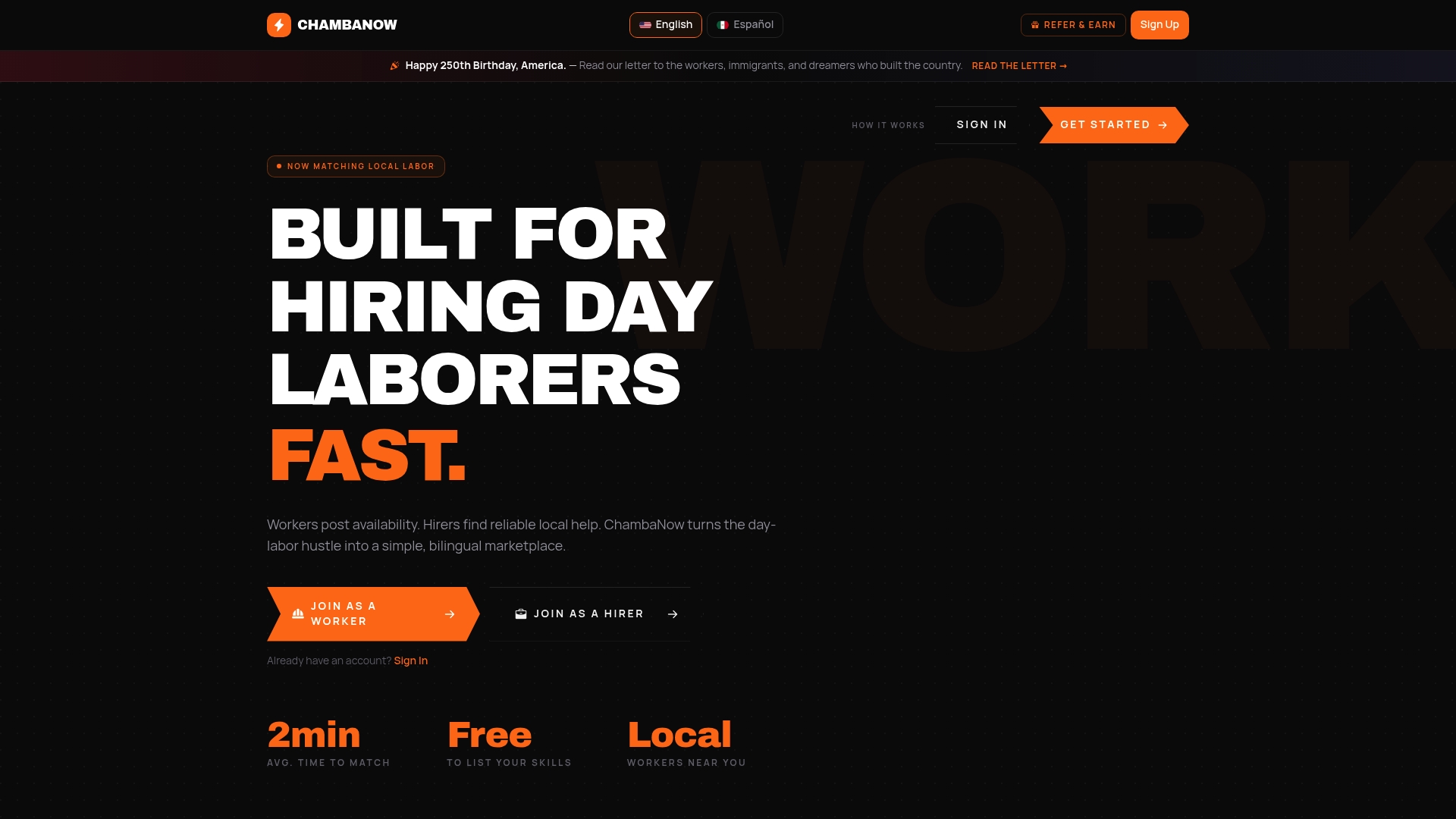
For contractor engagements, Chambanow supports the documentation side of onboarding: worker profiles that capture skills and availability, digital agreement workflows, and payment records that support 1099 reporting. It does not make classification decisions or replace I-9s when a worker is an employee. Those calls belong to HR and legal. What it does is reduce the friction between finding the right person and getting the paperwork in order.
Chambanow is not a substitute for legal compliance. It is the faster path to the workers you need, with the documentation infrastructure to back it up. Browse local workers and post your first job to see how the platform fits your contractor hiring workflow.
Sources
These official resources are the right starting point for any I-9 or contractor compliance question:
- Supplemental guide for federal contractors, subcontractors, independent contractors and volunteers | E-Verify
- I-9, Employment Eligibility Verification
For enforcement questions, classification disputes, or any situation where a worker’s status is genuinely uncertain, consult qualified legal counsel. Official guidance changes, and the stakes of getting it wrong are high enough that a professional review is worth the investment.
This article provides general information about Form I-9 requirements and contractor classification. It is not legal advice. Confirm current rules with USCIS, the Department of Labor, the IRS, or a qualified employment attorney before making compliance decisions.
Recommended
Construyendo conocimiento que funciona.