
Event Setup and Breakdown Crews: How Businesses Can Hire Fast
Event crews can be hired fast when the job is split into roles, call times, and limits before you post.
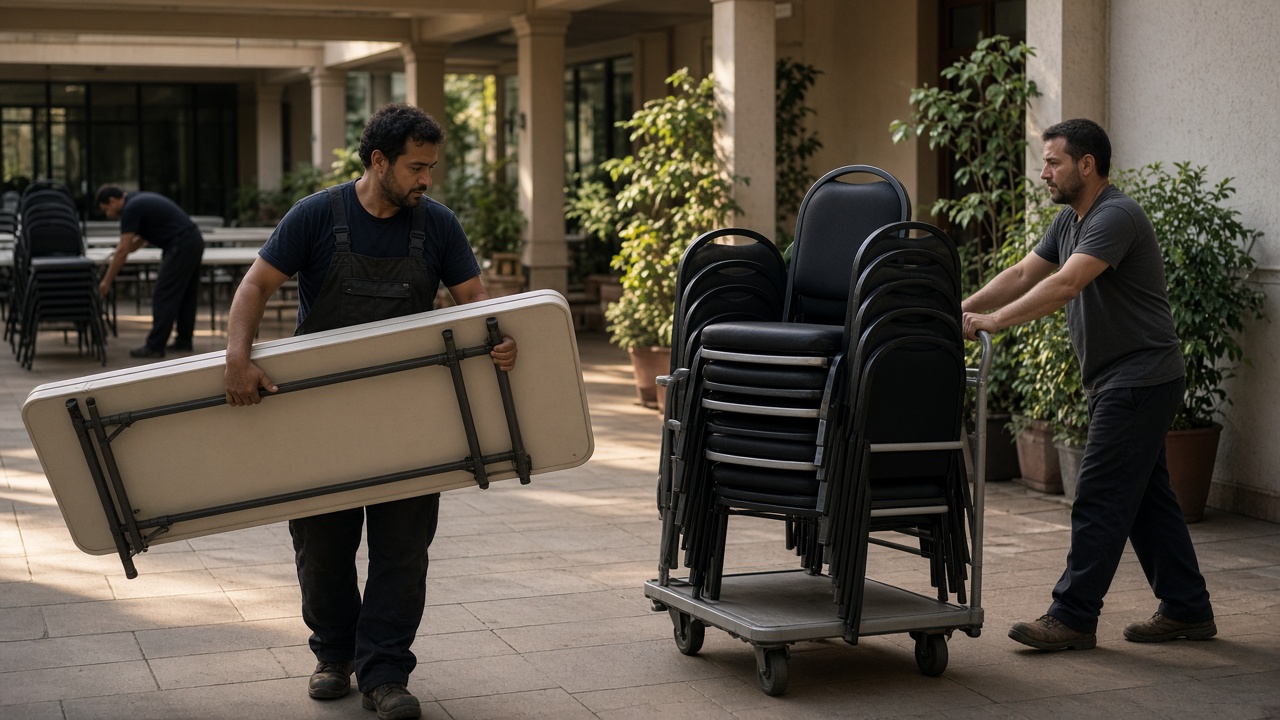
Event crews can be hired fast when the job is split into roles, call times, and limits before you post.
Corporate events, trade show booths, conferences, weddings, festivals, store openings, and community events all share a hard deadline. Setup must finish before doors open, and breakdown must finish before the venue's out-time, often late at night. When a business needs extra hands for that, speed matters. Speed without structure, though, leads to idle workers in the morning, chaos in the afternoon, and damaged rentals at midnight.
This guide is for businesses, event planners, and venue managers who need to hire setup and breakdown labor quickly. It covers how to define roles, what unskilled labor should and should not do, the permit and safety limits to respect, what wage data shows, and a fast hiring plan.
Break the event into roles
Labor posts that say "event help needed" attract everyone and prepare no one. Define roles instead.
- Load-in and load-out crew: unloads trucks, moves cases, cartons, and rentals to their positions, and reverses the process at the end
- Furniture crew: sets tables, chairs, linens, and stanchions to the floor plan
- Staging and booth assembly crew: assembles pre-engineered stage decks, booth frames, or displays following the manufacturer's or production lead's instructions
- Decor crew: places signage, decor, and branded materials
- Runners: deliver supplies, handle last-minute fixes, and keep walkways clear
- Cleanup and breakdown crew: clears trash, breaks down cartons, packs rentals, and returns the space to the venue's condition
Assign a crew lead to each role on larger events, and one overall lead who holds the floor plan and the schedule.
What general labor should not do
Some event tasks require specialists. Keep temporary general labor out of these areas unless they are working under qualified supervision.
Rigging
Hanging lights, speakers, truss, banners, or scenery overhead is specialized work. Industry certification exists for this. The Entertainment Technician Certification Program, run by ESTA, certifies riggers for arena and theatre work. Leave overhead rigging to the venue's approved riggers or a qualified production company.
Electrical power distribution
Temporary power for stages, lighting, and vendors should be handled by qualified electricians or production technicians. ETCP also certifies entertainment electricians and portable power distribution technicians. General laborers can run cable ramps and tape down cords where directed, but should not connect power distribution equipment.
Tents and temporary structures
Many fire codes based on the International Fire Code require a permit and approval from the fire code official for tents and membrane structures above a certain size. The 2022 Oregon Fire Code, for example, sets that threshold at more than 400 square feet, with exceptions such as qualifying tents open on all sides up to 700 square feet. Thresholds and editions vary, so check with your local fire marshal. Large tents are usually installed by the rental company's own trained crew.
Heavy equipment
Forklifts, scissor lifts, and boom lifts require trained and authorized operators. Do not hand keys to temporary labor because someone says they have driven one before.
What to look for in event workers
Event work rewards reliability and attention to detail more than raw strength. When you review applicants, look for these signs.
- Prior event, catering, rental, trade show, or moving experience they can describe
- Comfort following a floor plan and placing items to exact positions
- Availability for the full call, including late breakdowns
- Careful handling of rentals, glassware, AV cases, and finished venue surfaces
- A professional appearance when the crew will be visible to guests
- Reliable transportation to the venue at the call time, including late-night return
Ask one practical question: "How would you set 30 rounds of ten from a floor plan?" Experienced workers talk about reading the grid, setting tables before chairs, and checking spacing for aisles. That answer tells you more than a list of past jobs.
What wage data shows
The Bureau of Labor Statistics does not publish a specific event-setup occupation. The closest May 2025 national benchmark is hand laborers and freight, stock, and material movers, who earned a median of $19.35 per hour, with the middle half earning $17.35 to $22.56. Event labor often runs nights, weekends, and split shifts, which can push local rates above that benchmark. Some workers will ask about a minimum number of paid hours for short shifts, so decide your answer before you post.
For broader rate context, see how much you should pay a day laborer in 2026 (https://chambanow.com/chambamatters/how-much-should-you-pay-a-day-laborer-in-2026-rates-by-job-type).
A hypothetical crew budget
This is an illustration only. A business hires six workers at $20 per hour for a 5-hour setup and a 4-hour breakdown, plus a crew lead at $25 per hour for both shifts. Direct wages would be $1,080 for the crew and $225 for the lead, or $1,305, before payroll costs, parking, meals, or overtime. Splitting setup and breakdown into separate shifts, rather than paying people to wait through the event, is often the biggest savings.
A fast hiring plan
Step 1 Lock the timeline
Confirm the venue's load-in time, doors time, end time, and load-out deadline. Build call times backward from those.
Step 2 Write the role list and headcount
Use the roles above. Estimate how many people each role needs for setup and for breakdown separately.
Step 3 Post the job with specifics
Include the venue address, parking or transit details, call times, expected end times, dress code, physical demands such as lifting and standing, and pay. If you want the same people for setup and breakdown, say so.
Step 4 Confirm and reconfirm
Confirm each worker the day before with the address, check-in point, and lead's name. Expect some no-shows on short-notice jobs, and line up one or two backups.
Step 5 Brief at check-in
Spend ten minutes on the floor plan, the schedule, restricted areas, lifting rules, the emergency exits, and who to ask for help.
Step 6 Release and review
Sign workers out, confirm hours, and note who you would hire again for your next event.
Event-day safety basics
- Keep emergency exits, aisles, and fire equipment clear at all times
- Use carts and dollies, and require team lifts for heavy cases and staging
- Tape and ramp cables in walkways
- Keep workers out from under overhead work
- Plan water and breaks, especially for outdoor events in heat
Load-in and load-out are also when venue property is most likely to be damaged. Walk the space with the venue manager before setup and after breakdown, and take photos.
Hiring event crews on ChambaNOW
ChambaNOW lists general laborers by city, for example in Los Angeles (https://chambanow.com/hire/los-angeles-ca/general_labor). Businesses can post an event setup or breakdown job free, review workers who respond, and message them about that job. Live English and Spanish translation helps when crews and leads do not share a first language. For short timelines, see our guides to same-day hiring (https://chambanow.com/chambamatters/same-day-hiring) and the emergency staffing checklist (https://chambanow.com/chambamatters/emergency-staffing-checklist), or start at the hirer overview (https://chambanow.com/for-hirers).
Key takeaways for event hiring
Define roles and call times, keep rigging, power, tents, and lifts with qualified specialists, split setup and breakdown shifts, confirm workers the day before, and brief every crew at check-in.
Sources - Entertainment Technician Certification Program, ESTA (https://etcp.esta.org/) - Oregon Fire Code 2022, Chapter 31, Tents, Temporary Special Event Structures and Other Membrane Structures, via UpCodes (https://up.codes/viewer/oregon/or-fire-code-2022/chapter/31/tents-temporary-special-event-structures-and-other-membrane-structures) - U.S. Bureau of Labor Statistics, OEWS May 2025, Laborers and Freight, Stock, and Material Movers, Hand (53-7062) (https://www.bls.gov/oes/current/oes537062.htm) - OSHA, Heat Exposure (https://www.osha.gov/heat-exposure)
Written by Barry Graham, Founder, ChambaNOW
Building knowledge that works.