
Emergency Staffing Checklist: Fill Any Shift Today
Need to fill a shift quickly? Follow this emergency staffing checklist for a fast, effective way to onboard local workers today.

When a worker calls out and the shift starts in two hours, you need a plan that moves faster than paperwork. Here is a compact, 8-step emergency staffing checklist you can follow right now to post, vet, legally onboard, and pay a same-day local worker in the United States.
Quick-action checklist:
- Post the job with clear W-2 or 1099 classification stated in the title (use Chambanow for immediate local visibility)
- Vet the candidate: confirm availability, transportation, and any required licenses in under 10 minutes
- Verify work eligibility: have the worker complete Form I-9 Section 1 at hire
- Complete I-9 Section 2 by day one if the assignment is shorter than three business days
- Deliver a 5-minute site-specific safety briefing per OSHA temporary-worker guidance
- Collect a signed orientation acknowledgment and emergency contact form
- Log start and end times on a signed timesheet
- Report any incidents before the worker leaves the site
Pro Tip: Post on Chambanow in both English and Spanish. Bilingual postings reach a wider local pool and reduce the back-and-forth that costs you time when a shift is already short-staffed.
Table of Contents
- What does each step in the emergency staffing checklist actually require?
- What are the legal essentials for a same-day hire?
- How do you handle safety training before a same-day shift?
- How do you record pay and prevent disputes after the shift?
- Key Takeaways
- What actually works in same-day hires
- Chambanow gets your shift posted and filled today
- Useful sources and further reading
What does each step in the emergency staffing checklist actually require?
Follow these steps in order. Each one has a clear owner and a time window.
- Complete Form I-9 Section 2 (day one, authorized employer rep) — Examine original documents in person and sign the certification block. USCIS requires the same person who examined the documents to sign Section 2.
Pro Tip: Timebox the vetting call to 8 minutes. Set a timer. If a candidate cannot answer the six screening questions clearly in that window, move to the next profile rather than extending the call.
For same-day hires in specific markets, city pages like Tampa, FL or Pasadena, CA show workers who are available today, which cuts the screening list before you even make a call.
What are the legal essentials for a same-day hire?
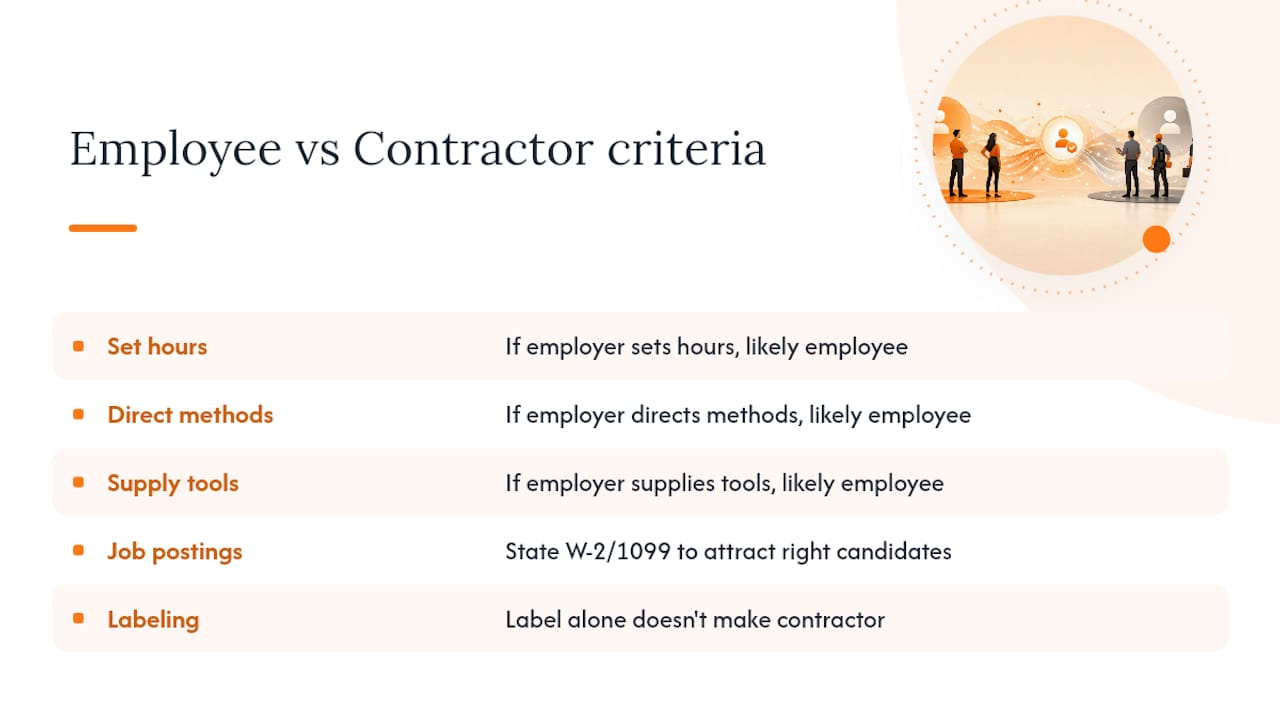
W-2 vs. 1099: get the classification right before you post
The U.S. Chamber of Commerce is direct on this: postings that explicitly state W-2 or 1099 attract the right candidates and reduce misclassification risk. Labeling a worker an independent contractor does not make them one. If you set their hours, direct their methods, and supply their tools, the Department of Labor’s economic-reality test will likely classify them as an employee regardless of what the contract says.
Form I-9 timing
USCIS rules are specific: Section 1 at hire, Section 2 within three business days. When the assignment is shorter than three business days, both sections must be completed on day one, before work begins. There is no grace period for single-day shifts.
Joint liability when using a staffing agency
Using an agency does not transfer all legal risk. The Association of Corporate Counsel notes that host companies can face joint liability even when the agency performs verification. A written contract that assigns safety training, PPE supply, and incident reporting to a named party is the clearest protection you have.
Short contract/roles checklist to include in any agency agreement:
- Named party responsible for site-specific safety training
- Named party responsible for supplying PPE
- Named party responsible for completing and retaining I-9 records
- Named party responsible for workers’ compensation coverage
- Agreed process for incident reporting and recordkeeping
The EEOC’s guidance on contingent workers adds another layer: federal anti-discrimination laws apply to temporary workers, and joint-employer status affects how complaints are assessed. Document your assignment practices.
Key compliance point: A single-paragraph written allocation of responsibilities between hirer and agency reduces confusion in urgent hires and protects both parties if a dispute arises.
How do you handle safety training before a same-day shift?
OSHA’s temporary-worker guidance is unambiguous: temporary workers must receive the same site-specific training as permanent staff, and host employers cannot outsource that responsibility to the agency. The agency handles general safety orientation; the host employer handles site-specific hazards.
Minimum site-specific briefing items (5 minutes, supervisor-led):
- Active hazards on the work site today
- Required PPE and where to find replacements
- Location of emergency exits and first-aid kit
- Lockout/tagout procedures if the worker will operate or work near machinery
- How to report an injury or near-miss before leaving the site
After the briefing, the worker initials a one-line sign-off: “I received a site-specific safety orientation on [date] at [location]. Supervisor: ______. Worker: ______.” Keep this form with the I-9.
The NIOSH/CDC best-practices publication organizes host-employer responsibilities into three categories: contracting, training, and injury reporting. Printable checklists from that resource can supplement the supervisor sign-off form above.

Pro Tip: Photograph the signed orientation form with your phone immediately after the briefing. Upload it to a shared cloud folder named by date and worker name. A photo timestamp is admissible documentation if a dispute arises later.
How do you record pay and prevent disputes after the shift?
Minimal timesheet template:
Both parties sign before the worker leaves. Pay options for same-day or next-day settlement include cash with a signed receipt, same-day ACH transfer, or platform-based payment where available. Whichever method you use, keep a copy of the receipt or transfer confirmation.
Temporary workers are still subject to federal overtime and minimum-wage rules under the Fair Labor Standards Act, and many states set higher minimums. Verify your state and local rates before posting pay. Log hours for every temporary worker the same way you log hours for permanent staff.
For disputes, create a one-paragraph incident log immediately after the shift: date, worker name, issue description, resolution attempted, and both parties’ signatures if possible. A written record created the same day carries far more weight than a recollection made weeks later.
Key Takeaways
A same-day hire succeeds when classification is clear in the posting, I-9 paperwork is completed at hire for short assignments, and a signed safety briefing happens before work begins.
| Point | Details |
|---|---|
| I-9 timing for short shifts | Complete both Section 1 and Section 2 at hire when the assignment is under three business days. |
| Classification in the posting | State W-2 or 1099 explicitly; the Department of Labor’s control test, not the contract label, determines status. |
| Site-specific safety briefing | Host employers must deliver it regardless of agency involvement; get a signed worker acknowledgment. |
| Joint-liability protection | A written contract naming who trains, supplies PPE, and files incident reports protects both hirer and agency. |
| Chambanow for same-day posting | Post on Chambanow to reach local workers immediately, with bilingual communication built in. |
What actually works in same-day hires
The single biggest delay in same-day hiring is not finding a worker. It is the back-and-forth that happens when the posting is vague. A hirer posts “need help today,” gets five responses, and then spends 45 minutes clarifying pay, location, and what to bring. By the time the shift is confirmed, half the morning is gone.
What closes shifts fast is specificity up front: the exact address, the exact start time, the pay rate, the PPE requirement, and the classification. Workers who see that information can say yes or no in one message. That clarity also filters out mismatches before they waste anyone’s time.
The second pattern worth noting is the safety briefing. Hirers who skip it because the shift is short are the ones who face the most friction afterward, whether that is an injury report, a workers’ compensation question, or a worker who simply did not know where the emergency exit was. Five minutes and a signed form close that gap entirely.
Bilingual communication matters more than most hirers expect. A worker who receives a confirmation message in their preferred language shows up prepared. One who guesses at the details shows up uncertain, and uncertainty at the start of a shift costs everyone.
Chambanow gets your shift posted and filled today
When a shift opens without warning, the gap between posting and filling it comes down to how quickly you reach workers who are ready right now. Chambanow connects hirers directly with local workers who have active profiles, posted availability, and the skills you need, without the agency markup or the waiting.
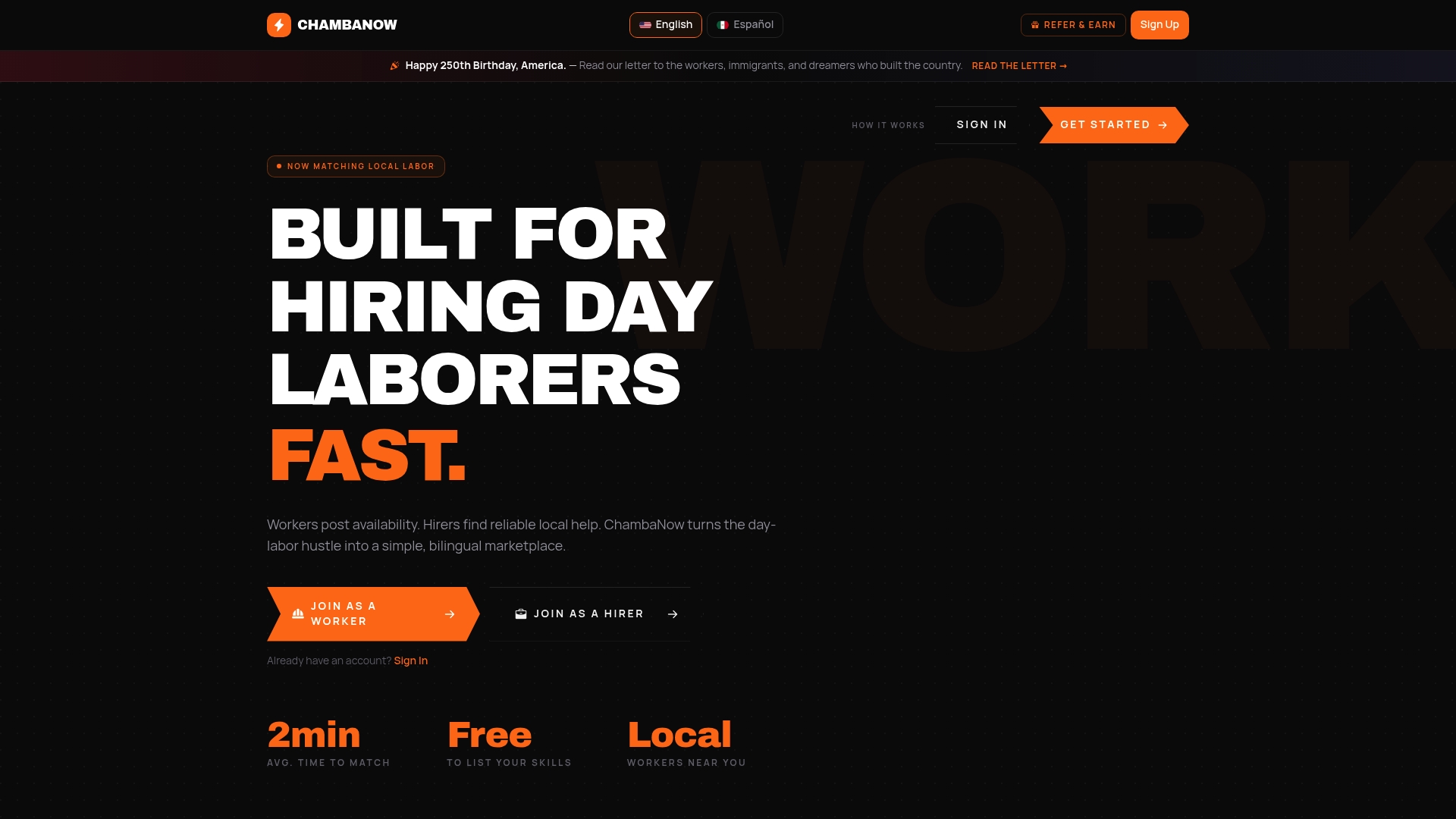
Post in English or Spanish, browse worker profiles by location and skill, and send a confirmation message through built-in real-time translation. Workers in cities like Long Beach, CA and Los Angeles, CA are on the platform today. The posting takes minutes, the communication is clear on both sides, and you stay in control of the hire from post to paycheck. Post your first job on Chambanow and see who is available in your area right now.
Useful sources and further reading
These authoritative sources back the legal and safety guidance in this guide. Bookmark the ones relevant to your situation.
- Protecting Temporary Workers | Occupational Safety and Health Administration
- Who must complete Form I-9 | USCIS Handbook for Employers (M-274)
- Protecting Temporary Workers: Best Practices | NIOSH (CDC)
- Temporary vs. contract employee: What you need to know | U.S. Chamber of Commerce
- Less meets the eye: Potential liability when using temporary workers | Association of Corporate Counsel
- Completing Section 2: Employer review and verification | USCIS M-274
- Enforcement guidance: Application of EEO laws to contingent workers | EEOC
- Contract or temporary workers | CareerOneStop (U.S. Dept. of Labor partners)
This guide provides general information, not legal or compliance advice. Verify current I-9 rules, state labor laws, and OSHA requirements with the primary sources above or a qualified employment attorney before acting.
Recommended
Building knowledge that works.