
Common-Area Upkeep for Property Managers: Walkways, Trash Rooms, and Curb Appeal
Common-area upkeep is regular labor for walkways, trash rooms, and curb appeal, not a unit turnover.
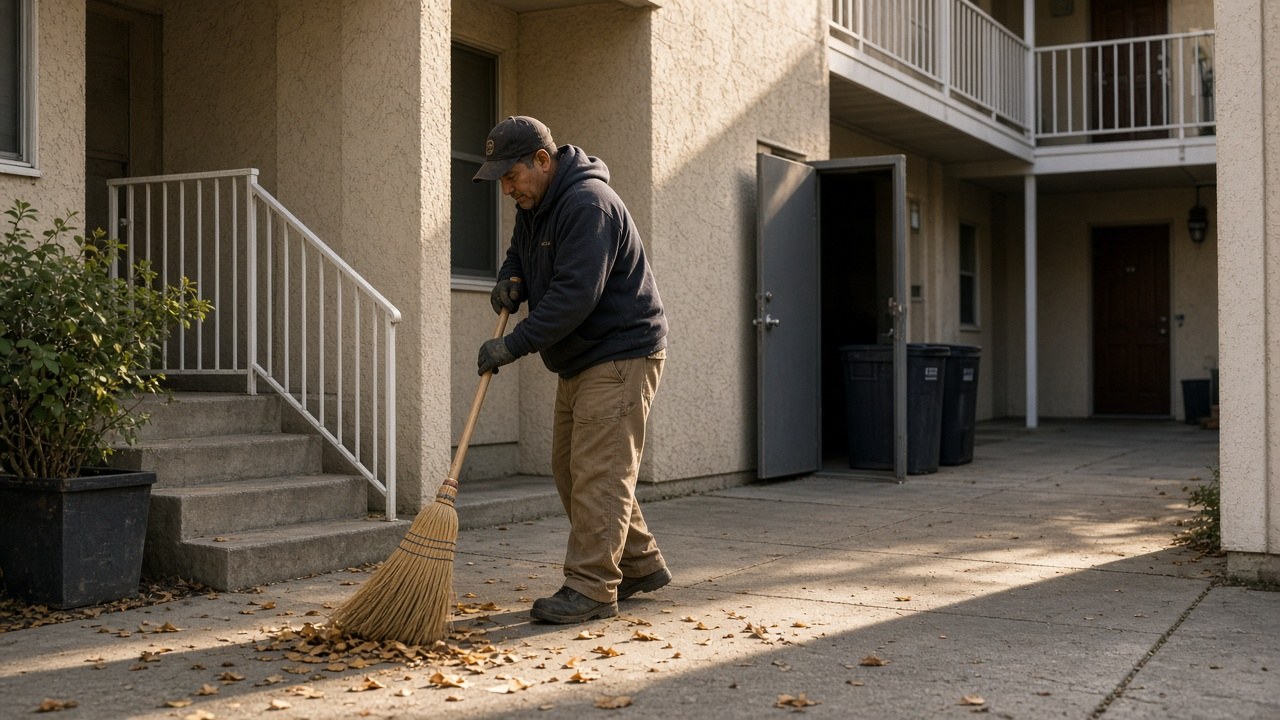
Common-area upkeep is regular labor for walkways, trash rooms, and curb appeal, not a unit turnover.
Property managers often need help between seasons, or between vendor visits, in the spaces every resident shares. Walkways, trash rooms, breezeways, and the front of the building are where a property looks cared for, or neglected. Temporary labor can handle a short, repeating list if you write it clearly. This is not pressure washing, and it is not a make-ready inside a unit. For exterior wash work, see pressure-washing and exterior cleanup labor for property managers (https://chambanow.com/chambamatters/pressure-washing-and-exterior-cleanup-labor-for-property-managers). For unit turns, see a property manager's guide to hiring turnover and make-ready labor (https://chambanow.com/chambamatters/a-property-manager-s-guide-to-hiring-turnover-and-make-ready-labor).
What common-area labor can include
- Sweeping and picking up litter on walks, stairs, and parking-lot edges
- Tidying a trash or recycling room, including bags that missed the bin
- Wiping entry glass, door hardware, and a lobby or breezeway table
- Straightening package piles in a way you have approved, without opening mail
- Pulling weeds, blowing or sweeping leaves, and a light curb-appeal tidy
- Reporting lights that are out, a broken rail, ice, or a spill
- Setting out or bringing in sandwich boards, cones, or courtesy bags you supply
Keep the list physical and bounded. Do not ask a labor crew to enforce rules, screen visitors, or discuss residents.
Keep the walking surfaces safe
Shared walks and stairs have to stay clear enough to use. OSHA's walking-working surfaces rule for general industry, 29 CFR 1910.22, requires that surfaces be kept clean, dry, and orderly so far as possible, and that spills and similar hazards be addressed (https://www.osha.gov/laws-regs/regulations/standardnumber/1910/1910.22). That rule is written for workplaces, but it is a solid standard for any property walk you ask people to use.
If snow or ice is the issue, treat it as its own job with the right tools and timing. See how to hire snow shoveling and snow removal help (https://chambanow.com/chambamatters/how-to-hire-snow-shoveling-and-snow-removal-help). Do not bury a freeze response inside a weekly tidy list.
Access, residents, and Fair Housing
Give helpers a clear map, keys or codes that are limited to common areas, and a rule about entering units, which should be never, unless a manager is present and the task is written down. The Fair Housing Act still applies to how a property is run and advertised. HUD's Fair Housing page is the starting point for the federal rules (https://www.hud.gov/fairhousing). Keep the crew off any task that looks like screening, steering, or commenting on who lives at the property.
A repeating checklist
Write a one-page route so the work is the same each visit.
- Start and end point, and the order of buildings
- Trash rooms, entries, and walks that are in scope
- Areas that are a vendor's job, such as a contracted landscaper's beds
- Supplies you provide: bags, gloves, a broom, and any cleaner
- What to photograph or text to the office
- Where to leave the site at the end of the visit
- Hours, rate, and same-day pay
A guide for property managers hiring temporary labor (https://chambanow.com/chambamatters/a-guide-for-property-managers-hiring-temporary-labor) covers access and supervision in more detail.
What to pay and how often to book
A small property may need a short visit each week. A larger one may need a half day, or two people for a monthly reset. Closest Bureau of Labor Statistics May 2025 national medians are $17.71 an hour for janitors and cleaners and $18.82 for landscaping workers. Local rates vary. See how much should you pay a day laborer in 2026 (https://chambanow.com/chambamatters/how-much-should-you-pay-a-day-laborer-in-2026-rates-by-job-type).
Example labor estimates
These are hypothetical illustrations, not quotes.
- A small building, walks and trash room, 1 worker for 3 hours at about $18: about $54
- A mid-size property, entries, walks, and curb tidy, 2 workers for 4 hours at about $18: about $144
- A monthly deeper reset, 2 workers for 6 hours at about $18: about $216
Weekly vs monthly routes
A short weekly visit is best for trash rooms, litter, and entries that go downhill fast. A longer monthly visit can handle a deeper curb-appeal tidy, cobwebs, and the corners a weekly pass skips. Do not replace a weekly trash-room stop with one big monthly clean, or the property will look neglected between visits.
If you find a worker who knows the route, keep the checklist identical so a backup person can follow it. Pay each visit on the day of the work, and confirm the next date before they leave.
Spills, needles, and other hazards
Helpers can wipe an ordinary spill and report it. They should not be asked to handle needles, blood, or unknown chemicals. Give them a rule to stop, keep people away, and call the office. The same goes for a broken rail, a dark stair, or an icy patch. Those are same-day safety calls, not notes for next week.
Write that reporting rule into the route sheet so no one has to invent it under pressure.
How to hire help step by step
- Step 1: Walk the property and write a one-page route, including what is already a vendor's job.
- Step 2: Stage bags, gloves, and tools in a locked closet the crew can reach.
- Step 3: Post the job with the hours, the rate, and the access rules.
- Step 4: Meet the first time, walk the route, and show what "done" looks like in a trash room and at an entry.
- Step 5: Collect photos or notes, pay the same day, and confirm the next visit.
Keep the rate consistent from visit to visit unless the route changes. A fair, predictable payment is one of the reasons a good helper will keep a weekly common-area job.
Hiring common-area help on ChambaNOW
ChambaNOW is a bilingual marketplace for short cleaning and general labor jobs, including repeating property work. Posting a job is free. Put the route and access rules in the post, then message workers about that posted job. Start on the hirer page (https://chambanow.com/for-hirers), or browse workers in cities such as Phoenix (https://chambanow.com/hire/phoenix-az) and Houston (https://chambanow.com/hire/houston-tx).
Quick answers
Is common-area upkeep the same as landscaping service?
No. A landscaper may already own the beds and lawn. This labor is for walks, trash rooms, entries, and light curb appeal around those contracts.
Can I have the same worker every week?
Yes, if the person is available and the work is consistent. Confirm each date, and keep the checklist the same so a backup worker can step in.
Should helpers go into units?
Not for common-area work. Unit entry should be a separate, supervised job.
What if a walk is icy?
Treat ice and snow as a same-day safety job, not as a note on next week's tidy list.
Sources
- Occupational Safety and Health Administration, 29 CFR 1910.22, Walking-Working Surfaces (https://www.osha.gov/laws-regs/regulations/standardnumber/1910/1910.22)
- U.S. Department of Housing and Urban Development, Fair Housing (https://www.hud.gov/fairhousing)
- U.S. Bureau of Labor Statistics, OEWS May 2025, Janitors and Cleaners (37-2011) (https://www.bls.gov/oes/current/oes372011.htm)
- U.S. Bureau of Labor Statistics, OEWS May 2025, Landscaping and Groundskeeping Workers (37-3011) (https://www.bls.gov/oes/current/oes373011.htm)
Written by Barry Graham, Founder, ChambaNOW
Building knowledge that works.