
Pressure-Washing and Exterior Cleanup Labor for Property Managers
Pressure washing looks easy, but runoff rules, ladders, and high-pressure spray make it more than routine cleanup.
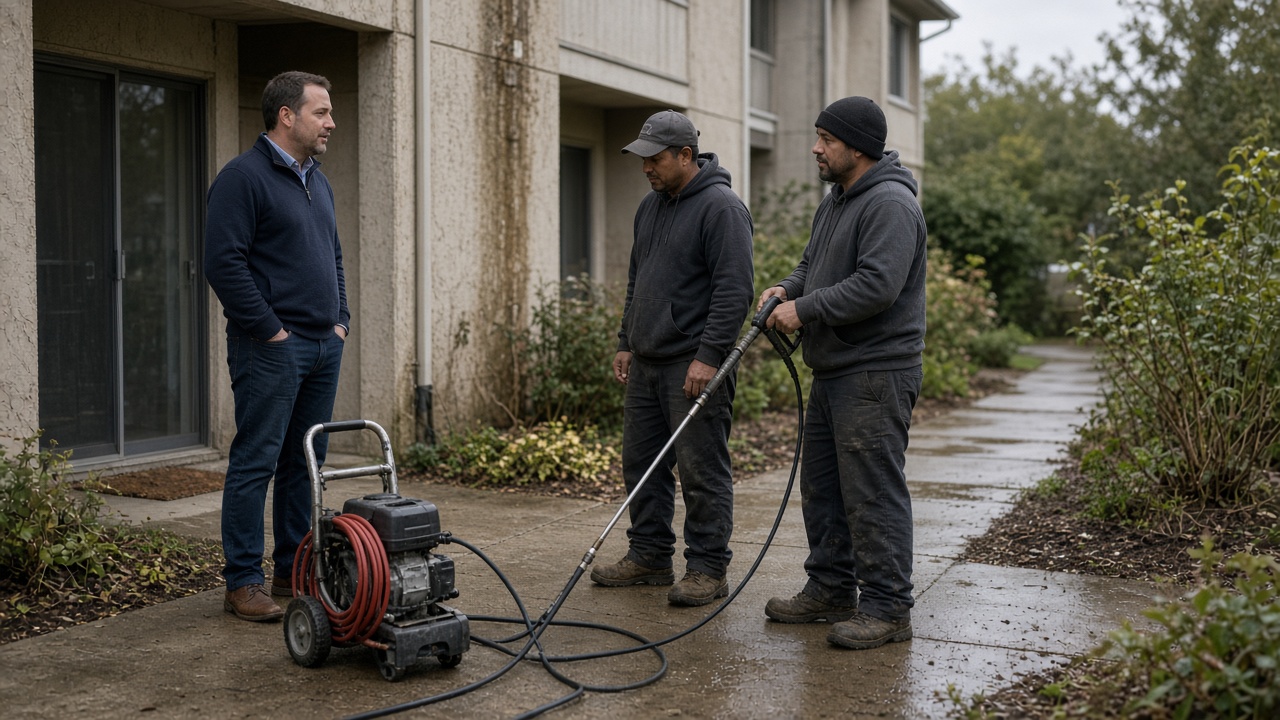
Pressure washing looks easy, but runoff rules, ladders, and high-pressure spray make it more than routine cleanup.
Property managers book pressure washing for good reasons: dirty breezeways, stained parking areas, dumpster pads, mildewed siding, gum-covered walkways, and move-out turnovers. It makes a property look cared for. It is also a job where a careless worker can etch concrete, strip paint, force water behind siding, flood a unit, send dirty water into a storm drain, or fall from a ladder. The cheapest hire is not always the cheapest outcome.
This guide is for property managers and owners of apartments, HOAs, retail centers, and office properties who hire pressure-washing or exterior cleanup labor. It covers the scope decisions to make first, the environmental and safety issues to plan for, the skills to look for, and what wage data shows.
Decide the scope before you hire
Write down exactly what you need cleaned and how. Pressure washing covers very different tasks.
- Flat concrete: sidewalks, parking areas, breezeways, pool decks, dumpster enclosures
- Building exteriors: siding, stucco, brick, and trim, which usually call for low-pressure or "soft wash" methods
- Stairs and railings in multi-story buildings
- Gum, grease, or oil stain removal
- Exterior cleanup that goes with washing, such as debris pickup, sweeping, and gutter-line cleanup at ground level
Each surface tolerates different pressure, nozzles, and cleaning products. Wood, painted surfaces, some siding, and window seals are easy to damage. A good scope names the surface, the method, and the products allowed.
Wash water is regulated, so plan for it
This is the issue most property managers underestimate. Pressure-washing wastewater can carry detergents, oil, grease, metals, dirt, and other pollutants. Ohio EPA's guidance for mobile power washers, for example, says that wastewater generated by power washing is considered industrial wastewater, that even biodegradable soaps do not change that, and that companies cannot discharge it directly into storm drains. It notes that outdoor drains in parking lots and along streets are usually storm sewers that lead to streams or lakes, not sanitary sewers.
Local programs give similar direction. Alachua County, Florida, for example, tells pressure washers to plan collection and disposal before starting, block or seal storm drains, use vacuums, berms, or other collection equipment, and dispose of collected wastewater properly. Its guidance states that discharging pressure-washing wastewater into storm drains, ditches, or gutters in the county is prohibited.
Rules differ by state and city, so contact your local stormwater or wastewater agency. At minimum, your scope should require the worker or vendor to do the following.
- Identify storm drains before starting and block or cover them
- Sweep and dry-clean debris and oil spots first
- Collect wash water rather than letting it run to the street
- Use the minimum detergent needed, and only products you approve
- Dispose of collected water where the local authority allows
Safety issues to plan for
High-pressure spray
High-pressure spray can seriously injure skin and eyes, and it throws debris. Require closed-toe footwear, eye protection, and gloves, and keep tenants and pets out of the work zone. Never let anyone point a wand at a person.
Ladders and height
Washing upper floors, overhangs, and second-story breezeways often involves ladders or extension wands. Under OSHA's construction ladder rules, ladders must have nonconductive side rails if the worker or ladder could contact exposed energized electrical equipment. Prefer extension wands and soft-wash methods from the ground over ladder work with a pressure wand, which can push a worker off balance.
Electrical
Keep spray away from exterior outlets, light fixtures, meters, panels, and overhead service lines. Cover outlets and fixtures when washing nearby, and confirm that cords and equipment are rated for wet conditions.
Slips and chemicals
Wet concrete and algae are slippery. Mark wet areas for tenants and schedule work for low-traffic hours. Store and mix cleaning chemicals according to the label, and never combine products.
Older painted surfaces
Washing can lift loose paint. Lead-based paint was used in housing before 1978, according to EPA, and EPA's Renovation, Repair and Painting rule applies to paid work that disturbs painted surfaces in pre-1978 homes, including rental properties. If the job is really paint preparation on an older building, treat it as renovation work and confirm certification requirements first.
Scheduling around tenants and businesses
Pressure washing on an occupied property is as much a logistics job as a cleaning job. Plan these details before the crew arrives.
- Send notices early enough for tenants to move cars, close windows, and bring in doormats, bikes, and plants
- For retail or office properties, wash walkways and entries before opening or after closing
- Wash upper levels before lower levels, and buildings before the parking areas below them, so dirty water does not land on clean surfaces
- Check the weather, since wind carries spray and chemicals onto cars and neighbors
- Confirm the hose bib or water source can supply the equipment, and who pays for water if a meter is involved
On large properties, split the work into zones by day and tell residents which zone is next. Fewer complaints mean fewer return trips.
What wage data shows
The Bureau of Labor Statistics does not publish a pressure-washer occupation. The closest May 2025 national benchmarks are cleaners of vehicles and equipment, who earned a median of $17.23 per hour (middle half $14.62 to $19.73), and janitors and cleaners, who earned a median of $17.71 (middle half $15.50 to $21.18). Workers who bring their own commercial equipment, water recovery systems, and insurance are running a business, and their pricing will reflect that.
When you compare a vendor's price to hiring labor, include equipment rental, water recovery gear, chemicals, insurance, and your staff's time supervising. For broader rate context, see how much you should pay a day laborer in 2026 (https://chambanow.com/chambamatters/how-much-should-you-pay-a-day-laborer-in-2026-rates-by-job-type).
What to look for in a worker or crew
- Experience with the surfaces you need cleaned, and photos of past work
- Knowledge of nozzle tips, pressure settings, and soft-wash methods
- Their plan for blocking drains and collecting water
- Their own equipment list, if they bring equipment
- Proof of insurance if they operate as a business
Ask how they would clean painted siding versus a concrete dumpster pad. If the answer is the same, keep looking.
A property manager's checklist
- Written scope by surface and method
- Approved cleaning products listed
- Storm drain and runoff plan in writing
- Tenant notice with date, time, and areas affected
- Parking and access plan for equipment
- Water source and power source confirmed
- Before and after photos for each area
- Final walk-through for damage, water intrusion, and debris
Our guide for property managers hiring temporary labor (https://chambanow.com/chambamatters/a-guide-for-property-managers-hiring-temporary-labor) covers the broader hiring process.
Hiring exterior cleanup help on ChambaNOW
ChambaNOW lists cleaning workers by city, for example in Orlando (https://chambanow.com/hire/orlando-fl/cleaning). Post the job free with your scope, review workers who respond, and message them about that job. Start at the hirer overview (https://chambanow.com/for-hirers).
Key takeaways for property managers
Define surfaces and methods, require a runoff plan, keep high-pressure work off ladders when you can, keep spray away from electrical equipment, and walk the property before and after.
Sources - Ohio EPA, Mobile Power Washing and Environmental Regulations, June 2025 (https://dam.assets.ohio.gov/image/upload/epa.ohio.gov/Portals/41/sb/publications/powerwash.pdf) - Alachua County, Best Management Practices for Pressure Washing (https://alachuacounty.us/Depts/epd/WaterResources/WaterConservation/Documents/ADACompliant/Pressure%20Washing%20BMP%202018%20modified_ADA.pdf) - OSHA, 29 CFR 1926.1053, Ladders (https://www.osha.gov/laws-regs/regulations/standardnumber/1926/1926.1053) - U.S. EPA, Lead Renovation, Repair and Painting Program (https://www.epa.gov/lead/renovation-repair-and-painting-program) - U.S. Bureau of Labor Statistics, OEWS May 2025, Cleaners of Vehicles and Equipment (53-7061) (https://www.bls.gov/oes/current/oes537061.htm) - U.S. Bureau of Labor Statistics, OEWS May 2025, Janitors and Cleaners (37-2011) (https://www.bls.gov/oes/current/oes372011.htm)
Written by Barry Graham, Founder, ChambaNOW
Building knowledge that works.