
Best TaskRabbit Alternatives for Workers in 2026
Discover the best TaskRabbit alternatives in 2026. Find the right platform for your skills and maximize your earning potential today!

The best TaskRabbit alternatives in 2026 are national lead marketplaces for home trades, specialist caregiving and pet-care platforms for recurring work, and on-demand labor pools for same-day local hiring. Each serves a different kind of worker, and picking the wrong one costs you time and money.
Here is the short version of who should go where:
- Fast day labor and bilingual local hiring: Chambanow connects workers and hirers for immediate or long-term local jobs, with free worker profiles, real-time language translation, and availability indicators built in.
- Home trades and larger projects: National lead marketplaces like Thumbtack and Angi give workers access to hundreds of service categories, from house cleaning to licensed home improvement, with quote-based bidding for bigger jobs.
- Caregiving, pet care, and recurring bookings: Specialist platforms like Care.com and Rover focus on repeat-client relationships, background-checked profiles, and niche-specific trust signals.
The right platform depends on the kind of work you want, how steady you need income to be, and how much control you want over your pricing and clients. TaskRabbit itself tends to fit ad-hoc, small-scope tasks like furniture assembly rather than repeat trade relationships, which is exactly why so many workers are looking elsewhere.
Table of Contents
- How do these TaskRabbit alternatives compare on fees, vetting, and pay?
- Platform profiles: what each marketplace actually looks like in practice
- How do you choose the right platform for your situation?
- How to sign up and land your first gigs as a worker
- Why Chambanow stands out for bilingual, immediate local hiring
- Short profiles for each alternative: pros, cons, and how to get started
- How do platforms charge workers and hirers?
- How do platforms handle customer support and disputes?
- What do platforms require from workers before they can take jobs?
- What payment methods do these platforms support?
- Key Takeaways
- What the gig platform landscape actually rewards
- Chambanow connects local workers and hirers in minutes
- Useful sources and further reading
How do these TaskRabbit alternatives compare on fees, vetting, and pay?
The table below maps nine major platforms and Chambanow across the dimensions that matter most to workers: what the platform is best for, how it charges, how it vets workers, how fast it pays, where it operates, and how easy it is to land jobs.
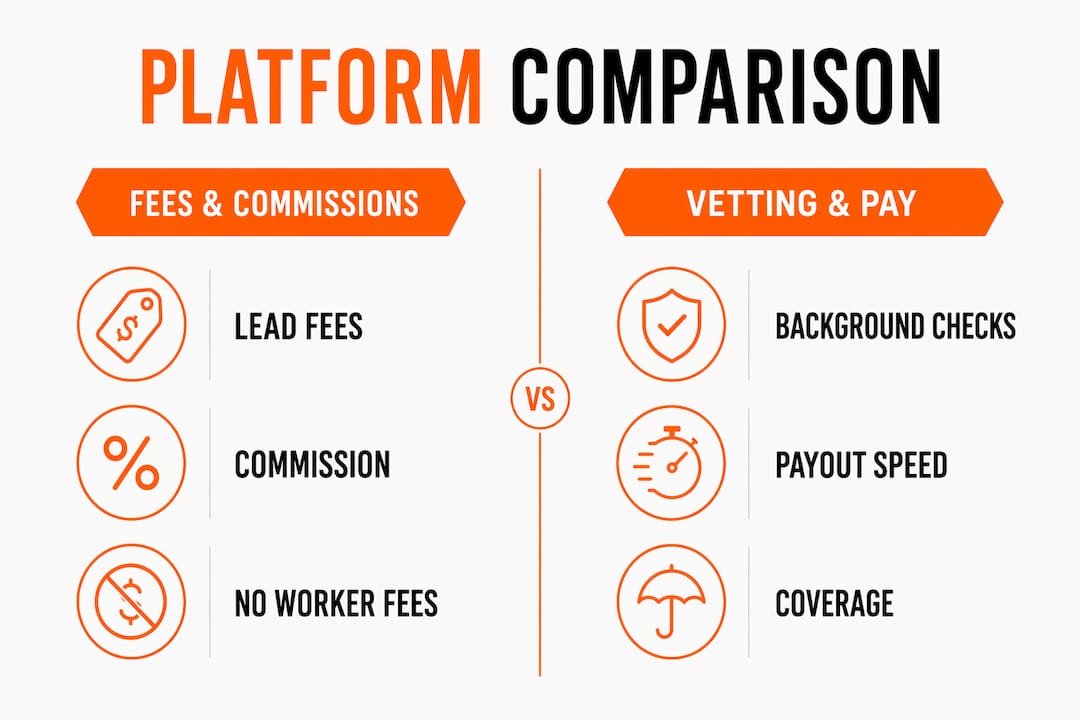
| Platform | Best for | Worker fees / commission | Vetting & background checks | Payout speed | US coverage | Ease of getting jobs | Insurance / guarantees |
|---|---|---|---|---|---|---|---|
| Chambanow | Bilingual day labor, immediate local hiring | Free for workers; hirers pay subscription | ID verification, profile review | Fast local match; direct payment | Growing metro network (Boston, LA, Houston, Austin, NYC, more) | Matching + direct apply | Dispute support; real-time translation |
| Thumbtack | Home trades, professional services | Workers pay per lead | Soft background check available | Direct deposit, varies | National | Bidding on leads | Thumbtack Guarantee on some jobs |
| Handy | Recurring home cleaning, handyman | Platform takes commission | Background check required | Weekly direct deposit | National (major metros) | Matching | Handy Happiness Guarantee |
| Care.com | Childcare, elder care, tutoring | Subscription for workers (premium) | Background check add-on | Direct payment from hirer | National | Browse + apply | Limited platform guarantee |
| Rover | Dog walking, pet sitting, boarding | ~20% platform commission | Background check required | Weekly or on-demand | National | Matching + search | Rover Guarantee, 24/7 support |
| Angi | Home improvement, licensed trades | Workers pay for leads / membership | License and background check | Varies by job | National | Lead matching | Angi Happiness Guarantee |
| Airtasker | General tasks, errands, moving | ~15–20% commission | ID verification | Fast payout | Limited US metros | Bidding | Airtasker Protection |
| Wonolo | Warehouse, events, light industrial | No fee for workers | Background check required | Same-day or next-day | National (B2B focus) | Direct matching | Employer liability |
| Jobble | Events, retail, hospitality | No fee for workers | Background check required | Weekly | National | Direct matching | Employer liability |
| Nextdoor | Neighborhood odd jobs, local referrals | Free | None formal | Arranged directly | Hyperlocal / national | Browse + message | None formal |
A few fee patterns are worth spelling out. On lead-marketplace platforms like Thumbtack and Angi, workers pay for the lead itself, whether or not the job converts. That model rewards workers who respond fast and close well, but it can drain money during slow periods. Commission-based platforms like Rover and Airtasker take a cut of each completed job instead, which means no upfront cost but a smaller net per booking. Platforms like Wonolo and Jobble charge workers nothing at all because the business hiring through the platform pays the fee. Chambanow’s model keeps worker profiles free, with hirers paying for job postings and subscriptions.
Platform profiles: what each marketplace actually looks like in practice
Understanding how each platform operates day-to-day is what separates a good fit from a frustrating one. Here is a practical look at each.
Thumbtack
Thumbtack is a national lead marketplace covering a broad range of categories from house cleaning to licensed home improvement. Workers set up a profile, define their service area, and pay per lead when a potential hirer contacts them or when they send a quote. The bidding model works well for experienced tradespeople who can close quickly, but newer workers sometimes find the lead costs add up before they build a client base.
Pros: Wide category coverage, national reach, flexible pricing control. Cons: Workers pay per lead regardless of outcome, competition can be high in dense metros.
Handy
Handy focuses on recurring home cleaning and handyman jobs. The platform matches workers to jobs automatically rather than requiring them to bid, which means less hustle to find work but also less control over scheduling. Background checks are required before a worker can accept jobs. Payout is weekly via direct deposit.

Pros: Steady recurring work, no bidding required, clear weekly pay schedule. Cons: Platform sets the rate, limited pricing flexibility for workers.
Care.com
Care.com serves childcare, elder care, tutoring, and housekeeping. Workers create profiles and apply to families directly. A premium subscription unlocks more visibility and messaging. Background checks are available but often paid for separately, which means the depth of vetting varies by worker and family. Payment is arranged directly between worker and hirer.
Pros: Large pool of families seeking ongoing help, strong niche focus. Cons: Premium features require a paid subscription, background check depth varies.
Rover
Rover is the dominant platform for dog walking, pet sitting, and boarding. The platform takes roughly 20% of each booking. Background checks are required. Workers set their own rates and availability, and Rover’s algorithm surfaces them in search results based on reviews and response time. The Rover Guarantee covers certain veterinary costs and property damage, which is a genuine trust signal for both sides.
Pros: Strong brand recognition, built-in insurance coverage, flexible scheduling. Cons: 20% commission adds up on high-volume bookings, competitive in large metros.
Angi
Angi (formerly Angie’s List) targets licensed home improvement contractors. Workers can receive matched leads or pay for a membership that increases visibility. License verification and background checks are part of the profile process for many categories. The Angi Happiness Guarantee offers some protection for hirers, which helps workers close jobs with hesitant clients.
Pros: Strong hirer trust, license verification adds credibility, national reach. Cons: Lead costs and membership fees can be significant, best suited to licensed trades.
Airtasker
Airtasker operates as a general task marketplace where hirers post jobs and workers bid. The commission runs roughly 15–20% per completed job. ID verification is required, but the depth of background checks is lighter than trade-specific platforms. Airtasker’s US presence is still growing, so coverage outside major metros can be thin.
Pros: Flexible bidding, wide task variety, fast payout. Cons: Limited US metro coverage, lighter vetting than trade platforms.
Wonolo
Wonolo connects businesses with on-demand workers for warehouse, events, and light industrial shifts. Workers apply through the app, complete a background check, and get matched to shifts posted by businesses. Payout is same-day or next-day, which is one of the fastest in the category. There is no fee for workers.

Pros: No worker fees, fast payout, steady B2B shift work. Cons: Work is shift-based rather than self-directed, limited to business clients.
Jobble
Jobble focuses on events, retail, and hospitality gigs. Like Wonolo, it charges workers nothing and pays weekly. Background checks are standard. The platform is national but skews toward urban markets with high event density.
Pros: No worker fees, broad event and hospitality coverage, weekly pay. Cons: Work volume depends heavily on local event calendar.
Nextdoor
Nextdoor is a neighborhood social network, not a formal gig marketplace. Workers can post services in their local feed and respond to neighbor requests, but there is no formal vetting, no escrow, and no dispute resolution. Payment is arranged directly. It works well for hyperlocal odd jobs where a personal referral carries more weight than a platform badge.
Pros: Zero fees, hyperlocal reach, strong community trust. Cons: No formal vetting, no payment protection, inconsistent job volume.
Pro Tip: On any platform that charges per lead, track your lead-to-booking conversion rate for the first 30 days. If you are converting fewer than one in four leads, the problem is usually your profile or response speed, not the platform itself.
How do you choose the right platform for your situation?
The best gig platform for you is the one that matches your work type, your income goals, and your tolerance for upfront costs. Here is a practical checklist to narrow it down.
-
Define your work type first. One-off small tasks (furniture assembly, errands) fit matching platforms. Licensed trade work (plumbing, electrical) fits lead marketplaces with license verification. Caregiving and pet care fit specialist platforms. Day labor and immediate local shifts fit on-demand pools or Chambanow.
-
Decide how much income variability you can absorb. Lead-marketplace models mean paying for leads before you earn. Commission models mean no upfront cost but a smaller cut per job. Zero-fee platforms like Wonolo and Jobble are lower risk but offer less pricing control.
-
Ask about dispute resolution before you sign up. A platform with no formal dispute process leaves you exposed if a hirer refuses to pay or files a false complaint. Look for escrow, milestone payments, or a named guarantee policy.
-
Check geographic coverage for your metro. National platforms vary widely in local job density. A platform with 500,000 registered workers nationally may have only a handful active in your city. Comparing local-service marketplaces by metro density is worth doing before you invest time in a profile.
-
Verify payout speed and payment method. Payout timing varies widely across platforms, from same-day to weekly to post-escrow release. If cash flow matters, prioritize platforms with same-day or next-day options.
Red flags to watch for:
- Fees that are not disclosed until after you complete a job
- No verified reviews or a review system that allows only positive ratings
- Payout held for more than 7 days with no stated reason
- Customer support that is email-only with no stated response time
- No background check option for workers in safety-sensitive categories
Trust signals that actually mean something:
- Third-party background checks (not self-reported)
- Escrow or milestone-based payments for larger jobs
- Verified license or insurance badges from a named third party
- A named guarantee policy with stated coverage limits
For larger or licensed projects, direct bidding and transparent quote comparison consistently reduces cost and risk compared to fixed-fee matching, a pattern that holds across home improvement, moving, and specialty trades.
How to sign up and land your first gigs as a worker
Getting your first booking on any gig platform comes down to three things: a complete profile, fast response time, and a realistic starting price. Here is how to move through onboarding without stalling.
-
Complete every profile field before applying to anything. Platforms surface complete profiles higher in search results and matching queues. Include a clear headshot, a short bio that names your specific skills, and at least one photo of past work if the platform allows it.
-
Complete verification steps immediately. Background checks and ID verification can take 24–72 hours. Submit them the same day you create your account so you are not locked out of applying when a good job appears.
-
Set a competitive starting rate, not your ideal rate. Your first few jobs are about building reviews, not maximizing hourly earnings. Price slightly below the local average for your category, then raise rates after you have five or more positive reviews.
-
Set your availability accurately. Platforms that use availability indicators, like Chambanow, surface workers who are marked as ready to work. Keeping your availability current is one of the simplest ways to get matched faster.
-
Apply or respond within the first hour. On most platforms, the first two or three workers to respond to a new job posting get the majority of hirer attention. Speed matters more than a perfectly crafted message.
Profile tips that build trust for local gigs:
- Use a photo taken in good natural light with a neutral background
- Name specific tools or certifications you hold (e.g., “licensed electrician,” “CPR certified,” “bilingual English/Spanish”)
- Ask your first few clients to leave a review immediately after the job, while the experience is fresh
Workers looking for worker resources and onboarding guidance can find platform-specific help that covers profile setup and first-job tips.
Why Chambanow stands out for bilingual, immediate local hiring
Chambanow was built around a specific problem: the gap between workers who are ready to work today and hirers who need someone now but cannot communicate across a language barrier. Most gig platforms treat language as an afterthought. Chambanow treats it as a core feature.
Here is what that looks like in practice:
- Free worker profiles with no subscription or lead fee for workers
- Availability indicators so hirers can see who is ready to work right now, not just who is registered
- Automatic real-time language translation in messaging, so a Spanish-speaking worker and an English-speaking hirer can communicate without a third party
- Immediate local-hire flow designed for day labor, short-term staffing, and urgent local needs
- City-specific hiring pages that connect hirers directly to workers in their metro, including Boston, Houston, Austin, Tucson, and New York
The use cases where Chambanow is a strong fit include day labor for construction and landscaping, urgent local staffing for small businesses and events, and any hiring situation where language differences have slowed things down in the past.
Pro Tip: Hirers on Chambanow can reduce time-to-hire significantly by posting a job with a specific start time and using the availability filter to see only workers who are marked as ready. That combination typically surfaces a shortlist of qualified, available workers within minutes rather than hours.
Short profiles for each alternative: pros, cons, and how to get started
This section brings together the practical entry points for each platform so workers and hirers can act without digging through multiple sign-up flows.
Thumbtack: Create a free profile, define your service area and categories, then set a budget for leads. Hirers search and request quotes; workers respond. Best for experienced tradespeople who can close quickly. Start at thumbtack.com, complete your profile, and set a modest daily lead budget while you build reviews.
Handy: Apply through the Handy pro portal, pass a background check, and wait for job matches in your area. No bidding required. Best for cleaners and handymen who want steady, predictable work without the hustle of lead generation. Payout is weekly.
Care.com: Create a caregiver profile, list your certifications and experience, and apply to family postings directly. A premium membership increases your visibility. Best for caregivers, tutors, and housekeepers seeking ongoing client relationships. Background check options are available at an added cost.
Rover: Sign up as a sitter or walker, complete a background check, set your rates and service area, and go through Rover’s onboarding quiz. Best for pet lovers who want flexible scheduling and repeat clients. The Rover Guarantee provides a meaningful safety net for both sides.
Angi: Register as a pro, verify your license and insurance where required, and choose between receiving matched leads or paying for a membership. Best for licensed contractors who want hirer-trust signals built into their profile. Response speed is critical because hirers often contact multiple pros simultaneously.
Airtasker: Create a profile, verify your ID, and browse posted tasks in your area. Submit offers on jobs that fit your skills. Best for workers who want variety and control over which jobs they take. Coverage is strongest in major US metros.
Wonolo: Download the app, complete a background check, and browse available shifts posted by businesses in your area. Accept shifts that fit your schedule. Best for workers who want consistent shift-based income without managing client relationships.
Jobble: Sign up, pass a background check, and apply to event and hospitality gigs near you. Best for workers who are available on short notice and enjoy varied environments. Weekly payout, no worker fees.
Nextdoor: Create a neighborhood profile and post your services in the local feed. Respond to neighbor requests. Best for hyperlocal odd jobs where community reputation matters more than platform credentials. No fees, no formal vetting.
How do platforms charge workers and hirers?
Fee structures across gig economy platforms fall into three main models, and knowing which model a platform uses before you sign up prevents surprises.
Lead-fee model (Thumbtack, Angi): Workers pay a fee each time they contact a potential hirer or submit a quote. The fee is charged whether or not the job converts. This model shifts financial risk to the worker and rewards those who respond fast and close well. Workers on these platforms should track their cost-per-booking carefully.
Commission model (Rover, Airtasker, Handy): The platform takes a percentage of each completed job. No upfront cost, but the net per booking is lower. Rover’s commission runs around 20%. This model is more forgiving for new workers because there is no money lost on unconverted leads.
Zero-fee-for-workers model (Wonolo, Jobble, Chambanow): Workers pay nothing. The business or hirer pays for access, job postings, or a subscription. This model is the most financially accessible for workers entering the market. Chambanow’s Hirer Plus subscription follows this structure, keeping the platform free for workers while hirers pay for posting and matching.
Niche platforms often specialize by vertical, which affects not just fee structure but also the steadiness and margin of available work. A platform focused on lawn care or pet sitting will have different pricing dynamics than a general task marketplace.
Some trade-oriented services use photo or video-based estimates to avoid trip fees and provide more accurate fixed quotes for small jobs, a model that reduces the risk of inflated hourly billing and gives both parties a clearer expectation before work begins.
How do platforms handle customer support and disputes?
Dispute resolution is one of the sharpest differences between platforms, and it is often the last thing workers check before signing up.
Platforms with formal guarantee policies, Handy, Rover, and Angi, have named processes for handling complaints, refund requests, and damage claims. Rover’s 24/7 support line and Rover Guarantee cover specific veterinary and property costs. Handy’s Happiness Guarantee allows hirers to request a redo or refund for unsatisfactory work. These policies protect hirers primarily, but they also protect workers from frivolous chargebacks because the platform mediates rather than defaulting to the hirer.
Lead marketplaces like Thumbtack and Angi handle disputes more loosely. Because payment often happens outside the platform, the platform’s leverage in a dispute is limited. Workers on these platforms are largely managing client relationships independently.
On-demand staffing platforms like Wonolo and Jobble route disputes through the business client rather than a consumer-facing support team, which means resolution speed depends on the employer’s internal process.
Nextdoor has no formal dispute mechanism at all. Any disagreement is between the two parties directly.
Chambanow provides dispute support through its platform communication tools, and the real-time translation feature reduces the miscommunication that often triggers disputes in the first place.
For payment protection features across hiring platforms, the key question is whether the platform holds funds in escrow until job completion or releases payment immediately. Escrow and milestone options add a meaningful layer of protection for both sides on larger jobs.
What do platforms require from workers before they can take jobs?
Verification requirements vary more than most workers expect. Here is what each category typically demands.
Background checks: Most platforms that handle in-home work, Handy, Care.com, Rover, Wonolo, and Jobble, require a third-party background check before a worker can accept jobs. The check typically covers criminal history and, for driving-related work, a motor vehicle record. Processing takes 24–72 hours on most platforms.
License and insurance verification: Angi and Thumbtack require license and insurance documentation for categories like electrical, plumbing, and HVAC. Workers without current licenses cannot list in those categories. This is a genuine quality signal for hirers and a meaningful barrier to entry for unqualified workers.
ID verification: Airtasker and Chambanow use ID verification as the baseline requirement. This is lighter than a full background check but still confirms that a worker is who they say they are.
Self-reported credentials: Care.com allows workers to list certifications and experience without third-party verification unless they purchase an enhanced background check. Nextdoor has no formal verification at all.
Workers entering safety-sensitive categories, childcare, elder care, in-home cleaning, should expect and welcome stricter verification. It protects them as much as it protects hirers.
What payment methods do these platforms support?
Payment methods and payout frequency shape cash flow in ways that matter as much as the hourly rate.
Direct deposit (ACH): The most common method across Handy, Thumbtack, Angi, and Jobble. Payout is typically weekly, though some platforms allow workers to request early transfer for a small fee.
Same-day or next-day payout: Wonolo is notable for offering same-day or next-day payout, which is rare in the gig category and valuable for workers managing tight cash flow. Some platforms offer instant transfer to a debit card for an added fee.
In-app wallet or platform credits: Airtasker holds earnings in an in-app wallet that workers can transfer to a bank account. Transfer timing varies.
Direct hirer-to-worker payment: Care.com and Nextdoor facilitate direct payment between hirer and worker outside the platform. This gives workers flexibility on payment method (cash, Venmo, Zelle, check) but removes any platform-level payment protection.
Subscription-gated access: On Care.com, a premium subscription unlocks the ability to message hirers directly, which indirectly affects how quickly a worker can get paid by affecting how quickly they can secure a job.
Workers who need reliable weekly income should prioritize platforms with stated payout schedules and direct deposit. Workers who need cash fast after a job should look at Wonolo’s same-day option or platforms that allow instant debit-card transfer.
Key Takeaways
The best TaskRabbit alternative depends on your work type, income goals, and need for vetting: day-labor and bilingual hiring fits Chambanow, trade work fits lead marketplaces, and caregiving fits specialist platforms.
| Point | Details |
|---|---|
| Match platform to work type | Day labor fits on-demand pools; licensed trades fit lead marketplaces; caregiving fits specialist platforms. |
| Understand the fee model | Lead fees, commissions, and zero-fee models each carry different financial risk for workers. |
| Verify dispute resolution | Platforms with named guarantee policies protect workers from chargebacks; no-guarantee platforms leave you exposed. |
| Check payout speed | Wonolo offers same-day payout; most others pay weekly via direct deposit; Care.com and Nextdoor pay directly. |
| Chambanow for bilingual day labor | Chambanow is the recommended pick for immediate local hiring, bilingual communication, and free worker profiles. |
What the gig platform landscape actually rewards
The conventional wisdom about gig platforms is that more platforms mean more opportunity. Sign up for five, post your profile everywhere, and let the leads roll in. That logic sounds reasonable until you realize that most platforms reward depth over breadth.
Algorithms on matching platforms surface workers with high review counts, fast response times, and complete profiles. A worker spread thin across five platforms, with 3 reviews on each, will consistently lose to a worker with 25 reviews on one. The math is not complicated, but it is easy to ignore when you are anxious to find work quickly.
The more interesting gap is in fee transparency. Lead-marketplace platforms have improved their disclosure language over the past few years, but the true cost-per-booking is still something most workers calculate only after they have spent money on unconverted leads. Before committing to any lead-fee platform, run a simple test: spend a fixed amount on leads, track every response, and calculate what each booked job actually cost you in lead fees. If the number is uncomfortable, the platform is not the right fit for your category or metro.
The other thing that gets underestimated is the value of language access. A significant share of the US day-labor workforce is bilingual or primarily Spanish-speaking, and most gig platforms offer no meaningful support for that reality. Chambanow’s real-time translation in messaging is not a novelty feature. It is a practical solution to a hiring friction that costs both workers and hirers time every day.
Test one or two platforms based on the checklist above. Build depth before you build breadth.
Chambanow connects local workers and hirers in minutes
Most gig platforms make you wait: wait for a lead, wait for a background check to clear, wait for a weekly payout. Chambanow is built around the opposite idea. Workers create free profiles, mark themselves as available, and get matched with hirers who need help today. Hirers post a job, browse workers who are ready right now, and communicate through automatic real-time translation, no language barrier, no back-and-forth delay.
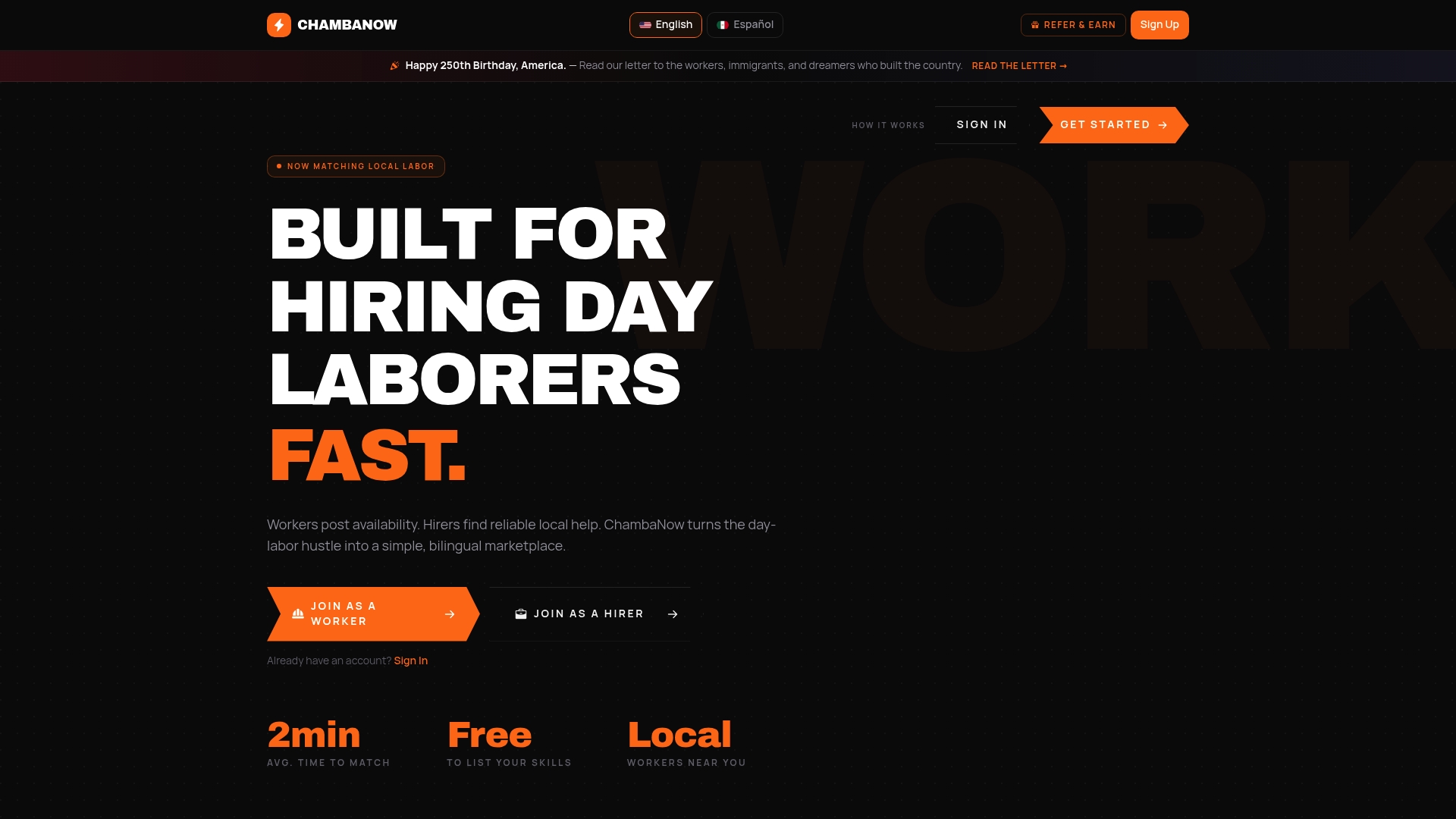
For hirers who need local day labor fast, whether for a construction site, a moving job, an event, or a landscaping crew, Chambanow removes the friction that slows every other platform down. City-specific hiring pages mean you are not browsing a national pool. You are looking at workers available in your metro, today.
Chambanow operates across a growing network of US cities, including Los Angeles, Long Beach, Portland, and beyond. Workers pay nothing to join. Hirers can review pricing and subscription options and post their first job in minutes.
Useful sources and further reading
The sources below back the claims in this article and offer deeper reading for workers and hirers who want to verify platform details before signing up.
-
G2: Top 10 TaskRabbit Alternatives — Aggregates user reviews and category comparisons across on-demand staffing, lead marketplaces, and gig pools. Useful for understanding how buyers and workers evaluate competing platforms side by side.
-
ServiceTitan: TaskRabbit Competitors for Lead Generation — Practitioner-focused breakdown of national lead marketplaces, including Thumbtack and Angi, with context on category breadth and worker fit for home trades.
-
Procured: 17 TaskRabbit Alternatives for Workers — Worker-first perspective on platform selection, covering niche verticals, income stability, and pricing control. Strong source for the how-to-choose framework.
-
Wikipedia: List of gig economy companies — Reference list of US-based gig platforms including Handy, Rover, Thumbtack, and Wag, useful for confirming platform origins and category descriptions.
-
Chambanow: Hire Day Laborers in Tucson, AZ — Example of Chambanow’s city-specific hiring pages, illustrating local operational presence and the immediate-hire flow for hirers in specific metros.
-
Chambanow: Hire Day Laborers in Boston, MA — Additional metro proof point showing Chambanow’s geographic reach beyond the largest coastal cities.
-
LocateHire: Hirelent Alternatives and Payment Protection — Industry partner analysis of payment protection features across hiring platforms; useful background for evaluating escrow and payout-speed claims.
Recommended
Construyendo conocimiento que funciona.