
How to Set Contractor Rates for Profit in 2026
Learn how to set contractor rates for profit in 2026. Get practical steps to ensure you cover costs, estimate hours, and maximize earnings.

Your contractor rate equals your total revenue target divided by realistic annual billable hours, plus a profit premium above that floor. Three actions get you there: (1) list every yearly cost, including IRS Schedule SE self-employment tax at 15.3% on net earnings up to the SSA wage base, health insurance, and overhead; (2) estimate honest billable hours after subtracting PTO, admin days, and slow seasons; (3) choose the pricing model that fits the work. The BLS Occupational Employment and Wage Statistics database gives you a market anchor for every trade before you finalize the number.
Table of Contents
- How to list every cost and compute your break-even hourly rate
- Which pricing model fits your work and how to convert break-even into client prices
- How to benchmark local rates and trade-specific markup norms
- How to choose a profit premium and when to charge above your floor
- How to present rates so clients say yes and disputes stay rare
- How often to review rates and which KPIs tell you when to act
- U.S. tools and data sources that speed up the math
- Key Takeaways
- Why most contractors leave money on the table without knowing it
- Useful sources
How to list every cost and compute your break-even hourly rate
Every profitable rate starts with a complete picture of what it costs you to operate for a year. Miss a line item here and you will underprice every job.
The three pillars of a sound estimate are materials, fully burdened labor, and overhead recovery. According to Joist’s contractor pricing guide, building every estimate around these three categories is essential for profitability.
Annual cost categories to capture:
- Direct labor (your own time, or subcontractors you pay)
- Materials and supplies
- Business insurance (general liability, workers’ comp)
- Vehicle costs (fuel, insurance, maintenance)
- Tools and equipment depreciation
- Business licenses and permits
- Accounting, legal, and software subscriptions
- Health insurance premiums
- Estimated quarterly income tax payments
- Self-employment (SE) tax: 15.3% on net self-employment income up to the SSA wage base, then 2.9% above it
Once you have an annual total, add your desired salary equivalent. That sum is your revenue target.
Break-even formula:
Revenue target includes desired salary, employer FICA premium, annual health insurance, and annual overhead
Break-even hourly = Revenue target ÷ realistic billable hours
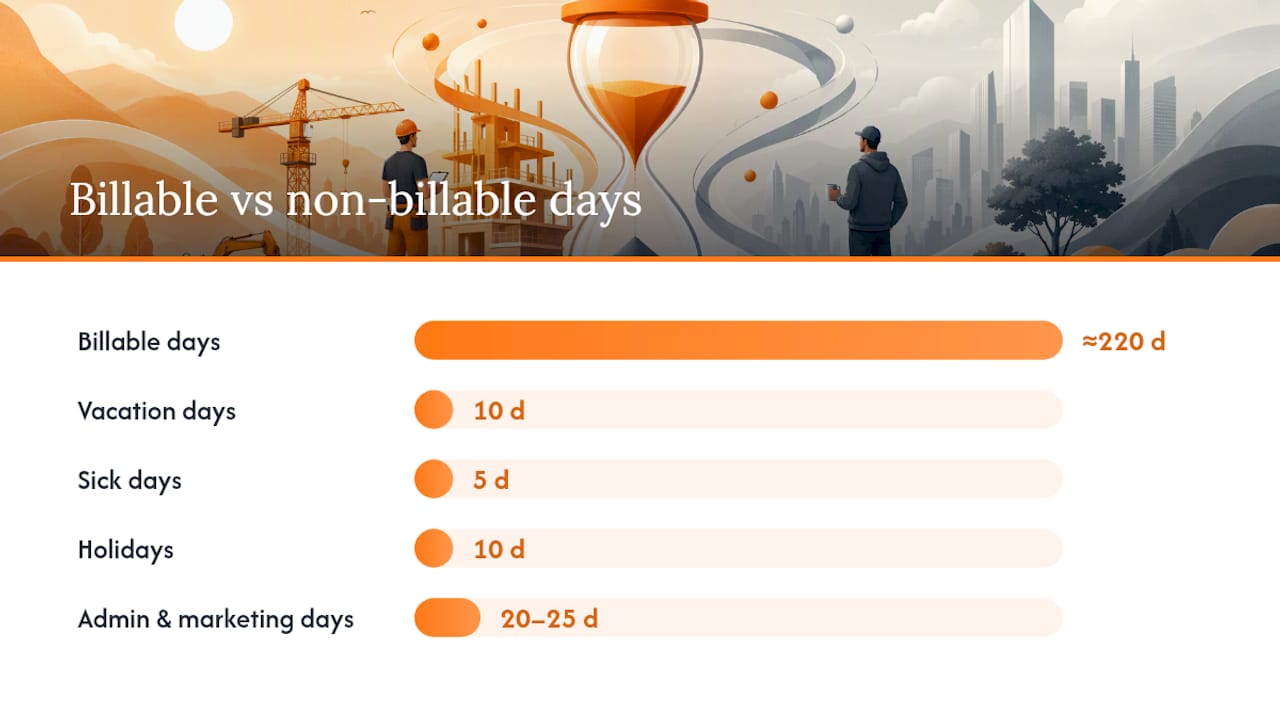
To estimate billable hours honestly, start with 52 weeks × 5 days = 260 working days. Subtract roughly 10 vacation days, 5 sick days, 10 holidays, and 20–25 non-billable admin and marketing days. That leaves approximately 220 billable days, or 1,760 hours at 8 hours per day. Many contractors budget closer to 1,500 hours once slow seasons and unpaid travel are factored in.
Worked example: Say your desired salary equivalent is $70,000. Add $10,710 in SE tax (15.3% × $70,000), $7,200 in health insurance, and $12,000 in overhead. Revenue target = $99,910. Divide by 1,500 billable hours: break-even hourly rate ≈ $66.60. The National Tax Tools contractor-rate calculator walks through this same W-2-to-1099 conversion and confirms that a $70,000 salary equivalent typically maps to a break-even hourly rate well above the raw W-2 equivalent of roughly $33–$35/hr.
Which pricing model fits your work and how to convert break-even into client prices
The break-even rate is your floor. The pricing model determines how you present that floor to clients.
Hourly billing protects you when scope is uncertain or deliverables are hard to define upfront. It is the safest choice for exploratory or diagnostic work. The downside: clients sometimes resist open-ended hours and push for a cap.
Day rates protect your availability on high-coordination days, like on-site installations or full-day workshops, where you cannot take other work. Timescanner’s analysis of day rate vs hourly billing shows that day rates win when coordination overhead is high and your time is effectively blocked regardless of how many hours the client uses. Conversion is straightforward: day rate = hourly rate × billable hours in a day (typically 7–8 hours).
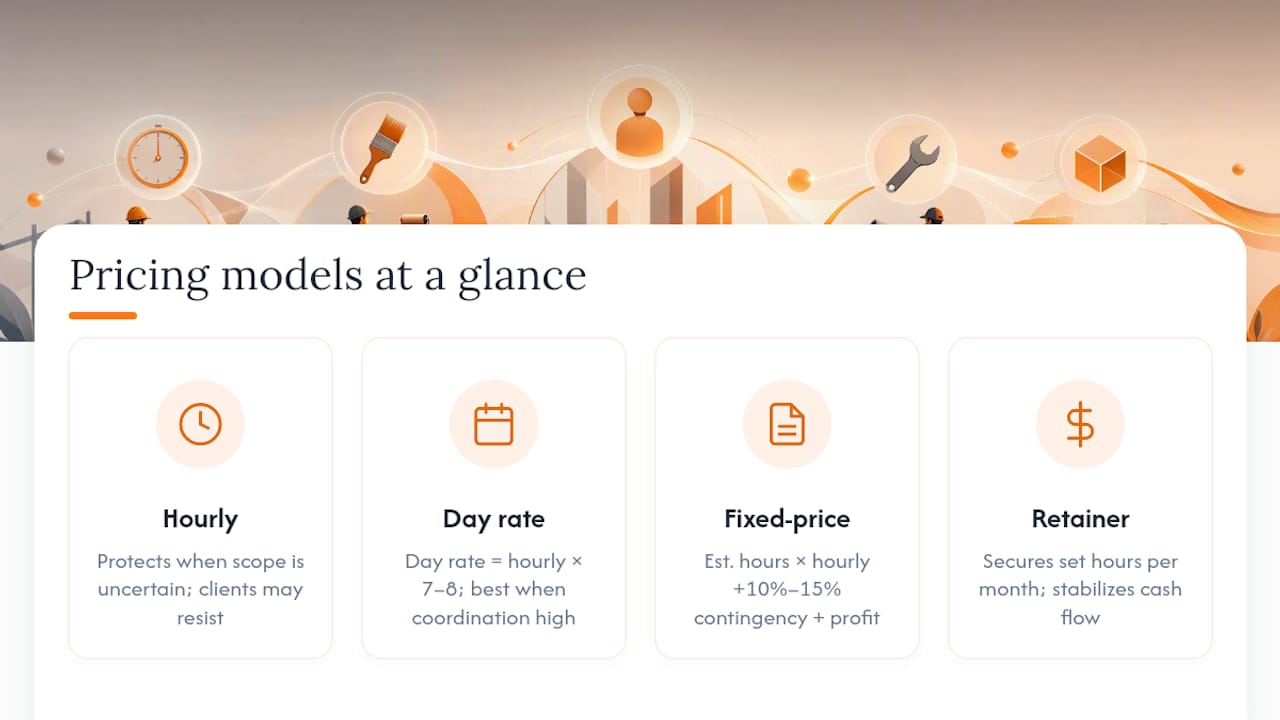
Fixed-price (project-based) proposals shift scope risk to you, so they require a contingency buffer. A practical formula: estimated hours × hourly rate + 10%–15% contingency + profit premium. Use fixed pricing when scope is clear and you have done similar jobs before.
Retainers stabilize cash flow by securing a set number of hours or days per month. They suit ongoing maintenance contracts or clients who need regular availability.
For residential clients, hourly or fixed-price tends to work best because homeowners want certainty. Commercial clients often prefer fixed-price or retainer arrangements tied to project milestones, which also makes it easier to justify a higher rate in writing.
Pro Tip: On any day where you are on-site and effectively unavailable for other work, charge a day rate rather than hourly. Set a half-day minimum in your proposal so a two-hour call-out still earns you half a day’s fee. Communicate this policy clearly before the job starts, and put it in writing.
How to benchmark local rates and trade-specific markup norms
Market research keeps your rates competitive without leaving money on the table. Start with the BLS OEWS wage database, which publishes median hourly wages by occupation and state. That median is a labor cost baseline, not a customer-facing rate.
To translate a wage median into what you charge a client, apply a trade markup factor. BidMaker’s contractor rate calculator uses BLS OEWS data and applies markup factors by trade to produce customer-facing rates:
| Trade | Typical markup factor | Key driver |
|---|---|---|
| General labor | 3.0× | Lower licensing burden |
| Carpentry / framing | — | Skill and material handling |
| Plumbing | 3.0× | Licensing, liability, code compliance |
| Electrical | 3.0× | Licensing, safety risk |
| HVAC | — | Equipment cost, certification |
| Roofing | — | Physical risk, warranty exposure |
Apply the factor to the burdened labor rate (not the raw wage), then add overhead recovery and your profit premium. A plumber with a burdened labor cost of $35/hr charging a 3.0× markup arrives at a $105/hr customer rate before profit.
Beyond BLS data, check local job boards, trade association surveys, and supplier quotes to sense-check regional variation. Rates in Los Angeles or New York can run 20%–30% above national medians; rural markets often sit 10%–15% below.
How to choose a profit premium and when to charge above your floor
The break-even rate covers costs. Profit is what makes the business worth running. Most small contractors target a gross margin above break-even, with net margins typically landing in a healthy range after all expenses.
National Tax Tools’ guidance shows that contractors commonly need a typical premium over a W-2 equivalent just to cover SE tax, benefits, and non-billable time. That premium is the floor for profit, not a bonus on top of it.
Raise your rate above the standard premium when:
- Your skill is scarce or certified (licensed electrician, OSHA-certified, bilingual crew)
- The job is emergency or after-hours work
- The client is commercial with stricter liability requirements
- You are offering a warranty or guarantee on the work
- The schedule is compressed and displaces other bookings
- Materials or equipment carry unusual depreciation or replacement risk
The discount trap is real. Cutting rates to win a job feels pragmatic in the short term, but it sets a client’s price expectation for every future job. A 10% discount on a $5,000 job is $500 gone. Across 20 similar jobs a year, that is $10,000 in lost margin.
How to present rates so clients say yes and disputes stay rare
A clear proposal protects your rate as much as the rate itself does. Commusoft’s contractor pricing guide recommends invoice management and scope clarity as the primary tools for reducing billing errors and accelerating payment.
Proposal checklist:
- Defined scope with explicit exclusions
- Labor and materials listed as separate line items
- Contingency allowance noted (typically 10%–15%)
- Payment schedule: deposit, progress draw, final payment
- Deposit amount (25%–50% upfront is standard for most trades)
- Start date and estimated completion window
- Change-order process: written approval required before any out-of-scope work begins
- Cancellation and late-fee terms
For change orders, document the additional hours, materials, and revised total before starting the extra work. A signed change order is the only protection against a client who disputes the final invoice.
Invoicing best practices: use net-15 or net-30 terms, photograph completed work at each stage, and get a client sign-off at each milestone. Tools like QuickBooks, FreshBooks, or Wave handle recurring invoices and payment reminders without manual follow-up.
How often to review rates and which KPIs tell you when to act
Rates set once and forgotten quietly erode. A quarterly review takes less than an hour and catches margin drift before it compounds.
Core KPIs to track:
- Effective hourly rate (actual revenue ÷ actual hours worked, including non-billable)
- Gross margin per job (revenue minus direct costs, as a percentage)
- Overhead recovery rate (overhead allocated vs overhead actually incurred)
- Billable utilization (billable hours ÷ total working hours)
- Average days to payment
Quarterly action plan:
- Pull actual supplier invoices and compare to your overhead estimate.
- Update your burdened labor rate if wages, insurance, or SE tax changed.
- Recalculate billable hours based on the last quarter’s actual utilization.
- Re-run the break-even formula with current figures.
- Adjust your rate card and update proposal templates before the next job.
BiAccountancy’s rate-setting guide recommends planning around 44 working weeks per year to account for downtime, which is a useful reality check when your utilization number looks lower than expected.
U.S. tools and data sources that speed up the math
| Source | What to use it for |
|---|---|
| BLS OEWS | Median hourly wages by trade and state |
| IRS Schedule SE | SE tax rate and calculation method |
| SSA wage base | Annual Social Security wage base for SE tax cap |
| National Tax Tools calculator | Break-even hourly rate from W-2 salary equivalent |
| BidMaker rate calculator | Trade-specific markup factors and customer-facing rates |
For invoicing and time tracking, QuickBooks Self-Employed, FreshBooks, and Wave each integrate with bank accounts and generate the reports you need for quarterly reviews. Buildertrend and Jobber handle estimating templates and change-order tracking for field trades.
If you are planning long-term income targets, especially around mortgage qualification, day-rate contractor mortgage guidance explains how lenders evaluate contractor income and what documentation supports a strong application.
Key Takeaways
Setting contractor rates correctly means your break-even hourly rate is the floor, not the target, and every job above it should carry a 20%–35% profit premium to cover risk, benefits, and non-billable time.
| Point | Details |
|---|---|
| Break-even formula | Divide your full revenue target (salary + SE tax + health insurance + overhead) by realistic billable hours. |
| Profit premium | Price 20%–35% above break-even to cover self-employment costs and non-billable time. |
| Trade markup norms | Apply 3.0× markup factors to burdened labor rates to reach competitive customer-facing prices, as most common trades use a 3.0× standard. |
| Quarterly rate review | Re-run break-even each quarter using actual costs and utilization to catch margin drift early. |
| Chambanow | Use Chambanow to test a new rate on short local jobs and get real market feedback before committing to a price card. |
Why most contractors leave money on the table without knowing it
The most common pricing mistake is not charging too much. It is charging too little because the break-even calculation was never done properly.
Most contractors who feel underpaid are not undercharging by a dramatic amount. They are missing one or two cost categories, using optimistic billable-hour estimates, and skipping the profit premium because they worry about losing the job. The math compounds quietly. A rate that is $8/hr below break-even on 1,500 hours a year is $12,000 in lost income before a single overhead surprise.
Defending a rate in negotiation is easier when the proposal shows line-item transparency. Clients rarely push back on a number they can see justified. They push back on a number that feels arbitrary. A clear scope, separated labor and materials, and a written change-order policy signal that you run a professional operation, and professional operations command professional rates.
Small rate increases compound meaningfully. Raising your effective hourly rate by $5 across 1,500 billable hours adds $7,500 to annual revenue without a single additional hour of work.
Chambanow helps you test rates where real work is happening
Setting a rate on paper is one thing. Knowing whether the local market will pay it is another. Chambanow connects contractors and skilled workers with hirers who need help today or for longer-term jobs, and it does it without the friction of a traditional job board. You can create a free worker profile, list your availability, and start picking up short jobs at your target rate to see what the market actually accepts.
For contractors in larger markets, Chambanow’s Los Angeles hiring page shows the volume and variety of local demand. Real-time market feedback from short engagements is the fastest way to validate a new rate before rolling it out across all your proposals. Check Chambanow’s pricing page to see how hirers connect with workers and what it costs to post a job.
Useful sources
- 2026 Contractor’s Guide: How to Price for Profit | Joist
- Contractor-rate calculator — National Tax Tools
- Contractor Rate Calculator — What to Charge by Trade & State
- Contractor pricing guide — Commusoft
- Day rate vs hourly rate: which fits your work | Timescanner
- How to Set Your Contractor Rate for Maximum Take-Home Pay
- Freelance Day Rate vs Hourly Rate — Which Should You Charge?
This article is general information, not tax or legal advice. Confirm current IRS rates, SSA wage bases, and licensing requirements with a qualified tax professional or the relevant government source before finalizing your rates.
Recommended
Construyendo conocimiento que funciona.