
Overtime for Contractors: What U.S. Hirers & Workers Need to Know
Understand the nuances of overtime for contractors in the U.S. Explore key regulations and determine if overtime applies to your situation.

Independent contractors generally are not entitled to overtime under the Fair Labor Standards Act (FLSA). Employees are, and so are many workers on covered federal contracts, even when their paperwork calls them “contractors.” Three rule sets decide the answer: the FLSA (which turns on employee status, not job title), the Contract Work Hours and Safety Standards Act (CWHSSA) and FAR clause 52.222-4 (which cover laborers and mechanics on many federal contracts), and state law (California’s daily overtime rule is the best-known example). Before you assume anyone is exempt, check three things:
- Is this person legally an employee or a true independent contractor?
- Is the work happening on a covered federal or federally assisted contract?
- Does the job’s state impose stricter rules than the federal 40-hour threshold?
Key Takeaways
Overtime for contractors depends on legal employee status, federal-contract coverage, and state law, not on what the worker’s contract calls them.
| Point | Details |
|---|---|
| Job title doesn’t decide coverage | Control, supervision, and tools determine employee status more than the word “contractor” on paper. |
| FLSA sets the floor | Covered employees get 1.5× pay over 40 hours per week; independent contractors generally do not. |
| Federal contracts add obligations | CWHSSA and FAR 52.222-4 require overtime for laborers and mechanics on many contracts over $100,000. |
| State rules can be stricter | California’s daily overtime rule shows why job location matters more than company headquarters. |
| Chambanow speeds hiring, not compliance | The marketplace helps document workers and jobs fast, but classification and overtime duties stay with the hirer. |
Table of Contents
- What “Contractor” Actually Means Under Overtime Law
- Do Contractors Get Overtime Under Federal Law?
- Overtime Rules for Federal Contractors: CWHSSA and FAR 52.222-4
- When State Overtime Rules Beat the Federal Baseline
- How to Tell If a “Contractor” Is Legally an Employee
- How to Calculate Overtime for Contractors and Federal Employees
- What Happens When Overtime Goes Unpaid
- A Compliance Checklist to Reduce Overtime Risk
- Hiring Through a Marketplace Doesn’t Change Who’s Liable
- Fix Time Capture Before You Fix Anything Else
- Hire Local Workers Fast Without Losing Sight of Compliance
- Primary Sources and Further Reading
- Frequently Asked Questions
- Sources
What “Contractor” Actually Means Under Overtime Law
The word “contractor” gets used three different ways, and each one triggers a different set of overtime rules. An independent contractor runs their own business and contracts with clients rather than working as staff. A government contractor is a company holding a federal contract, and its laborers and mechanics can still qualify for overtime under CWHSSA even though the firm is called a “contractor.” An employee is anyone the FLSA covers, regardless of what their pay stub says.
Job titles don’t decide which bucket someone falls into. A worker paid on a 1099, told when to show up, given a company uniform, and supervised hour by hour looks far more like an employee than an independent contractor, no matter what the contract says.
- Independent contractor: business-to-business relationship, no FLSA overtime coverage.
- Government contractor: a firm with a federal contract; its manual laborers may be CWHSSA-covered.
- Employee: covered by FLSA overtime rules unless a specific exemption applies.
This article covers U.S. federal and state rules only.
Do Contractors Get Overtime Under Federal Law?
The FLSA requires covered employers to pay 1.5 times the regular rate for every hour worked over 40 in a workweek, but that obligation attaches to employees, not independent contractors. That single distinction is why the question “do contractors get overtime” doesn’t have a one-word answer. It depends entirely on whether the “contractor” label matches reality.
Several FLSA exemptions also remove overtime eligibility even for true employees, and contractors who work adjacent to these categories should know the tests involved:
- Executive, administrative, and professional employees, tested by salary level and job duties, not title.
- Certain licensed professionals (doctors, lawyers, some outside sales roles).
- The computer employee exemption, which applies only to specific, well-defined technical duties.
The DOL’s classification guidance under 29 CFR Part 795, effective March 11, 2024, sets the framework agencies use to decide if a “contractor” is really an employee entitled to overtime pay. Misclassifying even one worker can expose an employer to back pay for every unpaid overtime hour going back years.
Quick math: an employee working 45 hours at $20/hour earns $800 in straight time plus 5 hours at $30 (1.5×), for $950 total that week.
Overtime Rules for Federal Contractors: CWHSSA and FAR 52.222-4
Federal contract work changes the overtime picture even for people labeled “contractors.” CWHSSA requires prime contractors and subcontractors on covered federal or federally assisted contracts over $100,000 to pay laborers and mechanics 1.5 times their basic rate for hours over 40 in a workweek. FAR clause 52.222-4 writes that same obligation directly into covered federal contracts, so it isn’t optional language, it’s a binding contract term.
CWHSSA also counts all hours worked on a covered contract toward the 40-hour threshold, including off-site fabrication or shop time, with no site-of-work carve-out. On prevailing-wage jobs governed by the Davis‑Bacon Act (DBA) and its related acts (DBRA), the wage determination’s base rate, not the fringe benefit amount, is used as the basic rate for overtime math.
- Withheld contract payments if wages are underpaid.
- Liquidated damages assessed per affected worker per day.
- Contract termination and possible debarment from future federal work.
Pro Tip: If your payroll system can’t separate a Davis‑Bacon base rate from fringe benefits, you’re one certified payroll cycle away from an audit finding.
When State Overtime Rules Beat the Federal Baseline
Federal law sets a floor, not a ceiling, and several states build stricter overtime triggers on top of it. California requires daily overtime after 8 hours in a single day, separate from the 40-hour weekly threshold, and some states (Colorado among them) layer on their own daily or weekly variations. State overtime rules vary enough that a national contractor operating in multiple states needs a location-by-location compliance map, not a single national policy.
The safest rule for contractor overtime pay laws is simple: apply whichever rule, state or federal, gives the worker more protection at that specific job site.
- Check the job’s actual location, not the company’s headquarters state.
- Configure payroll rules per state or per job site, not company-wide.
- Confirm current thresholds with the state’s own labor department before running payroll, since rates and thresholds change.
Chambanow’s city-specific hiring pages reflect this same logic: overtime obligations follow the job site, not a general assumption about where a business operates.
How to Tell If a “Contractor” Is Legally an Employee
Overtime exemptions for contractors only exist if the worker is genuinely independent. Courts and the DOL use multi-factor tests, most commonly the economic reality test, and some states apply a stricter ABC test. Maryland’s labor department puts it plainly: calling someone an independent contractor doesn’t make them one under wage law if the underlying relationship looks like employment.
Red flags that point toward employee status, and overtime coverage, include:
- The hirer sets the schedule and hours, not the worker.
- The company supplies tools, uniforms, or a required vehicle.
- The worker reports to a supervisor and can’t send a substitute.
- The relationship is exclusive and ongoing rather than project-based.
- Pay is hourly or salaried rather than tied to a defined deliverable.
Pro Tip: Keep a simple log of who controls the schedule, tools, and supervision for each worker. That single page is often the deciding evidence in a misclassification dispute.
If several factors point toward employee status, document the working relationship and consider contacting your state labor agency or the DOL’s Wage and Hour Division before a dispute forces the issue.

How to Calculate Overtime for Contractors and Federal Employees
Once you’ve confirmed someone is covered, the math follows a set formula. FLSA overtime uses the regular rate, total straight-time earnings divided by total hours worked that week, and pays 0.5 times that regular rate as the overtime premium on top of straight time for each hour over 40.
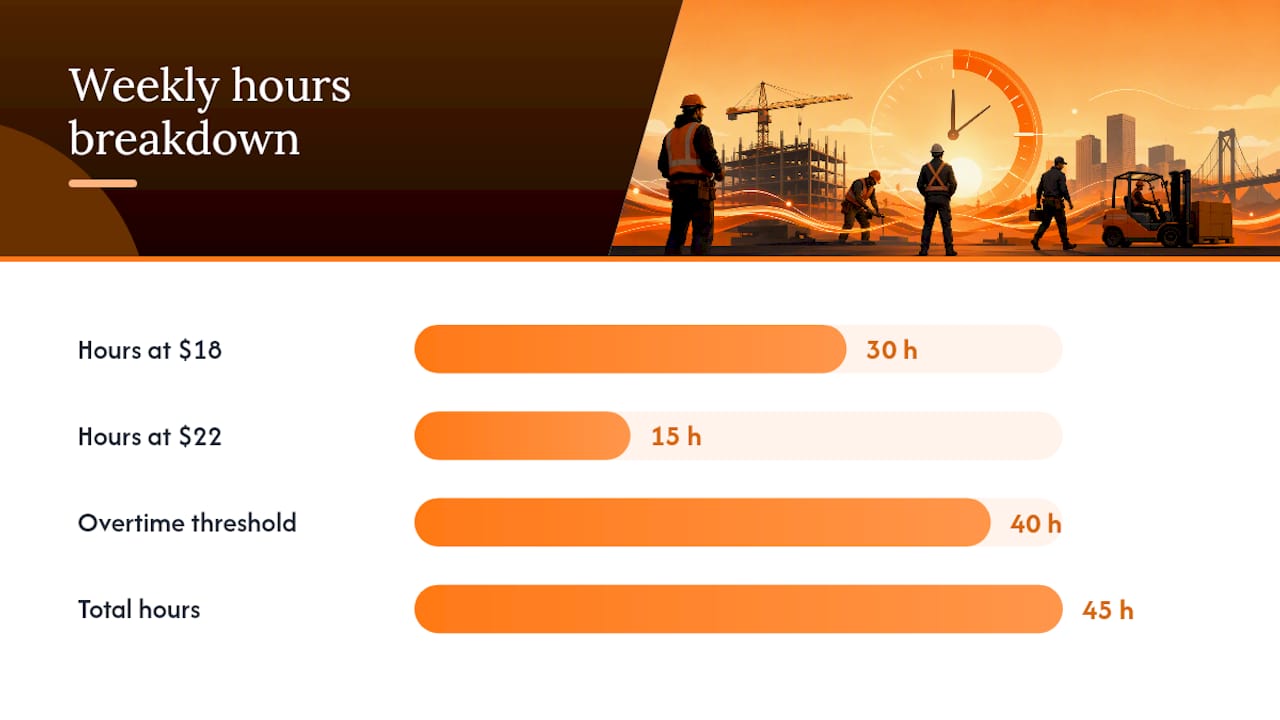
Example, blended rate: a worker logs 30 hours at $18/hour and 15 hours at $22/hour in one week (45 total hours).
On Davis‑Bacon jobs, the math changes: the wage determination’s base rate becomes the “basic rate” for CWHSSA overtime, and fringe benefits paid into a bona fide plan are typically excluded from that calculation. Mixing up base wage and fringe dollars is one of the most common, and costly, certified payroll errors on prevailing-wage projects.
- Always separate base rate from fringe before running the overtime formula.
- Recalculate the regular rate whenever a worker has more than one pay rate in a week.
- Treat cash-in-lieu-of-fringe payments carefully; they may or may not be excludable.
What Happens When Overtime Goes Unpaid
Unpaid overtime doesn’t resolve itself quietly, and both sides face real timelines and consequences.
- Workers should gather pay stubs and time records, then file a complaint with the DOL’s Wage and Hour Division or a state labor agency; remedies often include back pay plus liquidated damages equal to the unpaid amount.
- Employers should audit payroll immediately, correct any underpayment, and, on federal contracts, notify the contracting officer if CWHSSA violations are found.
- Federal contractors face heightened risk: unresolved violations can lead to withheld contract funds, contract termination, and debarment from future federal work.
Claims under the FLSA generally must be filed within two years, three for willful violations, so records matter and delay works against everyone involved.
A Compliance Checklist to Reduce Overtime Risk
Small and midsize hirers can close most of their overtime exposure with a handful of consistent habits:
- Review worker classification for every role, not just new hires.
- Capture time accurately, digital time stamps beat handwritten logs every time.
- Build payroll rules that handle multi-rate weeks and blended regular-rate math automatically.
- Separate fringe benefits from base wage on any Davis‑Bacon or prevailing-wage job.
- Apply the overtime rule for the job’s actual state, not the company’s home state.
- Keep payroll and time records for at least three years.
Pro Tip: On prevailing-wage jobs, field-verified time capture tied to a cost code at check-in catches classification errors before they become a certified payroll finding, not after.
Hiring Through a Marketplace Doesn’t Change Who’s Liable
Using a platform to find workers doesn’t shift legal responsibility for overtime. Classification, contract type, and job location still determine what you owe, and that obligation sits with the hirer, not the marketplace.
Before posting a job, confirm the worker’s actual status, define the job clearly (project-based versus hourly control matters), and document hours worked regardless of how the person was found.
- Verify whether the role looks like independent work or supervised employment.
- Set clear terms on schedule, tools, and scope before the job starts.
- Keep a written record of hours and pay for every job, every time.
Fix Time Capture Before You Fix Anything Else
If you’re a small hirer trying to reduce overtime risk fast, fix time capture first, then classification, then payroll math. Bad records make every other fix harder to prove. A verified digital timecard, even a simple photo check-in tied to a job, closes more risk than a policy memo nobody reads.
Hire Local Workers Fast Without Losing Sight of Compliance
Chambanow gets you connected to available local workers in minutes instead of days, cutting the search time that eats into a project’s margin before a single hour is even worked. The marketplace lets you browse verified worker profiles, message through built-in translation, and see who’s ready to work today, whether that’s Long Beach, Los Angeles, or any of the cities Chambanow serves.
None of that replaces your legal homework. Chambanow helps you find workers and keep a documented record of job postings, communication, and availability, but classification, contract type, and overtime obligations remain yours to manage as the hirer. Use the platform to move faster on hiring, then apply the checklist above before your first payroll run. Ready to see who’s available near you? Explore Chambanow’s hiring plans and post your first job today.
Primary Sources and Further Reading
Verify any rule in this guide directly against the source before making a payroll decision:
- DOL Fact Sheet #13 on employment relationship for the current independent contractor classification test.
- DOL overtime and work hours guidance for CWHSSA thresholds and regular-rate calculations.
- Tab 10 guidance on DBA/DBRA overtime for prevailing-wage overtime math and fringe treatment.
- Maryland Department of Labor’s independent contractor page as a state-level classification example.
- Sam for current wage determinations on prevailing-wage federal projects.
Frequently Asked Questions
Do contractors get overtime pay in the United States? Independent contractors generally do not, since the FLSA’s overtime rule only covers employees. Workers on covered federal contracts, or anyone misclassified as a contractor while actually working as an employee, can still be entitled to time-and-a-half.
What are the standard contractor overtime rates? Where overtime applies, whether under the FLSA or CWHSSA, the rate is 1.5 times the regular or basic rate for every hour worked over 40 in a workweek. Some states add daily overtime on top of that weekly threshold.
How do I calculate overtime for a contractor with multiple pay rates? Add total straight-time earnings for the week, divide by total hours worked to get the regular rate, then pay 0.5 times that rate as the overtime premium for each hour over 40, on top of straight-time pay already earned.
Are there overtime exemptions for contractors and certain professionals? Yes. Executive, administrative, and professional employees, along with some licensed professionals and computer employees meeting specific duty tests, can be exempt from FLSA overtime even as employees. True independent contractors are exempt because the FLSA doesn’t cover them at all.
Does a union contract change overtime eligibility for contractors? Collective bargaining agreements can set overtime terms that exceed the federal minimum, and those terms generally control for covered workers, provided they don’t fall below FLSA or CWHSSA floors where those laws apply.
Does a fixed-price contract remove overtime obligations? No. Whether a contract is fixed-price or time-and-materials affects how a business gets paid, not whether an individual worker on that job is legally an employee entitled to overtime. Classification, not billing structure, determines coverage.
This article is general information, not a substitute for advice from a qualified lawyer. Consult a qualified legal professional about your own circumstances before acting on anything here.
Sources
- Fact Sheet #13: Employment Relationship — FLSA
- Overtime and Work Hours — U.S. Department of Labor
- Overtime Pay on DBA/DBRA Contracts (Tab 10)
- Overtime laws by state: Compliance guide for contractors — ADP
Recommended
Construyendo conocimiento que funciona.