
Contractor Liability When Hiring: What Hirers Need to Know
Discover key insights on liability when hiring contractors to protect yourself from legal risks. Learn the exceptions and safeguard your interests.

Hiring an independent contractor generally does not make you legally responsible for their mistakes — but that protection disappears faster than most hirers expect. Under U.S. tort law, hirers are not vicariously liable for a contractor’s acts as a general rule, yet courts recognize several well-established exceptions: retained control over how the work is done, inherently dangerous activities, non-delegable public-safety duties, and negligent selection or retention. Add workers’ compensation exposure, misclassification risk under IRS and DOL guidance, and state-specific presumptions that vary widely, and liability when hiring contractors becomes a real, manageable risk rather than a theoretical one.
Three facts every hirer should hold onto from the start. First, if a contractor lacks workers’ compensation coverage, South African SMEs should refer to this guide on independent contractor payments to understand legal liabilities and payment processes, as you may be on the hook for an injured worker’s medical bills and lost wages in many states. Second, a Certificate of Insurance (COI) is your first line of defense, but only if you verify it properly. Third, the moment you start directing how a contractor does their work rather than just what outcome you want, you have likely crossed into retained-control territory, and a court may treat you as a liable party.
Key Takeaways
Liability when hiring contractors is manageable when you understand the exceptions to the general rule and build a consistent documentation habit before work begins.
| Point | Details |
|---|---|
| General rule has real exceptions | Retained control, inherently dangerous work, and negligent selection can all create hirer liability despite contractor status. |
| COI verification is non-negotiable | Confirm active policy dates, additional insured endorsements, and waiver of subrogation directly with the carrier before work starts. |
| Workers’ comp gap is a direct financial risk | If a contractor lacks coverage, hirers in many states bear responsibility for injured workers’ medical costs and lost wages. |
| Document before the first payment | Collect a signed ICA, W-9, COI, and license verification before work begins and retain records for at least three years. |
| Chambanow reduces documentation friction | Chambanow’s worker profiles and structured hiring workflow help hirers find and document local workers faster for day labor and skilled trades. |
Table of Contents
- When can a hirer be held legally liable for a contractor’s actions?
- What insurance actually protects you when a contractor causes harm?
- What contract language actually shifts liability away from you?
- What should you verify before a contractor starts work?
- What do you do immediately after a contractor-caused incident?
- Why do state rules change your exposure so significantly?
- Why COI verification deserves more attention than most hirers give it
- Balancing speed and safety when you need to hire now
- Chambanow helps you find documented local workers faster
- Authoritative resources for deeper research
- Sources
When can a hirer be held legally liable for a contractor’s actions?
The baseline rule comes from common law and the Restatement (Second) of Torts: a person who hires an independent contractor is not liable for physical harm caused by the contractor’s negligence. The contractor controls the work; the hirer controls only the result. That separation is the legal foundation of the independent-contractor relationship.
Courts and legal analysts have identified several doctrines that carve exceptions into that rule, and each one is worth understanding on its own terms.
Retained control (Restatement § 414). When a hirer reserves the right to control the operative details of the work, not just the end result, courts treat that control as a basis for liability. Telling a contractor which tools to use, setting their daily schedule, or supervising their methods are all signals of retained control. The question is not whether a supervisor was physically present, but whether the hirer’s instructions reached into how the work was performed.
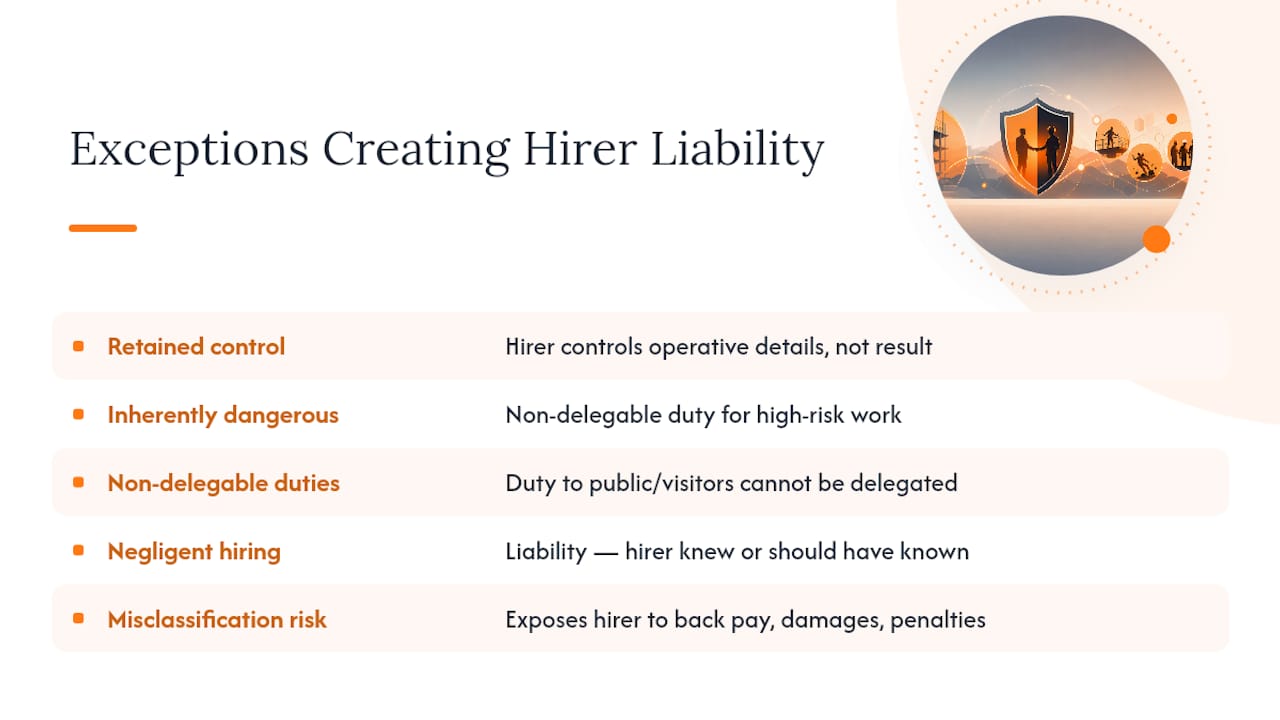
Inherently dangerous activities. Some work carries risks so significant that courts impose a non-delegable duty on the hirer regardless of how carefully the contractor was chosen. Demolition, work with explosives, and certain excavation projects fall into this category in most jurisdictions.
Non-delegable duties. Landowners and businesses sometimes owe a duty of care to the public or to visitors that cannot be transferred to a contractor by contract. A property owner who hires a contractor to repair a public walkway, for example, may still be liable if the work creates a hazard.
Negligent hiring and retention. If a hirer knew or should have known that a contractor was unqualified, unlicensed, or had a history of unsafe practices, liability can attach for that selection decision itself. This is separate from vicarious liability and does not require the hirer to have controlled the work.
Misclassification and joint-employer risk. The DOL’s economic-reality test and the IRS’s behavioral-and-financial-control test can reach different conclusions about the same worker. A person classified as an independent contractor for tax purposes may still be a covered employee under the Fair Labor Standards Act, exposing the hirer to back pay, liquidated damages, and penalties. California’s ABC test, used for workers’ compensation and wage-order purposes, presumes worker status unless the hirer can satisfy all three prongs, a notably higher bar than the federal standard.
Two fact patterns illustrate how quickly exposure can arise. A general contractor hires a roofing subcontractor and provides the scaffolding, sets the daily work schedule, and assigns a site supervisor who approves each phase before the crew moves on. When a worker falls, the general contractor’s retained control over the scaffolding and scheduling becomes the central issue. Alternatively, a homeowner hires an unlicensed electrician found through an informal referral, skips a license check, and the electrician’s faulty wiring causes a fire. The homeowner’s failure to verify credentials is the negligent-selection hook.
What insurance actually protects you when a contractor causes harm?
Insurance is where legal exposure becomes financial exposure, and the gap between what a contractor claims to carry and what they actually carry is where hirers get hurt.
General liability (GL) insurance covers bodily injury and property damage claims arising from a contractor’s operations. The Hartford’s market guidance notes that many small contracting businesses pay around the average market cost for GL coverage, though costs vary significantly by trade, location, and claims history. A contractor without GL coverage means any property damage or injury claim lands directly on the hirer’s doorstep if the hirer is named in the lawsuit.
Workers’ compensation insurance is the coverage that most often catches hirers off guard. Most states require it, and when a contractor lacks it, the hirer — particularly a prime contractor or project owner — can be held responsible for the injured worker’s medical costs and lost wages. Some states go further, treating the hirer as the statutory employer for workers’ comp purposes when a subcontractor is uninsured.

Commercial auto insurance covers vehicles used in the course of the contractor’s work. If a contractor’s employee drives an uninsured vehicle to a job site and causes an accident, the hirer’s own auto or umbrella policy may be drawn in.
Professional liability (errors and omissions) matters for design, engineering, or consulting contractors whose mistakes can cause financial harm rather than physical injury.
What to look for on a Certificate of Insurance
A COI is a snapshot of a policy, not the policy itself. Four fields deserve close attention every time.
Policy effective and expiration dates confirm the coverage is active on the date work begins and throughout the project. Limits show the per-occurrence and aggregate amounts; a contractor carrying $300,000 in GL coverage on a $2 million project is effectively uninsured for a major claim. The additional insured endorsement names you as a protected party under the contractor’s policy, which matters when a third party sues both of you. The waiver of subrogation prevents the contractor’s insurer from suing you to recover what it paid out on a claim.
Statistic: The Hartford reports that many small contracting businesses pay an average amount annually for general liability coverage — a cost that shifts entirely to the hirer when a contractor operates without it.
Industry advisories consistently identify the same five outcomes when a hirer engages an uninsured contractor: direct financial exposure for property damage, workers’ comp claims shifting to the hirer, no defense coverage for bodily injury lawsuits, potential policy gaps on the hirer’s own coverage, and reputational harm from unresolved claims.
What contract language actually shifts liability away from you?
A well-drafted contract does not eliminate risk, but it allocates who bears it and creates the paper trail that matters in litigation.
Indemnity and hold-harmless clauses are the primary tools. A one-way indemnity requires the contractor to defend and indemnify the hirer for claims arising from the contractor’s work. A mutual indemnity splits responsibility based on each party’s fault. Most hirers prefer a broad one-way indemnity, but enforceability varies by state. Several states, including California, Texas, and New York, have anti-indemnity statutes that void provisions requiring a party to indemnify another for that party’s own negligence in construction contracts. Counsel familiar with your state’s rules should review any indemnity clause before you rely on it.
Sample insurance requirement clause (adapt with counsel): “Contractor shall maintain, at its own expense, commercial general liability insurance with limits of not less than $1,000,000 per occurrence and $2,000,000 aggregate, workers’ compensation insurance as required by applicable state law, and commercial auto liability insurance with limits of not less than $1,000,000. Contractor shall name [Hirer] as an additional insured on all such policies and shall provide a waiver of subrogation in favor of [Hirer]. Certificates of Insurance evidencing such coverage shall be delivered to [Hirer] prior to commencement of work.”
Additional insured endorsements should be required in the contract and verified on the COI before work starts. An endorsement that names you as additional insured means the contractor’s GL policy will defend and indemnify you for covered claims, not just the contractor.
Waiver of subrogation prevents the contractor’s insurer from pursuing you after paying a claim. Without it, you can be sued by an insurer you never had a direct relationship with.
A contract checklist worth keeping on file before any engagement:
Scope of work with clear deliverables and no language that implies day-to-day direction. Insurance requirements with specific limits, coverage types, and endorsement requirements. Proof-of-coverage timing requiring COIs before the first day of work and updated certificates at each renewal. Independent contractor status language confirming the worker controls the means and methods. Termination clause allowing the hirer to end the engagement if coverage lapses. Indemnity provision reviewed for state-law compliance.
What should you verify before a contractor starts work?
The pre-hire phase is where most liability risk is either created or contained. A consistent documentation routine before the first payment protects you on negligent-selection claims and gives you the paper trail that matters if something goes wrong later.
-
Verify the contractor’s license and registration. Most states maintain searchable online databases through their contractor licensing boards or labor and industries departments. Confirm the license is active, covers the type of work being done, and has no disciplinary history.
-
Request and verify the COI. Ask for the certificate before work begins, not after. Confirm the policy is active, the limits meet your requirements, and you are named as an additional insured with a waiver of subrogation. Call the carrier directly if anything looks unusual.
-
Confirm workers’ compensation coverage. Ask for the workers’ comp certificate separately and verify it covers all workers the contractor will bring on site. Washington State’s L&I guidance is explicit: simply calling someone an independent contractor does not exempt a hirer from workers’ comp obligations if the state’s coverage tests are met.
-
Collect a completed W-9. This documents the contractor’s taxpayer identification and supports your 1099 filing obligation. It also signals that both parties understand the relationship is not an employment relationship for federal tax purposes.
-
Get references and check them. Two or three calls to past clients on similar projects take fifteen minutes and surface red flags that no document will show.
-
Sign an Independent Contractor Agreement (ICA) before work begins. The ICA should define scope, payment terms, the contractor’s control over methods, insurance requirements, and indemnity obligations. Keep a signed copy on file.
Retain all documentation — COIs, the signed ICA, W-9, license copies, and written notes from reference checks — for at least three years after the project ends, or longer if your state’s statute of limitations for construction claims is longer. Practical hiring guides consistently recommend collecting these documents before the first payment, not after the work is underway.
What do you do immediately after a contractor-caused incident?
The first hour after an incident shapes the entire claims and litigation process. A clear sequence matters.
Immediate steps (within hours). Secure the scene and preserve evidence. Photograph everything before anything is moved or repaired. Get medical help for anyone injured. Exchange contact and insurance information with all parties. Identify and document witnesses while memories are fresh.
Notify your insurer the same day. Most commercial policies require prompt notice of incidents that could give rise to a claim. Late notice can be used to deny coverage. Call your broker or carrier’s claims line and report the incident even if you are not sure a claim will follow.
Notify the contractor’s insurer. Pull the COI and call the carrier listed. Report the incident and ask for a claim number. This preserves your rights as an additional insured.
Near-term steps (within days). Collect the signed ICA and all COIs. Secure written incident reports from anyone involved. Avoid making statements about fault or offering to pay for damages before consulting counsel. A well-intentioned apology can be treated as an admission in litigation.
Pro Tip: Consult an attorney before making any written statement to a claimant or their insurer. Even a brief consultation helps you understand what the contractor’s policy covers, what your own policy covers, and whether retained-control or negligent-hiring theories could create exposure for you specifically.
Reporting deadlines vary by state and by policy. Most commercial GL policies require notice “as soon as practicable.” Workers’ comp incidents typically require employer notice within 24–72 hours under state rules. Missing these windows is one of the most common and avoidable ways hirers lose coverage they paid for.
Why do state rules change your exposure so significantly?
Federal law sets a floor for classification and wage obligations, but workers’ compensation rules, contractor licensing requirements, and liability presumptions are almost entirely state-driven. The gap between states is wide enough to change a hirer’s entire risk profile.
Washington State’s L&I contractor guidance presumes that workers are covered employees for workers’ comp purposes unless the contractor can satisfy a specific set of exemption criteria. A hirer who relies on a contractor’s verbal assurance of independent status, without checking the state’s own criteria, can face unpaid premium assessments and penalties. California’s ABC test, applied in wage-order and workers’ comp contexts, places the burden on the hiring entity to prove the worker is genuinely independent. The California Supreme Court’s decisions in recent years have reinforced the strong presumption against hirer liability for contractor injuries in some contexts, while simultaneously tightening the classification tests that determine whether a worker is a contractor at all.
Virginia and several other states have enacted or expanded statutory provisions that extend workers’ comp coverage obligations to prime contractors when subcontractors are uninsured. The practical effect is that a general contractor who hires an uninsured sub can become the statutory employer for workers’ comp purposes, regardless of what the contract says.
To check your state’s rules, start with three resources: your state’s workers’ compensation board or industrial commission, the state contractor licensing portal, and the state labor department’s independent contractor guidance page. These are primary sources, and they are updated when the law changes.
Why COI verification deserves more attention than most hirers give it
A Certificate of Insurance looks official. It has policy numbers, carrier names, and dollar amounts. That appearance of authority is exactly why it deserves scrutiny rather than a quick glance and a file.
GEICO’s contractor insurance guidance and other insurer advisories note that COIs can be forged, outdated, or issued for policies that have since been cancelled. A certificate showing a policy effective through December 31 tells you nothing about whether that policy was cancelled in October.
A reliable COI verification process has four steps.
-
Check the carrier name and policy number. Look up the carrier’s main claims or verification line independently — do not use a number printed on the COI itself — and call to confirm the policy is active and the named insured matches the contractor you are hiring.
-
Confirm the additional insured endorsement. Ask the carrier or the contractor’s broker to send the actual endorsement, not just the certificate. The endorsement is the binding document; the COI is a summary.
-
Verify the waiver of subrogation. This should appear as a checked box or an endorsement reference on the COI. If it is missing, request it before work starts.
-
Set a calendar reminder for renewal. Annual policies expire. If a project runs longer than a year, or if a contractor’s policy renews mid-project, you need an updated certificate before the old one lapses.
Pro Tip: For high-risk hires — roofing, electrical, demolition, or any work involving heavy equipment — ask your broker or in-house counsel to review the COI and endorsements before the contractor steps on site. The cost of that review is a fraction of the cost of a coverage dispute after an incident.
Balancing speed and safety when you need to hire now
There is a real tension in the way most hirers actually work. Urgent repairs, short-notice day labor, and fast-turnaround projects do not always leave time for a full documentation cycle. That tension is worth naming honestly rather than pretending it does not exist.
The practical answer is proportional risk management. A one-day landscaping job with a solo worker carries different exposure than a three-week roofing project with a crew of five. For lower-risk, shorter-duration work, a signed ICA and a verbal confirmation of insurance, followed by a COI request within 24 hours, is a reasonable starting point. For higher-risk or longer-duration work, full documentation before day one is not optional.
Gibson Dunn’s analysis of California Supreme Court decisions notes that courts scrutinize whether hirers retained control over operative details, not just whether they were present. That means the way you communicate with a contractor during the job matters as much as the paperwork you collected before it started. Directing methods, not just outcomes, is the behavior that creates exposure.
For hirers using platforms to find local workers, documented profiles, verified availability, and clear written agreements before work begins are the practical tools that compress the documentation cycle without eliminating it. Consult an attorney for any engagement where the work is inherently dangerous, the contract value is significant, or the classification of the worker is genuinely ambiguous.
Chambanow helps you find documented local workers faster
Hiring quickly and hiring carefully are not mutually exclusive, and that is exactly the problem Chambanow was built to address. Instead of relying on informal referrals and hoping the paperwork follows, hirers on Chambanow can browse worker profiles that show skills, availability, and work history before a single message is sent.
For urgent day labor, skilled trades, or recurring local work, Chambanow connects hirers with workers who are ready today. The platform’s bilingual communication tools remove language barriers that often slow down the vetting conversation, and the structured profile format makes it easier to document who you hired, when, and for what. That documentation record is exactly what the pre-hire checklist in this article calls for.
Hirers who need workers in Los Angeles or Long Beach can browse available workers now or check local availability in Long Beach. For pricing and subscription options that give you faster access to verified local workers, visit Chambanow’s pricing page.
Authoritative resources for deeper research
The sources below cover the primary legal, regulatory, and insurance frameworks discussed in this article.
| Resource | What It Covers |
|---|---|
| Cornell Law Wex: Independent Contractor | Baseline tort rule and primary exceptions under U.S. common law |
| IRS: Employee or Independent Contractor? | Federal tax classification tests and W-9/1099 obligations |
| DOL: Misclassification Guidance | FLSA economic-reality test and enforcement risk for misclassification |
| Washington L&I: Hiring a Contractor | State workers’ comp presumptions and contractor registration checks |
| The Hartford: GL Insurance for Contractors | Coverage types, market cost examples, and COI guidance |
| Forbes Advisor: Business Insurance for Contractors | Workers’ comp requirements by state and uninsured contractor risks |
This article provides general information about U.S. legal and insurance principles and is not a substitute for advice from a licensed attorney or insurance professional. Confirm current rules with your state’s labor department, workers’ compensation board, or qualified legal counsel before making decisions about specific engagements.
Sources
Recommended
Construyendo conocimiento que funciona.