
English-Only Policy: What Employers and Workers Must Know
Discover what employers and workers should know about the English only policy. Understand legal requirements and how to implement it effectively.

An English-only workplace policy is presumptively unlawful under U.S. federal law unless it is narrowly tailored to a documented business necessity. 29 C.F.R. § 1606.7 makes this clear: a rule requiring English at all times is treated as a burdensome condition of employment and will be closely scrutinized under Title VII of the Civil Rights Act of 1964. The practical takeaway for employers is straightforward. Before imposing any language restriction, document a specific business need, limit the rule to the tasks and times that need it, and seriously consider whether translation technology or bilingual staffing can solve the problem first.
The EEOC’s position: “A rule requiring employees to speak only English at all times in the workplace is a burdensome term and condition of employment… the Commission will presume that such a rule violates Title VII and will closely scrutinize it.” — 29 C.F.R. § 1606.7
Table of Contents
- When is an English-only rule actually permissible?
- What makes a language policy unlawful, and what are the risks?
- How do you write a narrowly tailored English-only rule?
- What alternatives reduce the need for restrictive language rules?
- How do EEOC and DOL complaints work in practice?
- How Chambanow helps reduce reliance on restrictive language rules
- Key Takeaways
When is an English-only rule actually permissible?
The legal test comes from 29 C.F.R. § 1606.7 and is reinforced by DOL guidance: a limited English-only rule is allowed only when the employer can demonstrate business necessity, and the rule must be communicated to affected employees in advance, including the specific times it applies and the consequences of a violation.
Business necessity is not a vague standard. It means the restriction must be tied to the safe or efficient operation of the business, not to coworker preferences or general comfort. Courts and the EEOC have recognized a narrow set of scenarios where a rule can survive scrutiny:
- Safety-critical communications: emergency radio calls, alarm protocols, or evacuation procedures where miscommunication creates physical risk.
- Recorded compliance calls: customer service or financial calls that are recorded for regulatory compliance and require a common language for accurate transcription.
- Direct supervision of specific tasks: situations where a supervisor who speaks only English must monitor a work process in real time.
- Customer-facing interactions: a cashier or service worker communicating with an English-speaking customer about a work matter.
For a rule to hold up, it must satisfy each of the following elements:
- A written record of the specific business need (safety, supervision, or customer communication).
- Scope limited to specific tasks, times, or locations, not the entire workday.
- Advance written notice to all affected employees, provided in their primary language if necessary.
- Documented evidence that alternatives (translation tools, bilingual staffing) were considered and found insufficient.
- A training component for supervisors on how to apply the rule consistently.
- A scheduled review date to reassess whether the rule remains necessary.
Regulatory note: DOL guidance explicitly states that business necessity justifications must be communicated to employees with the specific times the rule applies and the consequences of violation. A rule that exists only in a policy manual, with no notice to workers, is difficult to defend.
What makes a language policy unlawful, and what are the risks?

A blanket rule requiring English at all times is the clearest path to an EEOC charge. The EEOC won a $700,000 judgment against an employer whose blanket rule applied even during breaks and targeted workers who had been hired specifically for their bilingual skills. That case illustrates two compounding errors: the rule was overbroad, and it was retroactively imposed on workers whose language abilities were a condition of their hiring.
The table below shows the difference between unlawful broad restrictions and narrowly tailored alternatives.
| Scenario | Unlawful broad version | Narrowly tailored alternative |
|---|---|---|
| All-staff common area | “No language other than English in the break room at any time” | No restriction; breaks and informal conversations are protected |
| Customer service floor | “Speak only English to all coworkers at all times on the floor” | “Speak English when directly serving an English-speaking customer” |
| Safety alarm system | “All communications must be in English” | “Use English for all emergency alarm and evacuation announcements” |
| Supervisor monitoring | “All conversations must be in English so management can understand” | “Use English during recorded compliance calls with this supervisor” |
| Misconduct response | “Blanket English-only rule after one incident” | Individual discipline under existing policy; English required only for that employee’s monitored interactions |
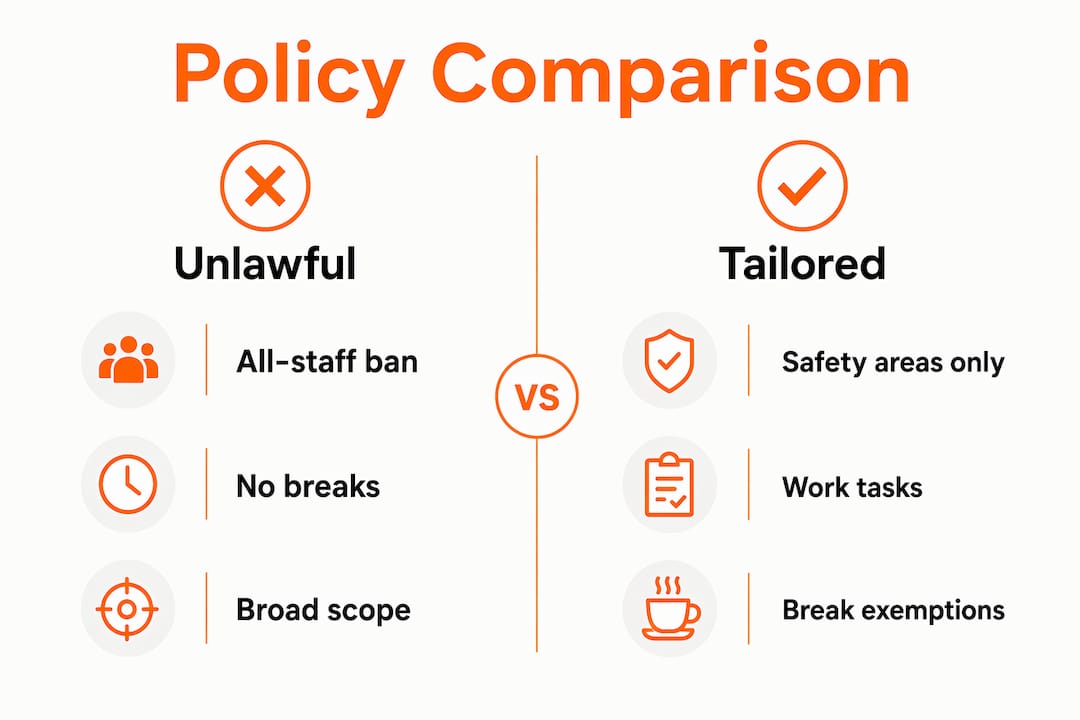
Pro Tip: Workers retain the right to use their primary language during breaks, lunch, and informal conversations. DOL guidance is explicit that restricting nonwork communications is rarely defensible as a business necessity. If your employer’s policy covers those moments, that restriction is likely unlawful.
The consequences of getting this wrong go beyond a single complaint. An EEOC charge can trigger a full investigation, mediation, and litigation. Monetary awards in the six figures are not unusual. Reputational harm in communities where word travels fast, especially among workers who rely on referrals and networks, can affect hiring for years.
How do you write a narrowly tailored English-only rule?
Start with a template clause that limits scope precisely. Here is language employers can adapt:
“Employees are required to communicate in English during [specific task, e.g., live emergency radio communications / recorded compliance calls] conducted at [specific location or workstation]. This requirement does not apply during breaks, meals, or informal conversations unrelated to the specified task.”
That one clause does the work: it names the task, the location, and the exception. Everything else in the policy builds the documentation trail that makes it defensible.
- Identify the specific task where English is operationally required. Write it down by name.
- Explain why language matters to safety, supervision, or customer interaction for that task. One paragraph is enough; vague references to “efficiency” will not hold up.
- List alternatives considered and explain why each was insufficient (translation app latency in an emergency, no bilingual supervisor available for that shift, etc.).
- Produce an impact analysis identifying which employee groups are affected and whether the restriction creates disparate impact on any national origin group.
- Run a limited pilot with a defined review date, not an indefinite rule.
- Provide advance notice in writing, in every language spoken by affected workers.
- Train supervisors on consistent application. Selective enforcement is its own liability.
- Document discipline using a clear matrix so no worker is treated differently than another for the same violation.
| Documentation item | Recommended timeline |
|---|---|
| Written business necessity analysis | Before the rule takes effect |
| Advance notice to affected employees | At least 5 business days before enforcement begins |
| Supervisor training records | Completed before enforcement begins |
| Ongoing review cycle | Annually, or after any EEOC inquiry |
What alternatives reduce the need for restrictive language rules?
Most of the time, the operational problem an employer is trying to solve does not actually require a language ban. Academic reviews of multilingual business practice consistently find that training, translation technology, and bilingual workflows outperform blanket mandates at both reducing friction and preserving inclusion.
Consider a construction crew where a supervisor imposed a broad English-only rule after struggling to monitor safety calls. The rule immediately drew complaints from Spanish-speaking workers who had been hired for their bilingual skills. The crew replaced the blanket ban with two targeted changes: a translated safety script posted at every workstation and a bilingual lead worker assigned to relay emergency communications. The broad restriction disappeared. The safety need was met. No EEOC charge followed.
Practical substitutes worth considering before writing any language restriction:
- Real-time translation apps integrated into team messaging (reducing the need for a common spoken language in written communications).
- Bilingual staffing for safety-critical or supervisory roles, so monitoring does not depend on a single language.
- Translated signage, scripts, and procedural checklists for high-risk tasks.
- Call routing to bilingual agents for customer interactions.
- Documented accommodation processes for workers with limited English proficiency.
Pro Tip: If a translation tool or bilingual hire can solve the communication problem, that solution is persuasive evidence that a language ban was unnecessary. Document the alternatives you tried before concluding a policy is needed. That record protects you if a complaint is ever filed.
Before imposing any new restriction, DOL guidance recommends consulting workplace civil rights representatives and weighing business justifications against discriminatory effects. State and local laws may provide additional protections beyond federal minimums. Always check local law and involve counsel before implementing a new rule.
How do EEOC and DOL complaints work in practice?
When a worker files a charge with the EEOC, the agency notifies the employer and typically requests a response within 30 days. That response should include the written policy, all notices provided to employees, training records, and any discipline records related to the rule. The EEOC then investigates, which can lead to mediation, a finding of cause, or a no-cause determination. If mediation fails and cause is found, the agency can litigate directly, as it did in the case that resulted in a $700,000 award.
| Employer action | Do | Don’t |
|---|---|---|
| Records | Preserve all policy documents, notices, and training records immediately | Delete or modify records after a charge is filed |
| Enforcement | Pause enforcement of the disputed rule pending review | Continue disciplining workers for the same conduct during investigation |
| Communication | Route all EEOC correspondence through HR or counsel | Have supervisors respond directly without guidance |
| Discipline | Freeze new disciplinary actions tied to the rule | Issue new warnings that could appear retaliatory |
A written policy is not a safe harbor. The EEOC evaluates how a rule is enforced, not just what it says. Selective enforcement or retroactive imposition can indicate discriminatory intent even when the written text appears neutral.
If a complaint is filed, involve employment counsel before responding to the EEOC. If the rule was broad or poorly documented, suspending it immediately while conducting an internal review is often the most practical first step. An equal opportunity employer framework that addresses language diversity proactively reduces the likelihood of reaching that point.
This article is general information, not legal advice. Confirm current rules with the EEOC, DOL, or a qualified employment attorney for your specific situation.
How Chambanow helps reduce reliance on restrictive language rules
The most direct way to avoid the legal risk of a broad language restriction is to remove the communication gap that prompted it. That is exactly what Chambanow is built to do.
Chambanow is a bilingual job marketplace that connects hirers with local workers through automatic real-time language translation in messaging, so a hirer and a worker can communicate clearly without sharing a first language. Features that directly substitute for restrictive language practices include:
- Automatic translation in all hirer-worker messages, so written communication works across languages without a policy mandate.
- Bilingual worker profiles, letting hirers filter for workers with the specific language skills a role requires.
- Translated job postings, so job requirements reach workers in their primary language.
- Hirer tools for posting jobs, browsing available workers by skill and location, and managing communications in one place.
Hirers looking to hire local workers today can browse available workers, post a job, and communicate through translation without ever needing to impose a language restriction. For employers who want to understand the full platform, Chambanow’s worker resources page covers how profiles, messaging, and translation features work together.
Pro Tip: If you do identify a task that genuinely requires a narrow English-only rule (live emergency communications, for example), document clearly why the platform’s translation feature was insufficient for that specific task. That record is part of your business necessity defense.
Key Takeaways
An English-only workplace policy is presumptively unlawful under 29 C.F.R. § 1606.7 unless narrowly tailored to a documented business necessity, with advance notice and documented alternatives.
| Point | Details |
|---|---|
| Legal presumption against broad rules | A rule requiring English at all times is presumptively unlawful under Title VII and EEOC guidelines. |
| Business necessity is narrow | Lawful rules are limited to specific tasks, times, or locations — not the entire workday or break periods. |
| Notice and documentation are required | Employers must provide advance written notice and keep records of alternatives considered before enforcing any rule. |
| Enforcement risk is real | The EEOC secured a substantial judgment against an employer whose blanket rule applied during breaks and targeted bilingual hires. |
| Alternatives often eliminate the need | Translation technology and bilingual staffing typically solve the communication problem without triggering legal risk. |
Recommended
Construyendo conocimiento que funciona.