
Contractor Pay Methods for Hiring Managers: 2026 Guide
Explore essential contractor pay methods for hiring managers in 2026. Discover efficient, low-cost options for paying independent contractors.

For most U.S. businesses, ACH direct deposit or a dedicated contractor-payment platform is the right default for paying independent contractors. Both keep costs low, create clean records, and integrate naturally with year-end 1099-NEC filing. Here is how common scenarios map to the best method:
- Domestic recurring payments: ACH or a contractor-pay platform (low cost, clean audit trail)
- Domestic one-off payment: ACH, check, or PayPal Business (fast, minimal setup)
- Urgent same-day domestic: Zelle (bank-to-bank, no processor fees, but limited to smaller amounts)
- Small or irregular amounts: PayPal, Stripe, or a debit card payment
- International recurring: Wise or Payoneer (lower FX margin than a bank wire)
- Large one-off international: SWIFT wire (reliable for any corridor, higher flat fee)
Every method in this guide touches at least one IRS requirement: collecting a Form W-9 before the first payment, tracking totals by contractor, and filing Form 1099-NEC when the annual threshold is met. The 2026 threshold for 1099-NEC reporting is $2,000, up from the prior $600 level. The sections below cover each method in depth, the step-by-step workflow, U.S. tax rules, international options, and how to pick the right approach for each contractor you hire.
Table of Contents
- What are the best contractor pay methods for each situation?
- How do you pay a contractor correctly from day one?
- What U.S. tax rules apply when you pay independent contractors?
- How do you pay contractors outside the U.S.?
- What tools and records make year-end 1099 filing simple?
- How do you choose the right payment method for each contractor?
- Key Takeaways
- The part most hiring guides skip
- Chambanow helps you find local contractors faster
- Useful sources for further reading
What are the best contractor pay methods for each situation?
Each payment method has a distinct profile on speed, cost, recordkeeping burden, and suitability. The table below gives you a side-by-side view; the notes that follow explain the tradeoffs worth knowing before you commit to a default.
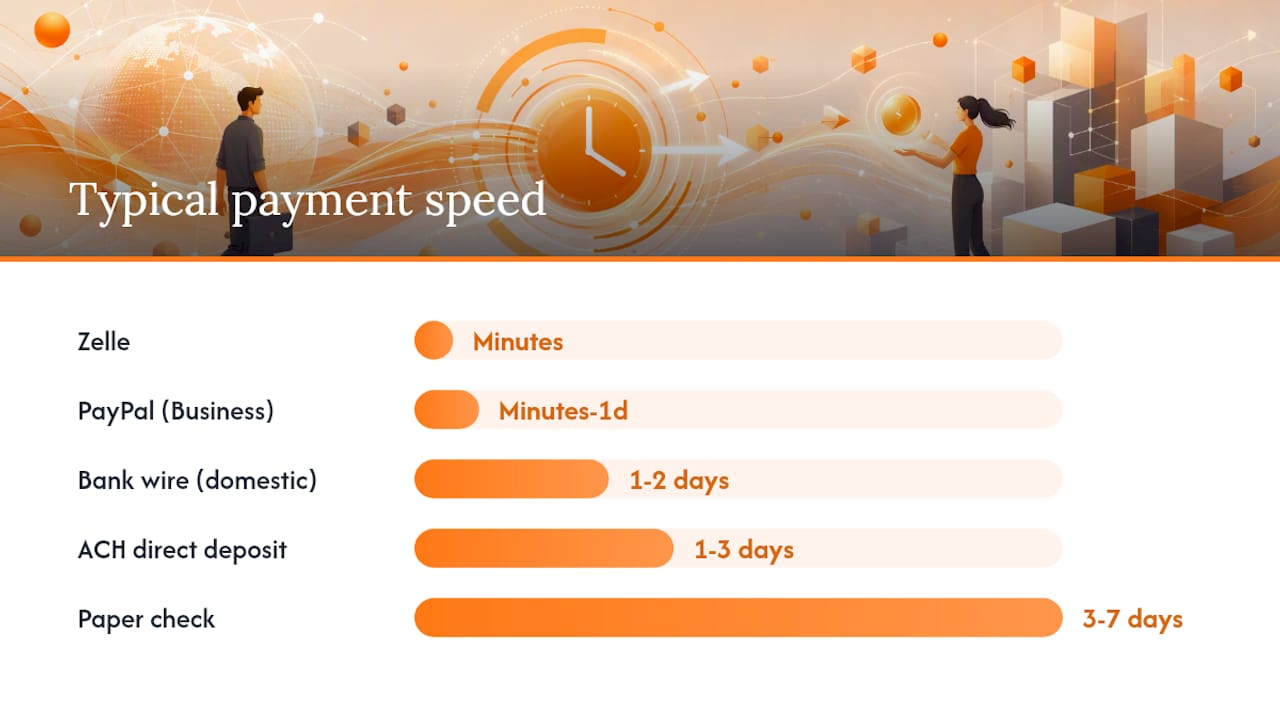
| Method | Speed | Typical cost (sender) | Best for | Tax reporting implication | Security / fraud risk | Setup complexity |
|---|---|---|---|---|---|---|
| ACH direct deposit | 1–3 business days | Free to ~$1 per transfer | Domestic recurring | Payer files 1099-NEC; clean bank record | Low | Requires contractor bank details |
| Paper check | 3–7 days (mail) | Postage + check stock | Occasional, unbanked | Payer files 1099-NEC; check is the record | Low-medium (mail theft) | Minimal |
| Credit/debit card | Same day | 2–3% processing fee | One-off, small amounts | Processor may issue 1099-K; payer still tracks | Medium (chargebacks) | Requires payment processor |
| Bank wire (SWIFT) | 1–2 business days domestic; 2–5 international | $25–$50 domestic; $40–$100+ international + 2–4% FX | Large or international one-off | Payer files 1099-NEC; wire confirmation is record | Low | Bank account + SWIFT details |
| Zelle | Minutes | Free | Urgent domestic, small amounts | Bank-to-bank; payer files 1099-NEC; no 1099-K | Low-medium (irreversible) | Both parties need Zelle-enrolled bank |
| PayPal (Business) | Minutes to 1 day | 0–2.9% + fixed fee | Domestic one-off, gig workers | Processor issues 1099-K above threshold; payer still tracks | Medium | Contractor needs PayPal account |
| Stripe (Connect) | 1–2 days | 0.4–1.8% all-in | Platforms, volume payouts | Stripe issues 1099-K; payer reconciles | Low-medium | Developer setup or no-code dashboard |
| Wise | 1–2 days (most corridors) | ~0.4–1.8% all-in (corridor-dependent) | International recurring | Payer files 1099-NEC; Wise receipt is record | Low | Recipient needs Wise account |
| Payoneer | 1–3 days | ~1–3% depending on method | International recurring | Payer files 1099-NEC; Payoneer receipt is record | Low | Recipient needs Payoneer account |
| Contractor-pay platform | 1–3 days (ACH rail) | Varies by platform subscription | Recurring, multi-contractor | Automates 1099-NEC generation; best audit trail | Low | Platform onboarding |
ACH direct deposit
ACH moves U.S. dollars between domestic bank accounts through the Automated Clearing House network. It is free or nearly free through most business bank accounts, settles in 1–3 business days, and produces a clean transaction record that maps directly to your 1099-NEC at year-end. For any contractor you pay more than once, ACH is the practical default.
The one limitation is geography: ACH is USD-only and works only between U.S. bank accounts. The moment a contractor is based outside the country, you need a different rail.
Paper checks
Checks remain useful for contractors without bank accounts or for one-off payments where you have no digital relationship yet. The paper trail is self-contained: the check number, date, payee, and amount are all on the stub. The downside is speed. Mail adds days, and reconciling dozens of outstanding checks at year-end is tedious work.
Credit and debit card payments
Paying a contractor by card is fast, but the processing fee (typically 2–3%) adds up on larger invoices. More important, card payments through a merchant processor can trigger a Form 1099-K from that processor. That does not eliminate your own 1099-NEC obligation if the contractor’s total payments across all rails exceed the threshold. You end up with two forms in play and a reconciliation problem.
Bank wires (SWIFT)
SWIFT wires are the fallback for large or international payments where no fintech option covers the corridor. Domestic wires run $25–$50 per transfer; international wires typically cost $40–$100 in flat fees plus a 2–4% FX margin. That cost is hard to justify for recurring small payments but reasonable for a single large project payment or an exotic currency corridor where Wise or Payoneer do not operate.
Zelle
Zelle is bank-to-bank and does not route through a third-party settlement organization, so it does not generate a 1099-K. The payer retains the 1099-NEC obligation as usual. Transfers are typically instant and free, but Zelle has per-transaction and daily limits that vary by bank, and payments are irreversible once sent. Use it for urgent domestic payments under those limits, not as a primary system for high-volume contractor pay.
PayPal, Venmo (Business), and Stripe
These platforms are convenient for gig workers and freelancers who already have accounts. PayPal Business and Stripe both issue Form 1099-K to contractors who exceed the processor’s reporting threshold. That does not mean you are off the hook for tracking: even when a payment platform issues a 1099-K, you still need to determine whether a 1099-NEC is required based on your total payments across all methods. Stripe Connect is particularly useful for businesses that pay many contractors through a platform or marketplace model.
Wise and Payoneer
For international contractor payments, Wise and Payoneer typically beat bank wires on total cost. Wise charges approximately 0.4–1.8% all-in for common corridors, compared to the 2–4% FX margin plus flat fee on a SWIFT wire. Both platforms allow contractors to hold a receiving account in their local currency, which simplifies the contractor’s side of the transaction. Setup requires the contractor to create an account, which is a one-time friction worth accepting for any recurring international relationship.
Contractor-pay platforms
Dedicated contractor-payment tools (AP-integrated platforms that support 1099 workflows) handle W-9 collection, payment disbursement via ACH, cumulative payment tracking, and 1099-NEC generation in one place. For small and mid-size U.S. businesses paying multiple contractors, centralizing payments in a contractor-pay platform is operationally superior to running contractors through payroll. The subscription cost is usually offset by the time saved at year-end.
How do you pay a contractor correctly from day one?
Follow this sequence every time you bring on a new contractor. Skipping step one is the most common mistake, and it creates backup-withholding exposure.
- Confirm classification. Before any payment, verify the worker qualifies as an independent contractor under the IRS behavioral, financial, and type-of-relationship tests. If you are unsure, review the IRS guidance before proceeding.
- Collect Form W-9. Request a completed W-9 (or the appropriate W-8 series form for non-U.S. contractors) before the first payment. This gives you the contractor’s Taxpayer Identification Number (TIN) and certifies their tax status. Collecting the W-9 at onboarding is the single most important step in the payment process.
- Agree on terms in writing. Set the rate, payment schedule, invoicing format, and preferred payment method in a written agreement or statement of work.
- Receive and approve the invoice. The invoice should include: invoice number, date, service description, amount, contractor name, and their TIN or business name as it appears on the W-9.
- Choose and execute the payment method. For domestic recurring work, default to ACH. For international, use Wise or Payoneer. For urgent domestic, Zelle works if the amount is within bank limits.
- Log the transaction immediately. Record the payment date, amount, method, transaction ID, invoice number, and contractor TIN in your AP system or accounting software.
- Retain proof. Keep the bank confirmation, wire receipt, or platform record. This is your documentation if the IRS questions the payment.
- Prepare for year-end. Tally each contractor’s total payments. If the total meets or exceeds the 1099-NEC threshold, file Form 1099-NEC by January 31.
Pro Tip: Set up a contractor onboarding folder (digital or physical) for each new hire that holds the signed W-9, the written agreement, and the first invoice. Auditors and accountants will thank you.
Timeline reality check: steps 1–3 should happen before any work begins. Steps 4–6 happen per invoice cycle. Steps 7–8 are ongoing through the year and finalized in January.
What U.S. tax rules apply when you pay independent contractors?
The short answer: you generally do not withhold income tax or payroll taxes from contractor payments. Your obligations are to collect a W-9, track payments, and file a 1099-NEC when the annual total meets the threshold.
Worker classification: the IRS three-factor test
The IRS uses three categories of evidence to determine whether a worker is an employee or an independent contractor: behavioral control (does the business control how the work is done?), financial control (does the business control the economic aspects of the worker’s job?), and type of relationship (are there written contracts, employee benefits, or an indefinite relationship?). Misclassifying an employee as a contractor exposes you to back payroll taxes, penalties, and interest.
If the classification is genuinely unclear, you can file Form SS-8 to request an IRS determination. That process takes time, so it is better used for prospective clarity than as a retroactive fix.
Form W-9 and backup withholding
A completed W-9 certifies the contractor’s TIN and confirms they are not subject to backup withholding. If a contractor does not provide a W-9, or if the TIN they provide does not match IRS records, you are required to withhold 24% of each payment as backup withholding and remit it to the IRS. That is a significant administrative burden and a signal that something is wrong with the relationship. Collect the W-9 before payment, every time.
1099-NEC: the 2026 threshold change
This change means some contractors you previously reported at $600–$1,999 will fall below the threshold in 2026. Still track every payment: the threshold can change again, and your own records are the source of truth regardless of what any processor reports.
How payment method affects reporting
Payments made through third-party settlement organizations (PayPal, Stripe, credit card processors) can trigger a Form 1099-K from the processor. That is a separate form from the 1099-NEC you may owe. The processor’s 1099-K does not replace your obligation to file a 1099-NEC if the contractor’s total payments across all rails meet the threshold. Zelle is treated differently: because it is bank-to-bank and not a third-party settlement organization, it does not generate a 1099-K. Your 1099-NEC obligation remains, but there is no duplicate form to reconcile.
Compliance checklist:
- W-9 on file before first payment
- TIN verified against the name on the W-9
- All payments logged by contractor, by method, by date
- Year-end total compared against the $2,000 threshold
- 1099-NEC filed by January 31 for qualifying contractors
- Backup withholding applied at 24% if TIN is missing or mismatched
This article is general information, not tax or legal advice. Confirm current IRS rules and thresholds with a qualified tax professional or the IRS directly.
How do you pay contractors outside the U.S.?
ACH does not cross borders. For international contractor payments, the choice comes down to three realistic options: SWIFT bank wires, fintech platforms like Wise or Payoneer, and payouts products like Stripe Connect.
| Method | Typical cost | Speed | Best corridor fit |
|---|---|---|---|
| SWIFT wire | $40–$100 flat + 2–4% FX margin | 2–5 business days | Any corridor; large or one-off payments |
| Wise | ~0.4–1.8% all-in | 1–2 business days | USD→EUR, USD→GBP, USD→INR, most major pairs |
| Payoneer | ~1–3% depending on method | 1–3 business days | USD→INR, USD→PHP, USD→BDT, freelance-heavy corridors |
| Stripe Connect | 0.4–1.8% all-in | 1–2 business days | Platform/marketplace models with many recipients |
When to use Wise or Payoneer
For recurring international payments on common corridors, Wise and Payoneer typically cut total costs significantly compared to a SWIFT wire. A $1,000 payment via SWIFT might cost $50–$100 in fees plus the FX spread. The same payment via Wise on a USD→EUR corridor might cost $10–$18 all-in. Over a year of monthly payments, that difference is real money.
Both platforms allow contractors to set up receiving accounts in their local currency, which means the contractor absorbs no conversion cost on their end. That matters for the working relationship: a contractor in India or the Philippines who receives the full agreed amount in their local currency is a contractor who stays.
When SWIFT is still the right call
SWIFT remains the practical choice for exotic corridors where Wise or Payoneer have limited coverage, for very large one-off payments where a flat wire fee is proportionally small, and for contractors whose banks do not support fintech receiving accounts. When sending a SWIFT wire, specify SHA fee allocation (costs shared between sender and recipient) or OUR (sender pays all fees) to avoid the contractor receiving less than invoiced.
Tax documentation for non-U.S. contractors
Non-U.S. contractors should provide a Form W-8BEN (individuals) or W-8BEN-E (entities) instead of a W-9. These forms certify foreign status and, in many cases, claim treaty benefits that reduce or eliminate U.S. withholding. Without a W-8, you may be required to withhold 30% of the payment. Keep the W-8 on file and update it when it expires (generally every three years).
What tools and records make year-end 1099 filing simple?
The goal is to never scramble in January. That means building the record during the year, not reconstructing it after.
The minimum record fields for each contractor payment are:
- Payment date
- Amount paid
- Payment method (ACH, wire, PayPal, etc.)
- Transaction ID or check number
- Invoice number
- Contractor’s legal name and TIN (as on the W-9)
- Confirmation that W-9 is on file
Accounting software like QuickBooks, Xero, or FreshBooks can track these fields if you set up each contractor as a vendor and log payments consistently. The advantage of a dedicated contractor-pay platform is that it centralizes W-9 collection, tracks cumulative payments by contractor, and generates 1099-NEC forms automatically at year-end. That automation is worth the subscription cost for any business paying more than a handful of contractors.
Pro Tip: If you use multiple payment methods for the same contractor (say, ACH for regular invoices and PayPal for a one-off), flag that contractor’s record for manual review at year-end. A processor 1099-K from PayPal and your own 1099-NEC can overlap, and the IRS will notice if the same income appears to be reported twice.
One practical rule that saves headaches: pick a default payment method for each contractor at onboarding and change it only when necessary. Switching methods mid-engagement creates bookkeeping complexity and increases the chance of a missed or duplicated record.
How do you choose the right payment method for each contractor?
Work through these questions in order for every new contractor relationship.
- How often will you pay them? Recurring payments favor ACH or a contractor-pay platform. One-off payments can use almost any method.
- Where are they located? Domestic contractors: ACH, check, Zelle, or PayPal. International: Wise, Payoneer, or SWIFT.
- How urgent is the first payment? If same-day, Zelle (domestic) or a wire (international) are the only real options.
- What does the contractor prefer? Ask. Some contractors have Wise accounts already; others only accept checks. Preference matters for the working relationship.
- Does your accounting software integrate with the payment method? ACH through your bank or a contractor-pay platform usually integrates cleanly. Cash and personal payment apps rarely do.
- What is the cost relative to the invoice amount? A 2.9% PayPal fee on a $50 invoice is $1.45. On a $5,000 invoice, it is $145. Scale the method to the amount.
Onboarding questions to ask every new contractor:
- What bank account or payment platform do you prefer to receive payment?
- Are you a U.S. person for tax purposes? (Determines W-9 vs. W-8)
- What fees, if any, does your preferred method charge you to receive funds?
- Do you have a TIN (SSN or EIN) you can provide on a W-9?
Red flags and what to do about them:
- Contractor refuses to provide a W-9 or TIN: apply 24% backup withholding and document the refusal.
- Contractor requests payment in cash: decline or document meticulously; cash creates no audit trail and complicates reconciliation.
- Contractor asks you to pay a personal Venmo or CashApp account: treat this as a one-off exception, document it, and push toward a business account or ACH for future payments.
- No bank account at all: paper check is the practical fallback; prepaid debit cards are another option but add complexity.
Key Takeaways
ACH or a contractor-pay platform is the right default for most U.S. businesses paying independent contractors, with Wise or Payoneer as the practical choice for international payments and SWIFT as the fallback for large or exotic-corridor transfers.
| Point | Details |
|---|---|
| Collect W-9 before payment | Always gather Form W-9 (or W-8 for non-U.S. contractors) before the first payment to avoid 24% backup withholding. |
| 2026 threshold is $2,000 | The 1099-NEC reporting threshold rose to $2,000 for 2026; file by January 31 for any contractor who meets or exceeds it. |
| ACH is the domestic default | ACH is low-cost, creates a clean audit trail, and integrates with accounting software for recurring U.S. contractor payments. |
| Use fintechs for cross-border | Wise (~0.4–1.8% all-in) and Payoneer typically cost far less than a SWIFT wire ($40–$100 + 2–4% FX) for common international corridors. |
| Chambanow speeds up sourcing | Chambanow’s bilingual marketplace helps hirers find and connect with local contractors quickly, so payment and compliance workflows can start sooner. |
The part most hiring guides skip
Most articles on paying contractors stop at the mechanics: collect the W-9, send the ACH, file the 1099-NEC. That is necessary, but it misses the upstream problem. The payment process breaks down most often not because a business chose the wrong rail, but because the contractor relationship was never set up correctly in the first place.
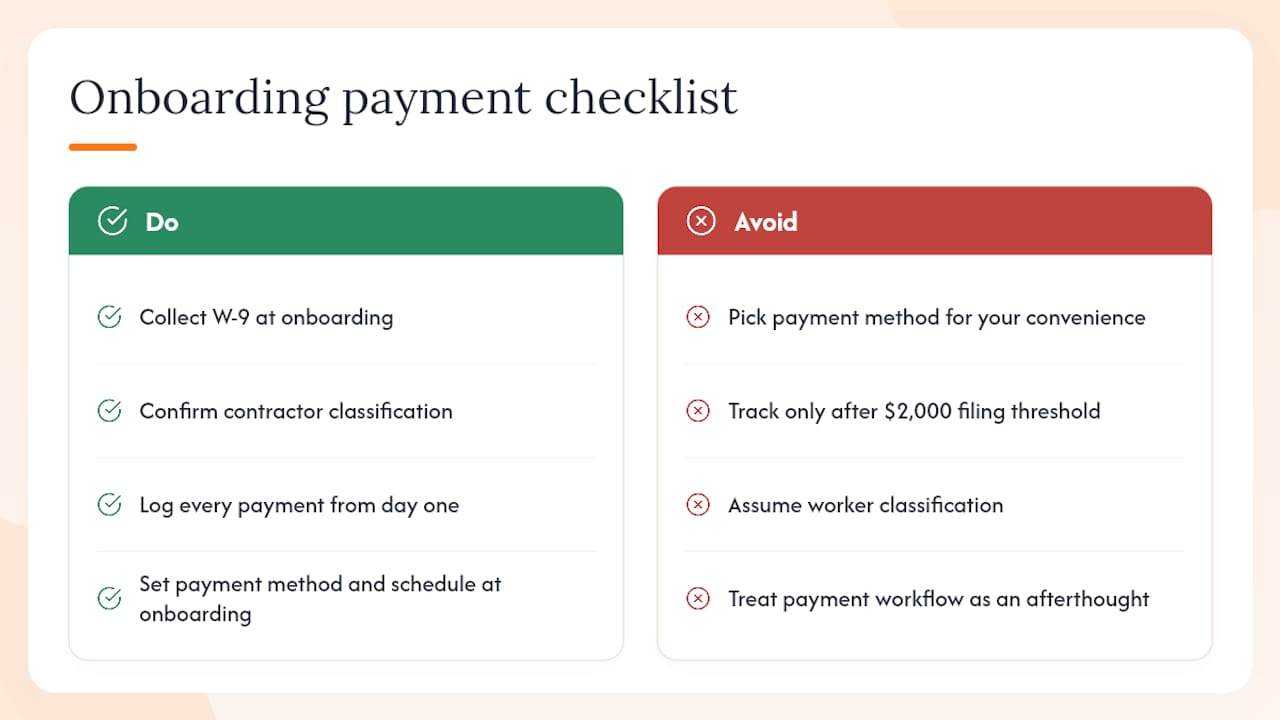
A contractor who was never asked for a W-9 at onboarding, whose classification was assumed rather than confirmed, and whose payment method was chosen for the hirer’s convenience rather than the contractor’s reality is a compliance problem waiting to surface. The 2026 threshold change to $2,000 will cause some businesses to relax their tracking, reasoning that fewer contractors will hit the threshold. That reasoning is backward. The IRS threshold determines when you must file, not when you must track. Every payment to every contractor should be logged from day one, regardless of whether you expect to hit the filing threshold.
There is also a practical dignity argument here. Contractors, especially day laborers and skilled tradespeople, often work for multiple hirers simultaneously. A payment that arrives late, in the wrong amount, or through a method that charges them a fee to receive it is not just an inconvenience. It signals that the hirer did not think through the relationship. Choosing a payment method that works for the contractor, not just the business, is a small act that builds the kind of working relationship where good people come back.
The businesses that handle contractor payments well tend to share one habit: they treat the payment workflow as part of onboarding, not an afterthought. The W-9, the preferred payment method, the invoicing format, and the payment schedule are all settled before the first day of work. That discipline pays off every January when 1099 season arrives and the records are already clean.
Chambanow helps you find local contractors faster
Finding the right contractor is often the harder half of the equation. Once you have someone to pay, the methods in this guide handle the rest. Chambanow is a bilingual hiring marketplace built for exactly that first step: connecting businesses and hirers with local workers who are available today, whether for a single day job or a longer engagement.
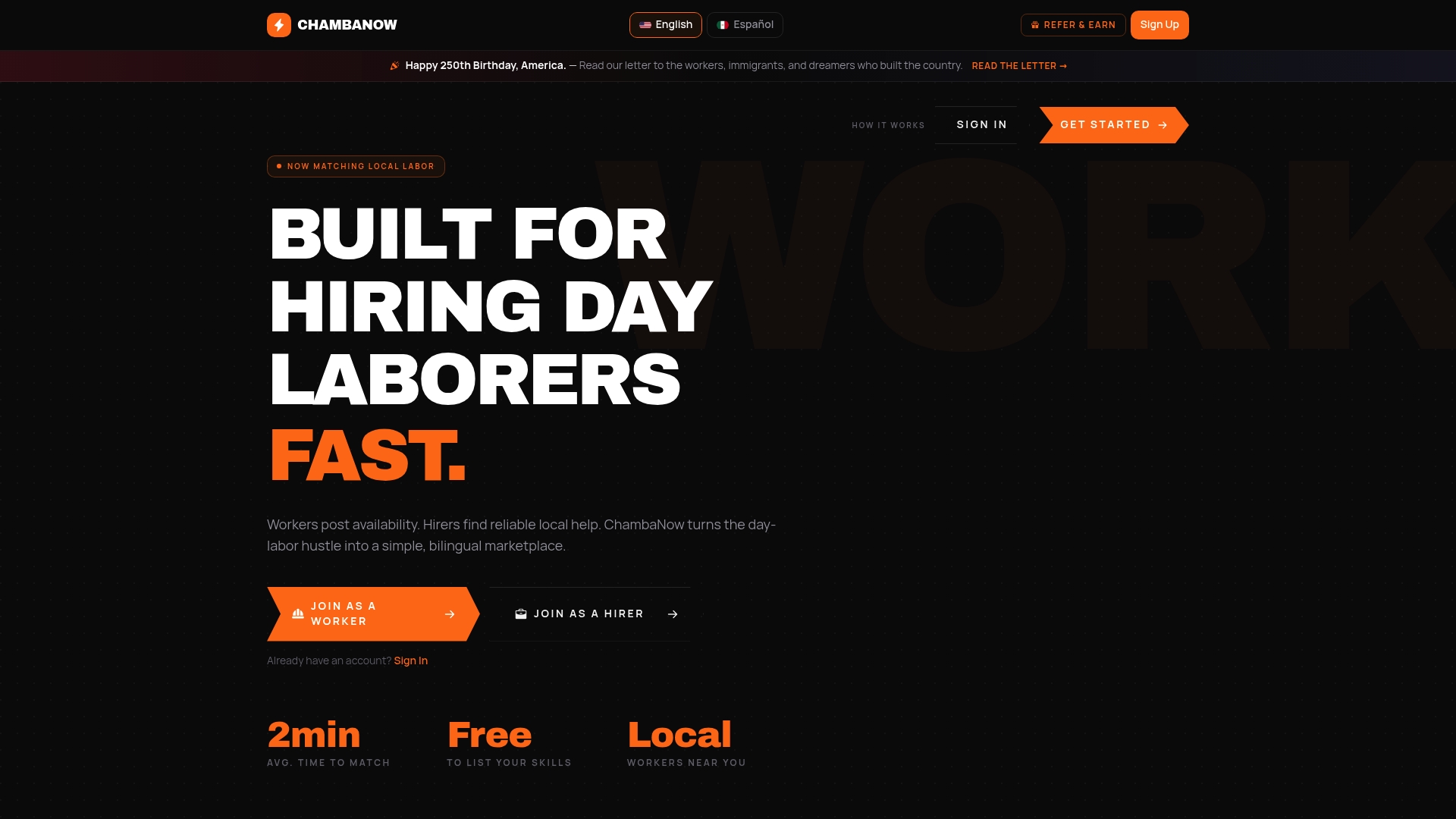
Hirers can browse worker profiles, post jobs, and communicate through automatic language translation, which removes one of the most common friction points when hiring across language barriers. For businesses in the Los Angeles and Long Beach areas, local contractors are available now through the platform. Once you have found the right person, the payment and compliance workflow in this guide picks up from there. See the Chambanow pricing page to review hirer subscription options and get started.
Useful sources for further reading
- Independent contractor (IRS) — Independent contractor (self-employed) or employee
- Understanding employee vs. contractor designation (IRS)
- Completing Form SS-8 (IRS)
- How to pay independent contractors: A process that keeps your small business on track (SurePayroll)
- How to Pay Independent Contractors: A Step-by-Step Guide | FirstHR
- Global contractor payment methods compared: ACH, SWIFT, Stripe, Wise (Omnivoo)
- How to Pay 1099 Contractors: Methods, Forms & Tips (Melio Payments)
- Independent contractor guidance (Xero)
Recommended
Building knowledge that works.