
Background Checks for Contractors: A Hiring Manager's Guide
Learn how to effectively conduct background checks for contractors. Follow essential steps to ensure compliance, safety, and proper verification.

Businesses can run background checks on independent contractors, and doing it right means following the Fair Credit Reporting Act when using a Consumer Reporting Agency, respecting state and local rules, and verifying licenses and insurance directly. Before you commission a single search, work through this priority checklist:
- Confirm your permissible purpose under the FCRA (evaluating a contractor for a business engagement qualifies).
- Prepare a clear, standalone written disclosure and obtain the contractor’s written consent before any check runs.
- Verify the contractor’s license number, bond, and Certificate of Insurance independently, not just by accepting documents at face value.
- Decide the scope of checks based on the role: criminal history, identity verification, driving records, drug testing, and professional license checks are the most common.
- Confirm whether the worker is genuinely an independent contractor or an employee, since IRS classification factors affect which obligations apply.
One distinction matters immediately: when you use a Consumer Reporting Agency to pull a consumer report, the FCRA applies in full. When you search public court records manually or call a licensing board yourself, the FCRA’s consumer-report rules do not govern that process, though state laws may still apply. Most hiring managers use a CRA for efficiency and legal structure, which is the approach this guide focuses on.
Key Takeaways
Compliant contractor background screening requires FCRA adherence, direct license and insurance verification, consistent EEOC-guided decision-making, and documented adverse-action procedures at every step.
| Point | Details |
|---|---|
| FCRA applies when using a CRA | Always obtain written disclosure and consent before ordering a consumer report through a Consumer Reporting Agency. |
| Verify licenses and insurance directly | Call the insurance carrier and query the state licensing board yourself; never rely solely on documents the contractor provides. |
| Use the EEOC individualized assessment | Evaluate nature of offense, time elapsed, and job nexus before any adverse decision based on criminal history. |
| Document every adverse-action step | Send a pre-adverse notice before finalizing, then a formal adverse-action notice; retain all records for at least five years. |
| Chambanow accelerates shortlisting | Use Chambanow to build a qualified candidate pool first, then apply CRA checks to your finalists for a faster, compliant hire. |
Table of Contents
- What screenings do hiring managers commonly run on contractors?
- What federal legal rules apply when using a CRA for contractor checks?
- How do state and local rules change the process?
- How to run a compliant background check on a contractor, step by step
- How to choose a background-screening provider
- How to interpret screening results fairly and consistently
- How to verify contractor licenses, bonds, and insurance correctly
- What are typical turnaround times and costs for contractor background checks?
- How a hiring marketplace like Chambanow can complement formal screening
- Chambanow helps you shortlist local contractors faster
- Sources
What screenings do hiring managers commonly run on contractors?
Contractor background screening covers a wider range of checks than many hiring managers expect. The right combination depends on the role, the industry, and the access the contractor will have to people, property, or sensitive data.
A CRA-produced consumer report carries full FCRA obligations. A manual public-record search, such as pulling a court docket yourself or querying a state licensing board directly, does not produce a consumer report under the FCRA. However, it still needs to be applied consistently to avoid discrimination claims. Standard screening packages typically combine the SSN trace, county criminal search, sex-offender check, and one or more role-specific checks into a single order.
Driving records are non-negotiable for any contractor who operates a vehicle on your behalf. Drug testing is mandatory in DOT-regulated industries and common in construction and manufacturing. Credit checks are legally restricted in many states and should only be ordered when the role genuinely involves financial responsibility.
What federal legal rules apply when using a CRA for contractor checks?
The Fair Credit Reporting Act is the governing federal statute whenever a business obtains a consumer report through a Consumer Reporting Agency. TThe steps below are not optional, and skipping any one of them creates legal exposure.
- Establish a permissible purpose. Evaluating an independent contractor for a business engagement is a recognized permissible purpose under the FCRA. Document it before you order any report.
- Provide a clear, standalone written disclosure. The disclosure must tell the contractor that a consumer report may be obtained for employment-related purposes. It must stand alone, not buried in a contract or onboarding packet.
- Obtain written authorization. The contractor must sign (or electronically authorize) consent before the report is pulled. No consent, no report.
- Provide a copy of the report if requested. Once a report exists, the contractor has the right to receive a copy. Build this into your process so it does not become a scramble.
- Follow the adverse-action process if the report influences your decision. This is the step most hiring managers handle incorrectly.
The adverse-action timeline works in two stages. First, send a pre-adverse action notice: a letter that includes a copy of the report and a summary of the contractor’s rights under the FCRA. Give the contractor a reasonable period, typically five business days, to dispute inaccurate information before you finalize any decision. Second, if you proceed with the adverse decision, send the formal adverse-action notice, which must state the name, address, and phone number of the CRA, confirm the CRA did not make the hiring decision, and explain the contractor’s right to dispute the report within 60 days.
Keep records of every disclosure, consent form, report, pre-adverse notice, and adverse-action notice. A retention period of at least five years is a reasonable baseline, though your legal counsel may recommend longer depending on your industry and state.
How do state and local rules change the process?
Federal FCRA compliance is the floor, not the ceiling. State and local laws frequently add requirements that a hiring manager must check before acting on any screening result.
Ban-the-Box laws restrict when you can ask about criminal history. Many states and cities require that criminal-history questions come only after a conditional offer has been made, not at the application stage. Cities like Los Angeles, New York, and Philadelphia have their own ordinances that go further than state law.
Lookback limits cap how far back a criminal record search can reach. Several states limit reporting of convictions older than seven years for positions below a certain salary threshold. California, for example, has strict limits on what a CRA may report and when.
State contractor licensing requirements add another layer. Some licensing boards conduct their own background checks as part of the licensure process. Arizona’s Registrar of Contractors requires all persons listed on a license application to complete a criminal background check submitted directly to the ROC. California’s Contractors State License Board requires fingerprinting and DOJ and FBI checks for licensure, and may deny a license for convictions substantially related to the trade. Knowing that a contractor has already cleared a state licensing board’s check does not eliminate your own FCRA obligations, but it is useful context.
Key authorities to consult before running checks or making adverse decisions:
- Your state’s department of labor or attorney general’s office for state FCRA analogs and Ban-the-Box rules.
- The city or county business licensing office for local ordinances.
- The relevant state licensing board for the contractor’s trade (electrical, plumbing, HVAC, general contracting).
- County court websites for jurisdictions where the contractor has lived or worked.
For contractors whose classification as independent versus employee is genuinely ambiguous, the IRS independent-contractor guidance and state-level worker classification rules both affect which screening obligations apply. Misclassification is a separate legal risk, but it intersects directly with how you structure your screening process.
Document your jurisdictional check. Keep a written record of which state and local rules you reviewed, when you reviewed them, and what you concluded. If a decision is ever challenged, that documentation shows you acted in good faith.
How to run a compliant background check on a contractor, step by step
A clear workflow prevents the gaps that create liability. Here is the operational sequence from planning through recordkeeping.
- Define the scope. Identify which checks the role requires based on access, industry, and risk. A warehouse contractor needs a criminal search and identity verification. A driver needs an MVR. A financial-services contractor may need a credit check where state law permits it.
- Confirm permissible purpose and classification. Verify the worker is genuinely an independent contractor. Document the permissible purpose for the FCRA record.
- Select your screening provider. Choose a CRA that is FCRA-compliant, covers the jurisdictions where the contractor has lived and worked, and provides adverse-action tooling (more on this in the next section).
- Deliver the written disclosure. Provide a standalone document that clearly states a consumer report will be obtained. Do not combine it with a service agreement or onboarding form.
- Obtain written consent. Get a signed (or electronically authorized) consent form before ordering any report. Keep the original.
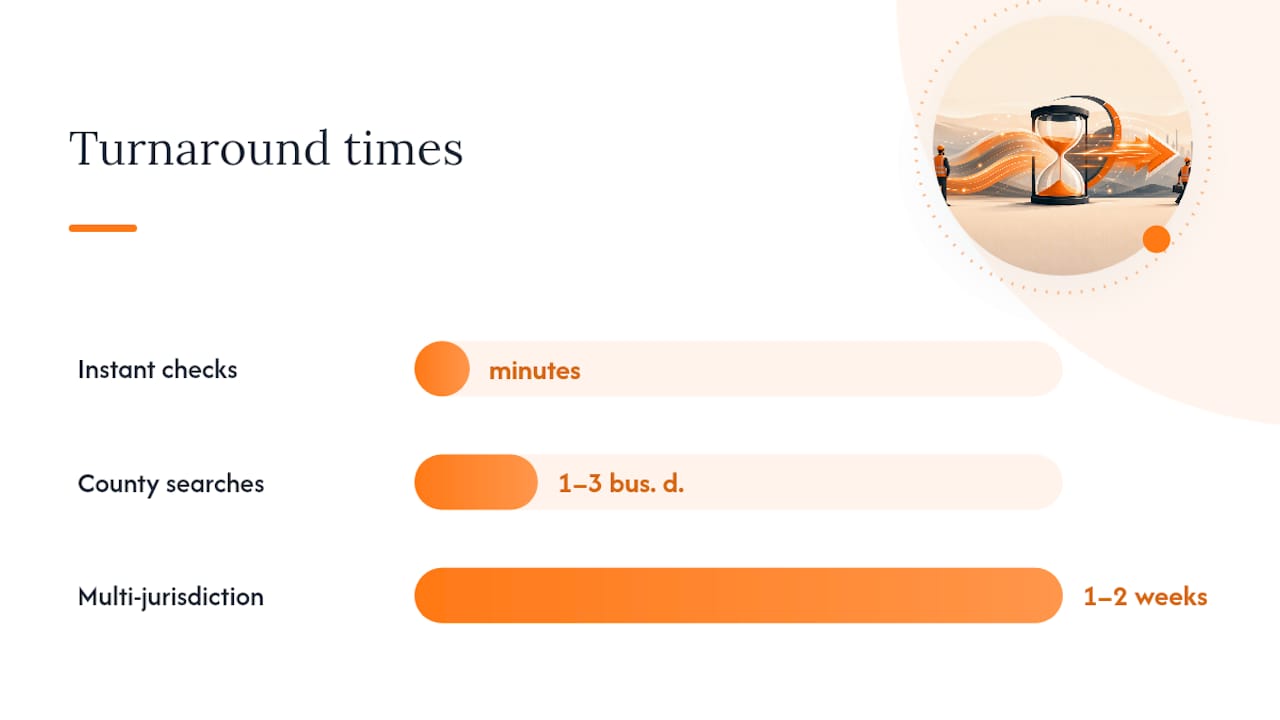
- Run the checks. Submit the order to your CRA. For county criminal searches, expect a few business days. Instant database checks (SSN trace, sex-offender registry) return within minutes.
- Review results against your written policy. Apply the same criteria consistently across all contractors. Use the EEOC’s individualized assessment framework (covered in the next section) for any criminal records.
- Send the pre-adverse action notice if needed. If a result may lead to a negative decision, send the notice with a copy of the report and the contractor’s rights summary. Wait a reasonable period before finalizing.
- Send the adverse-action notice if you proceed. Include the CRA’s name and contact information and the contractor’s right to dispute within 60 days.
- Store records securely. Retain all disclosures, consents, reports, and notices in a secure, access-controlled system. Limit access to those with a genuine need to know.
Sample disclosure language (adapt with legal counsel):
“[Company Name] may obtain a consumer report about you from a Consumer Reporting Agency for the purpose of evaluating your engagement as an independent contractor. This report may include information about your criminal history, employment history, education, and other background information. You have the right to request a copy of the report.”
This language is a starting point, not a finished legal document. Have your attorney review it before use.
How to choose a background-screening provider
Not every vendor that calls itself a background-check company qualifies as a Consumer Reporting Agency under the FCRA. Using a non-CRA vendor for consumer reports creates compliance gaps that can expose your business to liability.
Checkr is a widely recognized CRA that serves businesses screening contractors and gig workers, offering SSN traces, county and federal criminal searches, MVR checks, and built-in adverse-action workflow tools. It is a useful reference point for the features and compliance infrastructure a reputable CRA should provide, though it is one of several options in the market.
When evaluating any screening provider, work through these criteria:
- FCRA/CRA status. Confirm the vendor is a registered Consumer Reporting Agency. Ask directly and verify.
- Geographic coverage. County criminal searches require actual court-record access. Confirm the vendor covers the counties and states where your contractors have lived and worked, not just a national database that misses local records.
- Turnaround time. Instant checks (SSN trace, sex-offender registry) return in minutes. County criminal searches typically take one to three business days. Multi-jurisdictional or international searches can take one to two weeks.
- Accuracy and dispute resolution. Ask how the vendor handles disputes and corrects errors. A reputable CRA has a clear dispute process and corrects records within 30 days under the FCRA.
- Adverse-action tooling. The best vendors provide pre-built pre-adverse and adverse-action notice templates and track the timeline for you. This reduces the risk of missing a required step.
- Data security. Background check data is sensitive personal information. Confirm the vendor uses encryption at rest and in transit, limits internal access, and has a documented breach-response plan.
- Pricing structure. Most CRAs charge per report, with volume discounts for high-frequency users. Some offer subscription or bundled packages. Understand exactly what each package includes before committing.
The tradeoff between a fully CRA-based package and a manual public-record workflow comes down to legal structure and efficiency. CRA packages are faster, legally structured, and include adverse-action support. Manual searches give you more control but require you to build your own compliance process around them, which is a significant operational burden for most hiring managers.
How to interpret screening results fairly and consistently
A criminal record in a background report is not an automatic disqualification. Treating it as one creates discrimination risk and may violate the EEOC’s guidance on criminal records, which warns that blanket exclusions based on criminal history can constitute unlawful discrimination under Title VII.
The EEOC’s individualized assessment framework asks three questions, often called the nature–time–nexus test:
- Nature of the offense. What was the crime, and how serious was it?
- Time elapsed. How long ago did the offense occur, and what has the person’s conduct been since?
- Nexus to the job. Is the offense directly relevant to the duties and risks of this specific role?
A practical way to apply this is to map offense categories against time elapsed and role risk. A financial fraud conviction from two years ago is highly relevant to a role managing client payments. The same conviction from fifteen years ago, with no subsequent issues, may not be. A violent offense is more relevant to a role with unsupervised residential access than to a remote data-entry engagement.
Document the individualized assessment every time. Write down which factors you considered, what weight you gave each, and why you reached your conclusion. This documentation is your defense if a decision is ever challenged.
- Apply the same criteria consistently across all contractors in similar roles.
- Never make a decision based solely on an arrest record without a conviction.
- Give the contractor an opportunity to provide context before you finalize an adverse decision.
- Review your written screening policy at least annually to confirm it reflects current EEOC guidance and state law.
Pro Tip: Create a simple decision matrix that maps offense categories (violent, financial, drug-related, other) against time bands (0–3 years, 3–7 years, 7+ years) and role-risk levels (high, medium, low). Applying the matrix consistently across all contractor reviews reduces both discrimination risk and decision fatigue.
How to verify contractor licenses, bonds, and insurance correctly
Accepting documents at face value is where many hiring managers get burned. A license certificate can be expired, a bond can be insufficient for the scope of work, and a Certificate of Insurance can be forged or reflect a policy that has since lapsed.
Here is what to request and what to check on each document:
- License number. Request the contractor’s license number and the issuing state board. Look it up directly on the state licensing board’s website, not through the contractor. Confirm the license is active, covers the type of work being performed, and has not been subject to disciplinary action.
- Bond paperwork. Confirm the bond amount is adequate for the scope and value of the work. Check the bond’s expiration date and the surety company’s name.
- Certificate of Insurance (COI). Request a COI naming your business as an additional insured. Check the policy type (general liability, workers’ compensation, professional liability as applicable), coverage limits, and expiration date.
The critical step most hiring managers skip: call the insurance carrier directly to confirm the policy number, effective and expiration dates, named insured, covered activities, and current status. COIs can be forged or reflect coverage that has since been canceled. The carrier’s name and phone number are on the COI, but verify that contact information against the insurer’s public website before calling, since forged COIs sometimes list fake contact numbers.
For license verification, state licensing boards are the authoritative source. Arizona’s ROC, California’s CSLB, and equivalent boards in every state maintain searchable online databases. For contractors working across state lines, check each state where they hold or claim a license.
You can also use Installer to find and cross-reference verified professionals in home services trades, which can complement your own direct verification steps.
A short caution: if a contractor is reluctant to provide a license number or insurance carrier contact, treat that as a meaningful signal. Legitimate contractors with active licenses and valid coverage have no reason to hesitate.
What are typical turnaround times and costs for contractor background checks?
Planning your hiring schedule around screening timelines prevents delays. The table below reflects typical ranges; actual times vary by vendor, jurisdiction, and the contractor’s history.
| Check Type | Typical Turnaround | Illustrative Cost Range |
|---|---|---|
| SSN Trace / Identity Verification | Instant to a few hours | $5 per check |
| Sex Offender Registry Check | Instant | Included in most packages |
| County Criminal Search (single county) | 1–3 business days | $10–$30 per county |
| Statewide Criminal Search | 1–5 business days | $15 per state |
| Federal Criminal Search | 1–3 business days | $10 per search |
| Motor Vehicle Records (MVR) | Instant to 3 business days | $10 per state |
| Employment / Education Verification | 2–5 business days | $15 per verification |
| Drug Testing (lab-based) | 1–3 business days after collection | $30 per test |
| Multi-Jurisdictional / International | 1–3 weeks | Varies significantly |
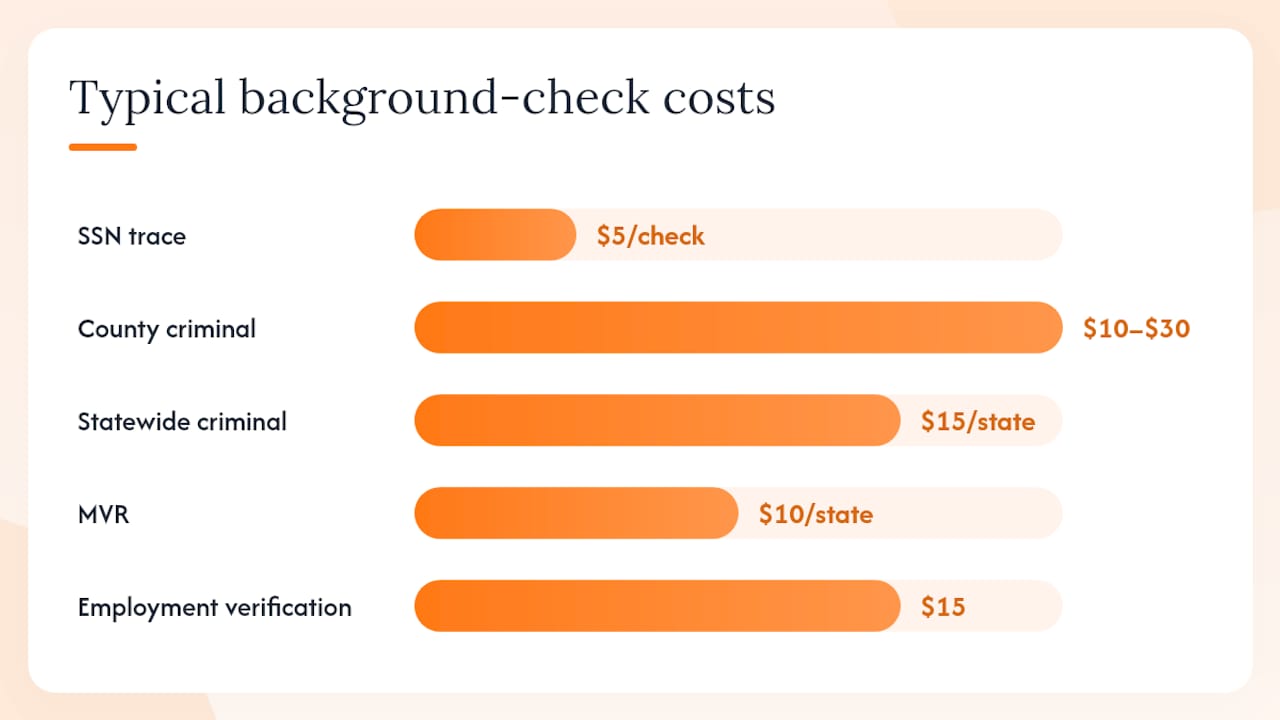
A basic package covering SSN trace, county criminal, and sex-offender registry typically runs $30–$60 per contractor. A mid-range package adding an MVR and employment verification lands in the $75–$120 range. International address history, manual county searches in jurisdictions without electronic records, and multi-state criminal searches all add time and cost.
Volume matters. Businesses that screen contractors regularly can negotiate per-report pricing with their CRA, which meaningfully reduces per-unit cost at scale. Manual county searches, where a researcher physically pulls court records, add one to three business days compared with instant database checks and typically cost more per jurisdiction.
How a hiring marketplace like Chambanow can complement formal screening
Formal CRA checks are the legal backbone of contractor due diligence, but they do not help you build a shortlist quickly. That is where a hiring marketplace fits into the workflow.
A practical sequence looks like this:
- Use a marketplace like Chambanow to browse worker profiles, filter by skills and availability, and identify candidates who match the role’s requirements.
- Request a license number, bond documentation, and COI from the shortlisted candidates before moving forward.
- Run CRA-based background checks on the candidates you are seriously considering, after obtaining written disclosure and consent.
- Onboard only those who clear both the marketplace shortlisting and the formal screening process.
Chambanow’s bilingual matching and worker profiles give hiring managers a faster starting point than posting and waiting. The platform’s same-day hiring capability is particularly useful for roles that need to be filled quickly, where the sourcing delay is often the bottleneck, not the screening itself. Workers on the platform can show their availability and skills, which lets you focus CRA spending on candidates who are genuinely viable.
One important boundary: marketplace profiles and platform-level information are sourcing tools, not consumer reports. They do not replace FCRA-compliant CRA checks and should never be used as a substitute for formal screening when a consumer report is required. The worker resources section of the platform offers additional guidance for workers preparing their profiles and documentation.
What hiring managers most often get wrong
The most common mistakes are not the obvious ones. Hiring managers rarely forget to run a criminal check. What they miss is the jurisdictional layer: they run checks in the contractor’s current state but overlook counties where the contractor lived five years ago. They accept a COI without calling the carrier. They send an adverse-action notice but skip the pre-adverse step, which is the one that gives the contractor a chance to dispute errors before a decision is final.
Inconsistency is the other persistent problem. Applying the EEOC’s nature–time–nexus framework to one contractor but not another, or using different lookback windows depending on who is doing the review, creates discrimination exposure even when the intent is neutral. A written policy that every reviewer follows is not a bureaucratic formality; it is the mechanism that makes your process defensible.
For any situation where contractor classification is genuinely ambiguous, or where a criminal record raises complex questions about nexus and proportionality, involve legal counsel before making a final decision. The cost of a brief consultation is small compared with the cost of a misclassification finding or a discrimination claim.
Chambanow helps you shortlist local contractors faster
Screening is only as good as the candidate pool you start with. Chambanow gives hiring managers a faster, more affordable way to find local contractors before formal CRA checks begin, which means you spend screening dollars on candidates who are already a strong fit.
The workflow is straightforward: browse local contractor profiles on Chambanow, filter by skill and availability, request license and insurance documents from your shortlist, then run CRA checks on the finalists. The bilingual platform removes communication barriers that often slow sourcing, and the subscription model through Hirer Plus keeps costs predictable whether you hire once a month or every week. For hiring managers in Southern California, city-specific pages for Los Angeles and Long Beach connect you with workers available today. Browse profiles and post your first job to see how much faster the shortlisting step can be.
Sources
Every hiring manager running contractor background checks should keep these resources accessible. Laws change, and the primary sources are always more reliable than secondary summaries.
- Fair Credit Reporting Act | FTC
- Criminal records and employment decisions | EEOC
- Independent contractor defined | IRS
- Contractor Background Checks | Arizona Registrar of Contractors
This article provides general information about background check processes and legal frameworks in the United States. It is not legal advice. Consult a qualified employment attorney to confirm how current federal, state, and local rules apply to your specific situation.
This article is general information, not a substitute for advice from a qualified lawyer. Consult a qualified legal professional about your own circumstances before acting on anything here.
Recommended
Construyendo conocimiento que funciona.