
What Should You Ask a Foreman on Your First Day?
A few smart questions on your first morning will save you hours of guessing later.
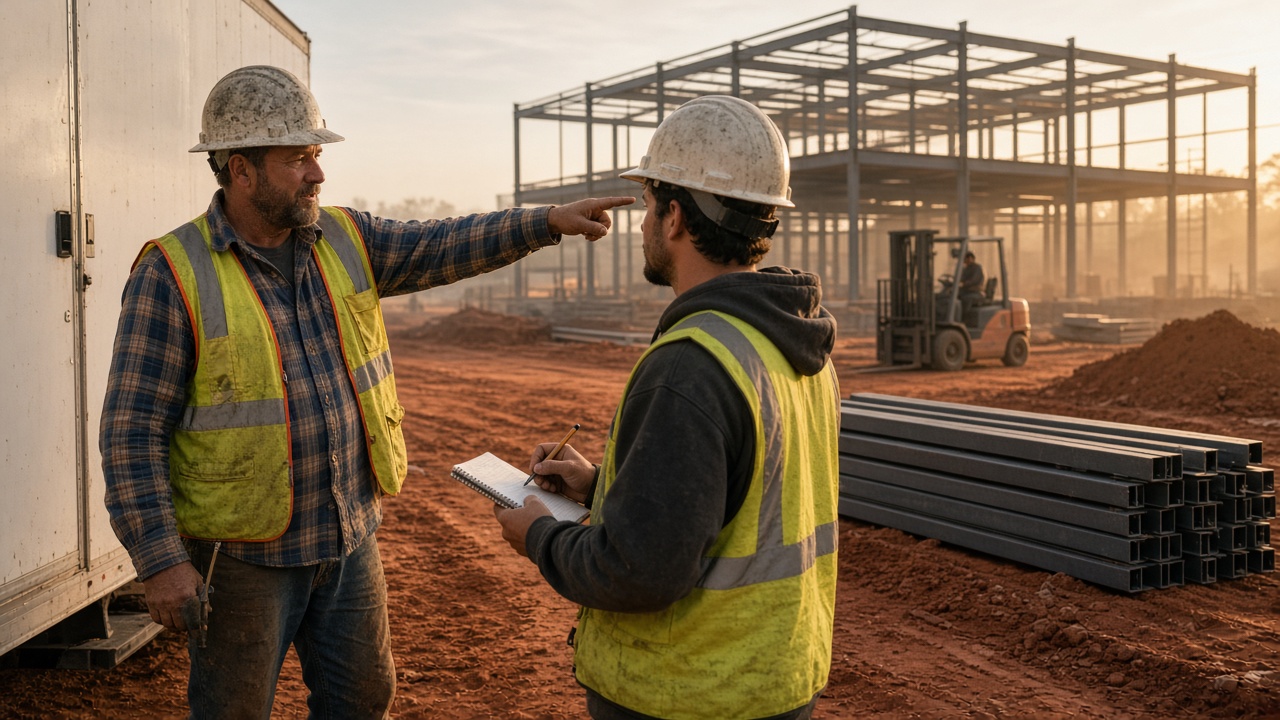
A few smart questions on your first morning will save you hours of guessing later.
Foremen are busy, especially at start time. But nearly every foreman would rather answer a clear question at 7 a.m. than fix a mistake at 2 p.m. The trick is to ask the right questions, at the right moment, in as few words as possible. Here is what to ask, why it matters, and how to keep it quick.
When to ask
Pick your moment. Right at check-in, before the crew scatters, is usually best. If the foreman is in the middle of a delivery or a safety talk, wait. Ask your questions in one short conversation instead of interrupting ten times.
A small notebook or a note on your phone helps. Writing things down shows you are taking it seriously and means you will not need to ask twice.
Question 1: Who do I report to today?
On a bigger site, the person who hired you may not be the person directing your work. Ask who you take instructions from and who you go to if that person is not around. If you came through a staffing agency, OSHA says the agency and the host employer share responsibility for your safety, so know both contacts (https://www.osha.gov/temporaryworkers).
Question 2: What is the job, and what does done look like?
This is the most important question. Ask what you are doing first, how they want it done, and how you will know you are finished.
Example: "You want all this demo debris in the dumpster, and the floor swept? Do you want the metal separated?" That one question can save you from doing the job twice.
Question 3: What are the hazards on this site?
Federal construction rules require employers to instruct each employee in recognizing and avoiding unsafe conditions on the job (https://www.ecfr.gov/current/title-29/subtitle-B/chapter-XVII/part-1926/subpart-C/section-1926.21). It is fair to ask directly.
- Are there open holes, edges, or areas where I need fall protection?
- Is there live electrical, gas, or water I should know about?
- Where is heavy equipment working, and where should I stay clear?
- Are there areas I should not enter?
Question 4: What safety gear do I need, and where do I get it?
Ask what the site requires, such as hard hats, safety glasses, gloves, hi-vis, or hearing protection, and where to get it if you do not have it. Under OSHA's construction PPE rule, the employer provides required protective equipment at no cost to the worker, with some exceptions such as everyday work clothes and ordinary safety-toe boots (https://www.osha.gov/laws-regs/regulations/standardnumber/1926/1926.95).
Question 5: Where are water, restrooms, and shade?
Simple, but people forget to ask. On hot days it matters a lot. OSHA reports that almost half of heat-related deaths happen on a worker's first day, and more than 70 percent in the first week, which is why it recommends easing new workers into heat over several days (https://www.osha.gov/heat-exposure/protecting-new-workers). Know where the water is before you need it.
Question 6: Where is the first aid kit, and what do we do in an emergency?
OSHA's construction rule on medical services requires first aid supplies to be easily accessible and requires a way to reach emergency medical services (https://www.ecfr.gov/current/title-29/subtitle-B/chapter-XVII/part-1926/subpart-D/section-1926.50). Ask where the kit is, who on site is trained in first aid, and the exact site address in case you have to call 911.
Question 7: When are breaks and lunch, and what time do we finish?
Ask the schedule so you are not the one who sits down early or keeps working while everyone else eats. Federal wage law generally treats short rest breaks of 20 minutes or less as paid time for employees, and bona fide meal breaks of 30 minutes or more as unpaid when you are fully relieved of duty (https://www.dol.gov/agencies/whd/fact-sheets/22-flsa-hours-worked). State rules may add more.
Question 8: How and when do I get paid?
If this was not settled before you arrived, settle it now, politely and privately. Ask the rate, whether it is hourly or by the day, when payday is, and how you will be paid. If the job may run long, ask how extra time is handled. ChambaMatters explains your pay rights at https://chambanow.com/chambamatters/your-right-to-be-paid.
Question 9: Which tools can I use?
Ask which tools are for the crew and which belong to individual tradespeople. Ask before using any power tool you have not been shown on this site. Different sites have different rules, and some tools, like forklifts and scaffolds, require specific training before you can use them.
Question 10: Who do I tell if something is wrong?
Ask who to tell if you get hurt, see something unsafe, break something, or run out of work. Then use it. OSHA says workers can raise safety concerns without being punished (https://www.osha.gov/workers).
Questions that make a good impression
Once the basics are covered, a few more questions show you want to be useful. Ask these later in the day when things calm down.
- "What do you want me to do when I finish this?"
- "Is there anything I can set up for tomorrow?"
- "What do your best helpers do that I should copy?"
- "Do you need people again later this week?"
Questions to avoid on day one
These are judgment calls, not hard rules, but they rarely go well on the first morning.
- Asking when you can leave early before you have started
- Asking for a raise on the first day
- Arguing about how something is being done in front of the crew
- Asking the same question three times instead of writing the answer down
A quick first-day script
This is an example to adapt, not a script to read word for word.
Good morning, I'm Luis. Who should I take instructions from today? What do you want me on first, and how do you want it done? Anything on site I should watch out for? Where's the water, the restroom, and the first aid kit? And just so I know, what time is lunch and what time do we wrap?
That is under a minute, and it covers the task, safety, basic needs, and the schedule. Pay can be confirmed separately and privately.
Keep the answers
After the first day, look over your notes. Next time you work for the same foreman, you will already know the rules, and they will notice. That is how you become the worker they call first. If you want more first jobs to practice on, post your skills and availability free on ChambaNOW at https://chambanow.com/for-workers.
Key takeaways
- Ask your questions in one short conversation at check-in
- Always ask about the task, what done looks like, and site hazards
- Know where water, restrooms, shade, and first aid are before you need them
- Confirm breaks, finish time, pay, and payday privately and early
- Ask who to tell if something is unsafe, broken, or finished
Sources
- 29 CFR 1926.21, Safety training and education: https://www.ecfr.gov/current/title-29/subtitle-B/chapter-XVII/part-1926/subpart-C/section-1926.21
- OSHA, 29 CFR 1926.95, Criteria for personal protective equipment: https://www.osha.gov/laws-regs/regulations/standardnumber/1926/1926.95
- 29 CFR 1926.50, Medical services and first aid: https://www.ecfr.gov/current/title-29/subtitle-B/chapter-XVII/part-1926/subpart-D/section-1926.50
- OSHA, Protecting New Workers (heat): https://www.osha.gov/heat-exposure/protecting-new-workers
- OSHA, Protecting Temporary Workers: https://www.osha.gov/temporaryworkers
- U.S. Department of Labor, Fact Sheet 22: https://www.dol.gov/agencies/whd/fact-sheets/22-flsa-hours-worked
- OSHA, Worker Rights and Protections: https://www.osha.gov/workers
Written by Barry Graham, Founder, ChambaNOW
Construyendo conocimiento que funciona.