
The Hidden Workforce Keeping America Moving
Before most people finish their first cup of coffee, millions of workers across America are already lifting, loading, digging, cleaning, building, moving, repairing, sorting, hauli
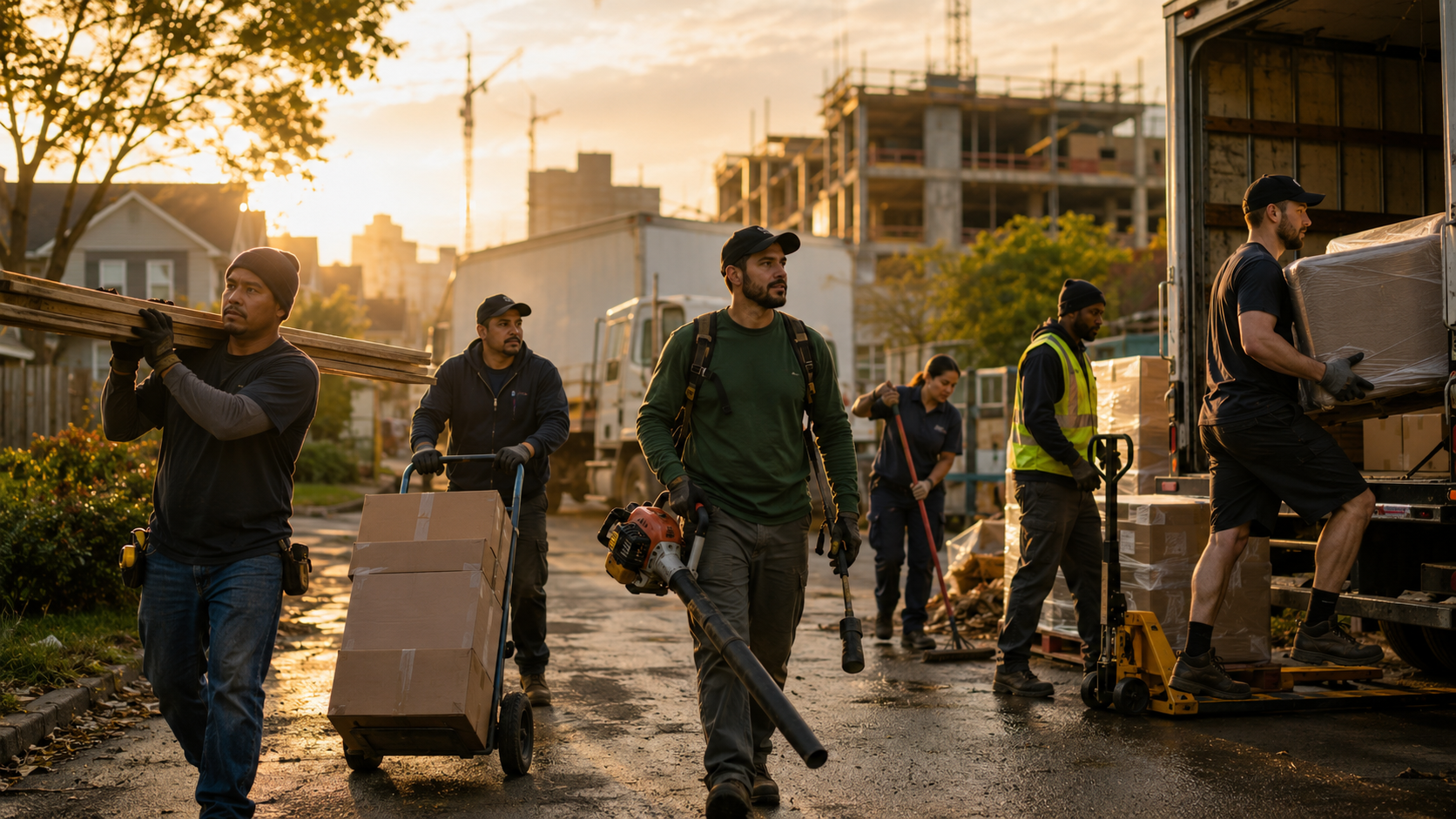
Before most people finish their first cup of coffee, millions of workers across America are already lifting, loading, digging, cleaning, building, moving, repairing, sorting, hauling, and preparing the places where the rest of the country lives and works.
They are landscapers cutting back overgrown yards before the heat arrives.
They are movers carrying couches down narrow staircases.
They are cleanup crews clearing out garages, apartments, construction sites, and businesses.
They are warehouse workers unloading trucks and moving products that will be on store shelves by afternoon.
They are construction helpers carrying lumber, mixing materials, sweeping jobsites, digging trenches, and doing the physical work that keeps projects moving.
They are painters, demolition workers, maintenance crews, handymen, laborers, and tradespeople.
Many of them will never have an executive title.
Most will never be featured in a business magazine.
Yet without them, much of everyday America would slow down almost immediately.
The Work We Notice Only When It Stops
Physical labor is unusual because people often notice it most when it is missing.
A homeowner notices when the debris is not removed.
A contractor notices when materials are still sitting where they were delivered.
A warehouse notices when a truck cannot be unloaded.
A family notices when nobody is there to help with a move.
A property manager notices when an apartment is not ready for the next tenant.
The finished result gets attention.
The people doing the lifting behind it often do not.
Drive through almost any American city early in the morning and you will see this workforce beginning another day.
Pickup trucks arrive at jobsites.
Landscaping crews unload equipment.
Warehouse parking lots fill.
Workers wait for buses.
Crews meet at gas stations, parking lots, supply stores, and designated pickup points.
Someone somewhere is looking for an extra pair of hands.
And someone else is hoping to find a day of work.
They Are Everywhere
The hidden workforce is not one industry.
It is woven through hundreds of them.
Construction depends on laborers who move materials, prepare sites, clean work areas, assist skilled trades, and complete countless tasks that rarely appear in photographs of the finished building.
Landscaping companies depend on workers who mow, trim, dig, plant, rake, haul, and maintain properties.
Moving companies need people capable of spending an entire day carrying furniture and boxes.
Warehouses rely on workers to receive, sort, load, unload, package, organize, and move products.
Property managers need help cleaning vacant units, removing abandoned belongings, preparing landscaping, and completing repairs.
Homeowners need workers for yard cleanup, demolition, junk removal, painting preparation, moving, fencing, and countless weekend projects.
Restaurants, event companies, farms, manufacturers, contractors, maintenance businesses, and delivery operations all depend on hands-on workers.
The job titles differ.
The common thread is simple:
Something physical needs to get done.
Day Labor Is Part of That Economy
Day labor sometimes gets treated as if it exists outside the normal labor market.
In reality, it is deeply connected to it.
Businesses often experience sudden labor needs.
A contractor may have two workers call out sick.
A delivery may arrive early.
A project may suddenly require additional cleanup.
A homeowner may realize a job is far bigger than expected.
A property manager may need an apartment cleared immediately.
A business may need extra hands for only one day.
Traditional hiring systems are not always designed for those situations.
Posting a job, collecting applications, scheduling interviews, completing paperwork, and waiting several days might make sense for a permanent employee.
It makes much less sense when someone simply needs two capable people tomorrow morning.
That gap is where day labor becomes extremely valuable.
The Worker Behind the Job
It is easy to describe people by what they do.
“Laborer.”
“Mover.”
“Landscaper.”
“Warehouse worker.”
But every one of those labels represents a person with a story.
Some workers have spent decades in construction.
Some are young people trying to build experience.
Some are between permanent jobs.
Some prefer flexible work.
Some are supporting families.
Some are learning English.
Some have transportation challenges.
Some have extensive skills that simply do not fit neatly onto a traditional résumé.
A worker might have years of experience building fences, pouring concrete, installing drywall, painting interiors, operating equipment, or maintaining properties without ever having a polished LinkedIn profile.
That experience is still real.
The challenge is connecting it with the people who need it.
Skill Does Not Always Come With a Résumé
Traditional hiring systems are built around credentials.
Applications.
Résumés.
Employment histories.
Interviews.
Degrees.
References.
Those things can be useful, especially for certain professions.
But physical work often tells a different story.
A person may know exactly how to prepare a room for painting because they have done it hundreds of times.
They may know how to safely move a refrigerator through a doorway.
They may know how to load a trailer so nothing shifts.
They may know how to organize a demolition project so cleanup happens continuously instead of becoming a massive mess at the end.
They may know how to work efficiently in extreme heat because they have spent years doing it.
Those are skills.
They simply do not always arrive in traditional packaging.
America Depends on Work That Cannot Be Done From a Laptop
Technology has transformed enormous parts of the economy.
People can work remotely.
Meetings happen online.
Software automates tasks that once required entire offices.
Artificial intelligence can write, analyze, design, translate, and organize information.
But a computer cannot carry your couch down three flights of stairs.
It cannot dig a trench in your backyard.
It cannot load broken concrete into a trailer.
It cannot pressure wash your driveway.
It cannot clear an overgrown property.
It cannot unload a truck full of building materials.
The physical world still requires physical work.
And as technology advances, that reality may become even more important.
There will always be jobs where someone has to show up.
The Work Is Often Harder Than It Looks
Many physical jobs look simple from the outside.
Until you try doing them for eight hours.
Moving one box is easy.
Moving 200 boxes is different.
Pulling one weed is easy.
Clearing an entire neglected property in summer heat is different.
Carrying one piece of lumber is easy.
Moving stacks of construction materials all day is different.
The difficulty of physical work comes from repetition, endurance, weather, weight, awkward positions, and the need to keep working safely even when tired.
Experienced workers develop a rhythm.
They learn how to conserve energy.
They learn how to lift properly.
They learn how to organize tasks.
They learn when to ask for help.
That experience has value.
Yet These Workers Can Be Difficult to Find
Here is one of the strange contradictions in the labor market.
Hirers regularly say:
“I can't find workers.”
Workers regularly say:
“I can't find work.”
Both can be true at the same time.
The problem is often not supply.
It is connection.
The worker is in one place.
The opportunity is somewhere else.
The hirer posts on one website.
The worker checks another.
The worker primarily speaks Spanish.
The hirer primarily speaks English.
The worker needs transportation.
The hirer does not know that transportation could easily be arranged.
The worker is available today.
The job listing is not seen until tomorrow.
The market is full of people who could help each other but never connect.
Language Is Part of the Divide
Language can create another invisible barrier.
A skilled Spanish-speaking worker may be completely capable of doing a job but hesitant to contact an English-speaking hirer.
The hirer may be equally hesitant because they worry about explaining instructions.
The opportunity disappears before either side ever discovers whether the match would have worked.
Modern translation technology can change that.
When workers and hirers can communicate across languages in real time, the focus can move away from language ability and toward the things that actually matter for the job.
Can the worker do the work?
Are they available?
Does the pay work for both sides?
Can they get to the location?
When can they start?
Those are the questions that should determine whether a connection happens.
Transportation Is Another Hidden Barrier
A surprising amount of work can be lost because of transportation.
Someone may be an excellent laborer but not own a vehicle.
They may rely on a bus.
They may share a car with family.
Their vehicle may be temporarily broken.
The job may be only five miles away, but there may be no practical transit route to reach it.
A hirer may see “needs transportation” and immediately move on.
But the worker might be exactly the person they need.
A 10-minute pickup could solve the entire problem.
The labor market becomes more effective when logistical challenges are treated as problems to solve rather than automatic reasons to reject people.
Reliability Matters on Both Sides
None of this means standards should disappear.
Workers should show up when they say they will.
They should communicate if something changes.
They should be honest about their abilities.
They should respect the property, workplace, and people around them.
Hirers have responsibilities too.
They should clearly explain the job.
They should communicate changes.
They should provide a safe work environment.
They should pay what was agreed.
They should respect the worker's time.
A better labor market requires accountability from everyone.
One Day of Work Can Matter
For someone hiring, a six-hour job may simply mean finally getting the backyard cleared.
For the person doing the work, that same day may mean groceries.
Gas.
A phone bill.
Rent.
School supplies.
An overdue payment.
Or simply the momentum that comes from knowing another job is finished and another hirer now knows their name.
That is one reason local labor markets matter so much.
Small jobs may not look significant in economic statistics.
But thousands of small jobs create real income and real opportunity.
The Best Workers Often Build Careers One Relationship at a Time
A one-day job does not always remain a one-day job.
A homeowner hires someone for a cleanup.
They do excellent work.
Two months later, the homeowner needs help moving.
Then a neighbor asks who helped with the yard.
The worker gets another referral.
A contractor needs an extra person for one day.
The worker shows up on time and works hard.
The contractor calls again the following week.
Eventually, the worker becomes someone that hirer contacts first.
This is how informal labor relationships can develop into steady income.
Reliability creates trust.
Trust creates repeat work.
Repeat work creates stability.
Technology Can Make the Hidden Workforce More Visible
The challenge is not replacing these workers with technology.
It is using technology to make it easier for them to participate in the labor market.
A worker profile can show experience and skills.
Availability tools can show who is ready to work now.
Location information can connect nearby people.
Ratings can help good workers build reputations.
Real-time translation can remove language barriers.
Transportation information can prevent mismatches.
Direct messaging can allow workers and hirers to communicate before the job begins.
Platforms like ChambaNOW are built around that idea: make the connection between local workers and the people who need them faster and easier.
The technology is simply the bridge.
The work is still done by people.
The Workforce We Should See
The next time you pass a landscaping crew, watch movers carrying furniture into a building, see workers unloading a truck, or drive past a construction site early in the morning, consider how much activity is happening behind the scenes.
Every city has this workforce.
Every neighborhood depends on it.
Every construction project, warehouse, property manager, homeowner, and small business eventually needs people willing and able to do physical work.
They may not always appear in headlines.
They may not sit behind desks.
They may not carry impressive job titles.
But they build, move, clean, repair, maintain, load, unload, dig, haul, and prepare the physical world the rest of us depend on.
They are not on the sidelines of the American economy.
They are underneath it.
And every morning, often before most of us are awake, **America's hidden workforce gets up and keeps the country moving.**
Written by Barry Graham, Founder, ChambaNOW
Watch the video
Building knowledge that works.