
Temporary Warehouse and Loading-Dock Labor for Businesses
Temporary warehouse labor works best when you separate hand-loading jobs from anything involving a forklift.
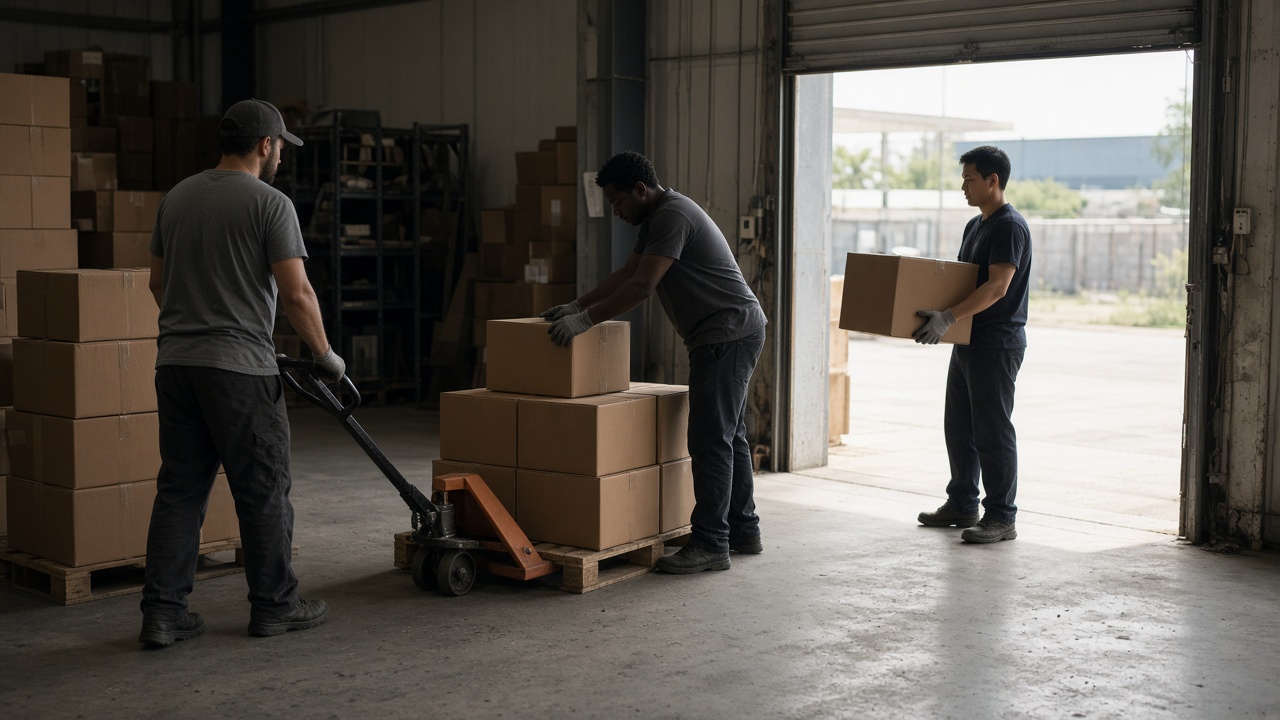
Temporary warehouse labor works best when you separate hand-loading jobs from anything involving a forklift.
Warehouses, distribution centers, retailers, and manufacturers bring in temporary labor for peak season, inventory counts, container unloads, a lost customer's returns, or a facility move. Most of that work is manual: unloading floor-loaded trailers, building and wrapping pallets, picking, sorting, and staging. Some of it involves powered equipment. The fastest way to get into trouble is to blur the two.
This guide is for operations managers, small business owners, and facility supervisors hiring temporary warehouse and loading-dock labor. It covers how to define roles, the OSHA rules that shape them, what national wage data shows, and a practical onboarding plan.
Define roles before you post
Write a separate role description for each type of work.
Hand loader or unloader
Unloads floor-loaded containers and trailers by hand, builds stable pallets, applies stretch wrap, and stages freight. Physically demanding, especially in hot trailers.
Picker, packer, or sorter
Picks orders from locations, packs and labels shipments, sorts returns, and counts inventory. Accuracy matters as much as speed.
General warehouse laborer
Moves product with pallet jacks or hand trucks, breaks down cardboard, cleans and organizes, and supports whichever area needs help.
Powered equipment operator
Operates forklifts, reach trucks, order pickers, or powered pallet jacks. This role carries specific training and evaluation requirements under OSHA.
Forklifts and other powered industrial trucks
OSHA's powered industrial truck standard is specific about who may operate equipment.
- The employer must ensure that each operator is competent to operate a powered industrial truck safely, as demonstrated by successful completion of the required training and evaluation.
- Training must combine formal instruction, practical training, and evaluation of the operator's performance in the workplace.
- Trainees may operate a truck only under the direct supervision of people with the knowledge, training, and experience to train operators, and only where that operation does not endanger anyone.
- The employer must certify that each operator has been trained and evaluated, and performance must be evaluated at least once every three years.
Prior training helps. OSHA says additional training in a topic is not required if the operator already received training appropriate to the truck and working conditions and has been evaluated and found competent to operate the truck safely. The evaluation still has to happen, and you still have to certify it. A card from a previous job is a starting point, not a substitute. If you are not prepared to evaluate and certify operators, keep temporary workers off powered equipment.
Docks, dockboards, and edges
Loading docks combine heavy equipment, foot traffic, edges, and trailers that can move. OSHA's walking-working surfaces rules apply.
- In general industry, workers on a walking-working surface with an unprotected side or edge 4 feet or more above a lower level must generally be protected by guardrails, safety nets, or personal fall protection. OSHA's rule includes a narrow allowance for the working side of a loading dock platform when fall protection is not feasible, the work is in process, access is limited to authorized employees, and those employees are trained.
- Dockboards must be able to support the maximum intended load, and portable dockboards must be secured so they cannot move out of a safe position.
Keep temporary workers away from open dock doors without a trailer, and make sure everyone knows the facility's trailer restraint or wheel chock procedure before anyone enters a trailer.
Material handling and injuries
OSHA identifies musculoskeletal disorders, mainly from overexertion in lifting and lowering, and being struck by powered industrial trucks and other material handling equipment as the most common warehouse injuries. Temporary workers are often unaccustomed to the pace and weight of floor-loaded freight. Plan for it.
- Use pallet jacks, conveyors, and lift assists wherever possible
- Rotate people between heavy unloading and lighter tasks
- Set team-lift rules for heavy cartons
- Mark pedestrian walkways and forklift lanes clearly
- Plan for heat in trailers and docks during warm months
What wage data shows
In the Bureau of Labor Statistics May 2025 national data, hand laborers and freight, stock, and material movers earned a median of $19.35 per hour, with the middle half earning $17.35 to $22.56. Stockers and order fillers earned a median of $17.95, with the middle half earning $16.56 to $21.47. Industrial truck and tractor operators, which include forklift operators, earned a median of $22.32, with the middle half earning $19.24 to $26.33.
These are national employee wages. Peak season, night shifts, cold storage, and local labor markets can push rates higher. Staffing agencies bill above these figures to cover payroll taxes, insurance, and their margin.
A first-shift onboarding plan
Before the shift
- Send the role description, start time, dress code, and safety footwear requirement
- Confirm parking, the entrance, and who will meet them
- Complete any required employment paperwork, and confirm workers' compensation coverage
First 30 minutes
- Facility walk-through: exits, first aid, restrooms, break area, and forklift lanes
- Equipment rules: what they may use, and what they must not touch
- Dock rules: trailer restraint procedure, dockboards, and open doors
- Lifting rules and team lifts
- Who to ask for help
During the shift
- Pair each new worker with an experienced lead for the first hours
- Check pallet builds and pick accuracy early, not at the end of the day
- Enforce breaks and water
End of shift
- Give quick feedback and ask whether they can return
- Note who you would hire again
Questions to ask temporary warehouse applicants
- Have you unloaded floor-loaded containers, and how many in a shift
- Have you used RF scanners or pick-to-light systems
- Which pallet jacks or powered equipment have you used, and were you evaluated by that employer
- Are you comfortable in hot trailers or cold storage, depending on the job
- Can you work the full shift schedule, including any mandatory overtime
Ask specifically about the equipment and conditions in your building. Someone with grocery cold-storage experience and someone from a parcel sortation hub bring very different strengths.
How many temporary workers to bring in
Size the crew from the work, not from a guess. For container unloads, estimate the number of containers per shift and how long your regular team takes per container. For picking, use your normal order volume and per-person pick rates. Add a buffer for the slower pace of new workers on their first day. This is planning math, and your own data will be more accurate than any rule of thumb.
Hiring warehouse labor on ChambaNOW
ChambaNOW lists general laborers by city, for example in Chicago (https://chambanow.com/hire/chicago-il/general_labor). Businesses can post a warehouse job free, describe the roles and any equipment requirements, review workers who respond, and message them about that job. If you need people on short notice, see our guide to same-day hiring (https://chambanow.com/chambamatters/same-day-hiring) and the hirer overview (https://chambanow.com/for-hirers).
Key takeaways for warehouse managers
Separate manual roles from powered equipment roles, evaluate any operator on your trucks before they drive, enforce dock and trailer rules, plan for lifting and heat, and onboard every temporary worker on the first morning.
Sources - OSHA, 29 CFR 1910.178, Powered industrial trucks (https://www.osha.gov/laws-regs/regulations/standardnumber/1910/1910.178) - OSHA, 29 CFR 1910.28, Duty to have fall protection and falling object protection (https://www.osha.gov/laws-regs/regulations/standardnumber/1910/1910.28) - OSHA, 29 CFR 1910.26, Dockboards (https://www.osha.gov/laws-regs/regulations/standardnumber/1910/1910.26) - OSHA, Warehousing (https://www.osha.gov/warehousing) - OSHA, Heat Exposure (https://www.osha.gov/heat-exposure) - U.S. Bureau of Labor Statistics, OEWS May 2025, Laborers and Freight, Stock, and Material Movers, Hand (53-7062) (https://www.bls.gov/oes/current/oes537062.htm) - U.S. Bureau of Labor Statistics, OEWS May 2025, Stockers and Order Fillers (53-7065) (https://www.bls.gov/oes/current/oes537065.htm) - U.S. Bureau of Labor Statistics, OEWS May 2025, Industrial Truck and Tractor Operators (53-7051) (https://www.bls.gov/oes/current/oes537051.htm)
Written by Barry Graham, Founder, ChambaNOW
Building knowledge that works.