
Staff on Demand: A Manager's Guide to Flexible Hiring
Discover how staff on demand lets you hire flexible workers and specialists, ensuring you meet varying business needs without long-term commitments.

Staff on demand means bringing in workers, freelancers, or temp specialists exactly when you need them, without adding them to permanent payroll. If your business faces uneven workloads, seasonal spikes, or a skill gap that will close in a few weeks, this model almost always beats a slow, expensive full-time search. The main forms you’ll encounter:
- Freelance marketplaces for project-based specialists
- Temp agencies and staffing pools for shift-based labor
- Local job marketplaces connecting hirers directly with available workers
Key Takeaways
Staff on demand works because it converts labor from a fixed cost into a variable one you control based on real, current demand.
| Point | Details |
|---|---|
| Match model to task | Use freelance marketplaces for projects, agencies for shift work, and local marketplaces for fast, single-day hires. |
| Vet before day one | Run a sample task or trial shift to catch quality issues before they cost you a full assignment. |
| Track repeat-hire rate | Rebooking the same worker often is a stronger quality signal than any single rating score. |
| Protect classification status | Put pay, scope, and classification in writing to avoid tax and legal exposure. |
| Try ChambaNOW for city-based hiring | Its bilingual profiles and availability filters let you source, vet, and hire local workers the same day. |
Table of Contents
- What Staff on Demand Actually Means: Models and Types
- Core Benefits of Staff on Demand
- When to Use Staff on Demand: Real-World Triggers
- How Staff on Demand Works: A Step-by-Step Checklist
- What Are the Risks of Staff on Demand?
- How Do You Measure ROI on Staff on Demand?
- How ChambaNOW Puts Staff on Demand Into Practice
- Hire Faster With ChambaNOW’s City-Based Marketplace
- Frequently Asked Questions
- Sources
What Staff on Demand Actually Means: Models and Types
The Exponential Organizations framework defines staff on demand as using external or flexible human resources to scale capacity fast, without adding fixed headcount. That’s the concept in one sentence. The practical reality splits into a few distinct operational models.
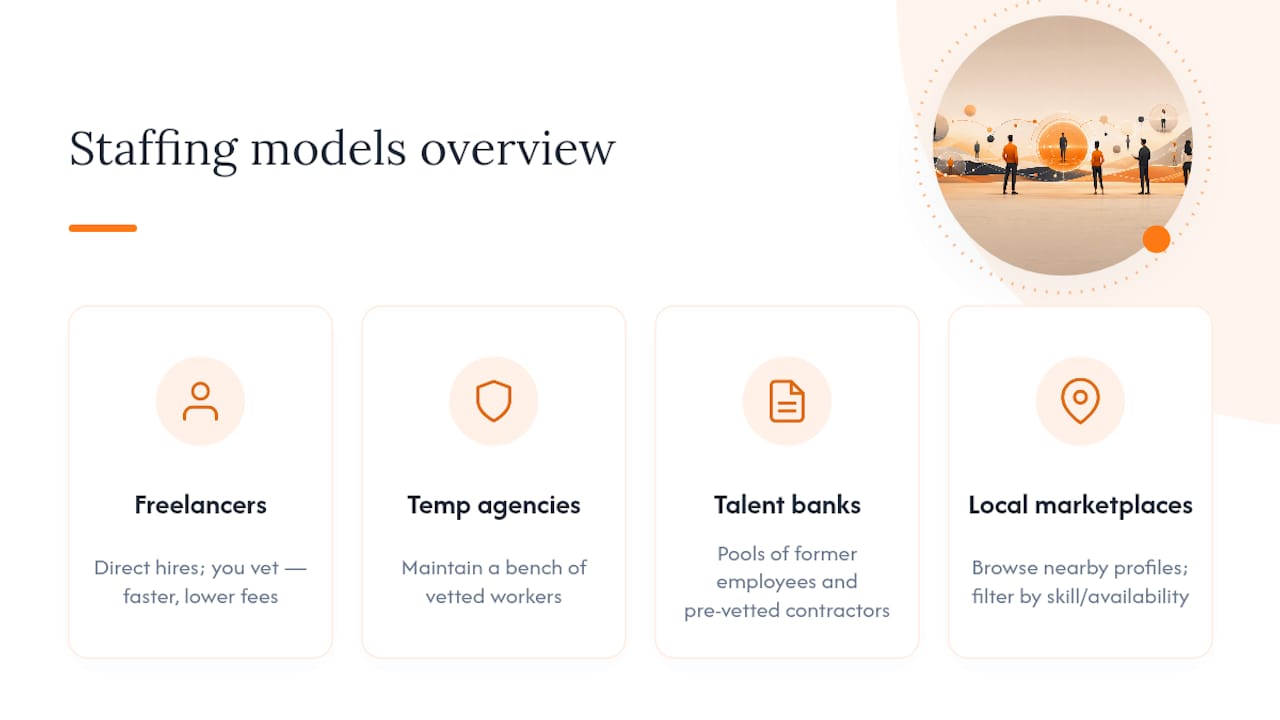
Freelance marketplaces connect you directly with independent contractors for defined projects, from graphic design to software sprints. Temp agencies maintain a bench of vetted workers and place them into shift-based roles, often in warehouses, hospitality, or events. Internal talent banks are pools of former employees, alumni, or pre-vetted contractors your own company keeps on file for repeat work. Local job marketplaces work differently again: hirers browse profiles of nearby workers, filter by skill and availability, and message them directly.

Each model sources and vets workers differently. Agencies pre-screen and take on liability for placement. Marketplaces put more of the vetting decision in your hands, but they trade that for speed and lower fees.
Pro Tip: Match the model to the task’s duration. A one-day labor job rarely needs the overhead of a formal staffing agency contract.
Core Benefits of Staff on Demand
The biggest draw is elastic headcount. You scale up for a rush order or a seasonal push, then scale back down without layoffs, severance conversations, or unemployment claims hitting your books. That flexibility is the entire premise behind the ExO staff-on-demand model, which frames external talent as a growth lever rather than a stopgap.
Three benefits stand out for managers evaluating the model:
- Scalability — add or shed labor hours in days, not months
- Skill access — reach specialists you don’t need year-round
- Cost control — shift labor from a fixed line item to a variable one tied to actual demand
Speed matters here too. Gig economy research shows businesses increasingly blend permanent staff with flexible labor specifically to build resilience against demand swings and to control cost during slow periods.
A quick benchmark: if a full-time hire takes weeks to source, screen, and onboard, on-demand staffing can often fill the same need same-day through a local marketplace.
When to Use Staff on Demand: Real-World Triggers
A handful of situations make the case for on-demand staffing obvious. Seasonal peaks, like retail before a holiday rush or landscaping in spring, are the clearest example. Project surges, pilot programs testing a new service line, absence coverage when a key employee is out, and short-term skill gaps all follow the same pattern: a temporary need that doesn’t justify a permanent hire.
A moving company facing three back-to-back weekend jobs might pull two day laborers through a local marketplace rather than carry idle payroll all month. A retail chain testing a new store format for six weeks might staff it entirely with temp workers before committing to permanent roles.
- Seasonal demand spikes (retail, agriculture, events)
- Project-based surges (construction phases, product launches)
- Absence coverage and short-term skill gaps
Pro Tip: Lean on internal talent banks for repeat, trusted work, and external marketplaces when you need volume or a skill your internal network doesn’t have.
How Staff on Demand Works: A Step-by-Step Checklist
Rolling out a staff-on-demand program isn’t complicated, but skipping a step almost always shows up later as a quality problem. Here’s the sequence that works:
- Define the need. Write the task, duration, and required skill level before you search. Vague postings attract mismatched candidates.
- Source candidates. Use a marketplace, agency, or internal bank depending on urgency and specialty.
- Vet quickly but deliberately. Check ratings, past job history, or a short sample task.
- Contract clearly. Spell out pay, hours, scope, and classification status in writing.
- Onboard fast. A one-page brief with expectations and site details prevents most first-day confusion.
- Schedule and track. Use a scheduling or timesheet tool that syncs with payroll.
- Manage performance. Give real-time feedback; don’t wait for a project to end to flag issues.
- Offboard cleanly. Close out payment, collect any equipment, and note whether you’d rehire.
Staffing providers built around temp placement emphasize exactly this rhythm: define the need precisely, connect candidates quickly, and get to start-up speed without sacrificing the vetting step.
A realistic timeline: sourcing and vetting for a single-day labor role can happen in hours through a marketplace; a specialized freelance contract might take three to five days to properly scope and sign.
Pro Tip: Build one onboarding checklist you reuse for every temp hire. Consistency in the first hour on the job does more for quality control than any interview question.
What Are the Risks of Staff on Demand?
The most common failure point is inconsistent quality, especially when hirers skip vetting to save time. A close second is worker classification risk: treating a contractor like an employee (fixed hours, direct supervision, company equipment) can trigger tax and legal exposure depending on your state’s rules. Data security is a real concern too, particularly when temp staff touch client information or proprietary systems.
Mitigate these with a few concrete moves:
- Put a written contract in place before day one, specifying scope, pay, and classification
- Use a short sample task or trial shift for any new worker before a longer assignment
- Limit system access and share only what the job requires
- Keep a backup list of two or three workers per role to avoid single-point dependency
None of this requires a legal department. It requires discipline in the first hour of the relationship, before problems compound. Review classification rules for your state periodically since hiring trends and labor regulations shift faster than most managers expect.
Pro Tip: Treat your first assignment with any new worker as a trial, even if the job itself is straightforward. It’s the cheapest quality check you’ll ever run.
How Do You Measure ROI on Staff on Demand?
Track time-to-fill, cost-per-hour, project cycle time, and a simple quality score after each assignment. Repeat-hire rate is one of the most underused metrics. If the same worker gets rebooked often, that’s a stronger quality signal than any resume.
- Time-to-fill (hours or days from posting to start)
- Cost-per-hour or cost-per-project versus a comparable full-time rate
- Quality score per assignment (simple 1 to 5 rating)
- Repeat-hire rate for high performers
| Factor | On-Demand Staffing | Traditional Hiring |
|---|---|---|
| Speed to start | Hours to days | Weeks to months |
| Cost structure | Variable, tied to hours worked | Fixed, includes benefits and overhead |
| Skill flexibility | High, swap workers per project | Low, tied to one hire’s skill set |
How ChambaNOW Puts Staff on Demand Into Practice
ChambaNOW is a bilingual job marketplace built for exactly this workflow. Hirers browse local worker profiles, filter by availability, and message candidates with automatic real-time translation removing the language barrier that stalls so many hires.
- Searchable profiles with skills and ratings
- Availability filters showing who’s ready to work today
- City-based listings, from Los Angeles to Boston
- Hirer Plus subscription for ongoing job posting access
Each feature maps directly to a checklist step: sourcing through city pages, vetting through profiles and ratings, and speed through same-day availability filters.
Why the model works best for short, specific bursts
Staff on demand earns its place when the need is short, the skill is specific, and speed matters more than a long onboarding process. It’s a poor fit for roles requiring deep institutional knowledge or ongoing supervision, where a hiring gap in governance can create more cost than it saves.
Hire Faster With ChambaNOW’s City-Based Marketplace
ChambaNOW is the alternative to a slow staffing agency contract when you need someone working today, not next week. Instead of posting a job and waiting on a recruiter’s callback, you browse real local profiles, filter by availability, and message workers directly, with translation built in so language is never the reason a job goes unfilled.
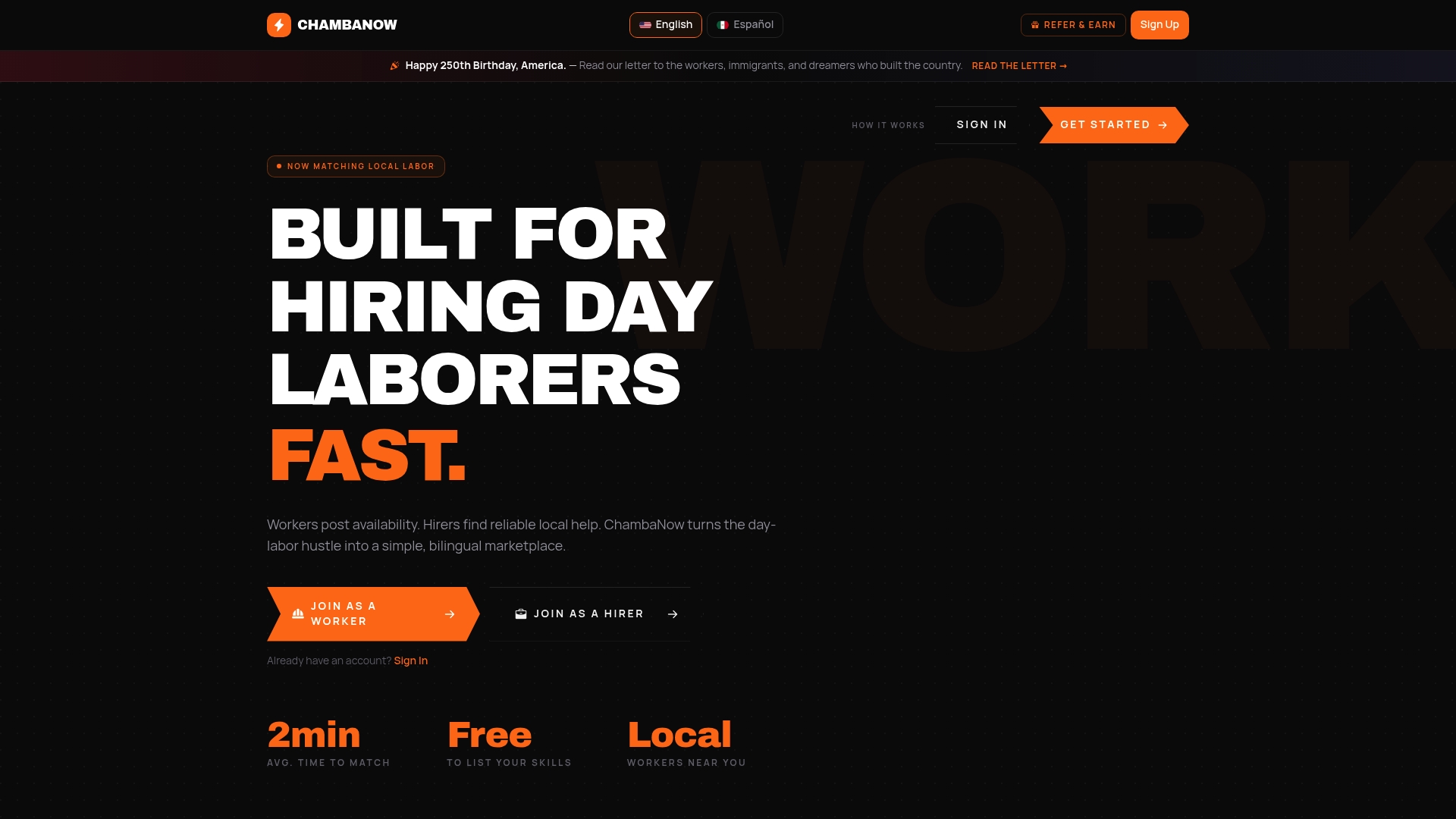
If you’re testing the model for the first time, start with a single city hiring page and post one job. Managers running recurring labor needs can compare Hirer Plus pricing to see what a subscription unlocks versus one-off postings. Either path gets a worker in front of you the same day you search.
Frequently Asked Questions
What is staff on demand? It’s a staffing model where businesses bring in external or flexible workers to scale capacity quickly, without adding permanent headcount.
How is staff on demand different from a traditional temp agency? Agencies pre-screen and manage placement for you, while marketplaces let you browse and hire local workers directly, usually faster and at lower cost.
Is staff on demand right for every role? No. It fits short, specific, or skill-based bursts well. Roles needing deep institutional knowledge or heavy supervision usually still call for permanent hires.
How fast can I hire through a marketplace like ChambaNOW? Many hirers connect with available workers the same day through city-based listings and availability filters.
What’s the biggest risk with staff on demand? Worker misclassification and inconsistent quality top the list. Clear contracts and a short trial task for new workers address both.
Sources
- Description of What is Staff on Demand?
- Staff on Demand: Increasing Your Company’s Growth & …
- The State of the Gig Economy
- Temporary staffing solutions | Vaco
Recommended
Watch the video
Building knowledge that works.