Skills-Based Hiring: A Practical Guide for HR Teams
Discover how skills-based hiring can transform your HR processes by focusing on candidates' abilities, not just their resumes. Start today!

Skills-based hiring means evaluating candidates on what they can actually do, not where they went to school or what their resume looks like on paper. The Good Jobs Initiative’s Skills-First Starter Kit and SHRM’s skills-first toolkit both frame it the same way: identify the skills a role genuinely requires, then build every screening step around proving those skills. To start today, pick one priority role, list its three to five core skills, and design one short work sample that tests the top skill. That single move puts you ahead of most organizations still debating whether to remove degree lines.
Adoption signal: NACE’s 2026 Job Outlook report tracks employer adoption of skills-based practices as a benchmark for entry-level hiring trends, and the direction is clear: skills-focused screening is becoming the default expectation, not a differentiator.
Key Takeaways
Skills-based hiring produces better outcomes than credential-based screening only when the operational infrastructure, defined skills, validated assessments, trained raters, and updated ATS settings, is built alongside the policy change.
| Point | Details |
|---|---|
| Start with one role | Pick one priority role, define three to five core skills, and design one work sample before changing anything else. |
| Build the rubric first | Create a scored, observable rubric before any rater reviews candidates to prevent credential bias from re-entering the process. |
| Update your ATS | Reconfigure resume parsers to surface certifications, apprenticeships, and trade credentials, not just degrees. |
| Measure the right KPIs | Track time-to-hire, quality-of-hire, first-year retention, and diverse shortlist rate together, not time-to-hire alone. |
| Chambanow accelerates pilots | Chambanow’s skills fields, bilingual profiles, and fast job posting make it a practical sourcing channel for hourly and trades-role pilots. |
Table of Contents
- What skills-based hiring actually means (and what it is not)
- Why HR leaders are shifting to skills-based hiring
- A step-by-step implementation checklist HR can use
- Practical assessment methods: which one fits your role
- How to write skills-based job descriptions that actually work
- Legal, EEO, and bias safeguards you need before you change requirements
- How to measure outcomes and avoid the most common pitfalls
- Authoritative resources and frameworks to consult
- The documented implementation gap and what actually fixes it
- How Chambanow sees skills-based hiring working in practice
- Chambanow can help you run a skills-based pilot faster
- Sources
What skills-based hiring actually means (and what it is not)
The phrase gets used loosely, so a clear boundary matters. Skills-based hiring, also called skills-first hiring or competency-based recruitment, is a structured approach that replaces proxy credentials with direct evidence of job-relevant ability. The Good Jobs Initiative Starter Kit defines it as hiring based on demonstrable skills rather than degree requirements, and maps the approach to public tools like O*NET, which gives HR teams a standardized vocabulary for naming and weighting skills across hundreds of occupations.
Three things clarify the concept:
- What it is: Defining the skills a role requires, then using validated assessments, work samples, or structured interviews to measure those skills directly before making a hiring decision.
- What it looks like in practice: A job posting that lists outcomes and core competencies instead of “bachelor’s degree required”; a screening process that scores a short work sample before a recruiter ever reads a resume.
- What it is not: Simply deleting the degree line from a job posting. Removing a credential requirement without replacing it with a skills-based screen changes the language of the posting but not the quality of the hire. The U.S. Department of Labor and the Good Jobs Initiative are explicit on this point.
The distinction matters because many organizations announce skills-first hiring and then keep every other credential-based filter in place. That gap between stated intent and actual practice is where most programs fail.
Why HR leaders are shifting to skills-based hiring
The business case is practical, not ideological. Skills-focused employment expands the candidate pool immediately, because it opens roles to workers who built their abilities through apprenticeships, military service, community college, or on-the-job experience rather than a four-year degree. A wider pool means more qualified candidates, faster fills, and lower cost-per-hire.
Retention is the metric that tends to surprise hiring managers most. When candidates are matched to roles based on actual capability rather than credential proximity, the fit is more accurate, and early attrition drops. iCIMS research points to measurable improvements in both time-to-hire and retention when skills-based screening replaces traditional credential filters, particularly for entry-level roles.
Diversity outcomes also improve, though they require deliberate design. Degree requirements have historically screened out candidates from lower-income backgrounds and underrepresented groups at rates disproportionate to actual job performance. Removing that filter while adding structured, observable assessments tends to produce more diverse shortlists without sacrificing quality.
Labor-market context: The World Economic Forum’s Future of Jobs report documents rapid skill change across industries, with a large share of workers needing new or different skills by 2030. Hiring for current credentials rather than current capabilities is a structural mismatch with that reality.
A concrete pilot target: an organization that replaces a degree screen with a 30-minute work sample for one hourly role can reasonably expect a shorter screening cycle, a broader applicant pool, and a first-year retention rate that outperforms the credential-screened cohort. Those three metrics are the pilot’s acceptance criteria.
A step-by-step implementation checklist HR can use
This eight-step sequence is designed to fit an 8–12 week pilot. Each step names who owns it and what “done” looks like.
-
Define the job’s purpose (Week 1, HR business partner + hiring manager): Write a two-sentence job brief that describes the outcome the role produces, not the tasks it performs. Done when both parties sign off on the brief.
-
Map required skills using O*NET (Week 1–2, HR business partner): Pull the role’s O*NET occupation profile and identify the skills listed as most important. Cross-reference with the hiring manager’s brief. Done when you have a raw list of eight to twelve skills.
-
Separate core from great-to-have (Week 2, hiring manager + L&D): Core skills are those without which the worker cannot do the job on day one. Great-to-have skills can be trained. Limit core skills to three to five. Done when the list is split and agreed upon.
-
Design one assessment per core skill (Week 2–3, HR + L&D): Work samples and structured interview questions are the most defensible options. Each assessment must be observable and scorable. Done when each core skill has a written assessment and a scoring rubric.
-
Adjust ATS and screening logic (Week 3–4, HR + recruiting ops): Update resume-parsing rules to surface certifications, apprenticeships, and micro-credentials alongside degrees. SHRM’s toolkit notes that roughly 45% of employees hold skilled credentials that standard ATS configurations miss entirely. Done when the ATS flags alternative credentials rather than filtering them out.
-
Train raters (Week 4–5, L&D + HR): Every person who scores an assessment must calibrate on the rubric before reviewing live candidates. Run one calibration session using sample responses. Done when rater agreement reaches an acceptable threshold on practice materials.
-
Run the pilot (Week 5–10, hiring manager + HR): Hire for one role using the new process. Track every candidate through each stage and record scores. Done when the role is filled and data is captured.
-
Evaluate and scale (Week 11–12, HR business partner + leadership): Compare pilot KPIs against baseline. If the pilot meets acceptance criteria, document the process and expand to two or three additional roles. Done when a written evaluation is shared with leadership.
Pro Tip: Build the scoring rubric before any rater sees a single resume. Raters who review credentials first and then score tend to anchor on the credential, not the skill. Pre-registering the rubric and the hire/no-hire decision rule removes that bias pathway before it opens.
Practical assessment methods: which one fits your role
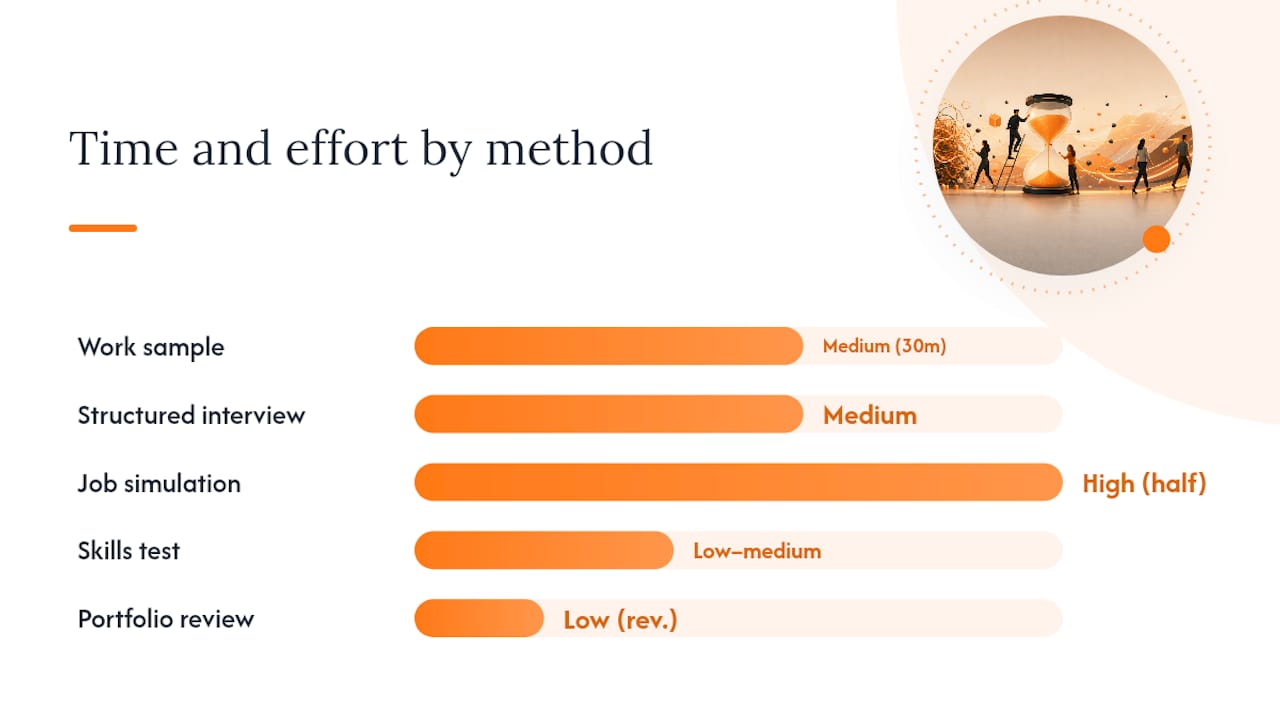
Choosing the right assessment depends on the skill being measured, the time available, and the level of the role. The table below covers the most common options.
| Method | Best for | Time/Effort | Predictive validity | Key trade-off |
|---|---|---|---|---|
| Work sample | Technical and craft skills | Medium (30 minutes) | High | Requires role-specific design |
| Structured interview | Behavioral and interpersonal skills | Medium | Moderate-high | Requires trained interviewers |
| Job simulation | Complex, multi-step roles | High (half-day) | High | Expensive to build and score |
| Skills test (standardized) | Cognitive and technical skills | Low–medium | Moderate | Off-the-shelf tests may not match role |
| Portfolio review | Creative and knowledge work | Low (review only) | Moderate | Self-reported; needs verification |
A short scoring rubric keeps every method honest. For a work sample, a five-point scale works well:
- 5: Exceeds standard; output is complete, accurate, and requires no correction.
- 4: Meets standard; output is complete and accurate with minor gaps.
- 3: Approaches standard; output is mostly complete with one or two notable errors.
- 2: Below standard; output is incomplete or contains significant errors.
- 1: Does not meet standard; output is missing or fundamentally incorrect.
Observable criteria matter more than the scale itself. “Accurate” needs a definition: for a data-entry work sample, it might mean fewer than two errors per 100 fields. Write that definition before scoring begins.
Pro Tip: Blind-score work samples whenever possible. Remove candidate names and any identifying information before sending materials to raters. Then run a short calibration session where two raters independently score the same sample and compare results. Disagreements of more than one point on the rubric signal that the criteria need tightening.
How to write skills-based job descriptions that actually work
The job posting is the first filter. A credential-heavy posting screens out qualified workers before they apply. A skills-based posting attracts them.
Three short templates show the pattern:
Junior role (e.g., warehouse associate): “You will pick, pack, and ship orders accurately and on time. Core skills: ability to read shipping labels, physical stamina for a full shift, and basic inventory counting. No degree required. Relevant experience includes warehouse work, retail stocking, or military logistics.”
Mid-level role (e.g., field technician): “You will diagnose and repair HVAC systems in residential and commercial settings. Core skills: refrigerant handling certification, electrical troubleshooting, and customer communication. Apprenticeship completion or equivalent field experience qualifies.”
Senior role (e.g., project coordinator): “You will manage timelines, budgets, and vendor relationships for construction projects up to $2M. Core skills: schedule management, budget tracking, and written reporting. A PMP, relevant trade certification, or five or more years of documented project experience qualifies.”
Screening questions work the same way. Asset questions surface relevant experience that a resume might miss. Knockout questions confirm minimum requirements without using credentials as a proxy.
- Asset question: “Describe a time you identified an error in a process and corrected it before it caused a problem. What was the error and what did you do?”
- Knockout question: “This role requires a valid driver’s license and the ability to lift 50 pounds. Can you confirm both?”
On the ATS side, SHRM’s toolkit recommends updating resume-parser settings to recognize certifications, apprenticeships, and trade credentials as qualifying signals. Most enterprise ATS platforms allow custom keyword weighting; shift weight from degree fields to skills and certification fields. For HR teams exploring broader ATS configuration options, a comparison of HR software for skills-based screening can help identify platforms that handle alternative credentials well.
Legal, EEO, and bias safeguards you need before you change requirements
Changing hiring requirements carries legal exposure if the change is not documented and validated. A short compliance checklist keeps the process defensible.
- Consult EEOC guidance before removing or adding any screening requirement at scale. The EEOC’s Uniform Guidelines on Employee Selection Procedures govern whether an assessment has disparate impact and whether it is job-related.
- Review DOL resources and the Good Jobs Initiative Starter Kit for practical steps on documenting skill requirements and assessment rationale.
- Use the Massachusetts Skills-Based Hiring Toolkit as a template source. Massachusetts Executive Order 627 required state departments to replace unnecessary education requirements with structured, skills-focused screening, and the toolkit includes ready-made job description templates and interview forms that HR teams in any sector can adapt.
- The State of Washington’s Office of Financial Management guidance similarly provides stepwise instructions and reminds agencies to check recruitment and assessment rules before proceeding.
It is important to examine whether the assessment is measuring the right skill, whether the scoring criteria are observable and consistent, and whether rater training was sufficient.
On AI and automated screening tools: validation and human oversight are not optional. Any automated tool that scores or ranks candidates must be validated for job-relatedness and monitored for adverse impact. Document every tool, its vendor’s validation evidence, and your own monitoring results. This is general guidance, not legal advice; consult employment counsel before deploying automated scoring at scale.
Compliance note: The SHRM BEAM framework, referenced in SHRM’s skills-first toolkit, links skills-first hiring directly to inclusion compliance and recommends written hiring policies, skills-based job descriptions, structured interviews, and community partnerships as the four operational pillars of a defensible program.
How to measure outcomes and avoid the most common pitfalls
A skills-based hiring pilot without measurement is just a policy change. The KPIs below give HR teams a dashboard they can report to leadership.
| KPI | Baseline target | Pilot target | Why it matters |
|---|---|---|---|
| Time-to-hire | Current average (days) | 10% reduction | Faster screening signals a cleaner process |
| Quality-of-hire (manager rating) | Current average score | Maintain or improve | Confirms skills match predicts performance |
| First-year retention | Current rate | Improve by 5–10 points | Skills-matched hires tend to stay longer |
| Diverse shortlist rate | Current % | Increase meaningfully | Tracks whether the pool is actually widening |
| Cost-per-hire | Current average | Reduce or hold flat | Validates ROI for leadership |
| Assessment pass rate | Not tracked | Establish baseline | Flags whether the assessment is calibrated correctly |
Implementation gap: Burning Glass Institute research found that while many employers publicly announce dropping degree requirements, sustained implementation remains a challenge for the majority of organizations. The gap between public statements and actual hiring practice is the most common failure mode.
The most frequent pitfalls, and their remedies:
Removing the degree but keeping credential-based screens. A posting that drops “bachelor’s degree required” but still filters for “four or more years of experience in a degreed role” has not changed the underlying screen. Audit every filter in the ATS and every question on the application for credential proxies.
Skipping rater training. Untrained raters revert to credential signals when they are uncertain. Calibration sessions are not optional.
Measuring only time-to-hire. Speed is easy to improve by lowering standards. Track quality-of-hire and retention alongside time-to-hire to confirm the pilot is producing better outcomes, not just faster ones.
Scaling before validating. Run the pilot for one full hiring cycle and collect data before expanding. A single role with clean data is more persuasive to leadership than five roles with anecdotal results.
Authoritative resources and frameworks to consult
Every resource below is free and publicly available. Each one serves a specific purpose in building or validating a skills-based hiring program.
-
Good Jobs Initiative / Skills-First Starter Kit (DOL): The most practical starting point. Defines skills-first hiring, walks through identifying core vs. great-to-have skills, and links to O*NET for skill mapping. Use this to build your job brief and skills list.
-
SHRM Skills-First Toolkit: Operational steps, ATS configuration guidance, and the BEAM inclusion framework. Use this for ATS updates, rater training design, and bias safeguards.
-
O*NET Online: The DOL’s occupational database. Search any role to find standardized skill names, importance ratings, and related occupations. Use this to build your skills list and validate that your core skills align with industry norms.
-
Massachusetts Skills-Based Hiring Toolkit: Ready-made templates for job descriptions, structured interviews, and screening guides. Use these as starting drafts rather than building from scratch.
-
Burning Glass Institute: Labor-market research on the implementation gap between stated skills-first intent and actual hiring practice. Use this to set realistic expectations and build the case for sustained investment.
-
NACE 2026 Job Outlook: Employer adoption metrics for skills-based practices, particularly for entry-level roles. Use this for benchmarking and stakeholder presentations.
-
iCIMS Skills-Based Hiring Guide: A practitioner-oriented summary of implementation steps, KPIs, and industry examples. Use this as a quick reference for teams new to the approach.
Minimal pilot package: To run an 8–12 week pilot, you need four things: a one-page job brief, one work sample tied to the top core skill, a five-point scoring rubric with observable criteria, and a 12-week project plan with milestones and acceptance criteria. Every resource above contributes at least one of those four components.
The documented implementation gap and what actually fixes it
The most important finding in the skills-based hiring literature is not about adoption. It is about follow-through. Burning Glass Institute research documents a clear pattern: many employers publicly commit to dropping degree requirements, but sustained, consistent implementation across the full hiring process remains a challenge for the majority. The announcement is easy. The operational change is hard.
The gap shows up in predictable places. Degree requirements disappear from job postings, but ATS filters still weight four-year institutions. Hiring managers are told to evaluate skills, but no rubric exists, so they default to the credential signals they know. Recruiters source from the same pipelines they always used, which skew toward degree holders by design.
What the research shows: Studies and expert guides consistently find that removing degree requirements alone rarely produces better hiring outcomes unless paired with concrete skill definitions, validated assessments, and rater training. The operational infrastructure is what makes the difference, not the policy statement.
Three fixes that address the gap directly:
-
Write the rubric before the job opens. A pre-registered scoring rubric prevents raters from constructing post-hoc justifications for credential-based preferences. It also makes the process auditable.
-
Source from new pipelines. Community colleges, apprenticeship programs, workforce development organizations, and platforms that surface workers by skill rather than credential are the supply-side fix. Changing the demand side without changing the supply side produces the same pool with different paperwork.
-
Tie manager accountability to skills-match data. If hiring managers are evaluated only on time-to-fill, they will optimize for speed, which usually means reverting to familiar credential screens. Adding quality-of-hire and retention to the manager’s scorecard changes the incentive.
The Hiring Lab research on educational requirements in job postings confirms that degree requirements in job postings have been declining, but the pace of operational change inside organizations lags the pace of public announcements. That gap is where HR teams can create real competitive advantage: by doing the operational work that most organizations skip.
How Chambanow sees skills-based hiring working in practice
Skills-based hiring is not an abstract policy for the workers Chambanow connects with hirers every day. It is the operating assumption the platform was built around. A worker who shows up with five years of drywall experience, a valid OSHA-10 card, and a bilingual profile that communicates clearly with a Spanish-speaking crew is a skilled candidate. The credential on a diploma is not the relevant signal. The skills listed on the profile are.

What Chambanow has observed is that the fastest, most accurate hires happen when hirers are specific about what they need and workers are specific about what they can do. The platform’s skills fields and bilingual profiles make that specificity possible across language lines, which matters in trades and labor markets where a significant share of the workforce communicates primarily in Spanish. Speed and skills-match are not in tension when the sourcing infrastructure is built for both.
Chambanow can help you run a skills-based pilot faster
Posting a skills-based job and sourcing workers who match it does not have to take weeks. Chambanow’s marketplace lets hirers post a job in minutes, browse worker profiles organized by skills and availability, and communicate with candidates through real-time bilingual translation. For organizations running a pilot on hourly or trades roles, that means less time sourcing and more time evaluating.
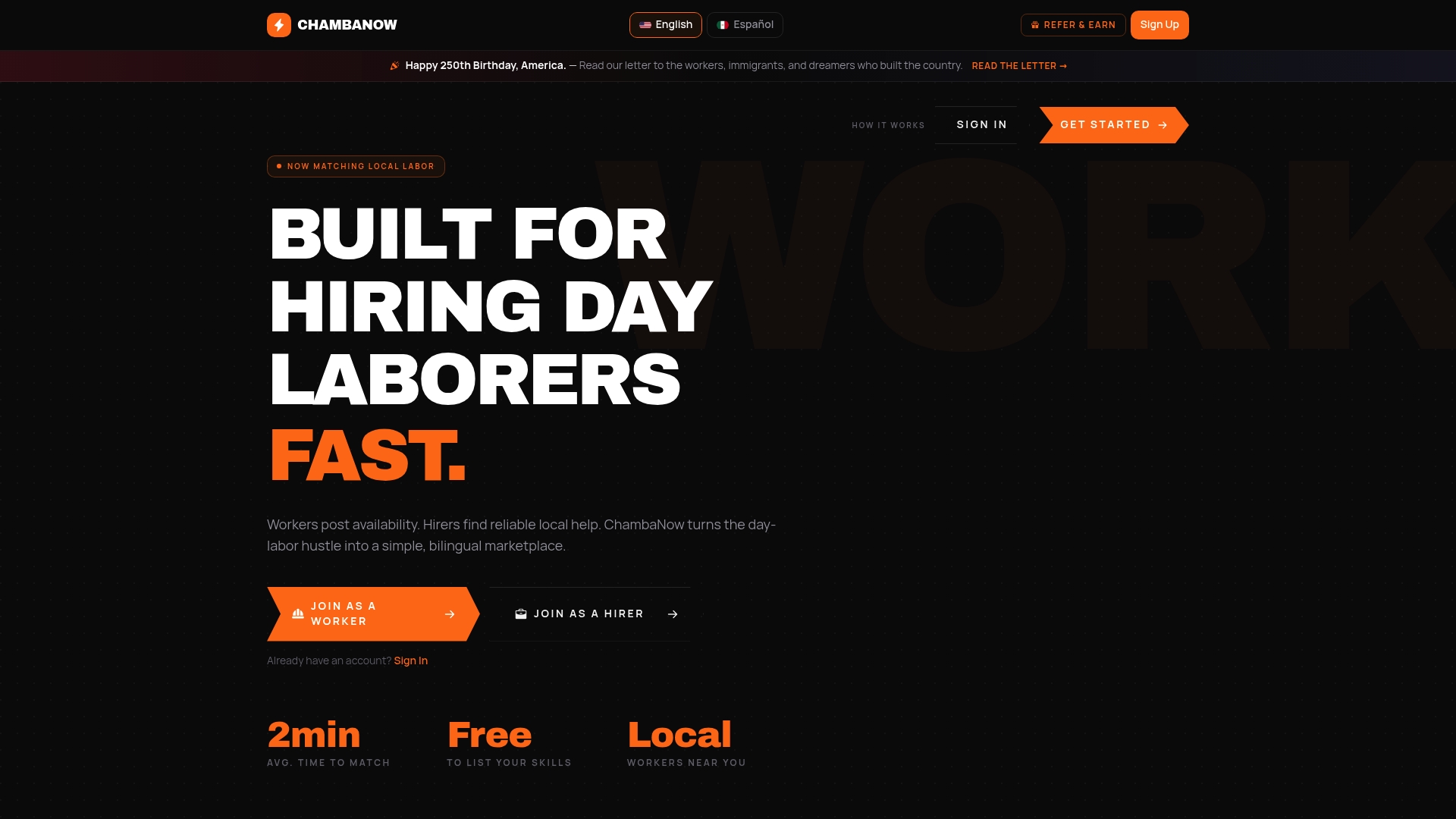
A practical pilot use-case: post one skills-based job for ten hourly workers, attach a short work sample as part of the screening question, and use Chambanow’s skills fields to filter for candidates who list the specific competencies the role requires. The Hirer Plus subscription gives you unlimited job postings and direct worker messaging, so the pilot does not stall on sourcing volume. Workers on the platform set their availability and list their skills upfront, which means the first filter is already done before you send a single message.
If you want to see how the platform works before committing, browse available workers and review their skills profiles at Chambanow. For teams in Southern California, local hiring pages for Los Angeles show workers available today.
Sources
- Skills-Based Hiring Starter Kit (Good Jobs Initiative / DOL)
- Toolkit: Transform Your Talent Acquisition Strategy with Skills-First Hiring (SHRM)
- Skills-Based Hiring Toolkit (Commonwealth of Massachusetts)
- NACE 2026 job outlook report (NACE)
Recommended
Construyendo conocimiento que funciona.