
Reduce Time to Hire: A Practical Playbook for HR
Discover effective strategies to reduce the time to hire with actionable steps that streamline your recruitment process and boost efficiency.

The fastest, evidence-backed way to reduce time to hire comes down to three moves: eliminate scheduling and handoff latency, run assessment stages in parallel instead of sequentially, and remove approval friction by pre-approving compensation bands before you post the job. Teams that fix these three bottlenecks first typically see measurable gains within a single hiring cycle, long before they touch sourcing strategy or employer branding.
Here’s the prioritized order, based on what actually moves the needle versus what sounds good in a meeting:
- Automate scheduling (fast win, days to implement): Self-serve scheduling links cut a task that used to take three to five email round-trips down to one click. Ashby’s recruiting operations data shows automated scheduling running about 26% faster than manual coordination.
- Parallelize interview stages (fast win, one process redesign): Send the assessment the same day you schedule the recruiter screen instead of waiting for one to finish before starting the other.
- Pre-approve compensation bands (medium effort, requires finance buy-in): Get salary ranges signed off before the requisition goes live so nobody waits on a Vice President’s calendar to make an offer.
- Build standing talent pipelines (longer project, compounding payoff): Referral networks and re-engaged past candidates start the clock from a warm shortlist, not a blank job board.
- Use structured scorecards (fast win, protects quality while you speed up): Standardized criteria let hiring teams debrief in minutes instead of relitigating the interview from memory.
Every one of these levers gets its own section below, with a stage-by-stage measurement plan and a 30/60/90 rollout you can hand to your team this week.
Key Takeaways
Cutting time to hire works when teams remove scheduling and handoff delays, run assessment stages in parallel, and pre-approve compensation bands before posting a role.
| Point | Details |
|---|---|
| Automate scheduling first | Self-serve links cut coordination time and run roughly 26% faster than manual scheduling. |
| Parallelize, don’t sequence | Send assessments and schedule interviews at the same time to remove waiting days. |
| Fix the offer gap | Pre-approve compensation bands so offers go out within 24 to 48 hours of a decision. |
| Measure time-in-stage weekly | Track where delays hide, not just the headline time-to-hire number. |
| Use Chambanow for urgent local hires | A bilingual marketplace that fills same-day or short-notice hourly roles alongside your structured pipeline. |
Table of Contents
- What Is Time to Hire and Why Does It Matter?
- How Do You Measure Time to Hire and Where Delays Hide?
- Standardize Your Hiring Process to Remove Friction
- Build Talent Pipelines Instead of Starting From Zero
- Which Tools Actually Remove Administrative Delays?
- Design Interviews That Lead to Fast Decisions
- When Should You Use Pre-Employment Assessments?
- Speed Up Offers Without Losing Candidates
- What Can You Learn From Real Hiring Speed Wins?
- How Do You Roll This Out Without Breaking Everything at Once?
- What Hiring Leaders Get Wrong About Speed
- Need Hourly or Day Labor Right Now? There’s a Faster Lane
- Sources
What Is Time to Hire and Why Does It Matter?
Time to hire is the number of days between a candidate entering your pipeline (typically application or first recruiter contact) and that candidate accepting your offer. It’s a different clock than time to fill, which measures from when a requisition opens until a candidate starts, and includes sourcing time before anyone has even applied. Confusing the two metrics is one of the most common measurement mistakes in recruiting operations, and it skews every benchmark you try to set.
The formula is simple: subtract the date a candidate enters your active pipeline from the date they accept the offer. What trips teams up isn’t the math. It’s agreeing on what “enters the pipeline” means. Does the clock start at application, at first recruiter touch, or when a candidate clears an initial screen? Pick one definition and use it consistently, or your month-over-month comparisons will be meaningless.
Why does shaving days off this number matter beyond internal tidiness? Strong candidates don’t wait. SHRM’s guidance on reducing time to hire points to role clarity, technology adoption, and better collaboration between recruiters and hiring managers as the practical levers that protect quality while cutting the calendar. Every extra week in your process is a week a competitor can make an offer first, and it’s a week your best candidates are fielding other calls.
- Candidate drop-off accelerates after the second week of silence in most pipelines.
- Cost of vacancy compounds daily: an open seat on a revenue team or in a warehouse doesn’t just sit idle, it actively costs output.
- Labor market churn, tracked monthly by the Bureau of Labor Statistics’ JOLTS report, shows how much competition you’re facing for the same pool of workers at any given time.
Pro Tip: Post your time-to-hire definition in writing and share it with hiring managers before you start measuring. A metric nobody agrees on isn’t a metric, it’s an argument waiting to happen.
How Do You Measure Time to Hire and Where Delays Hide?
You can’t cut what you haven’t measured, and most hiring teams have no idea which stage is actually eating their calendar days. Here’s how to build a baseline that shows you the truth.
- Pull raw timestamps from your ATS. Every stage transition (applied, screened, interviewed, offered, accepted) should have a date attached. If your applicant tracking system doesn’t log this cleanly, that’s your first fix.
- Cross-reference with calendar data. Scheduling delays often hide between ATS stages. A candidate might be marked “interview scheduled” for six days before the interview actually happens.
- Timestamp offer creation and offer acceptance separately. The gap between “hiring manager decided” and “offer went out” is one of the most common hidden sinks in the entire process.
- Segment by role type immediately. Blending your high-volume hourly roles with your specialized technical roles into one average tells you nothing useful.
Once you have clean data, track it against the metrics that actually explain your bottlenecks:
| Metric | Definition | Why it matters |
|---|---|---|
| Time-to-hire | Days from pipeline entry to offer acceptance | The headline number for cycle speed |
| Time-in-stage | Days a candidate spends in each individual stage | Pinpoints exactly where delays accumulate |
| Pass-through rate | Percentage of candidates advancing from one stage to the next | Flags stages that are too strict or too vague |
| Interview-to-offer time | Days between final interview and offer extended | Often the single largest fixable gap |
| Offer turnaround | Hours or days between decision and offer delivery | Reveals approval bottlenecks, not candidate behavior |
Industry benchmarks vary widely by role and sector, but recruiting operations data consistently shows that scheduling and debrief delays, not candidate scarcity, account for a disproportionate share of elapsed time. High-volume hourly roles should be measured in days, sometimes hours; specialized technical or executive roles will always run longer because rigor takes time. Don’t hold both to the same target.
Standardize Your Hiring Process to Remove Friction
Most delays don’t come from any single slow step. They come from handoffs where nobody owns the next action. Fixing this starts before the job is even posted.
Require a written intake brief and a signed role scorecard before any requisition goes live. This single change eliminates the single most damaging time sink in recruiting: hiring managers changing their mind about what they want three interviews into the process. If the scorecard is signed upfront, everyone interviewing against the same criteria, and mid-process pivots become rare instead of routine.

Design your interview flow to be as short as rigor allows. Combine steps where you can. A single ninety-minute panel that covers technical skills and culture fit beats three separate thirty-minute calls spread across two weeks, because it collapses scheduling overhead into one event instead of three. Your scorecard schema should capture consistent fields across every interviewer: role-specific competencies, a numeric or tiered rating, specific evidence from the conversation, and a clear recommend/don’t recommend field. Vague notes like “seemed good” don’t help anyone make a fast decision.
Set service-level agreements for every handoff:
- Reviewers give feedback within 24 hours of an interview, not “by end of week.”
- Debriefs happen the same day as the final interview whenever the panel’s schedules allow it.
- Hiring manager approvals on moving a candidate forward happen within one business day.
Pro Tip: Run stages in parallel wherever the evaluation criteria don’t depend on each other. Sending a technical assessment the same day you schedule the recruiter screen, instead of waiting for one to finish first, removes days of sequential waiting without cutting a single evaluation step.
Build Talent Pipelines Instead of Starting From Zero
The fastest hiring teams aren’t fast because they source candidates quickly. They’re fast because they already have a shortlist warmed up before the requisition opens. Building that pipeline is a sourcing strategy, not a scramble.
Prioritize these channels based on speed and role type:
- Employee referrals. Referred candidates typically move faster through screening because a trusted colleague has already done informal vetting.
- Internal mobility. An internal candidate skips the trust-building phase of the interview process entirely.
- Silver-medalist re-engagement. Strong candidates from a previous search who didn’t get the offer are often still interested, and they’ve already cleared your bar once.
- Talent pools and campus pipelines. For roles you hire repeatedly, a maintained pool of pre-screened candidates turns a six-week search into a two-week one.
Your careers page and outreach templates matter more than most HR teams realize. A careers page that clearly states pay range, schedule expectations, and next steps gets faster applications from serious candidates and fewer from people who would have dropped out at the offer stage anyway. Outreach templates that specify a concrete next step (“reply with two times this week that work for a 20-minute call”) get faster responses than open-ended “let’s connect” messages.
For high-volume hourly roles, pipeline mix should lean heavily on standing pools and fast reapplication paths since the goal is speed at scale. For specialized roles, referrals and silver-medalist lists carry more weight because the total candidate pool is smaller and each relationship matters more.

Which Tools Actually Remove Administrative Delays?
Technology doesn’t reduce time to hire by magic. It removes the specific manual tasks that eat calendar days: chasing availability, retyping notes, and waiting on approval emails.
Here’s how the major tool categories map to the bottlenecks they actually fix:
- Applicant tracking system (ATS): Centralizes stage tracking and timestamps, which is the prerequisite for measuring anything in the first place.
- Automated scheduling and self-scheduling links: Removes the multi-day email back-and-forth of finding a mutual interview time.
- AI-assisted resume triage: Speeds initial screening for high-volume roles where hundreds of applications need a first pass.
- Interview notetakers: Frees interviewers to stay present in conversation instead of splitting attention between the candidate and a keyboard, which speeds up scorecard completion.
- Pre-employment assessment software: Delivers asynchronous, standardized evaluation without adding a scheduling step to the calendar.
- Offer templates and approval automation: Cuts the days that offers sit waiting for a signature by routing approvals automatically instead of manually.
| Tool category | Impact on time-to-hire | Implementation effort | Cost | Best fit |
|---|---|---|---|---|
| Scheduling automation | High | Low | Low to medium | Both high-volume and specialized roles |
| ATS with stage tracking | High | Medium | Medium | Any organization hiring at scale |
| Pre-employment assessment software | Medium to high | Medium | Medium | High-volume and skills-based specialized roles |
| AI-assisted resume triage | Medium | Medium | Medium to high | High-volume hourly and entry-level roles |
| Offer approval automation | Medium | Low to medium | Low | Roles with multi-approver chains |
If you’re piloting, start with scheduling automation and one assessment tool rather than overhauling everything at once. Platforms like Harver specialize in pre-employment assessment for high-volume hiring, while HR platforms like BambooHR bundle ATS functionality with broader people-management tools. Both represent categories worth evaluating, not a single mandatory purchase. Vendor-reported results in this space vary, but one recruiting technology playbook describes compressing a typical 44-day cycle toward 14 to 18 days through coordinated scheduling and screening automation, an aggressive but directionally useful target for teams starting from a slow baseline.
Design Interviews That Lead to Fast Decisions
A structured interview only speeds hiring if the debrief that follows it is just as structured. Loose, meandering “so, what did everyone think?” debriefs are where decisions go to stall.
Every scorecard should capture the same fields across every interviewer on a panel: a rating against specific competencies, concrete evidence from the conversation, and a clear recommendation. When everyone fills out the same format, comparing notes across a panel takes minutes instead of a follow-up meeting three days later.
Set an SLA that interviewers submit feedback within 24 hours, and push hard for same-day debriefs whenever the panel’s calendars allow it. The hiring manager should own the final call, not a committee vote that drags on because nobody wants to be the deciding voice. Ambiguity about who makes the final decision is one of the quietest, most persistent sources of delay in the entire process.
Pro Tip: Block a 15-minute debrief slot immediately after the last interview on a panel day, before anyone leaves the building or logs off. Waiting even 48 hours means interviewers forget specifics and default to vague impressions, which slows the decision down and can lower its quality.
When Should You Use Pre-Employment Assessments?
Speed and rigor aren’t opposites if you pick the right assessment for the role and deliver it without adding a scheduling bottleneck.
Match assessment type to role:
- Work-sample tests suit roles where the actual task (writing, analysis, a mock customer call) predicts performance better than a conversation about it.
- Short coding tasks work well for technical roles when kept to 30 to 45 minutes, since longer tasks cause drop-off from candidates fielding multiple offers.
- Asynchronous video responses let candidates answer on their own schedule, which removes a scheduling step for high-volume roles.
- Cognitive and situational-judgment assessments suit roles where problem-solving under ambiguity matters more than a specific technical skill.
To integrate these without adding calendar days:
- Deliver assessments asynchronously so candidates complete them on their own time, not during a scheduled call.
- Set a clear pass threshold before you start, so results route candidates automatically instead of waiting on manual review.
- Send the assessment the moment a candidate clears the initial screen, running in parallel with scheduling the next interview.
Background checks deserve a specific note. They belong late enough in the process that you’re not paying for checks on candidates you won’t hire, but early enough that they don’t stall a signed offer for two extra weeks. Run them the moment an offer is verbally accepted, and be explicit with candidates that the written offer is contingent, so nobody’s surprised by the timeline. For any role involving regulated checks, financial licensing, or safety-sensitive work, that background screening step should never be rushed or skipped for speed, regardless of how urgent the hire feels.
Speed Up Offers Without Losing Candidates
The gap between “we’ve decided” and “we’ve made an offer” is one of the most fixable delays in the entire hiring process, and it’s almost entirely an internal process problem, not a candidate problem.
Share a compensation range early, ideally during the first recruiter screen, not after three rounds of interviews. This does two things: it filters out candidates whose expectations don’t match your budget before either side invests more time, and it means nobody’s negotiating from scratch once you’re ready to extend an offer. Pre-approve compensation bands with finance before the requisition is even posted, so a recruiter can move straight to an offer without waiting on a Vice President’s signature.
A realistic offer-speed target looks like this:
- Hiring manager makes the decision.
- Offer letter is drafted and internally approved within 24 to 48 hours.
- Recruiter delivers the verbal offer within one business day of final approval.
- Written offer follows within 24 hours of verbal acceptance.
Delaying compensation transparency doesn’t protect your negotiating position the way some hiring managers assume. It just pushes the disagreement to a later, more expensive stage of the process, after you’ve both invested weeks in interviews. Early disclosure tends to reduce late-stage declines because candidates aren’t blindsided by a number that doesn’t match what they expected walking in.
What Can You Learn From Real Hiring Speed Wins?
UPS offers one of the clearest public examples of what aggressive, well-designed streamlining can achieve. According to Fortune’s reporting on UPS’s seasonal hiring overhaul, the company cut the amount of data required from candidates for certain roles from roughly 200 data points down to under 30, paired that with a platform purpose-built for high-volume hiring, and brought time-to-offer for some seasonal roles down to minutes rather than weeks. The lesson isn’t that every company should copy UPS’s exact tech stack. It’s that asking candidates for less, faster, and routing decisions automatically for high-volume roles removes friction that most processes never questioned in the first place.
If you’re prioritizing where to start, here’s a rough sense of impact versus effort:
- Automated scheduling: Fast to implement, consistently saves days by removing multi-day email chains.
- Parallel interview stages: Fast to implement, saves days by eliminating sequential handoff waits.
- Pre-approved compensation bands: Medium effort, saves days at the offer stage specifically.
- Outsourced or automated first-round screening: Higher effort to set up, but frees recruiter time for high-volume roles at scale.
Practitioner perspectives on this balance are consistent: automation should absorb the administrative burden, while judgment and relationship-building stay human. In an interview on hiring fast while staying human, recruiting operations expert Marcus Morrison frames time-to-hire as fundamentally a candidate experience metric.
AI should accelerate the administrative tasks, scheduling and initial triage, so recruiters can spend their time on judgment calls and the conversations that actually build a relationship with a candidate.
That distinction, automating the paperwork and protecting the human parts of the process, is the throughline connecting every tactic in this guide.
How Do You Roll This Out Without Breaking Everything at Once?
Trying to fix your entire hiring process in one week guarantees nothing gets fixed well. A phased rollout lets you measure what’s actually working before you bet the whole process on it.
Days 1 to 30:
- Automate scheduling with self-serve links for every open requisition.
- Build and get sign-off on standardized scorecards for your three highest-volume roles.
- Set the 24-hour interviewer feedback SLA and communicate it to every hiring manager.
Days 31 to 60:
- Redesign your interview flow to run assessment and screening stages in parallel instead of sequentially.
- Pilot an asynchronous pre-employment assessment on one role family.
- Measure time-in-stage weekly and flag any stage running longer than your target.
Days 61 to 90:
- Pre-approve compensation bands with finance for your recurring roles.
- Roll out offer-approval automation to cut the decision-to-offer gap.
- Compare full-cycle time-to-hire against your baseline and calculate days saved per stage.
Assign an owner to each metric, not just each activity. Time-in-stage, offer turnaround, and pass-through rate should each have one person accountable for watching the number weekly, not a vague “the team will monitor this.” Pilot on a single role family before scaling changes across the whole organization. A change that works beautifully for a specialized engineering role can backfire on a high-volume retail hiring push, and you want to know that before it’s company-wide policy. For organizations weighing broader HR operational changes alongside hiring speed, case studies on streamlining HR functions offer a useful parallel on where outsourcing and process redesign pay off fastest.
What Hiring Leaders Get Wrong About Speed
The conventional wisdom treats speed and quality as a dial you turn one direction or the other, and that framing is mostly wrong. Most of the fastest fixes in this guide, parallel staging, scheduling automation, pre-approved bands, don’t touch evaluation rigor at all. They remove waiting, not judgment. The teams that get this wrong aren’t the ones moving too slowly. They’re the ones cutting the wrong thing, usually the interview itself, instead of the dead time around it.
Where I’d push back on the “move fast” instinct: executive search, roles requiring regulated licensing, and positions with mandatory background or credential checks are not places to apply the UPS playbook. A seasonal warehouse hire and a controller who’ll sign off on your financials are not the same risk profile, and treating them with the same speed targets is how companies end up with expensive, avoidable mistakes. Depth matters more than speed when the cost of a bad hire is measured in years, not weeks.
The metric that gets ignored while everyone chases time-to-hire is offer-acceptance rate, and six-month retention right behind it. A process that closes candidates in ten days but sees a third of them quit within six months hasn’t actually solved anything. It’s just moved the cost from the hiring calendar to the retraining budget. Track speed and quality side by side, or you’ll optimize yourself into a revolving door.
Need Hourly or Day Labor Right Now? There’s a Faster Lane
Everything above assumes a structured, multi-stage hiring cycle designed for roles you’re filling on a recurring basis. But sometimes you need someone on-site tomorrow morning, not in two weeks, and no amount of scorecard redesign closes that gap fast enough. That’s a different problem, and it calls for a different tool.
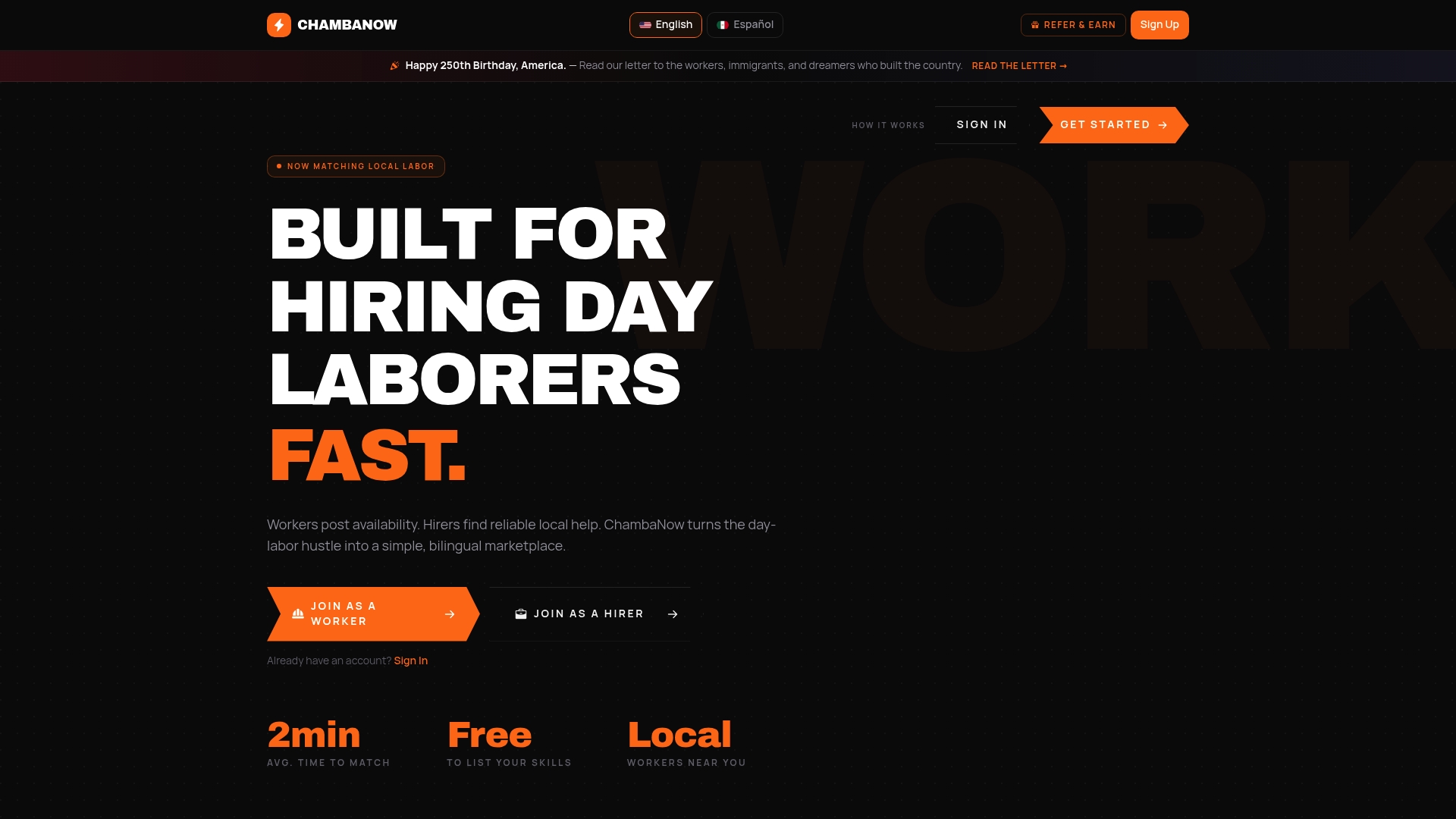
Chambanow is built for exactly that gap: a bilingual job marketplace where hirers browse local workers, post a job, and message candidates directly, with automatic translation removing the language barrier that slows down so many hourly and day-labor hires. Workers set their own availability, so you’re seeing who can actually start now, not guessing. This isn’t a replacement for the structured process you just read about. It’s the tool you reach for when the need is immediate and local rather than long-cycle and specialized.
Operationally, that means:
- No multi-week sourcing cycle for one-off or short-notice roles.
- Bilingual messaging built in, so language never stalls a hire.
- Workers indicate real-time availability, so you’re not chasing candidates who already took another job.
If your business regularly needs hourly help on short notice, alongside your structured pipeline for recurring roles, check Chambanow’s pricing to see how a Hirer Plus subscription fits your hiring mix, or browse available workers in Los Angeles to see the platform in action today.
Sources
- Job Openings and Labor Turnover — JOLTS
- Five ways to reduce time-to-hire without compromising quality | SHRM
- Recruiting Operations Benchmarks | 2026 Talent Trends Report | Ashby
- How to Reduce Time-to-Hire from 44 Days to 14 Days | EasyHire AI Blog
Keep these on hand for internal benchmarking conversations and executive updates. Numbers from a recognized authority carry more weight in a budget meeting than an internal estimate, even when your own data tells the same story.
Recommended
Building knowledge that works.