
OSHA Basics Every Temporary Labor Site Should Cover Before Work Starts
Before temporary or day laborers start work, an OSHA-covered site should cover at least seven basics: the specific hazards of this site, fall protection and ladder safety, required
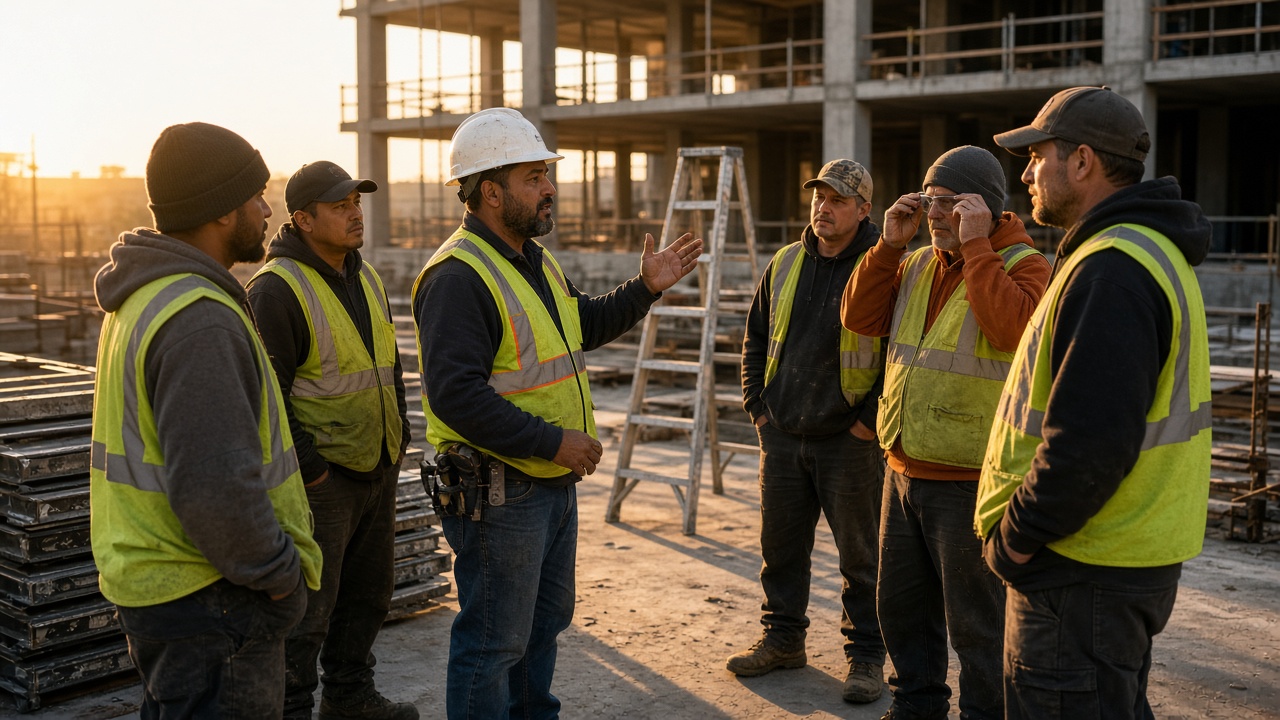
Before temporary or day laborers start work, an OSHA-covered site should cover at least seven basics: the specific hazards of this site, fall protection and ladder safety, required protective equipment provided at no cost, hazard communication for any chemicals, heat and water plans, first aid and emergency contacts, and how injuries are reported. OSHA treats staffing agencies and host employers as jointly responsible for temporary workers, and says hosts must treat temporary workers like any other workers in training and protection. A 10-minute walk-through before work starts covers most of it.
This article is general information, not legal advice. OSHA standards are detailed, and some states run their own OSHA-approved plans with additional requirements. Homeowners hiring for ordinary domestic tasks in their own residence are generally not subject to the OSH Act for that employment, but contractors on any site are.
What is a temporary worker under OSHA?
OSHA uses "temporary workers" for workers supplied to a host employer and paid by a staffing agency, whether or not the job is actually temporary (https://www.osha.gov/temporaryworkers). Day laborers hired directly are simply that employer's workers, with the same protections.
Who is responsible for safety?
OSHA says the staffing agency and the host employer are joint employers and both are responsible for a safe work environment, including training, hazard communication, and recordkeeping. In practice, agencies may provide general safety training, while hosts provide training specific to the site's equipment and hazards. OSHA recommends that the agency and host spell out their responsibilities in their contract. OSHA has also said temporary workers are often not given adequate safety training or explanations of their duties.
Why do the basics matter on short jobs?
Construction laborers have one of the highest rates of injuries and illnesses of all occupations, according to the Bureau of Labor Statistics (https://www.bls.gov/ooh/construction-and-extraction/construction-laborers-and-helpers.htm). New workers face extra risk: OSHA reports that almost half of heat-related worker deaths happen on the first day of work (https://www.osha.gov/heat-exposure/protecting-new-workers). On a one-day job, every worker is new.
What does OSHA cite most often?
OSHA's preliminary list of the most frequently cited standards for fiscal year 2026, covering October 1, 2025 through August 31, 2026 (https://www.osha.gov/top10citedstandards):
- 1. Fall protection, general requirements (1926.501)
- 2. Hazard communication (1910.1200)
- 3. Control of hazardous energy, lockout/tagout (1910.147)
- 4. Scaffolding (1926.451)
- 5. Ladders (1926.1053)
- 6. Respiratory protection (1910.134)
- 7. Powered industrial trucks (1910.178)
- 8. Fall protection, training requirements (1926.503)
- 9. Eye and face protection (1926.102)
- 10. Machinery and machine guarding (1910.212)
Five of the ten are construction standards, and four of those involve falls, ladders, and scaffolds, the kind of work day laborers are often asked to help with.
What should be covered on fall protection?
In construction, OSHA generally requires fall protection, such as guardrails, safety nets, or personal fall arrest systems, for workers on walking and working surfaces with an unprotected side or edge 6 feet or more above a lower level (https://www.ecfr.gov/current/title-29/subtitle-B/chapter-XVII/part-1926/subpart-M/section-1926.501). Before work starts:
- Identify every edge, opening, and roof area workers may approach
- Confirm guardrails, covers, or fall arrest systems are in place
- Train workers who will use fall protection; training requirements under 1926.503 are on OSHA's top-10 list
- Keep untrained workers off roofs and elevated surfaces
What should be covered on ladders and scaffolds?
- Inspect ladders before use and remove damaged ones
- Use the right ladder for the height and task
- Set ladders on stable, level footing and secure them
- Only trained workers should erect, move, or alter scaffolds
Who pays for protective equipment?
Under 29 CFR 1926.95, employers must provide required protective equipment at no cost to employees, with limited exceptions such as non-specialty safety-toe boots and prescription safety eyewear that workers may wear off the job, everyday work clothing, and ordinary weather gear. Employers pay for replacements unless the worker lost or intentionally damaged the equipment (https://www.osha.gov/laws-regs/regulations/standardnumber/1926/1926.95). If workers bring their own gear, the employer must make sure it is adequate and maintained.
- Eye protection for cutting, grinding, demolition, and power tools
- Hearing protection near loud equipment
- Hard hats where there are overhead hazards
- Gloves suited to the task
- Respirators where required, with the medical evaluation and fit testing the respiratory standard requires
What should be covered on hazard communication?
If workers will use or be near hazardous chemicals, such as solvents, adhesives, concrete products, or cleaning chemicals, they should know where the safety data sheets are, what the labels mean, and what protection to use. Hazard communication is OSHA's second most-cited standard.
What should be covered on heat, water, and sanitation?
OSHA's heat page notes that its construction rules require potable drinking water and first-aid provisions, and that heat hazards are enforced under the General Duty Clause while a federal heat standard remains in rulemaking (https://www.osha.gov/heat-exposure/standards). Several states, including California, Colorado for agriculture, Minnesota for indoor work, Oregon, and Washington, have their own heat standards.
- Cool water close to the work
- Shade and scheduled rest breaks in heat
- Lighter workloads for new workers on hot days
- Restroom access
What should be covered on emergencies and reporting?
- Location of the first-aid kit and the nearest clinic or emergency room
- Who to tell if someone is hurt, and how
- The site address, so anyone can give it to 911
Employers must report a work-related fatality to OSHA within 8 hours, and an in-patient hospitalization, amputation, or loss of an eye within 24 hours, under 29 CFR 1904.39 (https://www.ecfr.gov/current/title-29/subtitle-B/chapter-XVII/part-1904/subpart-E/section-1904.39). Reports can be made at https://www.osha.gov/report or 1-800-321-OSHA.
Does an OSHA 10 card mean a worker is trained for this site?
No. OSHA says its Outreach 10-hour and 30-hour courses are voluntary, provide general awareness, do not meet the training requirements of any specific OSHA standard, and are not a certification (https://www.osha.gov/training/outreach). Some states and cities require the cards for certain jobs. Site-specific training is still required.
Pre-start safety checklist
- Walk the site with workers and point out specific hazards
- Assign each worker a task and a lead to report to
- Confirm fall protection for any work at 6 feet or more
- Inspect ladders and scaffolds
- Hand out required protective equipment at no cost
- Explain any chemicals on site and where safety data sheets are
- Show water, shade, restroom, and first-aid locations
- Explain how to report injuries and unsafe conditions
- Explain the training in a language and words the workers understand, and ask them to repeat back key points
- Write down who attended the briefing and when
Where can small employers get help?
OSHA's On-Site Consultation Program offers free and confidential safety and health services to small and medium-sized businesses, with priority for high-hazard worksites (https://www.osha.gov/temporaryworkers). Workers with safety concerns can call OSHA at 1-800-321-OSHA.
Where does ChambaNOW fit?
Listing site hazards and required gear in the job post lets workers prepare and decide before arriving. Posting a job on ChambaNOW is free, and hirers contact workers about a specific posted job, with English and Spanish translation in messages to help explain safety rules. Contractors can browse construction and demolition help, for example at https://chambanow.com/hire/dallas-tx/construction or https://chambanow.com/hire/chicago-il/demolition, and review https://chambanow.com/for-hirers. Workers can read about their rights at https://chambanow.com/chambamatters/your-right-to-a-safe-workplace.
Key takeaways
- Staffing agencies and host employers share responsibility for temporary workers' safety
- Fall protection tops OSHA's FY2026 preliminary most-cited list; ladders and scaffolds are also in the top five
- Employers provide required protective equipment at no cost, with limited exceptions
- Report fatalities within 8 hours and hospitalizations, amputations, or eye loss within 24 hours
- An OSHA 10 card shows awareness training, not site-specific training
Sources
- OSHA, Top 10 Most Frequently Cited Standards (FY2026 preliminary)
- OSHA, Protecting Temporary Workers
- OSHA, 29 CFR 1926.95; 29 CFR 1926.501; 29 CFR 1904.39
- OSHA, Heat Standards; Protecting New Workers; Outreach Training Program
- Bureau of Labor Statistics, Occupational Outlook Handbook, Construction Laborers and Helpers
Written by Barry Graham, Founder, ChambaNOW
Building knowledge that works.