
Last-Minute Staffing Solutions for Employers in 2026
Unlock effective last-minute staffing solutions in 2026. Discover strategies for quick deployment, flexibility, and reliable local workers.

When a worker calls out sick at 6 AM and your shift starts at 7, you don’t have time to post a job and wait. Last-minute staffing is the rapid deployment of temporary or flexible workers to cover urgent workforce gaps, and the employers who handle it well have systems in place before the crisis hits. The right combination of technology, local talent access, and trusted staffing partnerships makes the difference between a covered shift and a costly gap.
Here is what effective last-minute staffing actually looks like in practice:
- Speed: Shifts filled within hours, not days, through on-demand platforms or pre-vetted worker pools
- Flexibility: Temp, temp-to-hire, and direct hire options depending on the urgency and role
- Local access: Workers within a reasonable distance who can actually show up on time
- Reliability: Pre-screened candidates who meet your standards before the emergency happens
- Technology: Automated alerts, scheduling apps, and real-time availability tracking that cut coordination time
Table of Contents
- What core features should a last-minute staffing solution have?
- How adaptive scheduling technology handles real-time workforce changes
- Real-time visibility tools that keep you in control of staffing status
- Which industries rely most on last-minute staffing solutions?
- How to evaluate and implement last-minute staffing solutions effectively
- What hiring managers say about last-minute staffing providers
- Chambanow connects you with local workers when you need them today
- Key takeaways
What core features should a last-minute staffing solution have?
The strongest emergency staffing solutions share a common set of capabilities that go well beyond a simple worker directory. Rapid shift filling is the obvious one, but the features that separate a reliable partner from a frustrating one are subtler: cross-location coverage so you can pull from nearby sites, automated notifications that reach available workers instantly, and real-time availability tracking so you know who is actually ready before you make the call.
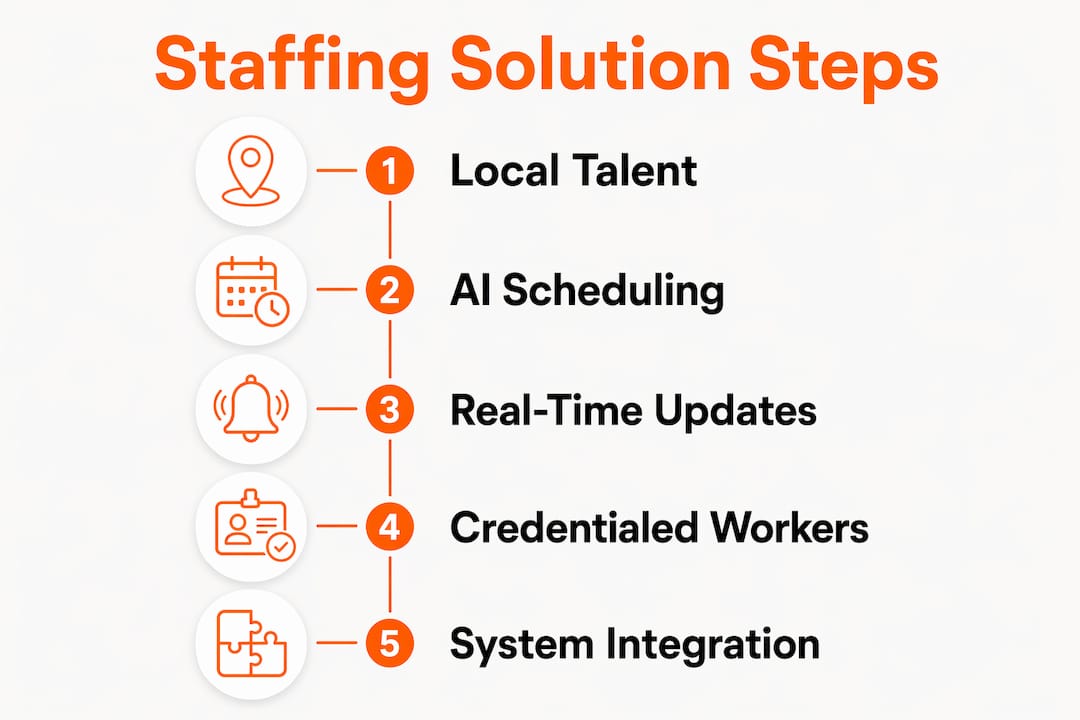
Technology plays a growing role here. AI-driven scheduling tools can match open shifts to qualified workers based on proximity, credentials, and past performance, cutting the time a hiring manager spends on the phone. Automated alerts sent via SMS or app push notifications reach workers faster than any manual outreach. The result is a shorter gap between “we have a problem” and “the shift is covered.”
Local talent pools are often underestimated as a feature. A worker who lives 15 minutes away is far more likely to show up than one who commutes 90 minutes each way, especially on short notice. Platforms and agencies that maintain genuinely local networks reduce both cancellation risk and the premium rates that come with last-minute, long-distance placements.
Pro Tip: When evaluating staffing partners, ask specifically about their local worker density in your area. A large national network sounds reassuring, but what matters is how many pre-vetted workers are within a reasonable drive of your facility.
How adaptive scheduling technology handles real-time workforce changes
Adaptive scheduling is what keeps operations running when the unexpected happens. Rather than treating a callout as a one-off crisis, modern scheduling platforms treat it as a workflow: the absence triggers an alert, available workers are notified automatically, and a replacement is confirmed before the shift begins. Adaptive scheduling that handles real-time changes like shift swaps and time-off requests improves both reliability and communication across the board.
Common scenarios where adaptive scheduling makes a measurable difference:
- A nurse calls out at midnight; the system automatically contacts pre-approved per-diem staff and logs the response
- A warehouse supervisor approves a last-minute time-off request; the platform flags the coverage gap and suggests available workers from the same location
- A retail manager needs to extend a shift; workers receive a push notification and can accept or decline in seconds
- A cross-location coverage option opens up when a nearby site has excess staff that day
The communication layer matters as much as the scheduling logic. Workers who receive clear, timely notifications through a channel they actually check, whether that is SMS, an app, or email, respond faster and with fewer misunderstandings. Reducing the back-and-forth is where most of the time savings come from.
Real-time visibility tools that keep you in control of staffing status

Knowing that a shift is covered is one thing. Knowing who is covering it, whether they have checked in, and whether any gaps remain is a different level of operational control. Technology platforms offer real-time visibility tools such as dashboards and alerts to monitor staffing status for immediate management needs.
Practical monitoring capabilities that hiring managers rely on most:
- Live staffing dashboards showing shift coverage by location, role, and time
- Coverage gap alerts that flag unfilled shifts before they become a problem
- Worker check-in tracking so you know who has arrived and who has not
- Integration with communication platforms like Slack or Teams for instant supervisor updates
- Shift fulfillment reports that help you identify patterns in callouts and coverage failures
The operational value of this visibility extends beyond the immediate crisis. When you can see that the same shift or location generates repeated gaps, you can address the root cause rather than just patching each incident. That kind of data turns reactive staffing into something closer to a managed process.
Which industries rely most on last-minute staffing solutions?

Short-notice workforce coverage is a reality across a wide range of sectors, not just healthcare. Temporary staffing agencies commonly provide temp, temp-to-hire, and direct hire options across multiple industries with rapid hiring capabilities. U.S. emergency rooms alone saw 139.8 million visits last year, a figure that illustrates just how unrelenting the demand for flexible healthcare staffing actually is.
Industries and workforce types where urgent staffing coverage is most common:
- Healthcare: Registered nurses, medical assistants, ER physicians, and allied health professionals
- Warehouse and logistics: Forklift operators, pickers, packers, and shipping coordinators
- Manufacturing: Line workers, quality control technicians, and machine operators
- Retail: Floor associates, cashiers, and inventory staff, especially during peak seasons
- Hospitality: Servers, housekeeping staff, event workers, and kitchen support
- Construction and trades: General laborers, skilled tradespeople, and site support workers
Each industry shapes what “last-minute” actually means. In healthcare, it might mean filling a shift within two hours with a credentialed professional. In construction, it might mean finding three laborers by 7 AM. The urgency is the same; the vetting requirements differ significantly.
How to evaluate and implement last-minute staffing solutions effectively
Choosing the right staffing partner or platform comes down to four variables: cost, quality, availability, and proximity. Balancing all four is what separates effective emergency staffing from a patchwork of expensive, unreliable fixes. Most hiring managers focus on cost first, but cutting costs too aggressively in staffing can lead to quality failures, and in regulated industries like healthcare, those failures carry real liability.
Proximity is the variable most often overlooked. Local pools within 90 minutes of your location improve both reliability and cost, since distant workers command higher rates and cancel more often. When evaluating a staffing partner, ask how many of their workers are genuinely local to your sites, not just registered in your state.
Credentialing and vetting matter as much as speed. Pre-credentialed professionals ready to deploy reduce the risk that comes with urgent placements. A worker who arrives without the right certifications or background check is not a solution; they are a different kind of problem. Build your contingency plan around partners who have done that work in advance.
Integration with your existing HR or scheduling system is worth prioritizing from the start. A staffing platform that does not connect with your time-tracking or payroll software creates manual work that slows you down exactly when you need to move fast.
Pro Tip: Build a pre-credentialed worker pool before you need it. Identify two or three reliable staffing partners or platforms, complete the onboarding process, and run a test placement during a non-urgent period. When the real emergency hits, you will already know who delivers.
What hiring managers say about last-minute staffing providers
Credibility in this space comes from track record, not marketing copy. Hiring managers who rely on staffing partners for urgent coverage consistently point to the same qualities: responsiveness when it counts, workers who show up prepared, and a partner who communicates clearly when something goes wrong.
Company longevity matters in this context. A staffing firm that has operated for more than two decades has weathered enough workforce crises to have real systems in place, not just promises. Specialized recruiters who focus on a specific industry or role type tend to outperform generalist agencies on quality, because they understand what “qualified” actually means for your environment.
Real-time shift management support, where a staffing coordinator is reachable around the clock, is a feature that hiring managers consistently rate as one of the most valuable. When a replacement worker does not show at 3 AM, knowing you can reach a live person matters.
That kind of feedback reflects what good emergency staffing actually looks like: not just a warm body in a slot, but a professional who fits the culture and meets the standard.
Chambanow connects you with local workers when you need them today
When the need is immediate and the worker needs to be local, Chambanow offers something traditional staffing agencies often cannot: direct access to workers who are ready today, without the overhead of a long agency process.
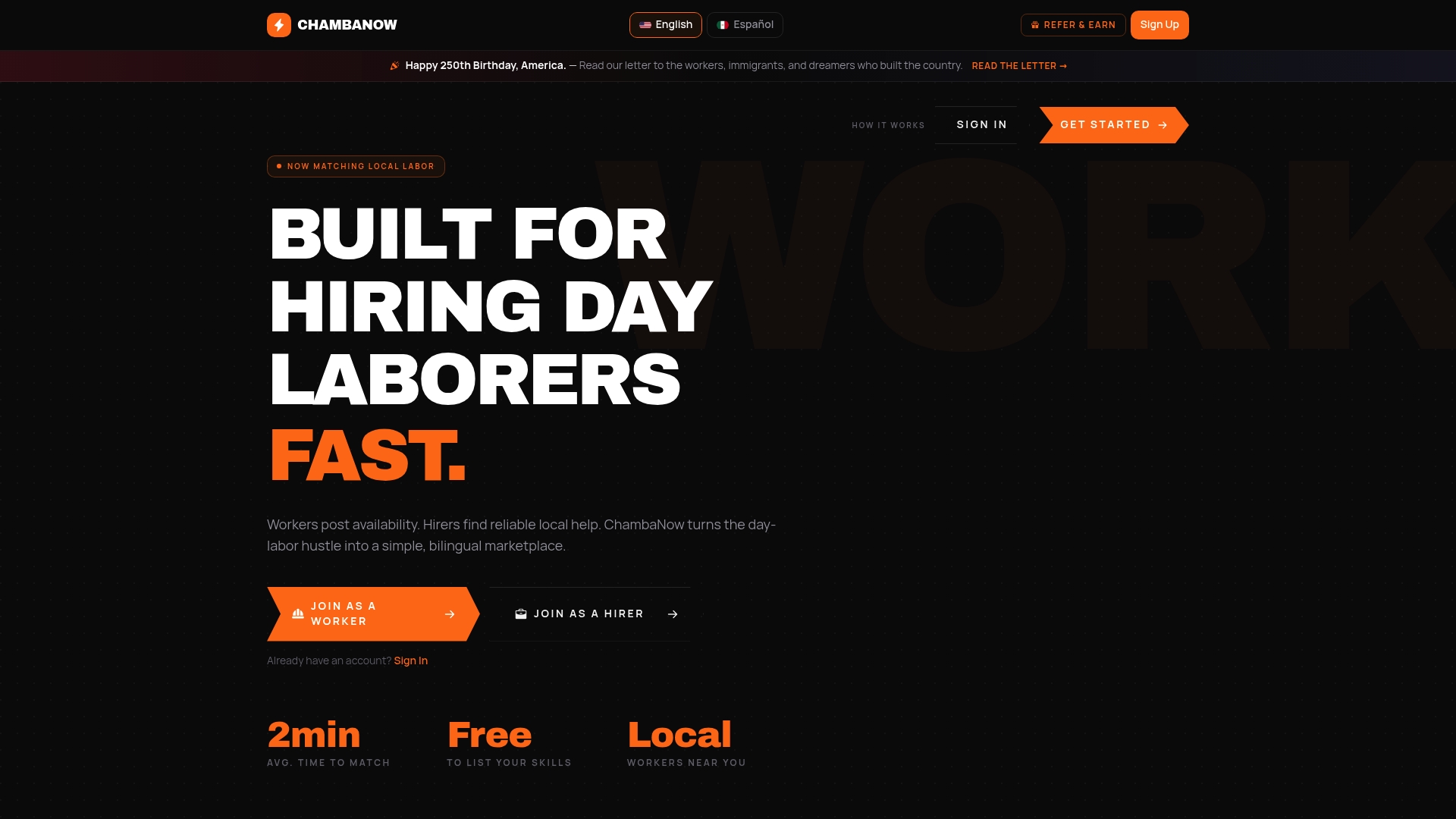
Chambanow is a bilingual job marketplace built for exactly this kind of urgency. Hirers can browse local worker profiles, post a job, and communicate through automatic language translation, all in one place. There are no lengthy contracts or agency markups. Workers set their own availability, so you can see who is genuinely ready to work right now, not just who is registered in a database. Whether you need day laborers in Los Angeles, coverage in Long Beach, or workers in Portland, Chambanow’s local-first model means shorter commutes, fewer no-shows, and faster starts. Check Chambanow’s pricing and post your first job today.
Key takeaways
Last-minute staffing works best when employers combine local talent access, pre-vetted worker pools, and real-time scheduling technology before the crisis arrives.
| Point | Details |
|---|---|
| Speed requires preparation | Pre-credentialed worker pools and onboarded platforms cut response time when urgency hits. |
| Proximity reduces cost and risk | Workers within 90 minutes of your location cancel less often and cost less than distant placements. |
| Technology closes the gap | Automated alerts, scheduling dashboards, and real-time tracking replace slow manual coordination. |
| Quality cannot be traded for speed | Cutting vetting standards under pressure leads to reliability failures and, in regulated industries, liability. |
| Chambanow for local, immediate hiring | Chambanow connects hirers directly with local, available workers, with no agency markup or long-term contract. |
Recommended
Building knowledge that works.