
Language Barrier Hiring: A Practical Playbook for Employers
Transform your hiring process with a focus on language skills. Learn practical steps to effectively assess and onboard bilingual talent.

Treat language as a measurable hiring dimension, not a gut feeling about accents or “polish.” Employers who get this right follow three moves: first, define exactly which language skills each role actually needs. Second, screen for those skills objectively, separate from technical judgment. Third, onboard with clear milestones and track whether the hire performs.
- Define role language needs before writing the job post.
- Screen objectively using a rubric, not an interviewer’s impression.
- Onboard and measure so language never remains a guess.
Pick one open role this quarter and run this checklist against it. You will likely find the “excellent communication skills” line in your job description means nothing testable.
Key Takeaways
Language barrier hiring succeeds when employers score communication as a distinct, measurable dimension instead of letting it silently bias overall candidate impressions.
| Point | Details |
|---|---|
| Sort roles into three tiers | Label each role essential, helpful, or not required for language before posting it. |
| Write testable job descriptions | Replace vague phrases like “excellent communication” with specific, testable requirements. |
| Score language separately | Use a scorecard that weights technical skill, role communication, and fit independently. |
| Match screening to scale | Use automated tests or AI voice screening for volume, live assessments for high-stakes roles. |
| Track outcomes, not just scores | Correlate assessment bands with client satisfaction and time-to-competency after 90 days. |
| Use Chambanow for fast local matches | Chambanow connects hirers with bilingual workers directly through real-time translated messaging. |
Table of Contents
- Why Language Barrier Hiring Affects Your Bottom Line
- When Is Language Skill Essential, Helpful, or Optional?
- Writing Job Descriptions That Attract Bilingual Talent
- How Do You Build a Bias-Resistant Hiring Process?
- Which Language Screening Method Fits Your Hiring Needs?
- Onboarding Strategies That Keep Bilingual Hires Around
- A Method to Connect Language Scores to Job Outcomes
- What Bilingual Hiring Marketplaces Teach About Language Bias
- How Chambanow Removes the Language Barrier From Local Hiring
- Where to Learn More About Language Barrier Hiring
- Frequently Asked Questions
- Sources
Why Language Barrier Hiring Affects Your Bottom Line
Language skills are not a soft nice-to-have. Nine out of ten U.S. employers rely on staff with language abilities beyond English, and 56% expect that demand to keep climbing over the next five years. One in four employers say they have lost business specifically because they lacked the language coverage to serve a client.
The effect shows up earlier than most hiring managers assume. A large field experiment found that language proficiency strongly increases a candidate’s odds of landing an interview, even for entry-level roles where the job itself barely requires bilingual skill. That means language signals on a resume are already shaping who gets seen, whether or not you intended it.
Lost deals and slower client response times are the visible costs. The invisible cost is candidates you never interviewed because your screening filtered on the wrong thing.
Pro Tip: Track your applications-by-language ratio against your interview-to-offer ratio for one hiring cycle. A big gap usually means language bias is creeping into early screening, not a real skills shortfall.
When Is Language Skill Essential, Helpful, or Optional?
Not every role needs the same language bar, and treating them all the same wastes good candidates. Sort roles into three categories before you post the job:
- Essential: the job cannot function without it (bilingual customer support, contact-center agents, client-facing sales in a specific market).
- Helpful but trainable: language smooths the work but a motivated hire can build it on the job (field technicians, warehouse leads, drivers coordinating with dispatch).
- Not required: the core task does not depend on English fluency at all (many back-office, data-entry, or production roles).
Write this decision directly into the job spec and the interview scorecard. If you cannot explain why a role needs “excellent English,” it probably belongs in the helpful or optional tier.
Writing Job Descriptions That Attract Bilingual Talent
Vague language requirements do two things badly: they scare off qualified non-native speakers and they give you no way to test what you asked for. Fix both by being specific.
- Swap “excellent communication skills” for “able to explain repair steps to a customer in English at a conversational level.”
- Separate “required” from “preferred” language skills explicitly, rather than bundling them into one paragraph.
- Post the ad in both languages when the role serves bilingual customers. Localizing adverts and defining role-specific language requirements improves candidate quality and speeds up time-to-hire.
- Note how the requirement will be tested (a phone screen, a work sample, a proficiency test) so candidates know what to expect.
Pro Tip: If you publish a bilingual posting, put the language-testing detail near the bottom in both language versions. Candidates who read that far are usually your strongest applicants.
How Do You Build a Bias-Resistant Hiring Process?
Language bias usually looks like favoring conversational fluency over demonstrated skill, and it slips in fastest during unstructured interviews. A structured process that separates technical skill from language dimension reduces that bias measurably.
Build a scorecard with independent categories, each weighted by role:
- Technical or trade skill: 50%
- Role-specific communication (not general fluency): 30%
- Team and culture fit: 20%
Ask questions that isolate each dimension:
- “Walk me through how you’d handle this specific customer situation” (tests domain skill).
- “How would you explain this safety step to a coworker who doesn’t speak your first language?” (tests role communication, not accent).
- “Tell me about a time you adapted your approach for a client with different expectations” (tests fit).
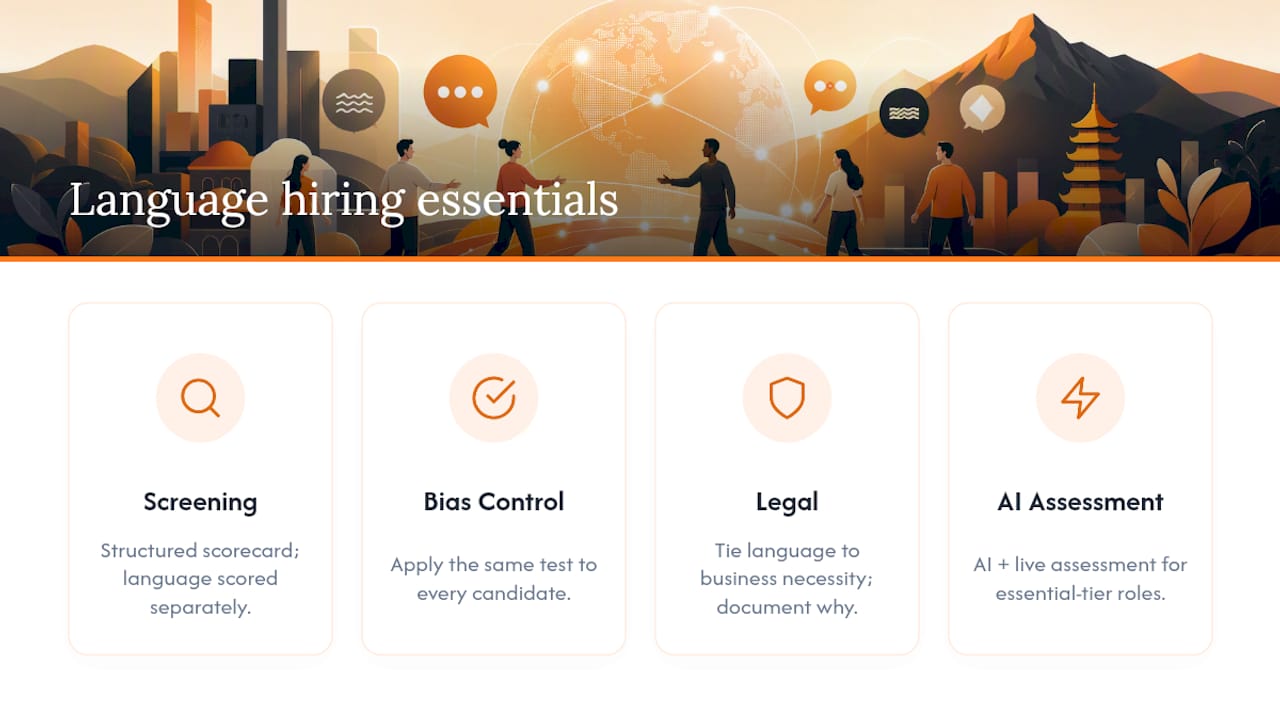
Escalate to a live language assessment or work sample only when the role sits in the “essential” tier from your framework, and score it on its own line rather than folding it into a general “communication” impression. Multilingual interview panels or real-time translation during screening let candidates answer in their strongest language while you still capture consistent data.
Which Language Screening Method Fits Your Hiring Needs?
Pick your screening method based on volume, budget, and how much risk you can tolerate.
- Automated language tests: fast and consistent across large applicant pools, but weaker at judging real workplace conversation. Best for high-volume roles with a clear proficiency bar.
- AI-powered voice screening: standardizes scoring across languages and can expand your candidate reach quickly. One case study reported a 40% larger candidate pool and 60% faster time-to-fill after six months of implementation. Best for contact centers and multi-location hiring.
- Live human assessments: slower and costlier per candidate, but far better at judging nuance, tone, and real-time problem-solving. Best for client-facing or high-stakes roles.
- Work-sample or translated take-home tasks: shows how a candidate performs the actual job, language included, without the pressure of a live interview. Strong for technical and trade roles.
Screening language early rather than late in the process can make hiring noticeably faster and improve retention, because you stop investing interview time in candidates who were never a fit for the role’s real communication demands.
Onboarding Strategies That Keep Bilingual Hires Around
A good hire can still walk if onboarding assumes fluency they don’t have, or ignores skill they do. Structure the first 90 days around checkpoints, not vague “settling in” time.
- Days 1 to 30: shadow a peer, confirm the hire understands core workflows in their strongest language, and set a first productivity milestone.
- Days 30 to 60: introduce a language-paired mentor for role-specific vocabulary and run a client-confidence check-in.
- Days 60 to 90: measure time-to-first-competency against your original scorecard prediction and confirm it holds up in practice.
Track a few numbers past day 90: client satisfaction scores, attrition by language cohort, and how long it took each hire to reach full competency. These flag training gaps before they become resignations.
- Pair new hires with a mentor who shares or supports their language, not just their job title.
- Build a visible path to advancement so language skill reads as an asset, not a ceiling.
- Re-test proficiency periodically if the role ties to a credential or client-facing tier.
A Method to Connect Language Scores to Job Outcomes
Assessment scores mean little until you connect them to what actually happens on the job. Building that link takes three steps.
- Pick outcome metrics that matter for the role, such as client satisfaction, first-call resolution, or time-to-productivity.
- Run a pilot where you hire across a range of assessment scores rather than only the top scorers, so you get real variation to compare.
- Correlate score bands with outcomes after 60 to 90 days. A strong signal looks like a clear step-up in performance between score bands; a weak one means your test may not match the role’s real demands.
An example pair worth tracking: a proficiency score of B2 or above correlating with faster first-call resolution in a bilingual support role. If you see no separation between B1 and B2 performers, the test threshold may be set too high for what the job actually requires.
This kind of tracking matters because the stakes are real. Given that 56% of employers expect language demand to keep rising, building a defensible scoring method now saves you from re-inventing screening under pressure later.

What Bilingual Hiring Marketplaces Teach About Language Bias
The biggest mistake employers make is treating language as a pass or fail gut check, applied inconsistently across interviewers. The fix is almost always structural: score language on its own line, and screen for it before the interview stage rather than during it.
I’ve seen the same pattern repeat across marketplace hiring: a candidate rejected for “communication concerns” turns out to have strong domain skill once someone separates the two dimensions. Fixing the scorecard, not the candidate, solves the mistake.
How Chambanow Removes the Language Barrier From Local Hiring
Chambanow is built for the exact gap this playbook addresses: matching hirers with workers fast, without language deciding who gets seen. Instead of screening out strong candidates because a job post used vague “excellent communication” language, hirers on Chambanow browse bilingual worker profiles, filter by availability, and message directly through automatic real-time translation.
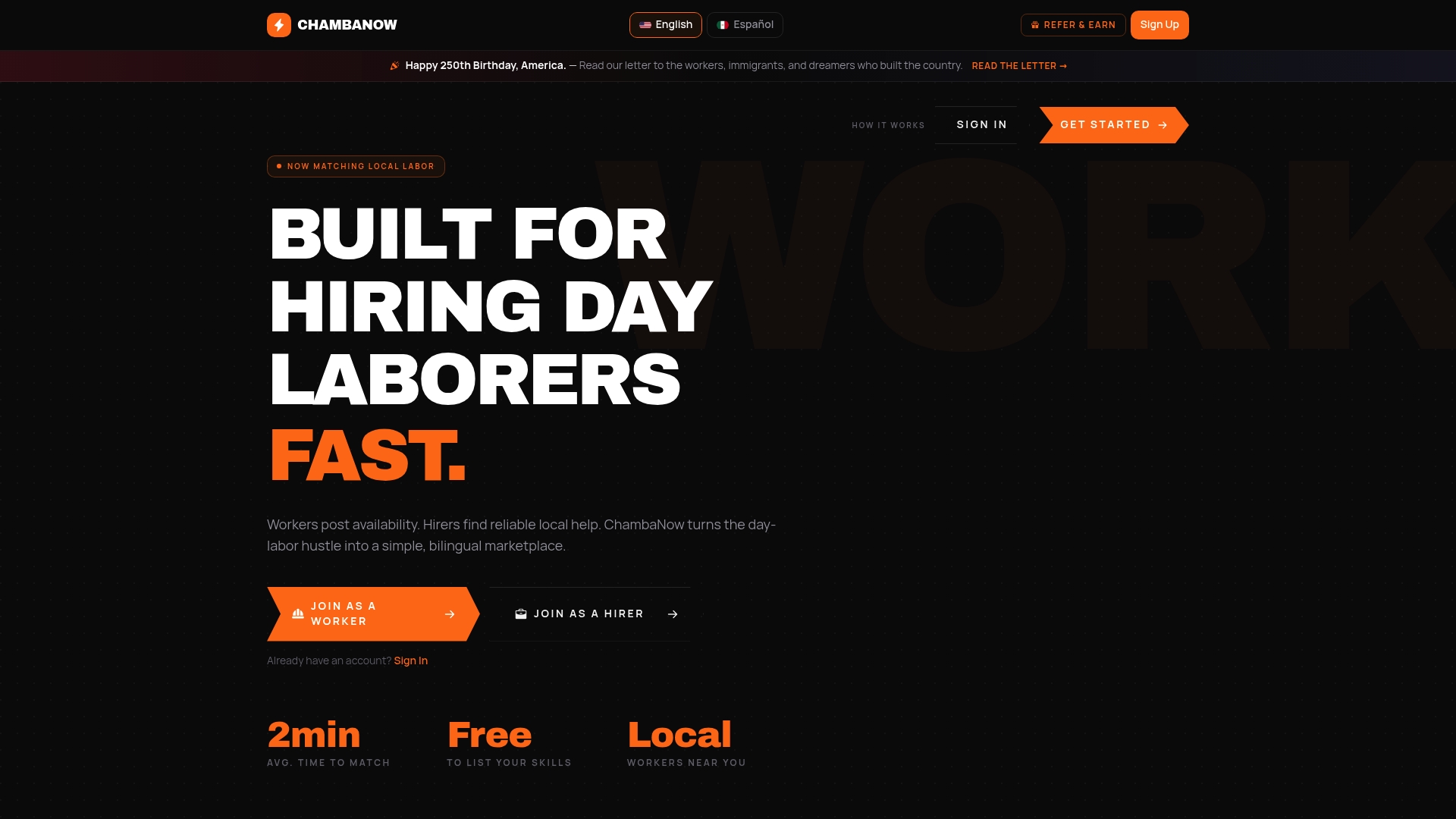
That setup solves two real scenarios. A contractor who needs a laborer on-site today can browse available workers nearby and communicate instantly, no translator, no delay. A business hiring a bilingual contact-center agent can filter for the language pairing they actually need and confirm fit before the first shift, not after a miscommunication costs a client.
If you want to pilot the framework from this guide on a real role, start with a same-day hire in Long Beach or post a role and check Hirer Plus pricing to see what fits your hiring volume.
Where to Learn More About Language Barrier Hiring
- ACTFL’s employer survey on U.S. language demand
- Field experiment on language proficiency and interview invitations
- Emmersion’s guide to bilingual hiring practices
- iSmartRecruit on multilingual recruitment best practices
- JobTalk AI case study on multilingual screening pipelines
- Olade Consulting’s framework for reducing language bias
- Tutoroo’s guide to language proficiency levels
- Chambanow’s marketplace overview
Frequently Asked Questions
What is language barrier hiring?
It refers to the practical challenges employers face when recruiting candidates whose primary language differs from the workplace’s dominant language, and the strategies used to screen, hire, and onboard them fairly.
How do I know if a role truly requires bilingual skills?
Ask whether the core task fails without it. If a customer support agent cannot resolve tickets without a second language, it is essential. If the task is trainable on the job, treat language as helpful rather than required.
Is it legal to require a specific language for a job?
Language requirements must be tied to a genuine business necessity for the role rather than a blanket policy. Overly broad or English-only requirements can raise discrimination concerns, so document why a specific role needs the skill and how it will be tested.
What’s the fastest way to screen for language skills without bias?
Use a structured scorecard that scores language independently from technical skill, and apply the same test to every candidate for that role, whether through an automated test, a live assessment, or a work sample.
Can technology really replace human language testing?
AI-powered screening tools can standardize scoring and expand your candidate pool quickly, but pairing them with a live assessment for essential-tier roles still gives you the strongest signal on real workplace communication.
## Sources
- [Making Languages Our Business: Addressing Foreign Language Demand Among U.S. Employers — ACTFL (report summary)](https://www.actfl.org/advocacy-and-public-education/making-languages-our-business)
- [Journal of Human Resources early content on language and hiring outcomes](https://jhr.uwpress.org/content/early/2026/05/13/jhr.1223-13300R3)
- [The ultimate guide to bilingual hiring — Emmersion.ai blog](https://blog.emmersion.ai/the-ultimate-guide-to-bilingual-hiring/)
- [Multilingual recruitment best practices for global hiring — iSmartRecruit](https://www.ismartrecruit.com/blogs/multilingual-recruitment-best-practices)
- [Building a multilingual hiring pipeline with AI — JobTalk AI blog](https://www.jobtalk.ai/blogs/building-multilingual-hiring-pipeline-ai)

## Recommended

- [ChambaNow — Hire Day Laborers in Minutes](https://chambanow.com)
- [ChambaNow — Hire Day Laborers in Minutes](https://chambanow.com/blog/nextdoor-alternatives)
- [ChambaNow — Hire Day Laborers in Minutes](https://chambanow.com/blog/ziprecruiter-alternatives)
- [ChambaNow — Hire Day Laborers in Minutes](https://chambanow.com/blog/angi-alternatives)
Building knowledge that works.